Birth in Fuyang
Born into a scholarly family in Fuyang County, Zhejiang; studied classical texts and painting diligently from early youth.
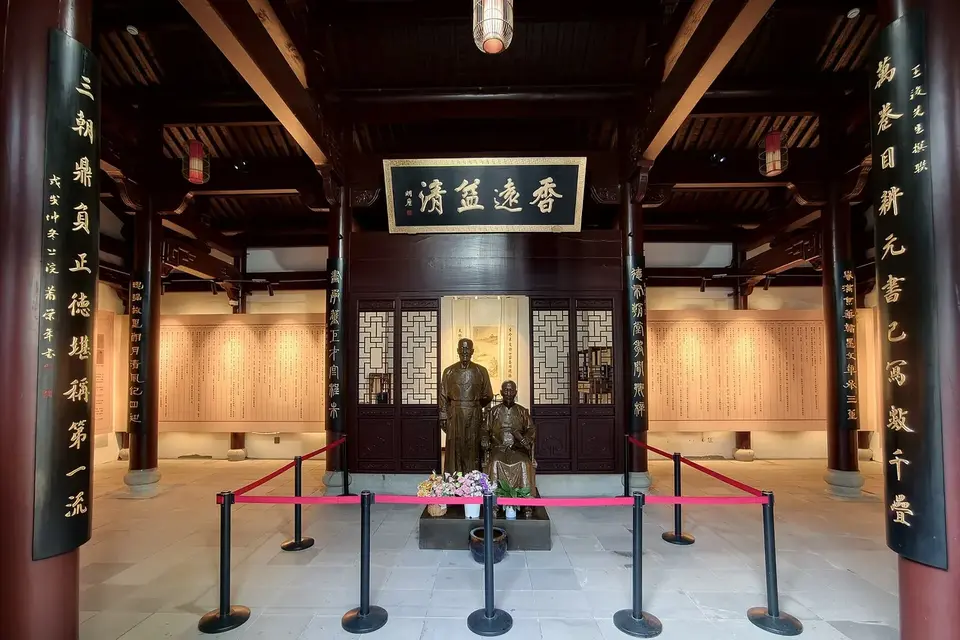
董邦达
Dong Bangda (董邦达, 1699 – August 19, 1769), courtesy name Fucun (孚存), secondary style Feiwen (非闻), and art name Dongshan (东山), posthumously honored as Wenke (文恪), was a native of Fuyang County, Hangzhou Prefecture, Zhejiang Province. He was an eminent Qing Dynasty statesman, master of classical landscape painting, and the premier court literati painter of the Qianlong era. Achieving second-class honors in the imperial palace…
Dong Bangda (董邦达, 1699 – August 19, 1769), courtesy name Fucun (孚存), secondary style Feiwen (非闻), and art name Dongshan (东山), posthumously honored as Wenke (文恪), was a native of Fuyang County, Hangzhou Prefecture, Zhejiang Province. He was an eminent Qing Dynasty statesman, master of classical landscape painting, and the premier court literati painter of the Qianlong era. Achieving second-class honors in the imperial palace examination of 1736, he was selected as a bachelor in the Hanlin Academy, appointed compiler, and summoned to service in the Southern Study, inaugurating three decades of influential court service under Emperor Qianlong. Throughout his official career, Dong Bangda held significant metropolitan and provincial posts, including Reader in the Hanlin Academy, Supervisor of the Household of the Heir Apparent, Grand Academician of the Grand Secretariat, Vice Minister of Revenue, Vice Minister of Works, Governor of Anhui, Minister of Works, and Minister of Rites. As Governor of Anhui, he championed the agricultural reclamation of southern mountain forests by migrant shack-dwellers (pengmin), resolutely repudiating local fengshui superstitions to expand grain reserves and stabilize frontier livelihoods. In the capital, he managed imperial construction and major editorial bureaus, directing the cataloging of imperial art treasures in the Precious Collection of the Stone Channel (Shiqu Baoji) and Pearl Forest of the Secret Hall (Bidian Zhulin), and supervising the creation of the rare imperial military cartographic compendium Complete Map of Sichuan (Sichuan Quantu). In art history, Dong Bangda is revered as the foremost exponent of the Qing "scholar-official painter" (cichen huajia) tradition. Integrating the structural rigor of Song masters with the dry-brush aesthetics of Yuan masters Huang Gongwang and Ni Zan, his landscapes displayed profound scholarly composure, earning praise from Ruan Yuan as the "number one landscape hand of the dynasty." Together with his son Dong Gao, he formed the celebrated "Two Dongs of Fuyang." He passed away in office in 1769 and was posthumously granted the title Junior Guardian to the Crown Prince.
Born into a scholarly family in Fuyang County, Zhejiang; studied classical texts and painting diligently from early youth.
Selected as an elite tribute student (bagongshi) from Shuntian Prefecture, moving to the capital to pursue imperial academy studies.
Attained the jinshi degree in the special inaugural examination of Emperor Qianlong, entering the Hanlin Academy as a compiler.
Commissioned to the inner court to inspect and catalog Buddhist and Daoist imperial paintings, compiling the Bidian Zhulin.
Appointed alongside Zhang Zhao to direct the compilation of the first series of the imperial art catalog Shiqu Baoji.
Commissioned to direct the cartographic painting of the 150-folio Complete Map of Sichuan, recording all provincial bastions and topography.
Appointed Governor of Anhui; successfully protected migrant shack-dwellers cultivating mountainous land, ending local land disputes.
Promoted to Minister of Works, overseeing national hydraulic construction, weights and measures, and imperial architectural projects.
Transferred to Minister of Rites and Chancellor of the Hanlin Academy, directing state ceremonies and imperial examinations.
Passed away of illness at his ministerial residence in Beijing on the nineteenth day of the seventh lunar month at age seventy-one; granted the title Wenke.
Dong Bangda was born in 1699 in Fuyang County, Hangzhou Prefecture, Zhejiang Province. His household belonged to an unpretentious local gentry family that upheld traditional values of agricultural labor and scholarly learning. From early childhood, Dong Bangda displayed remarkable intellectual aptitude and dedication to classical antiquity. In his modest village residence in Fuyang, he was known to read through the night by lamplight. Contemporary accounts noted his courageous demeanor; while lodging in an abandoned residence as a young student, he remained unfazed by nocturnal disturbances, demonstrating an upright moral temperament.
In 1733, at the age of thirty-five, Dong Bangda was selected as a tribute student (bagongshi). In 1736, during the inaugural civil service examination of Emperor Qianlong, he passed the metropolitan and palace examinations as a second-class jinshi. Following imperial evaluation in the Hanlin Academy, his refined classical prose style and elegant calligraphy secured his appointment as compiler. Emperor Qianlong, who took deep personal interest in painting and historical calligraphy, recognized Dong's extraordinary artistic sophistication and summoned him to the Southern Study as an imperial companion.
During the early Qianlong reign, the imperial palace embarked upon the comprehensive classification of thousands of paintings and calligraphic masterpieces amassed over centuries. In 1743, Dong Bangda was commissioned to inspect sacred artworks in the Qianqing Palace and Yangxin Hall, helping complete the 24-volume catalog Bidian Zhulin. In 1744, Emperor Qianlong appointed Minister of Punishments Zhang Zhao to lead an editorial board that included Dong Bangda, Liang Shizheng, and Li Zongwan to compile the monumental 44-volume Shiqu Baoji. Leveraging his profound connoisseurship, Dong systematically authenticated imperial masterpieces from the Wei-Jin through Ming dynasties, establishing the gold standard for Qing dynastic art cataloging.
In 1754, looking to reinforce administrative oversight and military deployments across the southwestern borderlands, the court commissioned Dong Bangda to oversee the production of the Complete Map of Sichuan (Sichuan Quantu). Leading imperial cartographers and painters, Dong completed an extraordinary 150-folio atlas depicting each prefecture, department, and county across Sichuan. The maps combined traditional blue-and-green landscape painting with ruled-line architectural drafting, recording city walls, mountain defiles, courier stations, military outposts, and granaries. Preserved in the imperial collections, this rare national treasure is now housed in the Sichuan University Library.
Advancing through metropolitan offices, Dong Bangda served as Supervisor of the Household, Reader of the Hanlin Academy, Grand Academician of the Grand Secretariat, Vice Minister of Revenue, and Vice Minister of Works. In 1762, he was appointed Governor of Anhui, assuming direct responsibility for provincial welfare. In the rugged mountains of Huizhou, Ningguo, and Chizhou, hundreds of thousands of migrant families—known as "shack-dwellers" (pengmin)—had settled to cultivate sweet potatoes, maize, and upland rice on uncultivated hillsides. Local gentry repeatedly instigated violent litigations, claiming that mountain clearing disrupted ancestral geomancy (fengshui).
Recognizing the economic necessity of the migrant farmers, Dong personally inspected the rugged topography and submitted a landmark memorial to the throne. He denounced geomantic objections, arguing that reserving hundreds of acres of fertile wilderness to protect a single ancestral tomb abandoned imperial rites and wasted national soil. He maintained that allowing shack-dwellers to cultivate grains enriched society, absorbed displaced vagrants, and achieved the goal of leaving no land wasted and no laborer idle. Emperor Qianlong approved his memorial, officially establishing the legal right of migrant cultivators to farm frontier mountain tracts.
In 1765, Dong Bangda was recalled to the capital and appointed Minister of Works, directing national civil engineering, official measurement standards, and Grand Canal maintenance. In 1767, he became Minister of Rites and Chancellor of the Hanlin Academy, supervising imperial rites, state sacrifices, and civil service examinations. Throughout his ministerial career, Dong acted with modesty and incorruptibility, winning the universal esteem of colleagues and literati.
Whenever duties permitted, Dong immersed himself in painting, executing numerous landscape scrolls commissioned by Emperor Qianlong. The emperor treasured his artworks, frequently composing personal imperial poems on his canvases. Ruan Yuan celebrated him as the "foremost landscape artist of the dynasty," comparing his stature to that of Wang Yuanqi. On August 19, 1769 (the nineteenth day of the seventh lunar month), Dong passed away in his Beijing residence at the age of seventy-one. Deeply saddened, Emperor Qianlong posthumously conferred upon him the title Junior Guardian to the Crown Prince, allocated imperial funeral funds, and bestowed the posthumous title Wenke.
Dong Bangda's primary scholarly contribution was his direction of Qing imperial art cataloging. In 1743, he participated in compiling the Bidian Zhulin, categorizing Buddhist and Daoist paintings in the palace. In 1744, he collaborated with Zhang Zhao and Liang Shizheng to produce the first series of Shiqu Baoji. Dong evaluated thousands of historical paintings from antiquity through the Ming Dynasty, examining paper fibers, silk weaves, seals, and historical colophons. His work established rigorous academic protocols for imperial connoisseurship, producing an irreplaceable bibliographic foundation for Chinese art history.
In 1754, Dong Bangda directed the compilation and execution of the monumental 150-folio Complete Map of Sichuan. Blending traditional landscape painting with precise boundary drafting, the album recorded the topography, water systems, walled cities, defensive passes, and granary storage of all 150 administrative divisions in Sichuan. This cartographic masterwork provided the Qing high command with essential geographic intelligence for southwestern administration and stands today as a masterpiece of Qing military cartography.
During his 1762 tenure as Governor of Anhui, Dong Bangda resolved bitter social conflict between regional landholders and migrant shack-dwellers. Denouncing local fengshui arguments as harmful superstition, he authored a memorial asserting that allowing farmers to clear mountain slopes for maize and tubers was essential statecraft. His policy legally protected migrant cultivation, expanded regional food supplies, and integrated tens of thousands of landless peasants into settled agrarian society.
Dong Bangda was universally acknowledged as the supreme leader of the Qianlong-era "scholar-official painters." Synthesizing the compositional depth of Northern Song masters with the dry-brush ink techniques of Yuan painters Huang Gongwang and Ni Zan, he pioneered dynamic textural techniques such as "cloud-head" and "sheep-wool" wrinkles. His landscapes combined monumental natural forms with strict architectural perspective, exuding the refined dignity of classical literati culture. Eminent critics Shen Chu and Ruan Yuan praised his brushwork as surpassing Yuan masters and crowned him the greatest landscape artist of the dynasty.
Beyond his personal mastery of painting and poetry, Dong Bangda established an esteemed familial tradition of public service and artistic excellence. His eldest son, Dong Gao, placed second (bangyan) in the 1763 palace examination, rose to Grand Secretary of the Wenhua Palace and Chief Grand Councillor, and continued the family's artistic prestige. Father and son were celebrated throughout the empire as the "Two Dongs of Fuyang," representing the ideal harmony of court governance and scholarly culture.
FIGURES ASSOCIATED WITH THIS DYNASTY