Life and Career
Early Hardship in the Palace Workshops
Shangguan Wan'er was born in 664 in Shan County, Shan Prefecture, belonging to a prestigious family with ancestral roots in Shanggui, Longxi. Her great-grandfather, Shangguan Hong, served as Assistant Director of the Jiangdu Palace during the Sui dynasty. Her grandfather, Shangguan Yi, was a chancellor during the reign of Emperor Gaozong of Tang and an arbiter of letters who originated the elegant "Shangguan Style" of court poetry. Her father, Shangguan Tingzhi, served as Palace Equerry and Gentleman in Waiting in the household of Prince of Zhou Li Xian.
In the winter of 664, Emperor Gaozong, discontented with Empress Wu's growing political dominance, secretly summoned Shangguan Yi to draft an imperial edict deposing her. Informants alerted Empress Wu, who confronted the emperor in his bedchamber. Lacking resolve, Emperor Gaozong shifted responsibility onto Shangguan Yi. Empress Wu's partisan Xu Jingzong framed Shangguan Yi and Shangguan Tingzhi for treason alongside the deposed crown prince Li Zhong, leading to their immediate execution and the confiscation of their family estate. The infant Shangguan Wan'er and her mother, Lady Zheng (sister of Vice Minister Zheng Xiuyuan), were consigned to the palace workshops (Yeting) as indentured servants.
Within the secluded palace workshops, Lady Zheng educated her daughter in classical literature. The workshops maintained two official tutors charged with instructing palace women in the classics. Possessing an exceptional intellect and retentive memory, Shangguan Wan'er mastered the Book of Songs, Spring and Autumn Annals, and Book of Documents, inheriting her grandfather's literary fluency. A popular tradition recorded that before her birth, Lady Zheng dreamt of a spirit bestowing a great balance with the prophecy: "With this, weigh all under heaven"—a legend presaging her future authority over court literature.
Palace Examination and Directing Imperial Decrees
In 677, when Shangguan Wan'er was fourteen, Empress Wu learned of the extraordinary literary gifts of the indentured daughter of her former rival. Intrigued, the empress summoned the adolescent girl to the Zichen Hall of the Daming Palace for a personal trial. Empress Wu assigned topics for prose essays and rhapsodic verses on the spot. Facing the sovereign, Shangguan Wan'er composed without pause, presenting balanced and ornate essays. Astonished by her poise and literary brilliance, Empress Wu revoked her penal servitude, ordering her to remain in the palace to assist with imperial secretarial duties.
By 696, as Wu Zetian aged and administrative demands escalated, Shangguan Wan'er was placed in sole charge of drafting imperial edicts and approving administrative petitions. All memorials from civil and military departments were submitted to her for review and initial adjudication. Gifted with an encyclopedic memory and a deep comprehension of statutes, her drafted decrees were praised for their literary elegance and political acuity, matching the empress's intentions.
Operating within the inner sanctum of the palace, Shangguan Wan'er wielded authority akin to an inner cabinet chancellor, becoming known as the "Female Chancellor." On one occasion, she incurred Wu Zetian's displeasure over a minor infraction that warranted capital punishment. Reluctant to lose her singular talent, the empress remitted the death penalty, imposing instead the punishment of facial tattooing. Demonstrating her ingenuity, Shangguan Wan'er concealed the scar with an ornamental crimson plum-blossom pattern, creating the "Plum Blossom Makeup" that was adopted by court ladies across the capital.
The Shenlong Restoration and Elevation to Zhaorong
In February 705, Chancellor Zhang Jianzhi, Cui Xuanwei, and General Li Duozuo launched the Shenlong Coup, slaying the Zhang brothers and restoring Emperor Zhongzong (Li Xian) to the imperial throne. Navigating the shifting loyalties between the Li and Wu factions, Shangguan Wan'er preserved her position through her mastery of palace protocol and state documentation.
Emperor Zhongzong, having spent decades in exile in Junzhou and Fangzhou, was mild-mannered and reliant on experienced administrators. Deeply impressed by Shangguan Wan'er's administrative competence, the emperor issued an imperial edict appointing her Imperial Consort of the Second Rank (Zhaorong), placing her among the nine principal consorts while charging her with drafting state rescripts. The emperor ennobled her mother, Lady Zheng, as Lady of Pei with a grant of one thousand households.
Upon attaining high office, Shangguan Wan'er petitioned Emperor Zhongzong to rehabilitate her grandfather Shangguan Yi. Recognizing Shangguan Yi's loyalty to the dynastic house, Emperor Zhongzong issued a decree in April 705 exonerating him, posthumously granting the offices of Secretariat Director, Commander-in-Chief of Qinzhou, Supreme Pillar of State, and Duke of Chu, while conferring the posthumous name Wen. Her father Shangguan Tingzhi was similarly honored, restoring the standing of her family in the capital.
Literary Renaissance of the Jinglong Era
Following the restoration, Emperor Zhongzong embraced literary statecraft. Responding to the emperor's interest, Shangguan Wan'er persuaded him to expand palace academies and appoint Erudites of the Xiuwen Academy, gathering scholars such as Li Qiao, Zong Chuke, Liu Xian, Shen Quanqi, and Song Zhiwen. During imperial banquets at the Liangyi Hall, Princess Changning's estate, and the Kunming Pool, she drafted matching poems for the emperor and Empress Wei simultaneously, producing verses that circulated among scholar-officials.
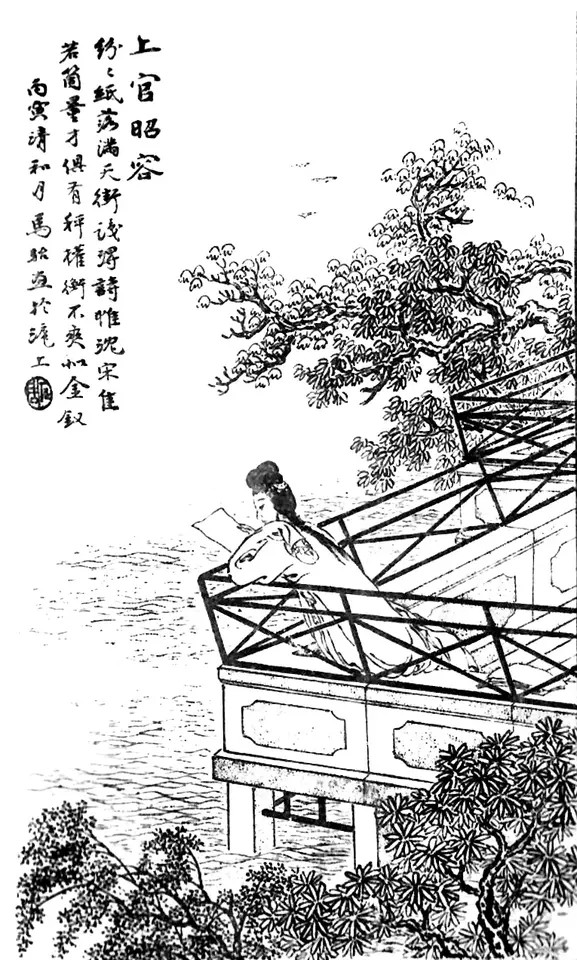
During these gatherings, the emperor instructed courtiers to compose verses and designated Shangguan Wan'er chief arbiter. Stationed upon a decorated pavilion, she evaluated the submissions, casting inferior sheets over the balustrade like drifting snow. During the famous gathering at the Kunming Pool in February 709, the competition narrowed to rival seven-character regulated verses by Shen Quanqi and Song Zhiwen.
While Shen's poem concluded with grand courtly praises, Song's piece closed with evocative imagery. Shangguan Wan'er announced her verdict: "Both masters possess transcendent talent. However, Master Shen's concluding couplet depletes its vital momentum, whereas Master Song's closing lines exhibit vigorous elegance and unrestrained spirit." Conceding her superior discernment, Shen bowed in agreement. Her adjudication established the formal aesthetic of regulated verse, shaping the "Jinglong Style" that presaged the flowering of High Tang poetry.
Resisting the Crown Princess Ambition Through Suicide
During the Jinglong era, Empress Wei and Princess Anle formed a dominant court faction. Capitalizing on Emperor Zhongzong's affection, Princess Anle demanded appointment as Crown Princess (Huang Tai Nü), seeking to position herself as the heir apparent and emulate Wu Zetian's accession.
Recognizing that this ambition would subvert dynastic succession and invite civil war, Shangguan Wan'er opposed the faction with remarkable fortitude. Disregarding her personal safety, she submitted four consecutive memorials warning the emperor against altering ancestral succession.
When Emperor Zhongzong hesitated, Shangguan Wan'er petitioned to surrender her noble rank and take Buddhist monastic vows. When this was declined, she requested demotion to private status. Finally, confronting the emperor in open court, she drank lethal poison to demonstrate her unyielding opposition. Horrified, Emperor Zhongzong summoned imperial physicians with antidotes, saving her life after days of medical care. Her drastic resistance forced the emperor to reject Princess Anle's petition. Following this confrontation, she requested demotion to Lady of Handsome Fairness (Jieyu). Her resistance was confirmed by the discovery of her excavated tomb epitaph in 2013, which documented her defense of dynastic legitimacy.
Drafting the Succession Testament Amid Crisis
On July 3, 710, Emperor Zhongzong died abruptly in the Shenlong Hall, suspected of being poisoned by Empress Wei and Princess Anle. Concealing the death, Empress Wei assembled her kin to command the northern and southern palace guards, plotting to usurp supreme authority.
In this crisis, Shangguan Wan'er allied with Princess Taiping, the influential daughter of Wu Zetian. Utilizing her authority over imperial drafting, she collaborated with Princess Taiping to compose Emperor Zhongzong's succession testament. Their draft established Zhongzong's youngest son, Li Chongmao (Prince of Wen), as emperor, while naming Prince of Xiang Li Dan (Emperor Ruizong) as co-regent alongside Empress Dowager Wei, establishing a constitutional counterweight against the Wei clan.
However, Wei partisans Zong Chuke and Wei Wen altered the text, expelling Li Dan from co-regency. Alarmed by the imminent coup, Prince of Linzi Li Longji (the future Emperor Xuanzong), partnered with Princess Taiping's son Xue Chongjian and guard commanders, launched the Tanglong Coup on the night of July 21, 710. Imperial forces stormed the Xuanwu Gate, executing Empress Wei and Princess Anle.
As coup forces entered the inner palace, Shangguan Wan'er remained composed. Confident in her loyalty, she organized palace attendants with lanterns and stepped forward to present the original draft testament to Liu Youqiu, demonstrating her effort to protect the Li Tang dynasty. Moved by the document, Liu Youqiu pleaded with Li Longji to spare her life.
However, determined to eradicate all female court influence, Li Longji concluded that her administrative agility posed an enduring hazard to imperial stability. Overriding Liu's pleas, Li Longji ordered her immediate execution before the palace flag pavilion. Shangguan Wan'er perished at the age of forty-seven, concluding a remarkable life spent at the nexus of imperial statecraft.
Posthumous Rehabilitation and Literary Legacy
Following the suppression of the coup, Li Chongmao abdicated, and Prince of Xiang Li Dan ascended the throne as Emperor Ruizong. Recognizing Shangguan Wan'er's resistance against Princess Anle and her drafting of the succession testament, Emperor Ruizong issued a decree in 711 restoring her title of Zhaorong and ordering an honorable burial. Princess Taiping contributed five hundred bolts of fine silk, providing an escort to inter her remains at the Hongdu Plateau in Xianyang, where an elaborate inscribed epitaph was erected.
In 713, having consolidated personal rule, Emperor Xuanzong recognized her literary accomplishments. He issued an imperial edict ordering a nationwide search for her scattered manuscripts, commanding Chancellor Zhang Yue to edit her writings. Zhang Yue compiled her poems, edicts, and prose into the twenty-volume Collected Works of Tang Zhaorong Shangguan, which was deposited in the imperial library, while the court conferred the posthumous name Huiwen.
In his celebrated preface, Zhang Yue commended her as an imperial master whose literary talent helped establish the poetic standards of the era. Shangguan Wan'er's trajectory from an indentured palace slave to the political and literary director of the Tang dynasty remains a celebrated chapter in Chinese cultural history.
Major Achievements
Directing Imperial Decrees as the Female Chancellor
Shangguan Wan'er occupies an unprecedented position in Chinese administrative history as a female official who exercised substantive chancellery authority. Rising from the palace workshops, she directed the drafting of imperial edicts and adjudicated official petitions for over two decades under Wu Zetian and Emperor Zhongzong.
Her command of statecraft, statutes, and prose enabled her to coordinate imperial policy, establishing an institutional precedent for female governance and representing the historical pinnacle of female political influence in imperial China.
Leading the Jinglong Literary Renaissance
In the evolution of classical Chinese poetry, Shangguan Wan'er served as the essential catalyst transitioning Early Tang court verse into the mature forms of High Tang poetry. She spearheaded the expansion of the Xiuwen Academy, recruiting foremost scholars to participate in state-sponsored symposia.
As chief adjudicator during the Kunming Pool poetry competitions, she evaluated the works of Shen Quanqi and Song Zhiwen, enforcing standards that balanced metric rigor with thematic vitality. Her patronage established the "Jinglong Style," paving the way for the poetic golden age of the High Tang.
Resisting Princess Anle's Imperial Ambition
Confronted with Princess Anle's conspiracy to subvert dynastic succession by claiming the title of Crown Princess, Shangguan Wan'er demonstrated uncompromising moral resolve.
Submitting four consecutive memorials and attempting suicide by poison to halt the appointment, her resistance compelled Emperor Zhongzong to reject the petition. Her archaeological epitaph confirmed her steadfast defense of dynastic order against factional overreach.
Drafting the Secret Testament to Preserve the Dynastic Line
Following Emperor Zhongzong's sudden death in 710, Shangguan Wan'er acted decisively to counter the Wei faction's attempt to seize the throne.
Collaborating with Princess Taiping, she drafted a succession testament that placed Prince of Xiang Li Dan into the regency council, providing a constitutional check on the Wei family and supplying the legal basis for the subsequent restoration of the Li Tang dynasty.
Preserving Imperial Archives and Classical Literature
During her tenure managing the inner secretariat, Shangguan Wan'er promoted the preservation and cataloging of imperial libraries. Recognizing the dispersal of classical manuscripts since the Sui dynasty, she urged the court to solicit private collections and employ scribes to recopy ancient texts.
Under her direction, inner palace holdings were reorganized into accessible reference libraries for court scholars, fostering the preservation of cultural heritage and supporting the intellectual flowering of the Tang dynasty.