Born in Linqiong
Born into the prominent iron-smelting industrialist family of Zhuo Wangsun in Linqiong, Shu Commandery, studying literature and music in youth.
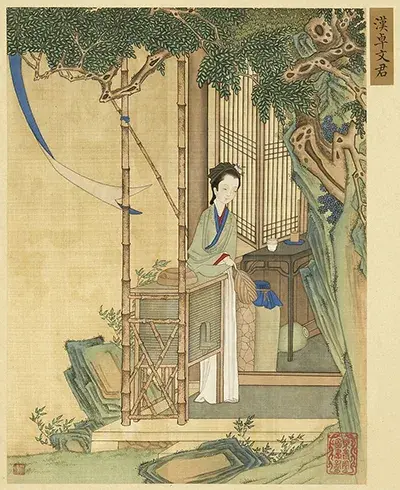
卓文君
Zhuo Wenjun (卓文君, 175 BC – 121 BC) was a celebrated woman of letters, musician, and cultural pioneer from Linqiong in Shu Commandery (modern Qionglai, Chengdu, Sichuan), whose ancestral family originated from Handan in the ancient State of Zhao. As the wife of Sima Xiangru, the towering genius of the Western Han rhapsody (fu), she is recognized as one of the most prominent female intellectuals in Chinese antiquity. Born…
Zhuo Wenjun (卓文君, 175 BC – 121 BC) was a celebrated woman of letters, musician, and cultural pioneer from Linqiong in Shu Commandery (modern Qionglai, Chengdu, Sichuan), whose ancestral family originated from Handan in the ancient State of Zhao. As the wife of Sima Xiangru, the towering genius of the Western Han rhapsody (fu), she is recognized as one of the most prominent female intellectuals in Chinese antiquity. Born into an immensely wealthy iron-smelting industrialist clan, she received an elite classical education from childhood, mastering literature, historical chronicles, and music, with extraordinary virtuosity in playing the guqin. Widowed at a young age and living at her father's estate in Linqiong, Zhuo Wenjun attended a banquet where she encountered Sima Xiangru. When Sima played the famous melody Feng Qiu Huang (The Phoenix Courting His Mate), expressing his passionate devotion through the zither strings, Zhuo Wenjun recognized his soaring talent and kindred spirit. Defying strict patriarchal conventions and social class prejudices, she eloped with him that very night and fled to Chengdu. Facing extreme destitution in Chengdu, Zhuo Wenjun resolved to return to Linqiong, where she set up an ordinary tavern and worked personally behind the counter ladling wine, while her husband washed wine vessels in the crowded market. Her public defiance compelled her father, the tycoon Zhuo Wangsun, to acknowledge their marriage and grant them substantial wealth, enabling them to establish an honorable household in Chengdu. When Sima Xiangru achieved high imperial favor under Emperor Wu in Chang'an and contemplated taking a secondary consort, Zhuo Wenjun sent poignant, resolute poetic remonstrances that evoked his deep shame and led to their lifelong reconciliation. Zhuo Wenjun's unyielding courage in pursuing personal autonomy and her brilliant artistic achievements remain enduring cultural emblems of female independence and romantic steadfastness.
Born into the prominent iron-smelting industrialist family of Zhuo Wangsun in Linqiong, Shu Commandery, studying literature and music in youth.
Married into a distinguished local lineage at age seventeen; her husband died shortly thereafter without issue, prompting her return to her father's residence.
Listened to Sima Xiangru perform the zither melody Feng Qiu Huang at an elite banquet; moved by his genius, she eloped with him to Chengdu under cover of night.
Returned to Linqiong to purchase an urban wine shop; her public labor at the counter compelled Zhuo Wangsun to bestow vast assets, establishing their prosperity.
Sima Xiangru contemplated taking a concubine in the imperial capital; Zhuo Wenjun addressed him with deeply moving verses, inspiring his repentance and fidelity.
Following Sima Xiangru's death from illness, Zhuo Wenjun organized the funeral arrangements and passed away shortly thereafter at age fifty-five.
During the reigns of Emperor Wen and Emperor Jing of Han, the empire flourished under benevolent governance and peaceful economic restoration. The town of Linqiong in Shu Commandery was renowned across the realm for its abundant iron ore reserves and advanced metallurgical technology. The Zhuo lineage had originally been skilled ironmasters in Handan within the State of Zhao; following the Qin unification, they were forcibly relocated to the Shu region. Through masterful enterprise in extracting iron ore and casting domestic implements, the clan accumulated extraordinary fortunes. By the generation of Zhuo Wangsun, Zhuo Wenjun's father, the family had become one of the wealthiest commercial dynasties in western China, possessing vast estates of prime agricultural land, upwards of one thousand domestic retainers, magnificent urban courtyards, and grand carriage retinues.
Growing up amidst great material luxury, Zhuo Wenjun possessed an innate brilliance and exceptional artistic discernment. In addition to her refined deportment, she immersed herself in classical poetry, historical annals, and the intricacies of musical composition, achieving exceptional virtuosity on the guqin. In accordance with contemporary matrimonial customs, she was wed at age seventeen to a notable family in the same commandery. However, her husband passed away from an acute illness shortly after their marriage. Having produced no male heirs, she returned to her father's mansion in Linqiong in accordance with ritual propriety. During her widowhood, she lived in quiet contemplation within her private pavilion, playing the zither and reading historical chronicles, declining numerous suitors due to her elevated artistic tastes and unyielding spirit.
In the late reign of Emperor Jing, the celebrated literary stylist Sima Xiangru departed the court of the deceased Prince Xiao of Liang and returned to his home city of Chengdu. Suffering from severe poverty and illness, he lacked the basic means of livelihood. Wang Ji, the Magistrate of Linqiong County, held Sima Xiangru's genius in the highest regard and invited him to stay in Linqiong. The magistrate housed him in a comfortable imperial postal pavilion and visited him daily with reverent courtesy, while Sima Xiangru frequently excused himself due to illness, heightening the awe of the local gentry.
Observing the magistrate's immense veneration toward the scholar, the two premier iron barons of Linqiong, Zhuo Wangsun and Cheng Zheng, prepared a magnificent feast to entertain him, inviting over one hundred distinguished guests. When noon arrived, the magistrate personally escorted Sima Xiangru to the gathering. Sima Xiangru's towering stature, elegant countenance, and composed demeanor struck all present with admiration. When wine flowed freely, Magistrate Wang placed a guqin before the guest of honor, requesting a performance. Sima Xiangru, aware that Zhuo Wangsun's widowed daughter was an accomplished musician listening from behind the screens, poured his profound yearnings into the melody, playing the famous piece Feng Qiu Huang to convey his ardent admiration.
Zhuo Wenjun had gathered behind the door screens to observe the proceedings. As the notes of the zither resonated through the hall, full of lyrical passion and sublime refinement, her heart was deeply shaken. She recognized in Sima Xiangru a rare artistic soul mate, yet feared that their vast disparity in fortune would render an open union impossible. When the banquet concluded, Sima Xiangru dispatched a trusted attendant with valuable gifts to convey his secret declaration of devotion. Transcending the rigid shackles of feudal propriety, Zhuo Wenjun made the audacious decision to flee her ancestral home that very night. Reaching Sima Xiangru's lodgings, the couple set out on horseback under cover of darkness, riding together back to Chengdu.
Upon arriving at Sima Xiangru's ancestral dwelling near the Bridge of the Brocade Market in Chengdu, Zhuo Wenjun discovered that the house was entirely bare, possessing nothing beyond four empty walls. The conditions were austere and destitute, forming an astonishing contrast to the jade-and-silk luxury of her father's palatial residence. Nevertheless, Zhuo Wenjun maintained an unyielding dignity, willingly sharing every hardship with Sima Xiangru without a single word of complaint or regret.
When Zhuo Wangsun learned that his daughter had eloped with a penniless scholar, he considered it a humiliating scandal. In a towering rage before the assembled clan elders, he publicly swore that although he would not take her life, he would never give her a single copper coin. For several months, the young couple lived in Chengdu on dwindling provisions until their resources were completely exhausted.
Assessing their predicament with pragmatic clarity, Zhuo Wenjun proposed a decisive solution to Sima Xiangru: rather than starving in isolation in Chengdu, they should return to Linqiong, where her kinsmen resided, and establish an independent trade. Acting upon her suggestion, the couple returned to Linqiong, sold their horses and remaining carriage fittings, and acquired a humble storefront in the central marketplace to operate an inn and wine shop. Casting aside all aristocratic pretensions, Zhuo Wenjun donned plain coarse attire, stood behind the counter to ladle wine, and greeted merchants and patrons from all walks of life. Meanwhile, Sima Xiangru dressed in common linen worker trousers, laboring shoulder-to-shoulder with hired hands to wash wine pots and carry water in the open street.
The sight of the daughter of the wealthiest iron magnate in the region serving wine in an open market caused an immediate sensation throughout western Shu, generating endless town gossip. Zhuo Wangsun felt so humiliated that his daughter and son-in-law were engaging in menial commerce before the entire populace that he shut his estate gates and refused to receive visitors.
Seizing this opportunity, Zhuo Wangsun's brothers, cousins, and respected community elders approached the patriarch with collective counsel. They argued that Zhuo Wangsun possessed surplus wealth beyond measure; Sima Xiangru, though impoverished, was a scholar of empire-wide renown and an honored guest of the county magistrate. Since Wenjun's union was already an accomplished fact, forcing his own flesh and blood to endure public hardship only brought disgrace upon the family name. Yielding to social pressure and paternal affection, Zhuo Wangsun finally conceded, granting the couple one hundred domestic retainers, one million copper coins, and all the luxurious silks, embroidered bedding, and gold ornaments originally prepared for her wedding. With this substantial fortune, Zhuo Wenjun and Sima Xiangru returned to Chengdu in triumph, purchasing fertile estates and grand residences to become one of the most prosperous and respected households in the city.
Years later, Liu Che ascended the throne as Emperor Wu of Han. While reading Sima Xiangru's masterpiece, the Zixu Fu (Rhapsody on Sir Vacuous), the emperor voiced deep regret that he could not live as a contemporary of its author. A palace official from Shu named Yang Deyi informed the throne that the rhapsody had in fact been composed by his fellow townsman Sima Xiangru. Overjoyed, Emperor Wu summoned the author to court. When Sima Xiangru presented his brilliant Shanglin Fu (Rhapsody on the Imperial Park), the monarch was spellbound and immediately appointed him Gentleman in Waiting at the imperial court.
Stationed in the grand capital of Chang'an and surrounded by imperial luxury, Sima Xiangru gradually adopted the prevailing courtly custom of maintaining concubines, contemplating taking a wealthy daughter from Maoling as a secondary consort and neglecting his wife back in Shu. Hearing of his intentions, Zhuo Wenjun responded neither with hysteria nor submissive acquiescence. Instead, she composed profound, dignified verses expressing heartfelt devotion combined with unyielding moral resolve, sending them directly to her husband in the capital. Upon reading her transcendent lines, Sima Xiangru was overcome with admiration and remorse, remembering their shared struggles and the boundless sacrifices she had made. Deeply ashamed, he abandoned all thoughts of taking a concubine and dispatched an earnest message seeking reconciliation. The couple remained devotedly united for the remainder of their lives. In 121 BC, Sima Xiangru passed away from illness; Zhuo Wenjun organized his final rites and died shortly thereafter at the age of fifty-five.
Over two millennia ago within the strict patriarchal hierarchy of the Western Han, Zhuo Wenjun boldly challenged feudal conventions and parental authority, becoming an unparalleled pioneer for female matrimonial self-determination and emotional agency in ancient China. In a society where marriages were strictly governed by clan status and parental command, Zhuo Wenjun, as a young widow, discerned Sima Xiangru's soaring intellectual character through the medium of music and courageously eloped, completely disregarding the vast disparity in material wealth.
Furthermore, when confronted with dire economic distress, Zhuo Wenjun exhibited extraordinary pragmatic courage. Rather than submitting to poverty or begging for familial forgiveness, she actively subverted social shame by serving wine in the open marketplace, forcing her wealthy father to negotiate and securing a rightful share of economic resources for her new family. Her fearless refusal to yield to patriarchal tyranny and her readiness to assume total responsibility for her destiny secure her an enduring landmark status in the history of female emancipation in China.
Zhuo Wenjun possessed an exceptional mastery of musical theory and poetic expression, whose literary brilliance perfectly complemented her moral fortitude. Confronted with the crisis of marital estrangement when her husband rose to imperial favor, she neither stooped to sycophantic entreaty nor resorted to vulgar resentment. Instead, she channeled her deep sorrows and pride into poignant verses characterized by emotional depth and intellectual clarity.
Her celebrated poetic exchanges with Sima Xiangru demonstrated an artistic mastery that bridged Han folk ballads with early five-character literati verse. With timeless lines that balanced tenderness with resolute dignity, she articulated an uncompromising demand for mutual spiritual equality within marriage. For centuries, her literary rejoinders have been celebrated by historians, poets, and critics as an exemplary triumph of saving a domestic union through superior artistic eloquence and asserting the sovereign dignity of womanhood.
FIGURES ASSOCIATED WITH THIS DYNASTY