Heritage
Inherited family historiographical scholarship, serving with his father Liu Fang in the Jixian Academy.
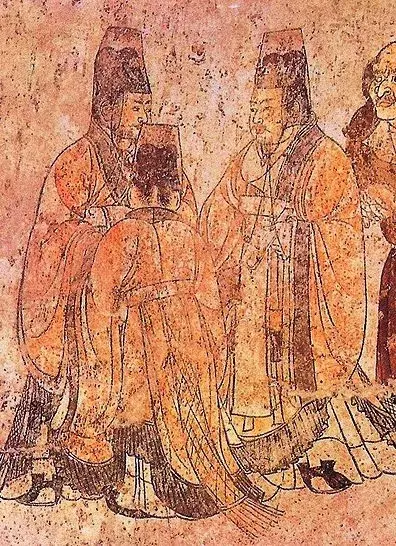
柳冕
Liu Mian (柳冕, dates unrecorded in historical annals), courtesy name Jingshu, a native of Jiexian in Hedong (present-day Yuncheng, Shanxi), was a prominent court historiographer, literary theorist, and foundational pioneer of the Ancient Prose Movement during the mid-Tang dynasty. Born into the illustrious Hedong Liu clan, he was the son of Liu Fang, a renowned historian during the reign of Emperor Suzong. Continuing his…
Liu Mian (柳冕, dates unrecorded in historical annals), courtesy name Jingshu, a native of Jiexian in Hedong (present-day Yuncheng, Shanxi), was a prominent court historiographer, literary theorist, and foundational pioneer of the Ancient Prose Movement during the mid-Tang dynasty. Born into the illustrious Hedong Liu clan, he was the son of Liu Fang, a renowned historian during the reign of Emperor Suzong. Continuing his prestigious family tradition of scholarship, Liu Mian served alongside his father in the Academy of Scholarly Worthies, establishing their reputation as an esteemed lineage of dynastic historiographers. During the early reign of Emperor Dezong, Liu Mian was summoned as Doctor of the Court of Imperial Sacrifices. His profound grasp of archaic ritual precedents won high praise from the monarch during state suburban and ancestral sacrifices; however, his outspoken and unyielding memorials provoked resentment among chief ministers, resulting in his reassignment as Prefect of Wuzhou. In 797, he was elevated to Palace Censor-in-Chief, Prefect of Fuzhou, and Surveillance Commissioner of Fujian. Wearied by protracted isolation on the southeastern frontier, he petitioned for an imperial replacement and passed away shortly after leaving office, receiving the posthumous title of Minister of Works. In Chinese literary history, Liu Mian is revered for championing the doctrine that "literature is fundamentally rooted in moral edification," vigorously rejecting the ornate parallel prose (pianwen) inherited from the Six Dynasties in favor of ideological utility and practical statecraft. His sophisticated theoretical system directly anticipated and inspired the Ancient Prose Movement led by Han Yu and Liu Zongyuan.
Inherited family historiographical scholarship, serving with his father Liu Fang in the Jixian Academy.
Served as Right Rectifier of Omissions and Historiographer; subsequently demoted to Sihu Canjun of Bazhou over official matters.
Summoned as Doctor of Sacrifices under Emperor Dezong, providing rigorous ritual precedents for imperial ceremonies.
Elevated to Bureau Director in the Ministry of Personnel; incurred the enmity of court ministers due to incisive criticism.
Reassigned out of the central court as Prefect of Wuzhou, prioritizing practical administrative reform.
Promoted to Palace Censor-in-Chief and Surveillance Commissioner of Fujian, assuming military and civil oversight.
Petitioned for an imperial successor due to failing health, dying on his return journey; posthumously honored as Minister of Works.
Liu Mian was born into the prestigious aristocratic Hedong Liu clan, a venerable bureaucratic lineage celebrated for deep literary and historical erudition. His father, Liu Fang, was a celebrated imperial historian of the mid-eighth century who compiled the 130-scroll imperial National History of the Tang and authored forty scrolls of the Tang Annals. Raised under rigorous familial instruction, Liu Mian internalized classical Confucian ritual ethics and historiographical objectivity from early childhood.
During the Dali era of Emperor Daizong, Liu Mian served concurrently with his father within the Academy of Scholarly Worthies, collating and editing rare imperial archives. He was subsequently appointed Right Rectifier of Omissions and Compiler of the Historiographical Institute, continuing his family's stewardship of state historical records. Later, caught in factional court friction, he was banished to become an administrative assistant in the mountainous interior of Bazhou. This prolonged exile provided him leisure to immerse himself in early classical texts and systematically reflect on the stylistic decay of contemporary literature.
Following Emperor Dezong's accession in 780, Liu Mian was recalled to the imperial court and appointed Doctor of the Court of Imperial Sacrifices. Emperor Dezong took immense personal interest in traditional state rituals, frequently interrogating court ceremonialists regarding sacrificial protocols for Heaven, Earth, and imperial ancestors. Drawing upon comprehensive historical knowledge, Liu Mian expounded upon archaic origins and developmental precedents with meticulous clarity, earning deep imperial admiration and trust.
Subsequently promoted to Bureau Director in the Ministry of Personnel, Liu Mian demonstrated unbending moral rectitude. Confronted with bureaucratic inertia, fiscal corruption, and ministerial sycophancy, he repeatedly submitted uncompromising memorials directly criticizing executive chancellors. His blunt rhetoric alienated powerful court factions, who orchestrated his dismissal from the capital to become Prefect of Wuzhou. In Wuzhou, Liu Mian governed through classical Confucian moral principles and composed extensive theoretical correspondence articulating his literary reform doctrines.
In 797, recognizing his senior administrative standing, Emperor Dezong appointed Liu Mian as Palace Censor-in-Chief, Prefect of Fuzhou, and Surveillance Commissioner of Fujian, placing him in supreme command of regional military and civilian administration. Having endured decades of marginalization far from the central court, Liu Mian's uncompromising and impatient nature deepened his feelings of resentment and isolation.
His adherence to archaic ritual governance created friction with subordinate local officials. Recognizing his declining physical strength, Liu Mian submitted an earnest memorial requesting that the throne dispatch a successor and granting him permission to make an imperial audience in Chang'an. Dezong consented, appointing Yan Jimei as his replacement. Shortly after handing over the seals of office and embarking on his northward journey, Liu Mian succumbed to illness at a way station. In recognition of his lifelong dedication to classical statecraft and court historiography, Emperor Dezong posthumously conferred upon him the noble rank of Minister of Works.
Liu Mian occupies a pivotal role in the history of Chinese literary criticism. Prior to the full emergence of Han Yu and Liu Zongyuan's literary revolution, Liu Mian systematically formulated an avant-garde prose theory rooted in Confucian moral cultivation. In direct opposition to the reigning six-dynasties aesthetic that prioritized ornate diction, tonal prosody, and formalistic parallelism, Liu Mian championed substantive prose.
He forcefully asserted that "literature is fundamentally rooted in moral education," maintaining that the sole legitimate purpose of writing was to elucidate the moral Way of ancient sages, promote statecraft, and reform social mores. He linked literary style inextricably to the moral virtue of the writer, formulating the famous maxim that "writing reflects the character of the man." These doctrines served as the direct ideological foundation for Han Yu's conception of "literature as a vehicle for the Way," earning Liu Mian recognition as an indispensable pioneer of Tang prose reform.
While eschewing frivolous lyricism, Liu Mian excelled at writing logically rigorous, highly persuasive discursive essays structured in epistolary form. Through famous treatises such as Letter in Reply to Prefect Zheng of Quzhou on Literature and Letter to Quan Deyu, he systematically delineated the relationship between prose composition, imperial moral governance, and individual integrity.
Composed entirely in unadorned, flowing classical prose, his treatises set a new standard for analytical rigor and rhetorical power, dismantling the stylistic shackles of parallel prose and revitalizing discursive writing during the late eighth century.
FIGURES ASSOCIATED WITH THIS DYNASTY