Birth in Suzhou
Born into an established medical lineage in Changzhou County, displaying early scholarly intellect and medical aptitude.
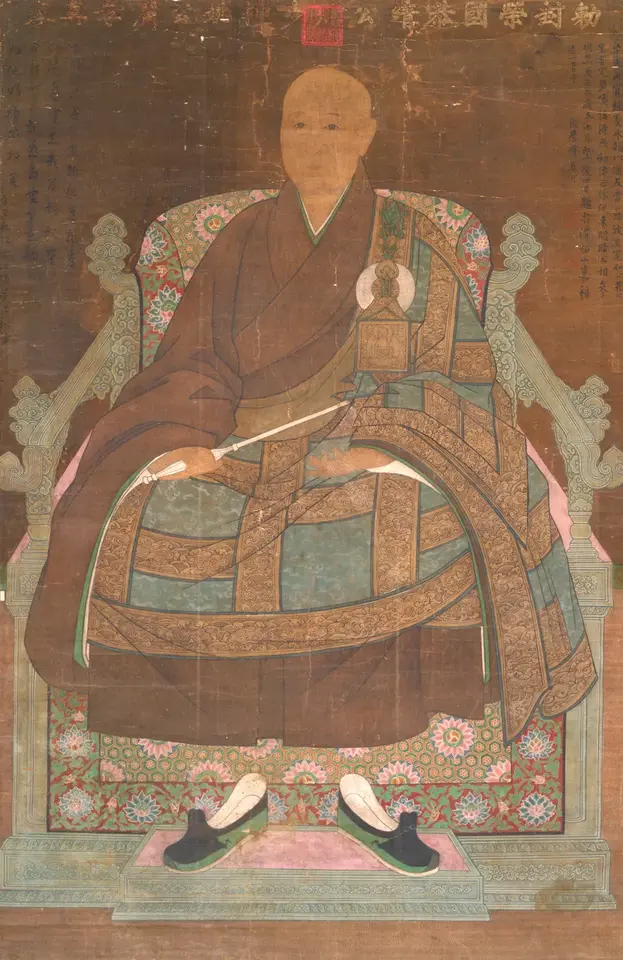
姚广孝
Yao Guangxiao (姚广孝, 1335 – April 1418), monastic dharma name Daoyan (道衍), courtesy name Sidao (斯道), art name Du'an Laoren (独庵老人) and Taoxuzi (逃虚子), posthumously honored as Gongjing (恭靖), was a native of Changzhou County, Suzhou Prefecture. He was an extraordinary early Ming Dynasty statesman, military strategist, Buddhist philosopher, poet, and the chief mastermind behind the Jingnan Campaign that elevated Zhu Di (Emperor…
Yao Guangxiao (姚广孝, 1335 – April 1418), monastic dharma name Daoyan (道衍), courtesy name Sidao (斯道), art name Du'an Laoren (独庵老人) and Taoxuzi (逃虚子), posthumously honored as Gongjing (恭靖), was a native of Changzhou County, Suzhou Prefecture. He was an extraordinary early Ming Dynasty statesman, military strategist, Buddhist philosopher, poet, and the chief mastermind behind the Jingnan Campaign that elevated Zhu Di (Emperor Yongle) to the imperial throne. Holding the office of Junior Preceptor to the Crown Prince and Left Patriarch of the Buddhist Registry, he was posthumously ennobled as Duke of Rong. Remarkably, Yao Guangxiao stands as the sole civil official across the nearly three centuries of the Ming Dynasty to be granted the supreme posthumous honor of enshrinement in the Imperial Ancestral Temple. Born into a family of hereditary physicians, Yao entered the Buddhist monastic order at age fourteen. Possessing comprehensive mastery of both Buddhist sutras and Confucian classics, he studied Daoist yin-yang divination and military statecraft under Master Xi Yingzhen. In 1382, following the death of Empress Ma, he was assigned to accompany Prince Zhu Di of Yan to Beiping, becoming abbot of Qingshou Temple and the prince's foremost strategic confidant. When the Jianwen Emperor launched an aggressive campaign to eliminate the princely fiefdoms, Yao urged Zhu Di to take up arms, constructing subterranean arsenals beneath the prince's estate and camouflaging metalworking clatter with flocks of noisy geese and ducks. During the Jingnan Campaign, Yao successfully defended Beiping against numerically superior southern imperial armies and devised the bold strategy of bypassing defended regional strongholds to strike directly at Nanjing, securing Zhu Di's triumph. Following Zhu Di's enthronement, Yao Guangxiao was appointed Junior Preceptor to the Crown Prince, restored to his ancestral surname Yao, and bestowed the personal name Guangxiao. Despite reaching the pinnacle of state influence, he steadfastly refused to grow his hair, marry, or occupy a lavish official residence, residing permanently in monastic quarters and earning the popular title of the "Black-Robed Prime Minister." He assisted Crown Prince Zhu Gaozhi during periods of imperial absence, tutored the imperial grandson Zhu Zhanji, directed the compilation of the monumental Yongle Encyclopedia (Yongle Dadian), and oversaw the revision of the Veritable Records of Emperor Taizu. He passed away at Qingshou Temple in 1418 at age eighty-four, interred with Buddhist monastic rites beneath a majestic brick pagoda in Fangshan.
Born into an established medical lineage in Changzhou County, displaying early scholarly intellect and medical aptitude.
Tonsured as a Buddhist monk at Miaozhi Hermitage at age fourteen, taking the monastic name Daoyan and studying military strategy under Xi Yingzhen.
Summoned to the capital when Emperor Taizu tested Confucian-trained monks; declined secular office and received imperial robes before returning home.
Selected to serve Prince Zhu Di of Yan following Empress Ma's death; became abbot of Qingshou Temple in Beiping and core advisor.
Urged Zhu Di to rebel against the Jianwen Emperor's aggressive fief reductions, constructing secret underground armories in Beiping.
Commanded the defense of Beiping during the Jingnan outbreak, lowering shock troops down city walls to defeat Li Jinglong's siege forces.
Advised Zhu Di to break the grueling siege of Jinan and rallied troops after the reverse at Dongchang to maintain the offensive.
Formulated the campaign-winning doctrine of bypassing fortified provincial cities to mount a rapid cavalry dash against Nanjing.
Zhu Di captured Nanjing and ascended the throne, naming Yao Guangxiao Left Patriarch of the Central Buddhist Registry as chief merit contributor.
Bestowed the secular rank of Junior Preceptor to the Crown Prince and renamed Guangxiao, declining official mansions to live in a temple.
Commissioned as Supreme Director to revise the Veritable Records of Emperor Taizu and compile the encyclopedic Yongle Dadian.
Guided Crown Prince Zhu Gaozhi as regent in Nanjing during northern expeditions, serving as tutor to imperial grandson Zhu Zhanji.
Passed away at age eighty-four after securing the imperial release of imprisoned monk Puqia; honored with an imperial stele and Duke of Rong title.
Yao Guangxiao was born in 1335 in Changzhou County, Suzhou Prefecture, into a respected local family of medical practitioners. Exhibiting brilliant intellect from early childhood, he studied both traditional medicine and classical Confucian literature. Amid the turbulent social disintegration that marked the final decades of the Yuan Dynasty, the fourteen-year-old youth chose the monastic life, taking vows at Miaozhi Hermitage under the dharma name Daoyan and courtesy style Sidao. Rather than confining himself strictly to Buddhist scriptures, Daoyan sought comprehensive mastery over all practical fields of statecraft.
He subsequently apprenticed under Daoist adept Xi Yingzhen, mastering astronomical calculation, yin-yang metaphysics, terrain divination, and the classical military doctrines of Sunzi and Zhuge Liang. Daoyan possessed an imposing and unconventional demeanor. During his youth, while visiting the Shaolin Temple on Mount Song, renowned physiognomist Yuan Gong observed him closely and remarked with astonishment: "What an extraordinary monk! Bearing triangular eyes and the stride of an ailing tiger, he possesses an inherent affinity for martial conquest, matching the mold of Liu Bingzhong!" Rather than taking offense, Daoyan rejoiced, embracing his ambition to guide imperial fortunes in robes of unadorned cloth.
In 1375, the Hongwu Emperor issued an imperial decree summoning Buddhist monks proficient in the Confucian classics to Beijing for evaluation by the Ministry of Rites. Daoyan passed the examination, and though he declined formal bureaucratic appointment, he received special imperial robes. In 1382, following the passing of Empress Ma, the imperial court selected prominent Buddhist prelates to accompany the various imperial princes to their regional principalities to offer memorial prayers. Left Buddhist Patriarch Zongle, deeply aware of Daoyan's strategic genius, recommended him to Prince Zhu Di of Yan. The prince and the monk conversed with immediate mutual admiration in Nanjing, and Zhu Di successfully requested Daoyan's assignment to his northern capital in Beiping.
In Beiping, Daoyan was appointed abbot of Qingshou Temple. Located near the Yan princely residence, the monastery enabled Daoyan to enter the palace chambers regularly. While public records suggested religious consultation, Daoyan met secretly with Zhu Di to analyze court vulnerabilities and geopolitical strategies. Daoyan recognized that while the imperial court in Nanjing was prone to bureaucratic factionalism, Zhu Di's frontier armies possessed immense combat potential, laying the groundwork for future political action.
In 1398, the Hongwu Emperor died, and his grandson Zhu Yunwen ascended the throne as the Jianwen Emperor. Guided by ministers Qi Tai and Huang Zicheng, the youthful sovereign swiftly revoked the fiefs of senior princes, deposing five imperial uncles within months and driving Prince Zhu Bai of Xiang to self-immolation. When Zhu Di hesitated to take up arms out of concern for popular loyalty to the legitimate throne, Daoyan responded firmly: "Your servant knows the mandate of Heaven, and Heaven surpasses temporal opinion!"
To steel the prince's resolve, Daoyan introduced physiognomist Yuan Gong and divination master Jin Zhong into the princely residence, predicting an imperial destiny for Zhu Di. Daoyan personally orchestrated covert military preparations within the sprawling Yan residence. Beneath the palace gardens, he excavated a cavernous underground armory enclosed by double brick walls and lined with ceramic jars to muffle sound. Within this subterranean vault, smiths forged blades, spears, and armor day and night, while thousands of ducks and geese were raised in the courtyard above to mask the metallic hammering.
In June 1399, when an imperial warrant was issued to seize the Yan household, Daoyan and Zhu Di ambushed regional commanders and launched the Jingnan Campaign under the banner of "clearing wicked counsellors from the sovereign's side." When severe gale-force winds blew roof tiles from the palace hall on the eve of battle, casting a superstitious pall over the troops, Daoyan turned the omen into inspiration, announcing that when the imperial dragon takes flight amidst storms, the dropping of green tiles signals the imminent replacement with the emperor's yellow tiles.
When Zhu Di launched an expedition to capture the frontier bastion of Daning, southern general Li Jinglong converged upon Beiping with 500,000 imperial troops. Daoyan remained in Beiping to assist Crown Prince Zhu Gaozhi in coordinating civil defense. Exhibiting extraordinary composure, Daoyan mobilized city residents, poured water over defensive walls in freezing weather to create sheer ice barriers, and lowered night assault teams over the ramparts using ropes to raid enemy bivouacs. When Zhu Di returned with reinforcements, Daoyan opened the gates to launch a coordinated pincer attack, routing Li Jinglong's grand army and securing the northern base.
During the subsequent years of attrition, Daoyan monitored the overall war effort from Beiping. When the siege of Jinan dragged into months, Daoyan advised a tactical withdrawal to preserve combat strength. When the Yan general Zhang Yu fell in battle at Dongchang, Daoyan urged renewed offensive operations. Late in 1401, perceiving that southern armies were concentrated along the northern defense perimeter while the imperial capital lay undefended, Daoyan presented the decisive strategy: "Bypass regional strongholds and march directly upon the capital! Nanjing's defenses are thin and will inevitably collapse." Zhu Di executed this bold cavalry dash across the Huai River, routing imperial divisions at Lingbi and crossing the Yangtze to seize Nanjing in June 1402.
Upon ascending the imperial throne, Emperor Yongle recognized Daoyan as his foremost merit advisor. Bestowing upon him the rank of Left Patriarch of the Central Buddhist Registry, the emperor promoted him in 1404 to Junior Preceptor to the Crown Prince, restoring his ancestral surname Yao and bestowing the name Guangxiao. Emperor Yongle never addressed him by his personal name in private consultations, using only the honorific title "Junior Preceptor."
Although the emperor urged him to return to secular life, marry, and accept a grand mansion with serving women, Yao Guangxiao adamantly refused. He continued to lodge in monastic cells, wearing official ceremonial robes during morning audiences but changing immediately into rough Buddhist cassocks upon returning to his quarters, earning the popular moniker "Black-Robed Prime Minister." While visiting his native Suzhou on an imperial famine relief mission, he distributed all imperial monetary awards among his clan and impoverished villagers.
Yao Guangxiao's contributions to culture were profound. Whenever Emperor Yongle traveled north or mounted steppe campaigns, Yao remained in Nanjing to assist Crown Prince Zhu Gaozhi as regent, ensuring administrative continuity and protecting the heir's succession from palace intrigues. He tutored the imperial grandson Zhu Zhanji, instilling principles of wise governance that later bore fruit during the celebrated Rule of Ren and Xuan. Most notably, Yao served as chief supervisor alongside Xie Jin to direct the compilation of the 22,877-volume Yongle Encyclopedia, orchestrating over two thousand scholars to preserve China's literary heritage across antiquity.
In March 1418, the eighty-four-year-old Yao Guangxiao fell gravely ill at Qingshou Temple in Beijing. Emperor Yongle visited his sickbed repeatedly, presenting him with personal gifts and inquiring whether he harbored any unfulfilled wishes. Yao Guangxiao bowed and made a solitary request: to pardon and release the monk Puqia, who had been imprisoned for over a decade under suspicion of concealing the fugitive Jianwen Emperor. Moved by the dying prelate's compassion, Emperor Yongle ordered Puqia's immediate release, whereupon Yao offered deep thanks.
Shortly thereafter, Yao Guangxiao passed away in his temple quarters. Emperor Yongle suspended court audiences for two days in profound grief, ordered a lavish state funeral adhering to Buddhist monastic rites, and posthumously bestowed upon him the titles of Pushan Fuguo Xiemou Xuanli Wenchen, Glorious Grand Master, Grand Pillar of State, and Duke of Rong, with the posthumous title Gongjing. The emperor personally composed the text for his sacred spirit road stele and constructed a nine-tiered brick stupa in Fangshan.
In 1425, Emperor Renzong (Zhu Gaozhi) honored Yao's lifelong loyalty by decreeing that the monk-statesman be enshrined alongside Emperor Taizong in the Imperial Ancestral Temple. Among the sixteen founding merit ministers granted this supreme dynastic honor, including generals Xu Da and Chang Yuchun, Yao Guangxiao was the sole civil official across the Ming Dynasty to enter the imperial temple, cementing his singular stature in imperial history.
Yao Guangxiao served as the supreme strategic architect of the Jingnan Campaign. Recognizing the vulnerability of the regional principalities during the Jianwen Emperor's sudden centralization, he convinced Zhu Di to strike for survival. He orchestrated covert weapons manufacturing within the Beiping palace, constructing sound-dampened subterranean foundries camouflaged by noisy flocks of waterfowl. When the campaign commenced, he assisted Zhu Gaozhi in holding Beiping against half a million besieging imperial troops, using sheer ice ramparts and midnight sorties to safeguard the northern base.
During the stalemate of 1401, when Yan forces were bogged down before fortified citadels in Shandong, Yao Guangxiao demonstrated brilliant military vision. Perceiving that the southern defense strategy had deployed its finest formations on peripheral frontiers, leaving the dynastic capital hollow, he formulated the game-winning counsel: bypass regional cities and march directly upon Nanjing. This audacious cavalry advance broke through southern lines at the Huai River and forced the crossing of the Yangtze, securing total imperial victory without protracted regional attrition.
Yao Guangxiao directed the grandest bibliographic preservation project in Chinese imperial history. Commissioned by Emperor Yongle in 1405 as chief director alongside Xie Jin, Yao coordinated more than 2,100 scholars to compile the colossal Yongle Encyclopedia. Comprising 22,877 volumes and approximately 370 million characters, this monumental compendium integrated literature, history, astronomy, medicine, and philosophy from antiquity through the early Ming. Yao's encyclopedic erudition across Confucian, Daoist, and Buddhist canons provided the organizational vision for this unparalleled literary treasury.
Yao Guangxiao served as supreme director for the comprehensive revision of the Veritable Records of Emperor Taizu (Ming Taizu Shilu). Because earlier records compiled during the Jianwen reign contained factional distortions, Yao led a meticulous textual overhaul, consulting primary palace archives and founding documents to standardize the dynastic chronicle. His editorial rigor established the structural conventions for all subsequent Ming imperial records.
Throughout Emperor Yongle's frequent steppe campaigns and absences in Beijing, Yao Guangxiao was entrusted with executive governance in Nanjing, guiding Crown Prince Zhu Gaozhi as imperial regent. Yao's shrewd political counsel shielded the gentle crown prince from political entrapment by his ambitious younger brother Zhu Gaoxu, preserving stability in the line of succession. Furthermore, Yao tutored imperial grandson Zhu Zhanji, providing the future Ming Xuanzong with comprehensive training in classical statecraft and ethical governance that underpinned the prosperity of the "Rule of Ren and Xuan."
Despite attaining the highest rank and imperial favor, Yao Guangxiao adhered strictly to monastic asceticism. Refusing official estates, female retinues, and secular titles, he walked to palace audiences in formal ministerial robes and returned to draft classics in coarse monk's attire, earning renown as the "Black-Robed Prime Minister." On his deathbed, his sole plea was the pardon of an innocent fellow prelate. Following his passing, Emperor Renzong granted him enshrinement in the Imperial Ancestral Temple alongside Emperor Yongle, making him the only civil minister throughout the entire Ming Dynasty to achieve this pinnacle of dynastic honor.
FIGURES ASSOCIATED WITH THIS DYNASTY