Imperial Birth
Born at Hetu Ala as the third son of Nurhaci's eldest son Cuyen; rigorously trained in equestrian arts and archery.
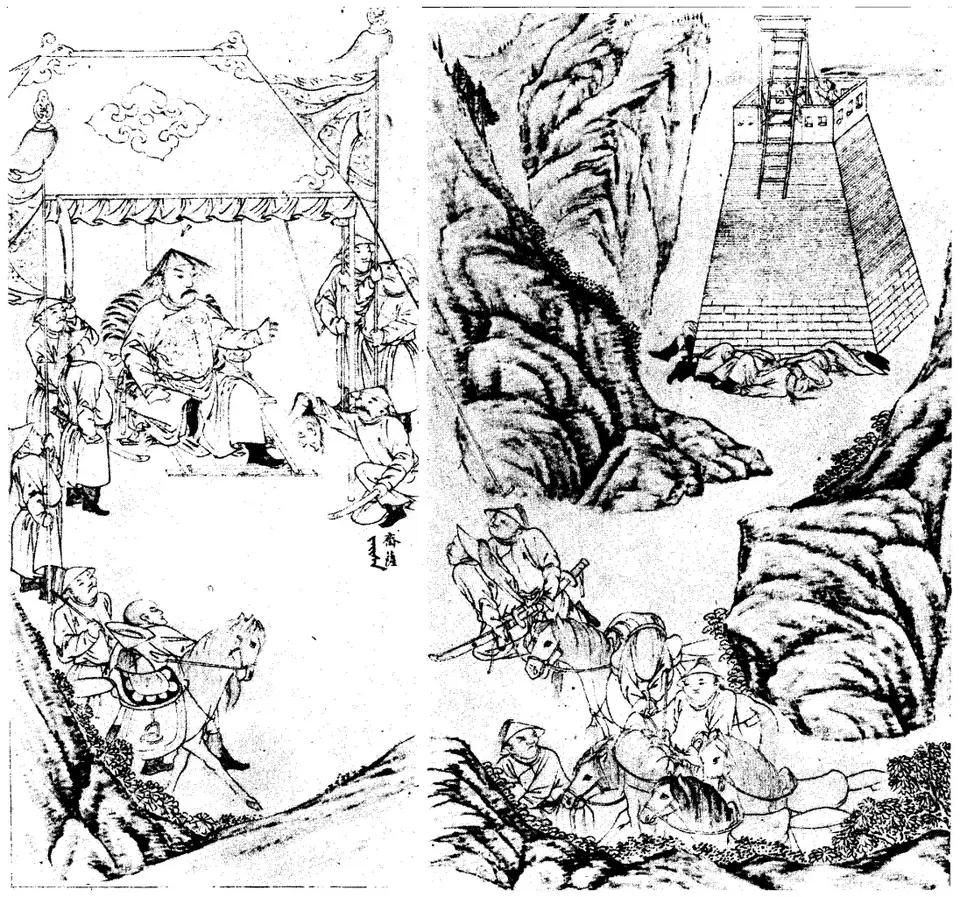
尼堪
Nikan (尼堪, 1610–1652), belonging to the imperial Aisin Gioro clan, was a grandson of Nurhaci (Emperor Taizu of Qing), the third son of Cuyen (Prince Guanglüe), and a premier military commander of the early Qing Dynasty. Celebrated from his youth for physical bravery, tactical poise, and mastery of mounted archery, Nikan distinguished himself during the Tianming era in expeditions against the Dorot and Dongkui tribes. During…
Nikan (尼堪, 1610–1652), belonging to the imperial Aisin Gioro clan, was a grandson of Nurhaci (Emperor Taizu of Qing), the third son of Cuyen (Prince Guanglüe), and a premier military commander of the early Qing Dynasty. Celebrated from his youth for physical bravery, tactical poise, and mastery of mounted archery, Nikan distinguished himself during the Tianming era in expeditions against the Dorot and Dongkui tribes. During the Tiancong and Chongde eras under Hong Taiji, Nikan rose steadily from Gusa Beizi to Deliberative Minister. He fought alongside Prince Yu Dodo to tie down Ming border armies at Jinzhou and Ningyuan, pursued King Injo of Joseon to Namhansanseong during the invasion of Korea, captured Tashan and Lianshan under Ajige, and commanded the vital frontier garrison at Jinzhou. Following the Qing crossing of Shanhaiguan in 1644, Nikan served as vanguard commander under Prince Regent Dorgon, crushing Li Zicheng's Shun army and advancing to Qingdu, for which he was elevated to Beile. In 1645, he accompanied Dodo south to conquer Jiangnan and Zhejiang, capturing the Southern Ming Hongguang Emperor (Zhu Yousong) at Wuhu and extinguishing the Hongguang court. In 1648, he led troops to Jiangxi, suppressing the widespread rebellions of Jin Shenghuan and Wang Deren, earning elevation in 1649 to Prince Jingjin of the First Rank and appointment as Director of the Imperial Clan Court. In 1652 (Shunzhi 9), when Southern Ming General Li Dingguo launched an expansive northern counter-offensive across Guangxi and Hunan, annihilating Kong Youde at Guilin, the Qing court appointed Nikan as Dingyuan Grand General at the head of one hundred thousand elite troops. In December 1652, during the Battle of Hengzhou, Nikan was drawn into an ambush at Yanwuping, where he fell in combat, becoming the highest-ranking imperial prince killed in action in Qing history.
Born at Hetu Ala as the third son of Nurhaci's eldest son Cuyen; rigorously trained in equestrian arts and archery.
Followed Dodo with a mobile wing into Jinzhou and Ningyuan, tying down the Ming dynasty's elite Guan-Ning iron cavalry.
Elevated to Gusa Beizi upon the founding of the Qing Dynasty; pursued King Injo of Joseon to Namhansanseong.
Following Joseon's capitulation, returned to Shengjing and was appointed Deliberative Minister in the fourth month.
Served under Dorgon at the Battle of Shanhaiguan, pursuing Li Zicheng's forces to Qingdu; elevated to Beile in the tenth month.
Captured Nanjing under Dodo and personally apprehended the Hongguang Emperor at Wuhu; created Prince of the Second Rank in 1646.
Extinguished the rebellion of Jin Shenghuan in Jiangxi; elevated to Prince Jingjin of the First Rank and appointed Director of the Imperial Clan Court.
Appointed Dingyuan Grand General by the Shunzhi Emperor to counter Li Dingguo's northern advance in Huguang.
On December 23, ambushed by Li Dingguo at Yanwuping outside Hengzhou; died fighting after his horse collapsed; granted the posthumous title Zhuang.
Nikan was born in 1610 (the thirty-eighth year of the Wanli reign of the Ming Dynasty) in the mountain fortress of Hetu Ala, Jianzhou, as the third son of Cuyen, the eldest son and early heir-apparent of Nurhaci. Following Cuyen's tragic execution in 1615 after acrimonious conflicts with the Five Ministers and younger brothers, Nikan and his elder brother Dudu occupied a delicate position within the imperial lineage. This familial reversal instilled in Nikan an unyielding drive to restore his branch's honor through battlefield valor. Physically imposing, endowed with immense strength, and possessing natural battlefield command instincts, he became an accomplished mounted archer.
During the Tianming era, the young Nikan began accompanying veteran commanders on military campaigns, participating in the pacification of the Mongol Dorot tribe and the Dongkui Jurchen clans in the eastern forests. Frequently charging ahead of his troopers, he earned repeated commendations from Nurhaci for his personal courage. In 1631 (Tiancong 5), during the Siege of Dalinghe, Nikan supervised long defensive siege-trenches that encircled Zu Dashou's garrison, demonstrating operational discipline. In 1635 (Tiancong 9), when Hong Taiji led the main Eight Banners armies through the Mongol passes into Shanxi, Prince Yu Dodo was ordered to lead a mobile flank force into the Liaoxi corridor. Serving under Dodo, Nikan raided the defensive lines between Jinzhou and Ningyuan, successfully pinning down tens of thousands of elite Guan-Ning cavalry and screening the withdrawal of the main expeditionary force.
In May 1636 (the fourth month of Chongde 1), Hong Taiji proclaimed himself emperor in Shengjing, founding the Qing Dynasty. In the initial distribution of noble ranks, Nikan was created a Gusa Beizi. In December of that year, when the Joseon Dynasty defied Qing suzerainty, Hong Taiji launched a punitive expedition against Korea. Serving in the vanguard under Dodo, Nikan led light cavalry in an overland march across the Yalu River, cutting off King Injo's escape route toward Ganghwa Island and trapping the Korean court inside the fortress of Namhansanseong. In the ensuing engagements, Nikan led his cavalry to intercept and destroy several thousand Korean relief troops, extinguishing hopes of provincial rescue. Following King Injo's surrender in February 1637, Nikan returned to Shengjing and was appointed Deliberative Minister, joining the inner council of state and military policy.
In 1639 and 1641, Nikan participated in the prolonged Songshan-Jinzhou campaign. Serving under Prince Wuying Ajige, he led four banner battalions to sever Ming supply lines between Tashan and Lianshan. Following the fall of Jinzhou in 1642, Hong Taiji appointed Nikan to garrison the strategic border fortress, where he repaired defensive works and reconciled surrendered populations, demonstrating executive administrative talent.
In April 1644 (Shunzhi 1), after Li Zicheng's Shun army captured Beijing and the Chongzhen Emperor committed suicide, Ming border general Wu Sangui surrendered Shanhaiguan to the Qing. Prince Regent Dorgon led the Eight Banners through the pass, commissioning Nikan as a vanguard division commander. In the decisive Battle of Shanhaiguan, Nikan led heavy cavalry in sweeping flank assaults against the Shun lines amid blinding dust storms, shattering Li Zicheng's field army. Following the occupation of Beijing, Nikan joined Ajige in pursuing the retreating Shun forces to Dingzhou and Qingdu, securing North China for the Qing dynasty. In November 1644, upon the Shunzhi Emperor's enthronement in Beijing, Nikan was elevated to Beile in recognition of his founding services.
In the spring of 1645 (Shunzhi 2), Nikan accompanied Dodo southward to conquer the Yangtze delta. During the siege of Yangzhou, Nikan led assault units across the Huai River, storming the city fortifications; he then advanced down the Yangtze, occupying the southern capital Nanjing without resistance. When the Southern Ming Hongguang Emperor fled to Wuhu, Nikan pursued him along the river with elite cavalry, dispersing loyalist forces and capturing the emperor alongside prominent Ming ministers, extinguishing the Hongguang regime. In 1646, he was promoted to Prince Jingjin of the Second Rank. In 1648 (Shunzhi 5), when defected Ming generals Jin Shenghuan and Wang Deren revolted in Nanchang, Nikan marched south alongside Prince Duanzhong Boro, crushing the rebel formations outside Nanchang and retaking Jiangxi. In June 1649, the Shunzhi Emperor elevated Nikan to Prince Jingjin of the First Rank and appointed him Director of the Imperial Clan Court, placing him among the foremost imperial commanders of the early Qing.
In 1651, following Dorgon's death, the Shunzhi Emperor assumed direct personal rule. In the southwest, the remnants of the Southern Ming movement were revitalized by an alliance between the Yongli Emperor and the former Great Xi insurgent leaders Li Dingguo and Sun Kewang, who commanded over one hundred thousand seasoned, disciplined troops. In early 1652 (Shunzhi 9), Li Dingguo launched an expansive northern counter-offensive from Yunnan and Guizhou.
Employing extraordinary mobility, Li Dingguo captured Yuanzhou and Jingzhou before sweeping into Guangxi, where he besieged Guilin. The Qing southern commander Kong Youde, Prince Pacifying the South, was routed and committed suicide in the flames of his palace, his entire command staff perishing alongside him. Li Dingguo then pivoted northward into Hunan, capturing Quanzhou, Lingling, Hengyang, and Changsha, trapping Qing garrison forces in northern Huguang. Kong Youde's death and the loss of two provinces shaken Qing rule across southern China, causing profound alarm in Beijing.
In September 1652, the Shunzhi Emperor issued an emergency mobilization decree appointing Nikan as Dingyuan Grand General, bestowing upon him the imperial battle standard and command batons. Nikan was placed in supreme command of several tens of thousands of elite Eight Banners guards and banner cavalry, augmented by regional armies from Zhili and Henan totaling over one hundred thousand troops. At a solemn ceremony in the Hall of Supreme Harmony, the emperor presented Nikan with an imperial sword and steed, urging him to pacify Huguang and destroy Li Dingguo. Accustomed to unbroken victories, Nikan harbored the typical haughtiness of Manchu aristocrats, underestimating the tactical sophistication of the Southern Ming army.
In late November 1652, Nikan arrived in Xiangtan with his heavy cavalry. By that time, Li Dingguo was besieging Changsha. Learning that the Qing court had deployed its premier imperial prince, Li Dingguo assessed Nikan's character as brave but rash, choosing to lay an elaborate trap. He lifted the siege of Changsha and retreated southward, ordering his troops to abandon pack animals, equipment, and baggage along the road to simulate a demoralized rout.
Convinced that the Southern Ming forces were disintegrating, Nikan grew increasingly overconfident. Subordinate commanders such as Shangshan and Prince Tunqi warned him that the rolling hills and rivers of southern Hunan favored ambushes, urging caution. Nikan dismissed their concerns with fury, insisting that his cavalry had always dispersed enemies effortlessly. Leaving behind his infantry, artillery, and supply trains, Nikan drove his elite cavalry forward day and night, arriving outside Hengzhou on December 22.
At dawn on December 23, thick fog shrouded the banks of the Xiang River. Li Dingguo positioned his veteran troops in concealed defiles along Yanwuping and the Caomao Bridge, north of Hengzhou. When Ming forward detachments made brief contact and feigned flight, Nikan drew his blade and charged into the narrow basin at the head of several thousand vanguard horsemen. The moment Nikan's formation entered the defile, Li Dingguo sounded the war drums, springing his trap from three sides. Concealed Ming musketeers, war elephants, and spear units cut off the narrow valley pass, pouring devastating volley fire onto the trapped riders.
Confined within the muddy basin, the heavy Eight Banners cavalry lost all momentum. Li Dingguo led broadsword assault teams charging down from the surrounding heights, severing the Qing vanguard into isolated pockets. Surrounded and facing certain death, Nikan fought with desperate courage. Galloping through the melee, he emptied his bow, killing over twenty Ming warriors. When his arrows were spent, he drew his sword and engaged in hand-to-hand combat, breaking multiple blades. However, Ming infantry converged in overwhelming numbers, slaying his horse and piercing his armor with lances. In the frantic clash, a Ming commander decapitated Nikan. The remaining Eight Banners cavalry broke and fled in disarray, concluding the battle with a decisive Southern Ming triumph.
The Battle of Hengzhou marked one of the greatest military victories in the history of the Southern Ming resistance. In combination with the victory at Guilin, it fulfilled Li Dingguo's celebrated feat of "slaying two renowned princes and shaking the realm," as recorded by the historian Huang Zongxi. Recognizing Nikan's aristocratic rank and battlefield valor, Li Dingguo ordered his troops to locate the prince's body, carved an aromatic wooden head to accompany the corpse, and placed the remains in an honorable coffin, permitting Qing couriers to repatriate the body during the subsequent troop redeployments.
When the news of Nikan's death reached Beijing, the Shunzhi Emperor and Empress Dowager Xiaozhuang wept in profound grief, and the court suspended public audiences for three days. The emperor dispatched high ministers one hundred li outside the capital to meet the returning funeral procession. In February 1653 (Shunzhi 10), the emperor personally led civil and military officials to make sacrifices outside the Chaoyang Gate, mourning: "Since the founding of our dynasty, among all imperial princes who have gone to war, Prince Jingjin alone has perished in battle! His loyal and valiant spirit stands solitary throughout a thousand years!"
The Qing court conferred upon Nikan the posthumous name Zhuang, designating him Prince Jingjin Zhuang, and erected a massive spirit-path stele and mausoleum outside the capital, granting his spirit tablet enshrinement in the Shengjing Imperial Ancestral Temple. His eldest son Nisihan inherited the title of Prince Jingjin of the First Rank. Nikan's military career, defined by sweeping conquests and an honorable death on the battlefield, secured him an enduring place as one of the most celebrated and tragic generals of the Qing founding era.
Nikan played an indispensable operational role in the military campaigns that established Qing dominion over China. From Korean campaigns at Namhansanseong to the decisive charge at Shanhaiguan and the conquest of Jiangnan under Dodo, Nikan consistently served as the premier shock commander of the Eight Banners cavalry. During the pursuit along the Yangtze River in 1645, his light horsemen captured the Hongguang Emperor at Wuhu, bringing a swift end to the first Southern Ming resistance court. In Jiangxi, he crushed the revolt of Jin Shenghuan at Nanchang, proving instrumental in consolidating Qing control over central and southern China.
Beyond his military service, Nikan functioned as an influential leader within early Qing dynastic politics. Elevated to Prince Jingjin of the First Rank and appointed Director of the Imperial Clan Court during the delicate transition following Dorgon's regency, Nikan managed imperial clan registrations, noble inheritances, and judicial affairs with impartiality. Upholding imperial statutes while mediating disputes among the Eight Banners noble families, he earned the complete confidence of the young Shunzhi Emperor, serving as a unifying figure between the throne and the founding Manchu military aristocracy.
The Battle of Hengzhou in 1652 represented the fiercest and most consequential clash between Qing banner forces and the Southern Ming resistance. Although entrapped by Li Dingguo's superior tactical ambush at Yanwuping, Nikan refused to flee or surrender. Fighting to the final extremity after his horse collapsed, he engaged in personal hand-to-hand combat until he was overwhelmed and killed. His death completed Li Dingguo's strategic triumph, while simultaneously exemplifying the unyielding martial spirit of early Qing imperial princes, marking a poignant military tragedy in the annals of the Qing conquest.
FIGURES ASSOCIATED WITH THIS DYNASTY