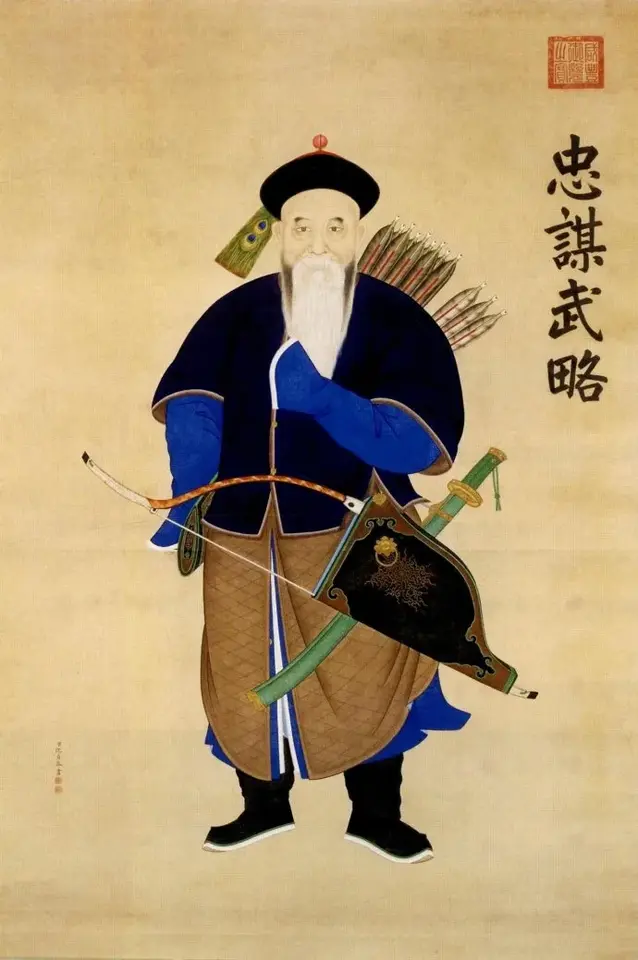
Life and Career
Early Upbringing and Entry into the Military
Yang Yuchun was born on January 30, 1761 (the twenty-fifth day of the twelfth lunar month in the twenty-fifth year of the Qianlong reign) in Bainian Village, Chongqing Subprefecture, Sichuan Province. His family was rooted in local farming and scholarship. At age six, he enrolled in the private school managed by his grandfather, Yang Zhankui. Endowed with serious judgment and sharp intellect, he mastered the essence of historical writings, drawing his grandfather's praise that "in childhood he possesses the gravity of an adult." By age seventeen, as family finances declined, Yang turned his attention toward martial arts, archery, and swordsmanship, determined to serve the state through military achievement.
In 1779, nineteen-year-old Yang Yuchun passed the provincial military examination with distinction, securing commissioning as a military candidate in Sichuan. The following year, the Sichuan Viceroyalty conducted an open selection to recruit elite guards for the viceregal brigade. Yang passed the physical and archery trials and was enlisted. His disciplined composure and operational agility quickly won the attention of provincial commanders. In 1784, when the religious rebellions led by Su Forty-three and Tian Wu flared in Gansu, Imperial Commissioner Fucha Fuk'anggan mobilized reinforcements from Sichuan. Yang served in the vanguard column, distinguishing himself in brutal assaults against entrenched stone redoubts at Didao and Shifengbao.
In 1787, the Lin Shuangwen rebellion erupted across Taiwan, threatening imperial authority throughout the island. Fuk'anggan commanded the expeditionary fleet crossing the Taiwan Strait, with Yang Yuchun serving as a strike commander. Clad in heavy armor, Yang spearheaded amphibious assaults at Lu'ermen and the relief of besieged Zhuluo, repeatedly repelling ferocious insurgent night attacks. In 1791, the Gurkha Kingdom invaded southwestern Tibet, plundering the Tashilhunpo Monastery at Shigatse. Emperor Qianlong ordered Fuk'anggan to conduct a trans-Himalayan punitive expedition.
Accompanying the imperial vanguard across thousands of li of blizzard-swept high passes, Yang Yuchun confronted extreme high-altitude conditions. During the assault at Tsamu, Yang strapped a rattan wicker shield to his back, leading infantry scaling precipitous mountain bluffs under torrential hail and stone barrages. Advancing to the Resuo Bridge and Jiarimu defiles, where Gurkha elite marksmen held narrow suspended footbridges over foaming rapids, Yang organized a dedicated shock unit that crossed the churning gorge and scaled sheer precipices, taking the Gurkha cliff redoubts by surprise. This enabled the main army to advance directly toward the Gurkha capital of Kathmandu, compelling the Gurkha monarch to submit and pay tribute. In 1795, when the grand Miao uprising broke out along the Hunan-Guizhou borders, Yang once again campaigned under Fuk'anggan, eliminating scores of mountain strongholds around Tongren and Songtao. Observing Yang's tactical instincts, Fuk'anggan remarked to his commanders: "Here is a supreme talent for generalship; in time he will independently command grand armies."
Bloodshed in Central China against the White Lotus
In 1796, the White Lotus rebellion swept through the borderlands of Hubei, Sichuan, and Shaanxi. Operating in dispersed bands throughout the Qinling and Daba mountain ranges, the insurgents repeatedly routed regular Green Standard and Eight Banners forces. Emperor Jiaqing appointed Grand Secretary Eledengbao as Imperial Commissioner to coordinate multi-provincial operations. Eledengbao appointed Yang Yuchun as his foremost forward commander. Yang maintained iron discipline; his men wore lightweight armor and sturdy boots, moving across alpine ridges with astonishing speed. Because he sported a thick, flowing beard, troops and civilians alike held him in reverent awe, calling him "Bearded Yang."
From 1797 to 1799, Yang Yuchun inflicted continuous defeats on insurgent columns across Nanzhang, Fangxian, Guangyuan, and Bazhou. At Nanzhang, rebel commander Zhang Hanchao assembled over ten thousand elite fighters to defend strategic mountain passes. Yang led a hundred cavalrymen along a concealed footpath around the enemy's rear, synchronizing with the frontal assault to sever rebel supply lines and shatter the encampment. While operating through the hills of Hubei, Yang encountered Yang Fang, an educated young scribe from Guizhou serving in the camp after failing civil exams. Recognizing Yang Fang's profound strategic intuition, Yang Yuchun immediately recommended him for commissioning as a platoon lieutenant and pledged lifelong brotherhood with him, inaugurating the legendary partnership of the "Two Yangs." At the Shisun River, when Yang Fang's nine riders pinned down thousands of retreating rebels, Yang Yuchun galloped through the river shallows with cavalry reinforcements to achieve total encirclement, winning renown across central China.
During engagements at Luojiang and Shehong, surrounded by dense waves of insurgents, Yang Yuchun organized circular infantry volleys behind defensive abatis while personally leading cavalry flanks to slice the rebel formations in half. In the rugged canyons of Yingshan, Tongjiang, and Dazhou, where rebel ambushers lined sheer cliffs, Yang dismounted whenever trails narrowed, scaling crags ahead of his men to map the terrain and leading assault squads to clear barricades. In the Battle of Bazhou, despite sustaining two bullet wounds, he continued waving his blade to lead the charge until the stronghold fell.
In 1800, Ran Tianyuan, the most formidable and audacious White Lotus chieftain, surrounded Guangyuan with tens of thousands of veteran fighters. Having crushed several imperial generals, Ran seemed unstoppable. Rushing to relieve Guangyuan, Yang Yuchun encountered Ran's elite formations at Matigang outside the town. Facing crushing numerical odds, Yang grasped a long spear and charged alone into the insurgent vanguard. Inspired by their general's fearless example, his cavalry plunged into the fray with unmatched ferocity. The battle raged until dusk in a torrential bloodbath; Yang Yuchun's robes were soaked in blood as he personally cut down several rebel commanders, finally shattering Ran's lines and coordinating with general Delengtai to capture Ran Tianyuan alive. This victory fundamentally altered the strategic balance in northern Sichuan. In Beijing, Emperor Jiaqing awarded Yang the supreme warrior title "Chaoyong Baturu" and elevated him to Regional Commander of Zhenyuan.
Over the following years, Yang hunted the remnants of Leng Tianlu and Gou Wenming through Shaanxi's mountain fastnesses. At Rentouyan, Yang ascertained Leng's dispositions, led cavalry across a frozen river under cover of night, and launched a dawn drum-roll assault that killed Leng Tianlu on the spot. Relentlessly pursuing Gou Wenming through Pingli, Xunyang, Ziyang, and Zhuxi, Yang operated for years without unbuckling his armor, completely wiping out the White Lotus leadership by 1805.
Governing Guyuan and Pacifying the Ningshan Mutiny
In 1806, forty-six-year-old Yang Yuchun was promoted to Provincial Commander-in-Chief of Guyuan in Gansu, assuming command over the premier Green Standard garrison of the northwest. Guyuan held vital strategic importance, but its ranks were plagued by indiscipline and corruption. Upon arrival, Yang abolished customary deductions from soldiers' pay, strictly forbade embezzlement, and personally supervised daily weapons drills, revitalizing the morale and combat readiness of the garrison.
That autumn, garrison troops in Ningshan, Shaanxi, mutinied after a subordinate commander withheld pay silver and issued spoiled corn for rations. Mutineers murdered the acting commander, swelled to over ten thousand men, plundered Yangxian and Liuba, and besieged Huxian, threatening the provincial capital of Xi'an. Emperor Jiaqing ordered Yang Yuchun and vice-commander Yang Fang to quell the rebellion immediately. Leading imperial formations to Fangchaiguan, Yang Yuchun engaged the mutineers in fierce clashes, resulting in a tense stalemate. Understanding that the rebels were provincial militia pushed to desperation by corrupt officers rather than hardened traitors, Yang Yuchun and Yang Fang coordinated an operation of tactical encirclement and psychological appeal. While Yang Yuchun's formations sealed off all escape defiles, Yang Fang rode unarmed into the rebel stronghold to appeal to their shared military brotherhood. Converted by this show of sincerity, the mutineers surrendered their ringleaders, and Yang Yuchun entered the camp to grant clemency and restore order, peacefully resolving a grave crisis.
Sapping Strategy and the Recovery of Huaxian
In autumn 1813, the northern Tianli Sect unleashed a sudden insurrection that shook the capital, with disciples penetrating the Forbidden City while sectarian leader Li Wencheng captured Huaxian in Henan, threatening communications along the Grand Canal. Emperor Jiaqing appointed Grand Councillor Nayancheng as Imperial Commissioner and summoned seasoned veterans Yang Yuchun and Yang Fang to the frontlines.
Arriving at Huaxian, Yang found the town protected by formidable moats, massive earthen walls, and wooden abatis, with sectarian defenders mounting desperate resistance against repeated frontal storming attempts. Inspecting the perimeter under enemy fire, Yang observed that the southern soil was soft and traversed by abandoned drainage conduits. He advised Nayancheng to abandon costly frontal assaults in favor of subterranean sapping.
While batteries maintained continuous round-the-clock bombardment against the battlements to fix the defenders' attention, Yang supervised hundreds of skilled miners and sappers in excavating a covert tunnel from the southwestern corner directly beneath the stone foundation of the city wall. Over nine continuous days and nights, the shaft was completed and packed with thousands of pounds of heavy gunpowder. On December 10, 1813, Yang ignited the fuses. A catastrophic explosion collapsed dozens of yards of ramparts in clouds of dense smoke. Drawing his blade, Yang shouted war cries and led storming parties through the dust and rubble into the breach. In intense street-by-street fighting, imperial forces eliminated over twenty thousand sectarian defenders, and Li Wencheng perished in self-immolation. For this triumph, Emperor Jiaqing bestowed upon Yang the title Junior Guardian to the Crown Prince and double-eyed peacock feathers.
Expedition to Xinjiang and the Battle of the Hun River
In 1826, Jahangir Khoja, an Afaqi Khoja descendant backed by the Kokand Khanate, launched a massive armed invasion of Xinjiang. Surprising the border garrisons, the insurgents captured Kashgar, Yangihissar, Yarkand, and Khotan, subjecting the oasis populations to severe devastation. Though sixty-six years old, Yang Yuchun immediately submitted a memorial volunteering for western service: "Though old and worn, I am ready to lead a brigade to sweep away these western traitors!" Deeply moved, Emperor Daoguang appointed Viceroy of Shaan-Gan Changling as Imperial Commissioner and named Yang Yuchun and Yang Fang as Assistant Councillors, dispatching thirty-six thousand troops across the Gobi Desert.
In early 1827, the imperial expedition crossed the Tianshan ranges, concentrating at Aksu. Jahangir's horsemen sought to check the advance at Awati and Keerping, but Yang's combined arms vanguard cleared the passes. In February, imperial columns approached the northern banks of the Hun River (modern Kyzylsu River) outside Kashgar. Tens of thousands of rebel horsemen lined the southern banks for dozens of li, their cavalry banners blotting out the sky, determined to use the river barrier to wear down imperial supplies.
Facing this imposing host, Yang Yuchun remained completely calm. He organized forward ranks of picked musket battalions, deploying three-tier rolling volley fire that unleashed continuous walls of lead, devastating the rebel frontlines. As the enemy cavalry wavered, Yang commanded his elite cavalry squadrons to ford the shallow waters and strike the rebel rear. Caught in a crushing vise, the insurgent army disintegrated; over ten thousand rebels were killed along the riverbanks, and countless others drowned. The triumph at the Hun River broke the back of the insurrection, enabling the rapid liberation of Kashgar.
Advancing into Yarkand, Yangihissar, and Khotan, Yang sealed government granaries, strictly forbade troop looting, immediately released innocent civilians coerced into the rebellion, and distributed emergency grain relief. Impressed by his benevolent governance, local oasis communities greeted the imperial forces with food and wine. Following a strategic withdrawal planned with Yang Fang, Yang Fang ambushed and captured Jahangir alive at the Ka'ertiegai Mountains. For his supreme battlefield contributions, Emperor Daoguang ennobled Yang Yuchun as the First Class Marquis of Zhaoyong, granted him purple reins, and hung his portrait at the very summit of the Hall of Purple Splendor.
Viceroyalty of Shaan-Gan and Civic Legacy
Having been formally appointed Viceroy of Shaan-Gan in 1825, Yang Yuchun returned to Lanzhou following the conclusion of the western campaigns, governing Shaanxi and Gansu for a full decade. The region had been devastated by decades of warfare, suffering from deserted farmland, rampant banditry, and severe ethnic friction.
Yang governed through principles of benevolence, agricultural expansion, and disciplined administration. He prohibited local magistrates from levying unauthorized surcharges, abolishing tens of thousands of taels in traditional gift fees and directing funds to orphanages and relief shelters. Addressing the arid northwestern climate, he supervised extensive water conservancy projects along the Yellow River, Hexi Corridor, and Hanzhong basins, repairing dozens of irrigation canals and reclaiming thousands of acres of wasteland. Recognizing the resilience of potatoes in cold, drought-prone soils, Yang imported seed potatoes from Sichuan and Shaanxi, distributing them to local farmers alongside cultivation guides. When severe droughts struck, the potato crop flourished, saving countless lives from famine. Grateful local populations affectionately christened the crop "Yang Yu" (Yang's Taro), celebrating his virtues in popular folk ballads.
In ethnic and religious affairs, Yang maintained a policy of impartial justice: "Treat all communities as one, punish ringleaders severely, and never implicate the innocent." Disputes among Han, Hui, Mongol, and Tibetan inhabitants were judged strictly according to law without prejudice, winning deep affection across all communities. Militarily, he eliminated phantom payrolls in Green Standard garrisons, prohibited commanders from using soldiers for private labor, and conducted regular inspections, ensuring border tranquillity. Emperor Daoguang repeatedly commended his service, noting that "with Yang in Shaan-Gan, the throne has no western anxieties."
Retirement and Posthumous Glory
In 1835, at age seventy-five, suffering from eye ailments, leg infirmities, and old battle scars, Yang Yuchun repeatedly petitioned to resign and return to Sichuan. Reluctantly granting his request, Emperor Daoguang conferred the unprecedented privilege of full viceregal salary in retirement and composed an imperial poem in his honor, celebrating his "fame echoing across northern frontiers through a hundred battles." On the day of his departure from Lanzhou, tens of thousands of citizens lined the highways in tears, burning incense along hundreds of li to bid farewell to their revered governor.
Retiring to Chengdu, Yang lived with extreme modesty and frugality, strictly forbidding his descendants from flaunting family status and distributing most of his pension to impoverished relatives and neighbors. On April 3, 1837, Yang Yuchun passed away peacefully at his Chengdu residence at age seventy-six. In Beijing, Emperor Daoguang was overcome with grief, suspending court for a day, posthumously conferring the title Grand Preceptor to the Crown Prince, enshining him in the Temple of the Wise and Virtuous, allocating three thousand taels of state treasury funds for funeral rites, and granting the posthumous title Zhongwu. His first-class marquisate was inherited by his eldest son, Yang Guozuo.
Major Achievements
Strategic Triumph at the Battle of the Hun River
Among the hundreds of engagements directed by Yang Yuchun, the Battle of the Hun River in 1827 was the most strategically decisive. Backed by Kokandi cavalry, Jahangir Khoja had fortified the southern banks of the river with tens of thousands of troops, hoping to bog down imperial forces in desert sands until logistics collapsed.
Sixty-six-year-old Yang Yuchun identified the vulnerability of the insurgent lines: reckless cavalry charges vulnerable to disciplined gunpowder fire and exposed flanks. He orchestrated a devastating synchronized assault, employing three-tier musket rolling fire to shatter frontal charges while sending shock cavalry fording the shallows to sever the rebel line of retreat. Over ten thousand insurgents were eliminated, collapsing Jahangir's entire defensive system. The triumph directly prompted the liberation of the four southern oases and extinguished foreign expansionist designs across the western borderlands, standing as the defining strategic victory of the Daoguang era.
Unmatched Tactical Mastery in Frontier Warfare
Among the illustrious commanders of the mid-Qing period, Yang Yuchun enjoyed an unrivaled reputation for combining tactical wisdom with unshakeable courage. Over four decades, he participated in virtually every major campaign of the Qianlong, Jiaqing, and Daoguang reigns: Gurkha invasions, Miao rebellions, White Lotus insurgencies, the Tianli Sect outbreak, and the Jahangir western expedition. In hundreds of battles, he sustained dozens of arrow and bullet wounds yet never suffered a single battlefield defeat, acclaimed as the empire's supreme "Ever-Victorious General."
Yang was an operational innovator. Against mobile White Lotus insurgents in mountain terrain, he pioneered long-range rapid cavalry sweeps; against formidable ramparts at Huaxian, he executed deep-underground sapping and detonation; during the Ningshan mutiny, he deployed psychological persuasion to resolve crisis without bloodshed. Imperial Commissioner Eledengbao lauded him: "Among all generals, only Yuchun combines strategic wisdom with physical bravery to independently command a front." Paired with Yang Fang as the celebrated "Two Yangs," he secured the unity and frontier stability of nineteenth-century China.
Northwestern Governance and Agricultural Transformation
Yang Yuchun achieved equal distinction as a visionary provincial administrator. Governing Shaan-Gan for ten years, he transformed a war-torn frontier into a prosperous, pacified region.
He reformed provincial finances, eliminated predatory exactions, constructed dozens of irrigation canals along the Yellow River and Hexi Corridor, and opened thousands of acres of wasteland for settlement. His introduction and popularization of the hardy potato ("Yang Yu") revolutionized northwestern agriculture, providing an indispensable food source that preserved millions during severe droughts. Practicing absolute impartiality in ethnic and religious disputes, he earned the unreserved love of all communities, who erected living shrines in his honor. Yang Yuchun exemplifies the rare military commander who successfully evolved into a revered civilian statesman.
Military Discipline and Welfare of Soldiers
Throughout his military career, Yang Yuchun maintained absolute discipline balanced by profound paternal care for his troops. He strictly prohibited soldiers from trampling farmland, commandeering civilian homes, or disrupting local markets; towns and villages traversed by his forces remained entirely peaceful and orderly. Officers convicted of extortion or withholding grain rations were executed without mercy.
Simultaneously, Yang shared every hardship with his common soldiers, eating coarse grain and sleeping on straw pallets. During freezing winter campaigns across the Qinling Mountains, he frequently gave his own fur coats to frostbitten troops, visited sick soldiers with medicine, and personally funded burials and pensions for fallen comrades. His troops reciprocated with boundless devotion, willing to fight to the death under his banner. This deep mutual trust forged his forces into the most resilient and formidable Green Standard army of the nineteenth century.
Agricultural Foresight with the Promotion of Yang Yu
During his viceroyalty, Yang Yuchun placed agricultural security at the core of frontier defense. Recognizing the short growing season and poor soil quality of the northwestern loess plateau, he systematically imported potato cultivars from Sichuan and Shaanxi, disseminating seed tubers alongside simple illustrated farming manuals across every county in Gansu.
During subsequent multi-year droughts that obliterated traditional millet and wheat crops, the potato harvests remained abundant, averting widespread famine across the province. Local populations immortalized his deed by naming the potato "Yang Yu" and composing verses honoring his memory. Yang's agricultural foresight established an enduring food staple that permanently altered northwestern demographic resilience.
Mentorship of Military Leadership
Beyond his personal operational triumphs, Yang Yuchun fostered a generation of outstanding military talent for the Qing Empire. Foremost among them was his mentorship of Yang Fang. Recognizing the brilliant potential of an impoverished scribe, Yang Yuchun secured his officer commission and spent years schooling him in mountain warfare and tactical maneuver, nurturing him into an imperial marquis and frontline commander.
Throughout his tenures at Guyuan and Lanzhou, Yang actively promoted capable, honest officers regardless of background or ethnic lineage, bypassing rigid seniority systems. Numerous regional commanders and battalion officers across Gansu and Shaanxi emerged from his viceregal headquarters. His standards of integrity, tactical rigor, and benevolence shaped two generations of officers, providing the foundational command cadre that preserved northwestern security into the late nineteenth century.