Relocation to Xuantu
Fled with his father Gongsun Yan to Xuantu Commandery as a low-ranking clerk, patronized by Grand Administrator Gongsun Yu.
公孙度
Gongsun Du (公孙度, ? – 204), courtesy name Shengji (升济), originally named Bao (豹), was a native of Xiangping, Liaodong Commandery, You Prefecture (modern Liaoyang, Liaoning Province). He was an ambitious warlord, military commander, and the foundational architect of the autonomous Gongsun regime in Liaodong during the late Eastern Han Dynasty and early Three Kingdoms era. Rising from impoverished beginnings, Gongsun Du…
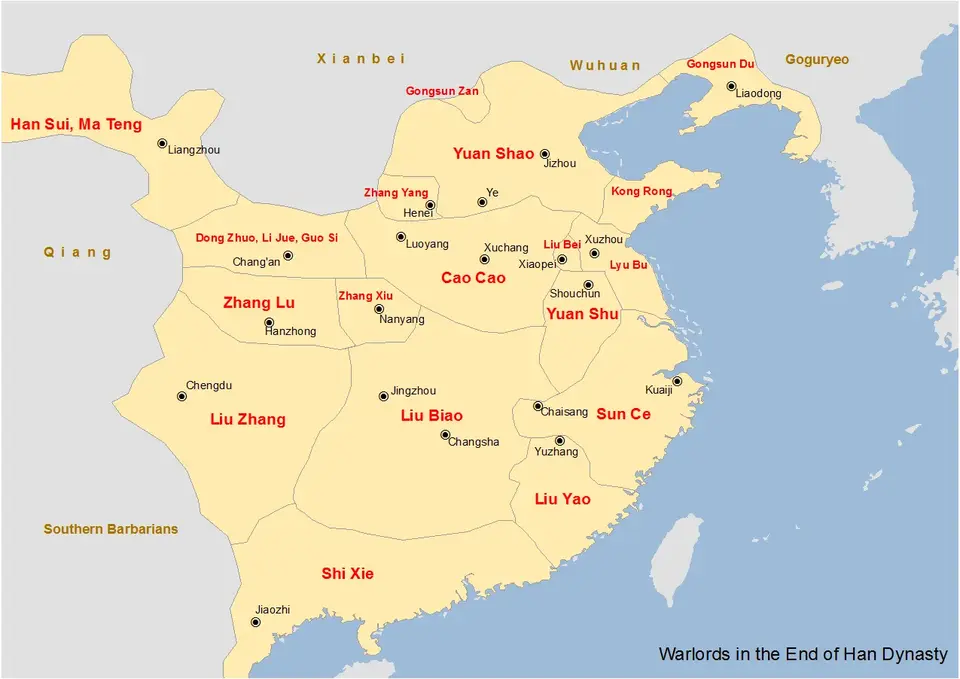
Gongsun Du (公孙度, ? – 204), courtesy name Shengji (升济), originally named Bao (豹), was a native of Xiangping, Liaodong Commandery, You Prefecture (modern Liaoyang, Liaoning Province). He was an ambitious warlord, military commander, and the foundational architect of the autonomous Gongsun regime in Liaodong during the late Eastern Han Dynasty and early Three Kingdoms era. Rising from impoverished beginnings, Gongsun Du accompanied his father Gongsun Yan into exile in Xuantu Commandery, serving as a minor petty clerk. Because his childhood name and age matched those of Xuantu Grand Administrator Gongsun Yu's deceased son, the administrator adopted him as his own, financing his education and arranging his marriage, thereby opening his path into imperial officialdom. In 169 (second year of Jianning), Gongsun Du was recommended as a scholar of virtuous conduct and appointed Gentleman of the Masters of Writing, later advancing to Inspector of Jizhou before being dismissed due to malicious rumors. In 189, during the collapse of the central Han government, his fellow townsman General Xu Rong recommended him to Chancellor Dong Zhuo, securing his appointment as Grand Administrator of Liaodong. Upon arrival, Gongsun Du consolidated power with ruthless resolve, executing over a hundred powerful regional clans that had disdained his humble origins. Externally, he mounted aggressive military campaigns, subduing the Kingdom of Goguryeo, repelling Wuhuan nomads, and arranging a diplomatic marriage alliance with King Weichutai of Buyeo, establishing absolute hegemony across the Northeast and commanding respect throughout the Eastern Barbarian realms. In 190, recognizing the fatal decline of the Han dynasty amidst civil war, Gongsun Du divided Liaodong into Liaoxi and Zhongliao commanderies and launched naval amphibious expeditions across the Bohai Strait to seize Donglai in the Shandong Peninsula, establishing Yingzhou. He proclaimed himself Governor of Pingzhou and Marquis of Liaodong, conducting imperial sacrifices to Heaven and Earth and riding in royal carriages. When Cao Cao attempted to enlist him by conferring the titles of General of Martial Might and Marquis of Yongning, Gongsun Du disdainfully locked the imperial seals in his armory. Concurrently, he maintained regional peace, sheltering eminent displaced scholars such as Guan Ning, Bing Yuan, Wang Lie, and Taishi Ci. He died in 204, leaving an autonomous regional dynasty that held the Northeast for fifty years across three generations.
Fled with his father Gongsun Yan to Xuantu Commandery as a low-ranking clerk, patronized by Grand Administrator Gongsun Yu.
Recommended as a virtuous scholar and evaluated at court, receiving appointment as Gentleman of the Masters of Writing.
Elevated to Inspector of Jizhou, but dismissed from office following slanderous rumors instigated by powerful regional families.
Appointed Grand Administrator of Liaodong upon General Xu Rong's recommendation to Dong Zhuo, executing over a hundred rival clan heads.
Declared his intent to pursue kingship to confidants Liu Yi and Yang Yi, creating new commanderies and seizing Donglai across the sea.
Defeated the Kingdom of Goguryeo in battle, repelled Wuhuan incursions, and married a female relative to the King of Buyeo.
Established scholarly hostels in Liaodong, welcoming displaced northern literati including Guan Ning, Bing Yuan, and Wang Lie.
Rebuffed Cao Cao's imperial appointment as General of Martial Might and Marquis of Yongning, storing the investiture seals in his armory.
Passed away in Xiangping after fifteen years of regional rule; succeeded by his eldest son Gongsun Kang, solidifying three generations of rule.
Gongsun Du was born during the mid-second century in Xiangping, Liaodong Commandery, into an impoverished household. In his youth, he went by the personal name Gongsun Bao. His father, Gongsun Yan, fled from local law enforcement, taking the family into exile in the neighboring frontier outpost of Xuantu Commandery. Reaching adulthood, Gongsun Du could find employment only as a low-ranking petty clerk in the commandery yamen, enduring the condescension of local gentry elites.
During this period, the Grand Administrator of Xuantu, Gongsun Yu, suffered the tragic loss of his eighteen-year-old son, who had also been named Gongsun Bao. Encountering Gongsun Du by chance, the administrator was struck by the shared name and identical age of the young clerk. Moved by paternal affection, Gongsun Yu took Gongsun Du into his household, funded his classical schooling under prominent teachers, and financed his marriage. This patronage transformed Gongsun Du from an obscure clerk into an educated candidate qualified for imperial civil service.
In 169 (second year of the Jianning era), Emperor Ling issued an imperial edict instructing regional commanderies to nominate men of upright virtue and scholarship. Endorsed by the administration of Xuantu, Gongsun Du traveled to the imperial capital of Luoyang alongside Xie Bi and Chen Dun. His responsive memorials displayed practical political acumen, securing his appointment as Gentleman-of-the-Palace and subsequently as Gentleman of the Masters of Writing (Shangshu Lang).
Following years of secretarial service in the capital, Gongsun Du was dispatched to provincial governance as Inspector of Jizhou. Jizhou was the heartland of powerful aristocratic clans with deep ministerial connections. Gongsun Du's stringent administrative methods and humble frontier background alienated local grandees, who disseminated malicious rumors regarding his conduct. Without conducting an investigation, the imperial court dismissed him from office, forcing Gongsun Du to return to his ancestral home in Liaodong to live in private retirement.
In 189, Emperor Ling died, and General Dong Zhuo seized control of the imperial capital, plunging the empire into civil war. Major General Xu Rong, a fellow native of Liaodong serving under Dong Zhuo, was well acquainted with Gongsun Du's formidable organizational talents and recommended him as Grand Administrator of Liaodong. Gongsun Du returned to his home commandery to assume supreme military and civil authority.
The dominant gentry families of Liaodong harbored longstanding contempt for Gongsun Du due to his origins as a menial clerk. Prior to his arrival, Gongsun Zhao, magistrate of the dependent territory residing in Xiangping, had deliberately humiliated Gongsun Du's son, Gongsun Kang, by conscripting him into a low-ranking infantry squad as a corporal. Upon arriving in Xiangping, Gongsun Du acted with lethal decisiveness. He arrested Gongsun Zhao and had him publicly flogged to death in the central market of Xiangping. He then targeted influential gentry clans such as the Tian family, who had historically treated him with disrespect, prosecuting and executing over a hundred leading lineages. This bloody purge extinguished local aristocratic resistance and established undisputed autocracy.
Having consolidated his internal base, Gongsun Du directed his military apparatus outward. The frontier environment of the Northeast was volatile, with the Kingdom of Goguryeo frequently raiding border garrisons and Wuhuan nomadic horsemen raiding southward. Drawing upon his intimate knowledge of frontier topography, Gongsun Du launched a major offensive against Goguryeo. The Liaodong cavalry crushed Goguryeo forces, compelling King Baekgo to submit, pay tribute, and dispatch general Daega Woogeo to assist Gongsun Du in suppressing local pirates.
Subsequently, Gongsun Du turned his armies westward, shattering Wuhuan nomad raiding parties. Situated between Goguryeo and the Xianbei, the Kingdom of Buyeo sought a stabilizing protector. King Weichutai of Buyeo sent envoys offering formal vassalage to Liaodong. Recognizing the strategic value of Buyeo as a buffer state, Gongsun Du married a female relative from his clan to the Buyeo monarch. Through military subjugation and matrimonial diplomacy, Gongsun Du pacified the Liaodong Peninsula, the Yalu River basin, and northern Korea, earning historical acclaim for commanding unchallenged authority across the eastern frontiers.
In 1390, eighteen regional warlords took up arms against Dong Zhuo, plunging the central plains into destructive warfare. Observing the irreversible collapse of the Han Dynasty, Gongsun Du summoned his chief lieutenants, Liu Yi and Yang Yi, declaring: "The mandate of the Han is extinguished; it is time for us to pursue regional kingship!" Around this time, a massive stone measuring over ten feet arose on three small stone feet near the ancestral shrine in Xiangping. Prominent soothsayers claimed the stone mirrored the imperial omen of Emperor Xuan of Han and that the village name matched his father's name, confirming his imperial destiny.
Gongsun Du enacted sweeping statecraft reforms. He subdivided Liaodong into the two commanderies of Liaoxi and Zhongliao, appointing trusted administrators. Demonstrating exceptional maritime vision, he dispatched an amphibious naval force across the Bohai Strait, capturing Donglai on the Shandong Peninsula and creating the trans-maritime province of Yingzhou under his own appointed inspector. Proclaiming himself Governor of Pingzhou and Marquis of Liaodong, he erected imperial altars south of Xiangping to offer state sacrifices to Heaven and Earth, performed the imperial spring plowing ritual, rode in imperial carriages with nine-tassel parasols, and instituted imperial bodyguard cavalry. When Cao Cao sought to appease him in 196 by appointing him General of Martial Might and Marquis of Yongning, Gongsun Du sneered that he was already king in Liaodong, banishing the bronze seals to his weapon vaults.
Despite his ruthless suppression of political rivals, Gongsun Du's territory remained an island of tranquility while the central plains were devastated by war. Under his governance, the strong did not oppress the weak, markets observed honest pricing, and banditry was extinguished. Tens of thousands of gentry families and commoners from Qingzhou, Xuzhou, and Jizhou crossed the sea to seek refuge in Liaodong.
Eminent northern intellectuals such as Guan Ning, Bing Yuan, Wang Lie, and military commander Taishi Ci were granted safety in Liaodong. Gongsun Du constructed guest residences and treated these scholars with ceremonial respect. Although scholars like Guan Ning refrained from discussing politics, Gongsun Du sheltered them for decades, allowing Han classical culture, Confucian ethics, and agricultural technology to take root in the Northeast. Gongsun Du passed away in Xiangping in 204. His eldest son Gongsun Kang succeeded him, establishing a resilient regional regime that spanned three generations across five decades until Sima Yi's northern expedition in 238.
Upon arriving as Grand Administrator of Liaodong in 189, Gongsun Du shattered the entrenched power of the commandery's hereditary gentry clans. Executing the magistrate Gongsun Zhao who had humiliated his family, he carried out thorough purges against more than one hundred prominent aristocratic households, including the powerful Tian clan. This iron-fisted pacification dismantled the regional oligarchic barriers that had constrained earlier administrators, forging a highly centralized wartime administration capable of mobilizing all provincial resources.
Gongsun Du completely reversed the defensive posture of the late Han frontier administration. Mobilizing his disciplined cavalry, he struck eastward into Goguryeo, shattering its elite divisions and forcing King Baekgo to become a subordinate tributary who supplied troops for Liaodong campaigns. Simultaneously, he crushed Wuhuan nomadic invaders in the west and forged a matrimonial alliance with King Weichutai of Buyeo. His campaigns established an undisputed sphere of influence encompassing southern Manchuria and northern Korea, securing the borders against barbarian incursions.
Displaying unprecedented maritime strategic foresight, Gongsun Du was the first warlord of the Han-Three Kingdoms era to establish a trans-maritime provincial administration. He organized a powerful expeditionary fleet that crossed the Bohai Strait, conquering the coastal counties of Donglai Commandery on the Shandong Peninsula. Consolidating this conquest into the newly established Yingzhou Province under his own inspector, he dominated maritime traffic across the Bohai Gulf, seized critical salt and iron revenues, and prevented rival warlords from flanking his territories by sea.
From 190 onward, Gongsun Du established a de facto independent imperial regime in the Northeast. Subdividing his territory into multiple commanderies, he instituted imperial sacrificial rites to Heaven and Earth south of Xiangping, plowed the imperial fields, and rode in royal chariots with nine-tasseled banners and imperial bodyguards. Rebuffing Cao Cao's offers of aristocratic titles, he laid the territorial, military, and institutional foundations that enabled his lineage—spanning Gongsun Du, Gongsun Kang, Gongsun Gong, and Gongsun Yuan—to rule the Northeast autonomously for fifty years.
During the cataclysmic civil wars that decimated northern China, Gongsun Du's territory remained exceptionally peaceful and prosperous. He welcomed waves of civilian refugees and constructed scholarly academies to host celebrated intellectuals, including Guan Ning, Bing Yuan, Wang Lie, and Taishi Ci. Under his protection, classical scholarship and agrarian techniques were preserved and transplanted into the northeastern borderlands, significantly accelerating the cultural and economic integration of the Liaodong region into Chinese civilization.
FIGURES ASSOCIATED WITH THIS DYNASTY