Birth in Sichuan
Born on the first day of the sixth lunar month in Shuzhou, belonging to a cadet lineage of the prestigious Hongnong Yang clan.
杨玉环
Yang Yuhuan (杨玉环, 719 – July 15, 756), religious name Taizhen (太真), was a native of Yongle, Puzhou (present-day Yongji, Shanxi Province), with ancestral roots in Huayin, Hongnong. She was the beloved imperial consort of Emperor Xuanzong of Tang (Li Longji) and is celebrated in Chinese cultural history as one of the Four Beauties of ancient China, epitomizing the phrase "putting flowers to shame" (xiuhua). Raised in…
Yang Yuhuan (杨玉环, 719 – July 15, 756), religious name Taizhen (太真), was a native of Yongle, Puzhou (present-day Yongji, Shanxi Province), with ancestral roots in Huayin, Hongnong. She was the beloved imperial consort of Emperor Xuanzong of Tang (Li Longji) and is celebrated in Chinese cultural history as one of the Four Beauties of ancient China, epitomizing the phrase "putting flowers to shame" (xiuhua). Raised in the household of her uncle Yang Xuanjiao in the eastern capital of Luoyang following her father's early passing, she was renowned for her radiant elegance, intelligence, exceptional vocal talent, mastery of the stone chime, and virtuosity in court dance. In 734, she was initially selected and wed as Princess Consort to Li Mao, Prince of Shou, the eighteenth son of Emperor Xuanzong. Following the death of Consort Wu, Xuanzong was consumed by despondency; upon being introduced to Yang Yuhuan at the Huaqing Hot Springs in 740, the emperor was deeply captivated by her artistic brilliance and beauty. To navigate the Confucian ethical barrier against taking his son's consort into the imperial bedchamber, Xuanzong arranged for Yang Yuhuan to become a Daoist nun, bestowing upon her the Daoist name Taizhen and establishing the Taizhen Palace within the imperial grounds. In 745, Xuanzong formally invested her with the title of Noble Consort (Guifei). Because no empress was appointed, Noble Consort Yang effectively governed the imperial harem, enjoying the emperor's undivided favor for over a decade. Her familial clan rose to supreme aristocratic and political power: her second cousin Yang Guozhong ascended to Right Chancellor, dominating court administration, while her three sisters received noble titles as Ladies of Han, Guo, and Qin. In the palace, Yang Yuhuan refined the performance of the celebrated Rainbow Skirt and Feather Garment Song and mastered the energetic Sogdian whirling dance, leaving an indelible imprint on high Tang musical and choreographic heritage. In 755, regional military governor An Lushan launched a cataclysmic rebellion under the pretext of executing Yang Guozhong, precipitating the devastating An Lushan Rebellion. In July 756, after the fall of the mountain stronghold Tongguan, Emperor Xuanzong fled Chang'an toward Sichuan with Noble Consort Yang and imperial retainers. Upon reaching the Mawei Courier Station, disaffected imperial guards mutinied, slaughtering Yang Guozhong and demanding the death of Noble Consort Yang to appease the empire. Under intense political pressure from military commanders and eunuch confidant Gao Lishi, Xuanzong consented to her execution, and Yang Yuhuan was hanged in a Buddhist shrine beside the courier station at the age of thirty-eight. Her tragic demise became an enduring symbol of the Tang empire's descent from supreme glory into prolonged crisis, inspiring immortal literary masterworks such as Bai Juyi's Song of Everlasting Sorrow and Hong Sheng's classical opera The Palace of Eternal Youth.
Born on the first day of the sixth lunar month in Shuzhou, belonging to a cadet lineage of the prestigious Hongnong Yang clan.
Following her father's death in local office, the orphaned girl was escorted to Luoyang to be raised by her uncle Yang Xuanjiao.
Attended the nuptials of Imperial Princess Xian'i; Prince of Shou Li Mao fell in love with her, and she was wed as his consort.
Xuanzong's favorite consort passed away; the emperor fell into prolonged melancholia, leading courtiers to recommend Yang's extraordinary talent.
Summoned by Xuanzong to the Hot Springs Palace; ordained as a Daoist nun with the religious name Taizhen and relocated to the forbidden precinct.
Xuanzong arranged a new consort for the Prince of Shou and formally elevated Yang Yuhuan to Noble Consort, granting her supreme status over the palace.
Incurred imperial anger through outspoken speech; dispatched back to her family residence, but recalled that very night by an anxious emperor.
Dismissed again over palace rivalries; sent a severed tress of hair to the emperor as a pledge of devotion, prompting an immediate imperial reconciliation.
An Lushan mobilized fifteen myriad cavalry in Fanyang under the slogan of purging Yang Guozhong, igniting the massive An Lushan Rebellion.
Fleeing toward Shu after Tongguan fell; mutinous imperial guards slain Yang Guozhong and forced Xuanzong to have Yang Yuhuan hanged at Mawei on July 15.
Yang Yuhuan was born on the first day of the sixth lunar month in 719, during the golden apex of Emperor Xuanzong's Kaiyuan era. Her lineage derived from a prominent cadet branch of the Hongnong Yang clan, one of the elite noble houses of medieval China, which traced its illustrious ancestry to Han Dynasty Grand Commandant Yang Zhen. Throughout the Northern dynasties, Sui, and early Tang, the family maintained continuous prominence within the Guanlong aristocratic establishment. Her high-great-grandfather, Yang Wang, had served as Grand Pillar of State, Minister of Personnel, and Chamberlain for the Palace of Justice during the Sui Dynasty, later serving the short-lived regime of Wang Shichong before being executed during the Tang unification.
Under Tang governance, the family transitioned into the regional civil bureaucracy. Yang Yuhuan's great-grandfather, Yang Lingben, served as Prefect of Jinzhou, while her grandfather, Yang Youliang, held the office of Prefect of Fangzhou. Her father, Yang Xuanyan, was appointed Administrative Assistant of Shuzhou in the Jiannan Circuit. Born in the official residences of Shuzhou, Yang Yuhuan spent her formative childhood surrounded by the scenic landscapes and cultured prosperity of the Sichuan basin.
Her mother originated from a prestigious bureaucratic lineage, providing young Yang Yuhuan with rigorous schooling in classical etiquette, moral conduct, and calligraphic literacy. From early youth, she exhibited an innate ear for musical pitch and rhythmic movement, absorbing traditional melodies with remarkable speed. However, this peaceful life ended abruptly around 729, when her father died in office and her mother passed away shortly thereafter, leaving the ten-year-old girl orphaned in regional Sichuan.
Following the loss of her parents, young Yang Yuhuan was escorted by relatives to the eastern imperial metropolis of Luoyang to reside under the guardianship of her paternal uncle, Yang Xuanjiao. Serving as an administrator in the Henan Prefectural Government, Yang Xuanjiao possessed ample material wealth and received his orphaned niece with profound affection, providing her with exceptional educational resources in the vibrant imperial capital.
In Luoyang, Yang Yuhuan broadened her cultural and artistic studies. She mastered the performance of the Chinese lute, studied grand court compositions and traditional folk melodies, and demonstrated unprecedented dexterity in striking the stone chime. Over the subsequent decade, she matured into an extraordinarily graceful young woman, characterized by luminous complexion, poised dignity, and sparkling conversational wit, gaining immense renown among aristocratic families in the capital.
In July 734, Emperor Xuanzong and his favorite consort, Consort Wu, hosted a magnificent wedding celebration in Luoyang for their daughter, Imperial Princess Xian'i, who was marrying Yang Hui. Yang Yuhuan attended the banquet alongside her uncle's household. During the festivities, Li Mao, the Prince of Shou—Xuanzong's eighteenth son born to Consort Wu—was captivated by her presence. Consort Wu endorsed her son's affection, petitioning the emperor for an imperial decree. On December 24, 734, Xuanzong issued an imperial edict formally installing Yang Yuhuan as Princess Consort of Shou. The couple took up residence in their princely mansion in the Jishan Quarter of Luoyang, enjoying harmonious marital affection.
The tranquil life of the princely household was shattered in December 737, when Consort Wu passed away. Consort Wu had been the uncontested favorite of Xuanzong's harem, receiving courtesies equivalent to an empress. Her untimely demise plunged the fifty-two-year-old emperor into deep melancholia. Although surrounded by thousands of concubines, Xuanzong found none capable of offering genuine intellectual and aesthetic companionship.
In October 740, Xuanzong made an official progress to the Hot Springs Palace at Mount Li. Chief eunuch Gao Lishi, acutely observant of the emperor's persistent sorrow and aware of the young Princess Consort of Shou's incomparable charm and musical erudition, discreetly proposed her name to the sovereign. Xuanzong subsequently summoned Yang Yuhuan to a private imperial audience at Mount Li.
Upon meeting the twenty-two-year-old Yang Yuhuan, Xuanzong was entranced by her radiant poise, gentle temperament, and musical brilliance. As a passionate musician himself who played the jie drum and composed melodies, Xuanzong found in her an unmatched artistic soulmate. However, imperial etiquette and Confucian moral codes strictly prohibited a sovereign from claiming his own daughter-in-law. To circumvent these strictures without provoking severe court condemnation, Xuanzong devised an indirect strategy using Daoist monasticism.
In October 740, under the public pretext of generating spiritual blessings for the anniversary of his late mother, Empress Dowager Dou, Xuanzong issued an imperial edict commanding Princess Consort Yang to receive Daoist ordination. Bestowing upon her the religious title Taizhen, the emperor dissolved her legal marital bond with the Prince of Shou. Soon afterward, Xuanzong constructed the secluded Taizhen Palace within the imperial palace grounds in Chang'an, installing Yang Taizhen as a resident nun, where the emperor could enjoy her company in secret.
After Yang Taizhen had resided in the monastic sanctuary for nearly five years, Xuanzong moved to formalize her position. In July 745, the emperor arranged for a daughter of Palace Commander Wei Zhaoxun to be installed as the new consort for the Prince of Shou, thereby providing social compensation to his son. One month later, on August 17, 745, Xuanzong issued an imperial declaration officially elevating Yang Yuhuan to the rank of Noble Consort. Since Xuanzong had resolved never to appoint another empress after deposing Empress Wang in 724, Noble Consort Yang stood as the supreme matriarch of the imperial household.
Following her formal investiture, Noble Consort Yang received unprecedented devotion from the aging emperor. Within the palace, all eunuchs, handmaidens, and imperial kin addressed her as "The Lady", rendering her honors equivalent to an empress regnant. Xuanzong was inseparable from her presence during administrative assemblies, state banquets, and seasonal progresses. Each winter, the sovereign accompanied her to the Huaqing Palace at Mount Li, where an opulent private bathhouse, the Begonia Pool, was constructed with white marble.
To supply the Noble Consort with lavish garments, the court maintained a permanent staff of over seven hundred textile artisans, embroiderers, and goldsmiths, working continuously to produce robes adorned with intricate motifs. Officials and regional governors vied to present rare jewels, fabrics, and delicacies to her quarters, seeking advancement through the consort's favor.
Despite the emperor's devotion, Yang Yuhuan possessed a proud and candid temperament, which twice precipitated fierce domestic disputes resulting in her expulsion from the palace. In July 746, Yang incurred the emperor's wrath through blunt words during an imperial assembly. Enraged, Xuanzong ordered Gao Lishi to convey her back to the private residence of her cousin Yang Xian in the Shengye Quarter of Chang'an.
However, mere hours after her departure, Xuanzong was overcome by restless regret, refusing meals and berating palace attendants. Gao Lishi astutely requested permission to dispatch over one hundred cartloads of imperial provisions and personal luxury items to the Yang mansion, which the emperor eagerly approved, adding dishes from his personal table. That evening, Gao Lishi arranged for imperial carriages to escort the consort back through the city gates. Upon re-entering the palace, Yang wept and begged forgiveness, and Xuanzong embraced her with renewed warmth.
In February 750, a second dispute arose when Yang voiced jealousy over harem protocol, prompting Xuanzong to expel her once more. Courtier Ji Wen intervened, discreetly warning the sovereign against exposing an imperial consort to public gossip, while Gao Lishi pleaded her cause. Recognizing her perilous dependence on the emperor's affection, Yang Yuhuan wept bitterly, took up shears, and severed a lengthy lock of her lustrous black hair, entrusting it to an imperial envoy as a sacred pledge of eternal devotion. Moved to tears by the sight of her hair, Xuanzong dispatched an imperial carriage to bring her back to the inner apartments, cementing an emotional bond that remained unshakable for the remainder of their lives.
The supreme favor enjoyed by Noble Consort Yang translated into extraordinary political ascendancy for her kinsmen, transforming the Hongnong Yang family into the foremost aristocratic bloc in the capital. Xuanzong posthumously enfeoffed her deceased father Yang Xuanyan as Grand Commandant and Duke of Qi, granted her mother the title Lady of Liang, and elevated her uncle Yang Xuanjiao to Chief Minister of the Court of Imperial Entertainments. Her cousin Yang Qi received an imperial appointment as Attendant Censor and was wed to Xuanzong's daughter, Imperial Princess Taihua.
Her three elder sisters were escorted to Chang'an and granted the titles Lady of Han, Lady of Guo, and Lady of Qin. Each lady received a monthly allowance of one hundred thousand copper coins for cosmetic upkeep, along with permission to enter the palace gates in decorated carriages. Among them, the Lady of Guo was particularly daring, taking pride in her natural beauty by appearing before the emperor without cosmetic powder. Whenever the imperial court journeyed to Mount Li, the five Yang households accompanied the sovereign in grand procession, each contingent distinguished by uniform silks, shedding pearls and gold ornaments along the post roads.
Most consequential was the ascent of her second cousin Yang Zhao, to whom the emperor bestowed the given name Guozhong. Initially a roguish gambler from Sichuan, Yang Guozhong exploited his skill in bookkeeping and gambling to win Xuanzong's favor. Supported by the consort and her sisters, Yang Guozhong amassed dozens of fiscal and administrative directorships. Following the death of chief minister Li Linfu in 752, Yang Guozhong was appointed Right Chancellor, monopolizing central policy and appointing sycophants to high offices, which alienated veteran scholar-officials and regional military commanders.
Yang Guozhong's aggressive governance ignited a violent power struggle with An Lushan, the Sogdian-Turkic general commanding three vital northeastern defense circuits. In earlier years, An Lushan had ingratiated himself with Xuanzong and Noble Consort Yang, performing the whirling dance and requesting to be adopted as the consort's godson. However, as Yang Guozhong repeatedly warned Xuanzong of An Lushan's impending treason and executed An's agents, he precipitated the very insurrection he feared. In November 755, An Lushan launched an open rebellion in Fanyang under the pretext of crushing Yang Guozhong.
Rebel forces swept southward with devastating speed, overrunning the eastern capital of Luoyang. In June 756, under Yang Guozhong's misguided counsel, Xuanzong executed loyal defensive generals Gao Xianzhi and Feng Changqing, and ordered the ailing commander Geshu Han to advance rashly outside the fortified pass of Tongguan. The imperial army was annihilated in the Lingbao gorge, Tongguan fell, and the road to Chang'an lay completely undefended.
In the early morning of July 13, 756, amid total public chaos, Xuanzong concealed his departure, fleeing through the Yanqiu Gate toward Shu. The small retinue included Noble Consort Yang, Yang Guozhong, Crown Prince Li Heng, Prince of Shou Li Mao, Gao Lishi, and approximately one thousand imperial guardsmen. Trekking under scorching summer heat with severe grain shortages, the imperial party endured immense hardship and hunger along the westward mountain route.
On July 14, 756, the exhausted entourage reached the Mawei Courier Station in Xingping. The imperial cavalrymen, starving, exhausted, and enraged by the collapse of the dynasty, directed their collective fury toward Chancellor Yang Guozhong. Left Dragon Martial General Chen Xuanli conspired with eunuch Li Fuguang to eliminate the Yang clan. When several Tibetan envoys approached Yang Guozhong outside the courier station demanding promised supplies, soldiers yelled that Yang was colluding with foreign invaders and attacked him. Yang fled on horseback but was shot down, decapitated, and dismembered, his head mounted on a pike. Mutineers then stormed the station, hunting down and killing Yang Guozhong's son and the Ladies of Han and Qin.
Having butchered the chancellor, the mutinous soldiers surrounded the station with drawn weapons. Xuanzong emerged with a cane to address the troops, announcing that Yang Guozhong was executed and ordering the ranks to proceed. However, the soldiers remained motionless. General Chen Xuanli stepped forward and declared: "Yang Guozhong has been executed for treason, yet the Noble Consort remains beside Your Majesty. The soldiers fear retaliation; we implore Your Majesty to sever familial affection and enforce the law to preserve the empire!" Xuanzong pleaded that the consort lived secluded in the palace and had no share in political treason.
With the armed guard threatening regicide, Gao Lishi knelt before the weeping emperor, urging: "The consort is indeed innocent, but the soldiers have already slaughtered Yang Guozhong. If she remains by your side, how can the soldiers feel safe? If the army mutinies, how can Your Majesty survive? We beseech Your Majesty to deliberate: when the soldiers are pacified, the sovereign is secure!" Recognizing that failure to sacrifice his favorite would bring total ruin to the dynasty, Xuanzong covered his face in tears, consenting to her death.
Gao Lishi led Yang Yuhuan into a Buddhist chapel beside the station. Calm and resigned, the thirty-eight-year-old consort bowed toward the imperial apartments, asking the emperor to protect his health. Gao Lishi then hanged her with a white silk cord from a pear tree in the courtyard. Her body was carried into the central hall, where General Chen Xuanli and his commanders were admitted to verify her death. Satisfied, the soldiers removed their helmets, bowed toward the emperor, and resumed their guard. Her body was hastily wrapped in purple brocade and buried in an unmarked earthen mound along the road.
Following the pacification of the mutiny, the imperial convoy continued toward Chengdu, while Crown Prince Li Heng departed northward to Lingwu, where he ascended the imperial throne as Emperor Suzong, honoring Xuanzong as Retired Emperor. In late 757, Tang armies under generals Guo Ziyi and Li Guangbi liberated Chang'an and Luoyang. In December, Xuanzong returned to the capital, residing in the secluded Xingqing Palace.
Haunted by the tragedy of Mawei, the aging sovereign commissioned court artists to paint Yang Yuhuan's portrait, which he hung in his bedchamber, gazing upon it daily in tears. When Xuanzong proposed an official reburial with imperial rites, ministers opposed the motion, arguing that public honors for the consort would provoke discord among the veterans who had executed Yang Guozhong.
Consequently, Xuanzong dispatched trusted eunuchs on a secret mission to Mawei to exhume her remains. Upon opening the grave, they discovered that while her physical body had decayed, the embroidered silk fragrant sachet she had worn remained intact. The envoys brought the sachet back to Chang'an and presented it to the weeping retired emperor, who kept it pinned inside his robes until his death in 762.
Yang Yuhuan was one of the most gifted instrumentalists and composers in Tang court history, leaving an enduring mark on the imperial musical institutions of the Taichang Temple and the Pear Garden. Beyond her proficiency on the pipa, her highest musical triumph lay in her virtuosity on the stone chime, an ancient percussion instrument central to the ritual harmony of Chinese court orchestras. Striking the tuned stone slabs required exquisite nuance in pressure and rhythm, as the slightest inaccuracy would destabilize the entire melodic scale.
Historical accounts record that Yang Yuhuan's performance on the stone chime produced crisp, celestial notes that blended seamlessly with court compositions. To celebrate her artistry, Emperor Xuanzong commissioned imperial jade craftsmen to carve a set of chimes from pure Lantian nephrite, renowned for its luminous resonance. Yang Yuhuan frequently performed as lead percussionist alongside the emperor, who played the jie drum, creating an iconic artistic partnership celebrated by court chroniclers.
In choreography, Yang Yuhuan was celebrated as the supreme exponent of Tang court dance. When Emperor Xuanzong adapted foreign Western Regions melodies into the grand classical suite Rainbow Skirt and Feather Garment Song, court dancers struggled to capture its ethereal, transcendent spirit. Drawing on both classical Han ribbon dance traditions and Central Asian rhythmic forms, Yang Yuhuan choreographed an innovative solo performance.
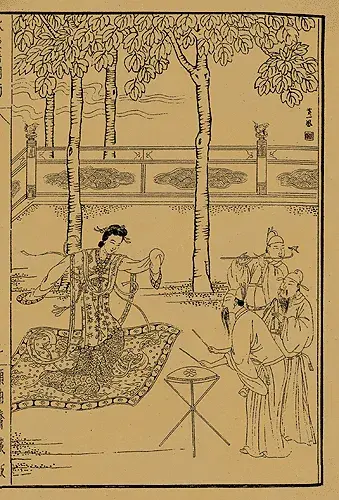
Dressed in shimmering gossamer robes embroidered with peacock feathers and cloud motifs, she danced with floating grace, matching the intricate musical shifts of the imperial orchestra. Poet Bai Juyi immortalized her performance, likening her spins to whirling snow and leaping dragons. Additionally, Yang Yuhuan mastered the energetic Sogdian whirling dance, introduced from Kangju. Although possessing a voluptuous physique, she twirled on a tiny silk carpet with breathtaking velocity and perfect equilibrium, epitomizing the vibrant, cosmopolitan aesthetic of the high Tang.
The cultural life of Xuanzong's court centered upon the Huaqing Palace at Mount Li and the Agarwood Pavilion within the Daming Palace in Chang'an. The expansive hot springs at Mount Li served as the seasonal retreat for state business and artistic performance during the cold winter months, where the imperial couple remained until early spring.
In the spring of 744, during the blooming of purple and white peonies before the Agarwood Pavilion in Chang'an, Xuanzong and Noble Consort Yang gathered to celebrate the blossoms. Wishing to depart from traditional court lyrics, the emperor summoned poet Li Bai to compose new verse. Li Bai produced the celebrated three-part Qingping Diao, likening the radiant consort to dew-kissed spring blossoms and mythic goddesses of Mount Jade. Sung by court master Li Guinian and accompanied by the emperor on a jade flute, this gathering came to symbolize the golden summit of Tang aesthetic refinement.
Noble Consort Yang's fondness for fresh lychees led to the establishment of an extraordinary long-distance courier network across imperial postal routes. Because lychees spoil within days of harvesting, the imperial administration organized an emergency relay system stretching thousands of kilometers from the orchards of Lingnan and Fuling in Sichuan to Chang'an.
Freshly harvested lychees were sealed within bamboo tubes and transported day and night by elite cavalrymen switching mounts at stations every few dozen li. When the shipments arrived at the Huaqing Palace, the fruit retained its original morning freshness and color. While fulfilling the palace's taste for rare luxuries, this costly courier system placed immense logistical burdens upon regional populations, serving in late Tang political critique as a vivid metaphor for imperial indulgence.
Among the private anecdotes recorded from the Tang inner court, the tale of the white parrot Xueyiniang illustrates the leisurely domestic intimacy shared between Xuanzong and Noble Consort Yang. Presented as regional tribute from Lingnan, the snowy white bird was trained by court scholars to recite poetic stanzas with clarity.
During chess matches between the emperor and his consort, attendants would call out the bird's name if Xuanzong faced imminent defeat. The parrot would flutter directly onto the board, scattering the chess pieces with its wings to playfully rescue the sovereign from a tactical loss. When the parrot was eventually killed by an eagle in the palace gardens, the sorrowful imperial couple ordered it buried in an ornate mound within the royal grounds, named the Parrot Tomb.
The dramatic arc of Yang Yuhuan's life—rising from an orphaned provincial girl to supreme palace glory and perishing in the tragedy of Mawei—rendered her one of the most compelling tragic archetypes in Chinese literature. In the late Tang, Du Fu lamented her loss in Lament by the River, and Li Shangyin composed his poignant Mawei poems, critiquing the monarch who ruled the empire for four decades yet failed to protect the woman he loved.
In 806, poet Bai Juyi and scholar Chen Hong visited the Xianyou Monastery, where Bai penned the immortal Song of Everlasting Sorrow, while Chen composed the matching narrative biography Account of the Song of Everlasting Sorrow. In the Yuan dynasty, Bai Pu dramatized the theme in Rain on the Wutong Tree, and during the Qing dynasty, Hong Sheng devoted decades to crafting the theatrical masterpiece The Palace of Eternal Youth. Through these enduring masterworks, Yang Yuhuan's story evolved into a timeless reflection upon the ephemeral nature of worldly power and the tragic beauty of romantic devotion.
FIGURES ASSOCIATED WITH THIS DYNASTY