Hereditary Entry and Secretarial Library
Entered civil service as an Imperial Secretariat Student; appointed Editorial Assistant and Palace Attendant, collating dynastic archives.
郑道昭
Zheng Daozhao (郑道昭, ?–516), courtesy name Xibo, self-styled Master Zhongyue, was a native of Kaifeng County in Xingyang Commandery (present-day Kaifeng area, Henan Province). He was the son of the eminent Northern Wei statesman and Director of the Imperial Secretariat Zheng Xi. A prominent statesman, literary master, classical scholar, and calligraphic patriarch during the middle Northern Wei dynasty, he rose to serve as…
Zheng Daozhao (郑道昭, ?–516), courtesy name Xibo, self-styled Master Zhongyue, was a native of Kaifeng County in Xingyang Commandery (present-day Kaifeng area, Henan Province). He was the son of the eminent Northern Wei statesman and Director of the Imperial Secretariat Zheng Xi. A prominent statesman, literary master, classical scholar, and calligraphic patriarch during the middle Northern Wei dynasty, he rose to serve as Director of the Palace Library and General Who Pacifies the South, having previously held senior posts including Chancellor of the National University and Grand Rectifier of Sizhou, as well as serving as Regional Inspector of Guangzhou and Qingzhou. After his passing, the imperial court posthumously granted him the titles of Grand General Who Pacifies the North and Regional Inspector of Xiangzhou, conferring the posthumous name "Wengong." Zheng Daozhao was born into the prestigious Xingyang Zheng clan, one of the foremost aristocratic lineages of northern China. From his youth, he was devoted to scholarly pursuits, mastering the Five Classics and gaining fame for his profound literary eloquence. In his early career within the imperial palace, he accompanied Emperor Xiaowen on the southern campaigns toward the Huai and Han rivers, participating in the imperial poetic symposium at the Bamboo Hall of Xuanhu, where his verses won high admiration from the sovereign. During the reign of Emperor Xuanwu, he served as Chancellor of the National University and Director of the Palace Library, repeatedly submitting memorials urging the throne to restore the Han-Wei stone classics, reconstruct academic colleges, and recruit students nationwide, demonstrating an unswerving dedication to Confucian learning. Between the Yongping and Yanchang eras, he served as General Who Pacifies the East and Regional Inspector of Guangzhou and Qingzhou, governing with mild benevolence and frugality while soothing regional unrest, earning lasting gratitude from the folk of Shandong. In the history of Chinese calligraphy, Zheng Daozhao holds a monumental status. While administering Guangzhou and Qingzhou, he immersed himself in the scenic wilderness of Mount Yunfeng, Mount Daji, Mount Tianzhu, and Mount Linglong (the "Four Mountains of Yunfeng"), composing and personally inscribing dozens of monumental cliff inscriptions and giant titling characters, including the celebrated Stele of Duke Zheng Wen, Poem on Discussing Classics and Books, Poem on Viewing Sea Children, Inscription of the Stone Chamber of Dongkan, and Inscriptions of Baiju Valley. He synthesized ancient seal script dynamics, clerical structural vigor, and regular script architecture into a unified calligraphic art that he termed "Cursive Seal Script," establishing a majestic Wei-stele style characterized by round-brush centered strokes, robust strength, and cosmic grandeur that stood in sublime balance with Tao Hongjing's southern Inscription on Burying a Crane. Scholars of the Qing Dynasty and modern era, including Ruan Yuan, Bao Shichen, Kang Youwei, Ye Changzhi, and Zhu Jia, praised his stone carvings as the ultimate peak of round-brush Wei-stele art, elevating him as the solitary "Sage of Northern Calligraphy" to stand in equal honor with Wang Xi-zhi of the south.
Entered civil service as an Imperial Secretariat Student; appointed Editorial Assistant and Palace Attendant, collating dynastic archives.
Accompanied Emperor Xiaowen's grand expedition against Southern Qi; Northern Wei forces routed the southern army north of the Mian River.
Attended the imperial banquet at the Bamboo Hall in Xuanhu, composing harmonious verses that won lavish personal praise from Emperor Xiaowen.
Prince of Pengcheng Yuan Xie routed Chen Bozhi at Feikou; Emperor Xuanwu dispatched Zheng Daozhao as yellow-gate envoy to console the troops.
Implicated when cousin Zheng Si joined Yuan Xi's aborted conspiracy; expelled from the inner court to serve as Consulting Sima to Prince of Beihai Yuan Xiang.
Appointed Chancellor of the National University; submitted memorial urging the restoration of Han-Wei stone classics; participated in imperial legal codification.
Promoted to Director of the Palace Library and Area Commander of Sizhou; repeatedly submitted memorials urging widespread student recruitment for imperial colleges.
Appointed General Who Pacifies the East and Regional Inspector of Guangzhou to pacify turbulent eastern frontiers; restored order through benevolent rule.
Established Daoist altars on Mount Daji; carved the immortal Stele of Duke Zheng Wen on Mount Yunfeng, founding the apex of northern cliff calligraphy.
Transferred to govern Qingzhou as General Who Pacifies the East; inscribed cliff texts at Mount Linglong while winning widespread popular devotion.
Recalled to Luoyang following Emperor Xiaoming's accession; reappointed Director of the Palace Library and promoted to General Who Pacifies the South.
Passed away suddenly in Luoyang; Emperor Xiaoming posthumously conferred the title General Who Pacifies the North and Regional Inspector of Xiangzhou, posthumously named "Wengong."
Zheng Daozhao was born into the prestigious Kaifeng branch of the Xingyang Zheng clan, one of the four prominent aristocratic houses of northern China that had produced ministers for generations. His father, Zheng Xi, was an eminent scholar and Chancellor of the Central Secretariat under Emperor Xiaowen, revered across the northern realm for his profound mastery of the Confucian classics and state rituals. Endowed with natural intelligence and a calm, noble disposition, Zheng Daozhao was immersed in canonical studies from childhood, mastering ancient histories, philosophical works, and metaphysical poetry. He developed a singular passion for pre-Qin epigraphy, bronze inscriptions, and ancient stone carvings, revealing extraordinary literary and calligraphic gifts in his youth.
During the Taihe era, Zheng Daozhao utilized his aristocratic privilege to enter the palace as an Imperial Secretariat Student. Owing to his exceptional erudition, he entered formal civil service as an Editorial Assistant in the Palace Library, cataloging and collating the imperial archives. He was subsequently promoted to Master of Writing, Regular Attendant of Sanqi, Assistant Director of the Palace Library, and concurrent Vice Director of the Central Secretariat. Throughout his tenure within the forbidden palace, Zheng Daozhao carried out his duties with meticulous rectitude, composing memorials characterized by elegant balance, earning immense respect from peers and senior ministers.
In the eighth month of 497, Emperor Xiaowen Tuoba Hong launched a massive military campaign against Southern Qi. Recognizing Zheng Daozhao's administrative competence and geographical knowledge, the emperor commanded him to accompany the imperial retinue. On the fourteenth day of the eleventh month, the Northern Wei forces clashed with Southern Qi armies north of the Mian River, winning a decisive triumph. Throughout the campaign, Zheng Daozhao served in the field secretariat, participating in strategic deliberations and drafting military dispatches.
In the third month of 498, Emperor Xiaowen's southern expeditionary force arrived at the strategic town of Xuanhu (in modern Runan County, Henan Province). In the fourth month, with military operations concluded, the emperor hosted a grand banquet at the Bamboo Hall of his temporary palace to entertain princes, generals, and close scholarly advisers. Zheng Daozhao and his elder brother Zheng Yi were invited to attend directly beside the imperial dais. Amid the performance of refined martial tunes by court musicians, imperial camaraderie flourished.
Moved by the ongoing division of the realm, Emperor Xiaowen spontaneously chanted an opening couplet: "The bright sun illuminates all under heaven without exception, yet the southeastern corner across the Yangtze remains unlit." Prince of Pengcheng Yuan Xie, Minister Zheng Yi, and General Xing Luan each responded in turn. When it was Zheng Daozhao's turn, he rose calmly and declared with resonant passion: "When the imperial wind sweeps forth, it circles the nine continents; upholding the sun and leaning against heaven, it purifies the six directions!" His majestic verse reflected his grand aspiration to assist his sovereign in unifying China.
Emperor Xiaowen was deeply touched, exclaiming to the assembled court: "Although I have been burdened with the administrative complexities of moving the capital to Luoyang, I have never ceased composing poetry with my gifted scholars; yet never has our joy been so complete as today at Xuanhu!" The emperor commanded General Xing Luan to compile the banquet verses into an imperial collection, turning to console Zheng Daozhao personally: "Over recent years, your household has endured successive tragedies of mourning, yet you remain dedicated to canonical poetry and the realm. I am profoundly moved." Shortly thereafter, Zheng Daozhao was promoted to full Vice Director of the Central Secretariat and transferred to Regular Attendant of Sanqi.
In the eighth month of 500, civil war broke out in the south, and Southern Qi general Chen Bozhi led an invasion force toward Shouchun. Emperor Xuanwu ordered Prince of Pengcheng Yuan Xie to lead reinforcements south, and General Fu Yong ambushed and routed Chen Bozhi's army at Feikou, capturing enemy commanders and securing the fertile Huainan territory for Northern Wei. When news of the victory reached Luoyang, Emperor Xuanwu was delighted, sending Zheng Daozhao, then serving as Attendant Gentleman of the Yellow Gates, to travel south as an imperial envoy bearing the imperial talisman to inspect and reward the troops.
Zheng Daozhao proclaimed imperial edicts in the army camp, distributed gifts of gold and silk, enforced discipline, and consoled the local populace, winning high acclaim among the frontier forces. However, political fortunes shifted abruptly. In the fifth month of 501, Emperor Xuanwu's uncle, Prince of Xianyang Yuan Xi, feeling marginalized, secretly conspired with court figures to raise a rebellion. The plot was uncovered in late June, and Yuan Xi was compelled to commit suicide.
During the subsequent political purge, Zheng Daozhao's cousin Zheng Si was arrested for participating in Yuan Xi's conspiracy. Under the severe laws of familial implication, Zheng Daozhao and his elder brother Zheng Yi were stripped of their inner palace posts and expelled from the central court. In the eleventh month, Prince of Beihai Yuan Xiang became Grand Tutor and Minister of Education. Aware of Zheng Daozhao's upright character and profound erudition, Yuan Xiang recruited him and Langye scholar Wang Bing to serve as Consulting Simas, shielding Zheng Daozhao from further retribution.
In 504, Prince of Beihai Yuan Xiang fell victim to palace intrigue, was stripped of noble rank, and died abruptly. Zheng Daozhao, having maintained complete integrity, remained untainted by the scandal. Recognizing his classical prestige, the court elevated him to Chancellor of the National University. Surveying the derelict academies in Luoyang, where ancient stone classics were crumbling and scholars pursued superficial vanity while ignoring Confucian ethics, he felt profound sorrow.
Zheng Daozhao submitted his celebrated memorial, Memorial on Erecting the Han and Wei Stone Classics. He argued passionately that the Confucian classics formed the eternal bedrock of dynastic rule, urging Emperor Xuanwu to follow the ancient examples of Emperor Guangwu of Han and Emperor Wen of Wei by repairing the academies and restoring the scattered fragments of the Han and Wei stone classics in the imperial college to establish an authoritative standard. However, Emperor Xuanwu was preoccupied with military campaigns and Buddhist temple construction, leaving the proposal unacted upon.
In the twelfth month of that year, Emperor Xuanwu commissioned scholar Yuan Fan to codify imperial legal statutes, inviting Chancellor Zheng Daozhao to participate in the deliberations, where he helped infuse the legal code with Confucian principles. In 507, during a general advancement of officials, Zheng Daozhao was promoted to Director of the Palace Library. Between 508 and 512, Prince of Guangping Yuan Huai served as Pastoral Governor of Sizhou, with Zheng Daozhao appointed Area Commander of Sizhou.
During this period, distressed by the decline of classical scholarship, he submitted two consecutive memorials titled Memorial Requesting the Appointment of Academic Instructors and Enrollment of Students. Citing historical precedents of Han emperors honoring Confucius, he urged the establishment of educational statutes to enroll talented students from every commandery into the National University. Emperor Xuanwu issued an edict praising his devotion to Confucian learning but took no concrete action. Frustrated in his educational ambitions, Zheng Daozhao poured his vast canonical erudition and moral vigor into monumental stone inscriptions.
In 510, the Northern Wei court faced administrative difficulty in the Shandong coastal commanderies. Guangzhou (centered in modern Laizhou, Shandong) had long been called "Eastern Qin," characterized by fierce martial traditions, entrenched local clans, and frequent unrest that had baffled previous regional inspectors. When Emperor Xuanwu asked his court who could pacify the region, ministers unanimously responded: "The customs of Guangzhou are turbulent and decadent; none possesses the moral authority and benevolent stature to transform them save Zheng Daozhao!"
Consequently, Emperor Xuanwu appointed Zheng Daozhao Holder of the Imperial Talisman, General Who Pacifies the East, and Regional Inspector of Guangzhou. Zheng Daozhao relocated to Laizhou accompanied by his sons Zheng Jingzu and Zheng Shuzu. Upon assuming office, he abolished draconian punishments, instituted mild, simplified governance, reduced taxes and corvee labor, and allowed the populace to recover. He established community academies, promoted agriculture, honored local elders, and suppressed regional bullies. Within a single year, peace was restored across Guangzhou, crimes ceased, and local citizens expressed unbounded gratitude.
Away from administrative duties, Zheng Daozhao immersed himself in the coastal mountains, cultivating a love for Daoist seclusion. Exploring Mount Daji in Laizhou, he established five retreat sites arranged according to cosmological directions—the Qingyan Monastery, Baiyun Hall, Songyang Terrace, Xuanling Palace, and Zhongming Altar—and roamed Mount Yunfeng and Mount Tianzhu. In 513, in recognition of his exemplary governance, the court transferred him to serve as General Who Pacifies the East and Regional Inspector of Qingzhou. Stationed in Yidu, he continued his benevolent policies, ascending Mount Linglong to carve poems into the rock faces. The people of Shandong built shrines in his honor to commemorate his virtuous rule.
During his regional governorship in Shandong, Zheng Daozhao was accompanied not only by official aides but also by his sons Zheng Jingzu, Zheng Shuzu, and Zheng Shunzu, exploring coastal mountains day and night. During the Yanchang era, he ascended the southern cliffs of Mount Yunfeng in Laizhou to supervise the carving of the renowned Stele of Duke Zheng Wen (formally Stele of the Late Director of the Central Secretariat and Director of the Palace Library Duke Zheng Wen of Wei). The inscription exists in two versions: the upper stele on Mount Tianzhu in Pingdu, which suffered from coarse rock and erosion, and the lower stele on Mount Yunfeng in Laizhou, carved on fine granite, surviving as an immortal masterpiece.
The inscription's record of his father Zheng Xi's posthumous title sparked scholarly debate in later centuries. Official histories record that upon Zheng Xi's death, Emperor Xiaowen decreed that his posthumous name should be "Wenling." Yet in the stone inscription, Zheng Daozhao honored his father simply as "Duke Wen." Song Dynasty epigrapher Zhao Mingcheng observed in Records of Metal and Stone that while imperial edicts were precise, Zheng Daozhao would not have dared to invent false titles publicly. Subsequent scholars established that commemorative stele inscriptions in the Six Dynasties were primarily composed to celebrate family honor, making the omission of derogatory characters an accepted convention of filial piety among medieval aristocratic clans.
In carving this stele, Zheng Daozhao poured out his filial devotion and supreme calligraphic mastery. The inscription traced the glorious lineage of the Xingyang Zheng clan from King Xuan of Zhou enfeoffing his brother, chronicling his father's deeds in supporting the Northern Wei throne. Decades later, in 564, his son Zheng Shuzu ascended Mount Yunfeng as Regional Inspector of Guangzhou and General of Chariots and Cavalry in Northern Qi, retracing his father's steps and carving Record of Re-climbing Mount Yunfeng, perpetuating a celebrated cultural tradition across Shandong.
During his years governing Guangzhou and Qingzhou, Zheng Daozhao crystallized his political vision, literati spirit, and canonical mastery upon the boulders of the Four Mountains of Yunfeng, leaving dozens of magnificent cliff carvings. In 515, Emperor Xuanwu passed away, and Emperor Xiaoming ascended the throne with Empress Dowager Hu assuming regency. In view of Zheng Daozhao's venerable stature as a foremost Confucian classicist, the court summoned him back to Luoyang, reappointing him Director of the Palace Library and elevating him to General Who Pacifies the South, placing him in charge of national archives and historical compilation.
Returning to Luoyang, Zheng Daozhao resided in his family home in Huiwen Ward east of the city. While holding senior archival authority, he chose to detach himself from the escalating political factionalism between imperial princes and maternal relatives, seeking solace in poetry, wine, and stone epigraphy. He spent his days collating ancient manuscripts in the Shiqu Pavilion and Dongguan archives, debating classical exegesis with scholars from across the realm.
In 516, Zheng Daozhao fell gravely ill and passed away in his official residence in Luoyang. Emperor Xiaoming and the assembled court mourned his death deeply, issuing an imperial edict posthumously granting him the titles of Holder of the Imperial Talisman, Grand General Who Pacifies the North, and Regional Inspector of Xiangzhou, conferring the posthumous name "Wengong." His third son Zheng Shuzu later rose to Left Vice Director of the Department of State Affairs and Minister of Works in Northern Qi, inheriting his scholarship and calligraphic legacy, ensuring that the Xingyang Zheng clan remained an enduring exemplar among medieval literati families.
While serving as Regional Inspector of Guangzhou and Qingzhou, Zheng Daozhao organized trails through the rugged precipices of Mount Yunfeng, Mount Daji, Mount Tianzhu in Laizhou, and Mount Linglong in Yidu (the "Four Mountains of Yunfeng"), personally composing and inscribing over forty cliff inscriptions and monumental titling characters. These carvings constitute the most extensive and well-preserved treasury of northern cliff epigraphy in Chinese history.
Foremost among these works is the lower Stele of Duke Zheng Wen, inscribed in 511 upon the southern cliffs of Mount Yunfeng. Spanning over one thousand three hundred characters, the inscription chronicles the life and achievements of his father Zheng Xi. Majestic, solemn, and enduring through fifteen centuries of natural erosion, it is recognized by epigraphers as the premier monument of Northern Wei stele art, standing in sublime dialogue across the Yangtze with Tao Hongjing's southern Inscription on Burying a Crane.
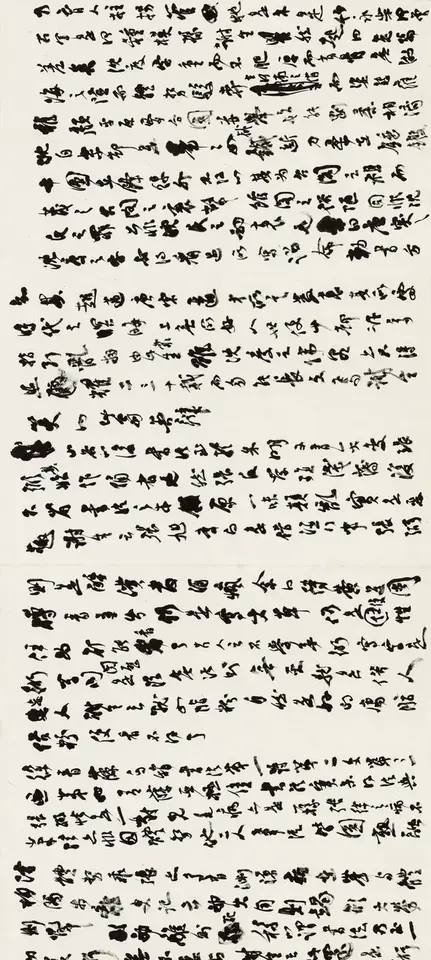
In the historical development of Chinese calligraphy, Zheng Daozhao served as a transformative innovator. The Northern and Southern Dynasties marked a crucial transition from clerical to regular script. While early Northern Wei stone carvings favored sharp, angular chisel strokes that often exhibited raw roughness, Zheng Daozhao integrated profound classical scholarship and epigraphic wisdom to pioneer an original style that he personally titled "Cursive Seal Script."
Zheng Daozhao's calligraphy was centered upon round-brush techniques, absorbing the rounded freedom of the Western Zhou San Shi Pan, the solemn density of the Stone Drum Inscriptions, and the broad gravity of Han clerical steles such as the Yiying Stele and Zhang Qian Stele, while embracing the flowing movement of popular running script. His giant titling characters, such as Inscriptions of Baiju Valley and The Mountain of Tianzhu, featured characters over a foot wide, executed with centered brushwork of immense power; his smaller cliff poems, such as Poem on Discussing Classics and Books and Poem on Viewing Sea Children, displayed buoyant agility, balancing round and angular strokes. Qing Dynasty scholar Bao Shichen praised his work in Art Boat with Two Oars, noting that "his spacing draws from the Yiying Stele, his stroke execution originates from the Stone Drums, combining seal momentum, clerical balance, and cursive spirit," establishing the supreme standard of round-brush Wei-stele calligraphy.
The dozens of monumental cliff inscriptions left by Zheng Daozhao across the Four Mountains of Yunfeng display remarkable stylistic diversity bound by rigorous classical discipline. At Mount Yunfeng, the lower Stele of Duke Zheng Wen inherits the rounded horizontal expanse of the San Shi Pan, exhibiting broad character architecture, tranquil nobility, and profound structural weight. In contrast, the Poem on Discussing Classics and Books utilizes angular brushwork with prominent horizontal strokes, creating an open, expansive presence. Newly discovered inscriptions such as the Liezi Titling and Hongya Zi Titling utilize centered, deliberate brushwork, where extended falling strokes glide like dancing immortals, conveying otherworldly tranquility.
At Mount Daji, inscriptions such as Qingyanli Titling and Year of Renchen Titling display slender yet muscular brushwork, with strokes fine as fingers yet penetrating deep into granite, employing Han clerical methods for characters seven inches wide. Zhongming Altar Titling and Xuanling Palace Titling present solemn, dense monumentality, while Double-Outlined Baiyun Hall Titling uses incised outlines that shift visually with the viewer's path.
The inscriptions of Mount Tianzhu are celebrated for their lean, soaring momentum. The five characters of This Mountain of Tianzhu enter the stone with light, swift brushstrokes; the character "This" features a sweeping horizontal stroke paired with coiled vertical elements resembling a leaping dragon, while the final stroke of "Of" strikes like a halberd and "Mountain" stands like an iron trident. At Mount Linglong in Qingzhou, the Inscriptions of Baiju Valley span over a foot across, featuring angular, chiseled power that surpasses even the famous Longmen statues, while Youpan Titling flows with natural asymmetry, devoid of artificial ornamentation.
Throughout his life, Zheng Daozhao regarded the preservation of Confucian cultural heritage as his sacred duty. Serving as Chancellor of the National University and Director of the Palace Library, he looked beyond personal career concerns to present three earnest memorials: Memorial on Erecting the Han and Wei Stone Classics, Memorial Requesting the Appointment of Academic Instructors and Enrollment of Students, and a follow-up petition.
Zheng Daozhao systematically analyzed the critical role of cultural education in ensuring dynastic longevity. He warned that if the state prioritized military conquest and material wealth while neglecting Confucian learning, even vast territorial expansion would end in collapse. He pleaded for funds to restore provincial schools, re-erect authoritative stone classics at the National University to standardize script and canonical interpretations, and require commanderies to recommend talented commoners for imperial study. Though obstructed by imperial shortsightedness, his proposals profoundly influenced the civil renaissance of the late Northern Wei and stand as seminal documents in Chinese educational history.
Guangzhou was a remote maritime territory where powerful clans held sway and litigation ran rampant, with previous governors relying on draconian suppression that inflamed civil strife. Entrusted with pacifying the commandery, Zheng Daozhao abandoned punitive methods, adopting a governing philosophy centered on "moral transformation and administrative simplicity."
He investigated the hardships of the agrarian population, lowered burdensome taxes, personally presided over legal disputes, and persuaded litigants with moral reason, resolving long-standing regional grievances. While building water conservancy works and supporting farming, he established Confucian academies and recruited scholars to lecture on virtue. Under his benevolent influence, a region long regarded as turbulent transformed within years into a civilized community, earning enduring popular devotion.
Beyond his standing as an administrator and calligrapher, Zheng Daozhao was an original poet in northern literature. While governing the mountains and coasts of Shandong, he adopted the title "Master Zhongyue," embracing Daoist ideals of natural simplicity and transcendent harmony. He constructed altars on Mount Daji, conversing with hermits, ascending coastal heights, and exploring scenic peaks.
His compositions, including Poem on Placing the Immortal Altar, Poem on the Chamber of Flying Immortals, Poem on Viewing Sea Children from Mount Yunfeng, Poem on Discussing Classics with Ten Companions on Mount Yunfeng, and Inscription on Mount Tianzhu, broke free from conventional court encomiums, pioneering a literati tradition of expressing philosophical transcendence through cliff poetry. These literary inscriptions blended seamlessly with the granite landscapes, turning the Four Mountains of Yunfeng into an enduring sanctuary where medieval Daoist culture and landscape poetry converged.
From the mid-Qing period onward, with the resurgence of evidential scholarship and epigraphy, academic luminaries such as Ruan Yuan, Bao Shichen, and Kang Youwei championed stele inscriptions over paper copybooks. Zheng Daozhao's cliff carvings were rediscovered from forgotten mountain valleys, initiating a historic re-evaluation of Chinese calligraphy. Scholars realized that the architectural essence of early Tang masters, including Ouyang Xun, Yu Shinan, and Chu Suiliang, traced directly back to the Wei-stele tradition pioneered by Zheng Daozhao.
Late Qing epigrapher Ye Changzhi declared in Yu Shi: "Zheng Daozhao's steles and poems on Mount Yunfeng possess brush strength capable of cleaving rhinoceroses and grappling with dragons; early Tang masters Ouyang, Yu, Chu, and Xue all fall within his stylistic embrace. Not only is he the premier master of northern calligraphy, but in the history of regular script, he stands alone! I say that Zheng Daozhao is the Sage of Calligraphy!" Modern calligraphic theorist Zhu Jia further concluded that while Wang Xi-zhi reigned supreme in the south through running-cursive letters, Zheng Daozhao dominated the north through monumental cliff inscriptions, making them complementary giants across China's north and south, establishing Zheng Daozhao's eternal standing as the "Sage of Northern Calligraphy."
FIGURES ASSOCIATED WITH THIS DYNASTY