Defeat at Dafeichuan
Served as deputy commander under Liu Shenli against Tibet, falling into captivity but spared due to royal resemblance.
王孝杰
Wang Xiaojie (died 697) was a native of Xinfeng in Jingzhao Prefecture and a distinguished military general and chancellor during the Tang and Wu Zhou dynasties. Early in his military service, he served as deputy general under Liu Shenli against the Tibetan Empire in 678, being captured at the Battle of Dafeichuan. Spared execution by the Tibetan btsan-po due to his striking resemblance to the deceased Tibetan monarch, Wang…
Wang Xiaojie (died 697) was a native of Xinfeng in Jingzhao Prefecture and a distinguished military general and chancellor during the Tang and Wu Zhou dynasties. Early in his military service, he served as deputy general under Liu Shenli against the Tibetan Empire in 678, being captured at the Battle of Dafeichuan. Spared execution by the Tibetan btsan-po due to his striking resemblance to the deceased Tibetan monarch, Wang lived in Tibet for several years, acquiring comprehensive firsthand knowledge of western passes, terrain, and nomadic fighting techniques. Summoned by Empress Wu Zetian upon his return in 692, he was appointed Area Commander-in-Chief of Wuwei. Wang spearheaded a major campaign, routing the Tibetan armies under Gar Trinring and recovering the Four Garrisons of Anxi (Qiuci, Yutian, Shule, and Suiye) after more than two decades of foreign occupation. He reconstituted the Protectorate General to Pacify the West with thirty thousand permanent Han troops. In 694, he crushed an allied Tibetan-Western Turkic host at Lengquan, rising to Minister of War and Chancellor. In 697, following the Khitan sacking of Yingzhou, Wang was commissioned as Commander-in-Chief of the Qingbian Army to lead a counter-offensive. At Dongxia Shigu (East Xiashi Valley), his vanguard encountered the main Khitan army. When rear commander Su Honghui fled the field in panic, Wang's vanguard was encircled. Refusing to yield, Wang Xiaojie fought to the last man and leaped from a precipice to his death. He was posthumously honored as Grand General of the Left Militant Guard and Duke of Geng.
Served as deputy commander under Liu Shenli against Tibet, falling into captivity but spared due to royal resemblance.
Repatriated to Chang'an after prolonged detention in Tibet, offering invaluable strategic intelligence on the western borders.
Appointed Commander of Wuwei, defeating Tibetan armies and liberating the Four Garrisons of Anxi to restore Chinese dominance.
Decimated allied Tibetan and Western Turkic forces at Lengquan, advancing to Minister of War and Joint Chancellor.
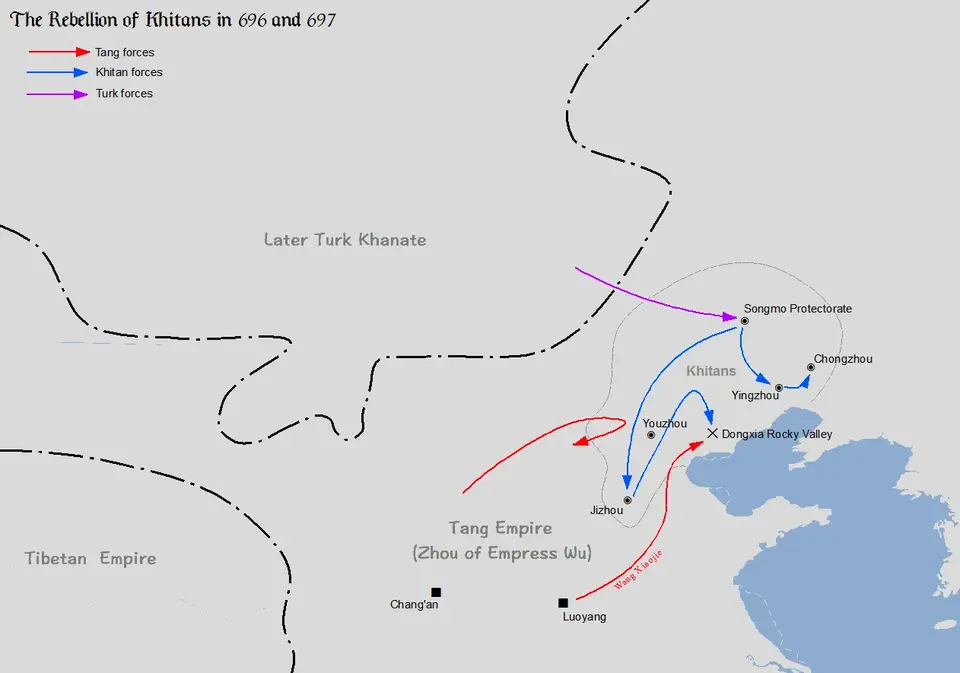
Khitan warlords sacked Yingzhou and ravaged Hebei; Empress Wu appointed Wang Supreme Commander to lead northern pacification.
Trapped in East Xiashi Valley after the desertion of deputy Su Honghui, leaping off a precipice after fighting to exhaustion.
Empress Wu Zetian issued an imperial decree punishing the deserter and posthumously creating Wang Duke of Geng.
Wang Xiaojie was born into an established military gentry family in Xinfeng, Jingzhao. Endowed with resolute courage and skill in horsemanship and archery, he entered the imperial military in his youth. In 678, during the reign of Emperor Gaozong, the Tibetan Empire launched recurring offensives across the western frontier. Chancellor Li Jingxuan was appointed supreme commander with Liu Shenli directing the forward columns and Wang Xiaojie serving as deputy vanguard general. At the Battle of Dafeichuan, Tang columns were lured into ambushes by Tibetan regent Gar Trinring, leading to Liu Shenli's and Wang's capture. When the young Tibetan btsan-po Khri-dus-srong beheld Wang Xiaojie, he wept profusely because Wang bore an uncanny physical resemblance to his late father, Mangsong Mangtsen. Spared from the sword, Wang was detained with honor near the royal encampment. Over nearly a decade in Tibet, Wang quietly surveyed western trade routes, defensive garrisons, logistical choke points, and military vulnerabilities, amassing unmatched strategic intelligence. Released in the early Chuigong era, he returned to Chang'an to present master strategies for frontier defense.
In 692, Empress Wu Zetian resolved to eliminate Tibetan occupation of the Western Regions, which had severed the Silk Road for two decades. Summoning Wang Xiaojie to court, the empress was deeply impressed by his strategic clarity and appointed him Area Commander-in-Chief of Wuwei, directing general Ashina Zhongjie and elite cavalry across the Jade Gate. Executing an audacious flanking maneuver, Wang routed the primary Tibetan army under Gar Tsenyen at Lake Dasabi, driving the invaders in disorganized retreat. He liberated the Four Garrisons of Anxi—Qiuci, Yutian, Shule, and Suiye—permanently expelling Tibetan authority from the Tarim Basin. Wang reconstituted the Protectorate General to Pacify the West at Qiuci and established thirty thousand permanent garrison troops, reviving Silk Road commerce. In 694, Wang smashed another joint invasion by Tibetan forces and Western Turkic prince Ashina Tuizi at Lengquan, taking thirty thousand heads. In recognition of his martial achievements, Wu Zetian appointed him Minister of War and Joint Chancellor, placing him at the helm of central civil and military decision-making.
In 696, Khitan chieftains Li Jinzhong and Sun Wanrong revolted against the harsh tyranny of Yingzhou Governor Zhao Wenhui, capturing Yingzhou and overrunning Hebei. Successive imperial armies were routed, alarming the capital. In response, Empress Wu appointed veteran general Wang Xiaojie as General-in-Chief of the Qingbian Army, with Su Honghui serving as deputy commander over 170,000 troops. In the third month of 697, Wang led his vanguard into the treacherous defiles of East Xiashi Valley (in modern Tangshan, Hebei). Dense Khitan cavalry launched sudden ambushes from flanking cliffs. Undaunted, Wang personally led the assault, slaying numerous enemy warriors. However, deputy commander Su Honghui turned coward upon witnessing the savage combat, fleeing the battlefield with the main imperial column. Cut off in the rocky valley, Wang's few thousand men were encircled by tens of thousands of Khitan horsemen. After fighting from dawn to dusk under torrential arrow volleys, his troops were decimated. Refusing surrender, Wang Xiaojie shouted toward heaven and leaped his warhorse off the towering cliff to his death. Grief-stricken, Empress Wu executed the cowardly generals and posthumously elevated Wang Xiaojie to Grand General of the Left Militant Guard and Duke of Geng.
Wang Xiaojie's liberation of the Four Garrisons stands as a landmark triumph in early medieval Chinese military history. After more than twenty years of foreign domination, he destroyed the Tibetan western legions, reopened the vital conduits of the trans-Eurasian Silk Road, and permanently stationed thirty thousand garrison troops in Xinjiang. His military genius established long-term stability and cemented Chinese administrative authority across the Tarim Basin throughout the High Tang era.
Exemplifying the stern martial fortitude of the Guanzhong military aristocracy, Wang combined cabinet statesmanship as Minister of War with supreme frontline command. Betrayed by treacherous comrades in the deadly gorge of East Xiashi Valley, he chose honorable death over surrender, inspiring subsequent generations of Tang commanders with his devotion to imperial defense.
FIGURES ASSOCIATED WITH THIS DYNASTY