Life and Career
Prison Escape and Rising at Wagang
Zhai Rang was born in Weicheng, Dong Commandery (modern Hua County, Henan Province). From youth, he was noted for his physical strength, martial prowess, and generous temperament. During the Daye reign of Emperor Yang of Sui, Zhai took service as Judicial Administrator (Fa Cao) of Dong Commandery, supervising local prisons and criminal proceedings. Known for his candid disposition, he ran afoul of powerful imperial officials, resulting in his conviction and death sentence. The local prison warden, Huang Junhan, observed Zhai's commanding stature and bravery, recognizing that he possessed extraordinary capabilities. In the dead of night, Huang unlocked Zhai's shackles and declared: "Administrator Zhai, the mandate of heaven is changing and the realm is in chaos. How can you submit to death in prison?"
Zhai was both shocked and overjoyed, kowtowing in gratitude: "I am like a swine trapped in a pen; my life is entirely in your hands! If I escape, how will you face the wrath of the imperial court?" Overcome with emotion, he wept. Huang Junhan rebuked him sharply: "I took you for a great man capable of rescuing the suffering people, which is why I risked my life to set you free. Why do you weep like a frail child? Save yourself without delay and trouble yourself no more over me!"
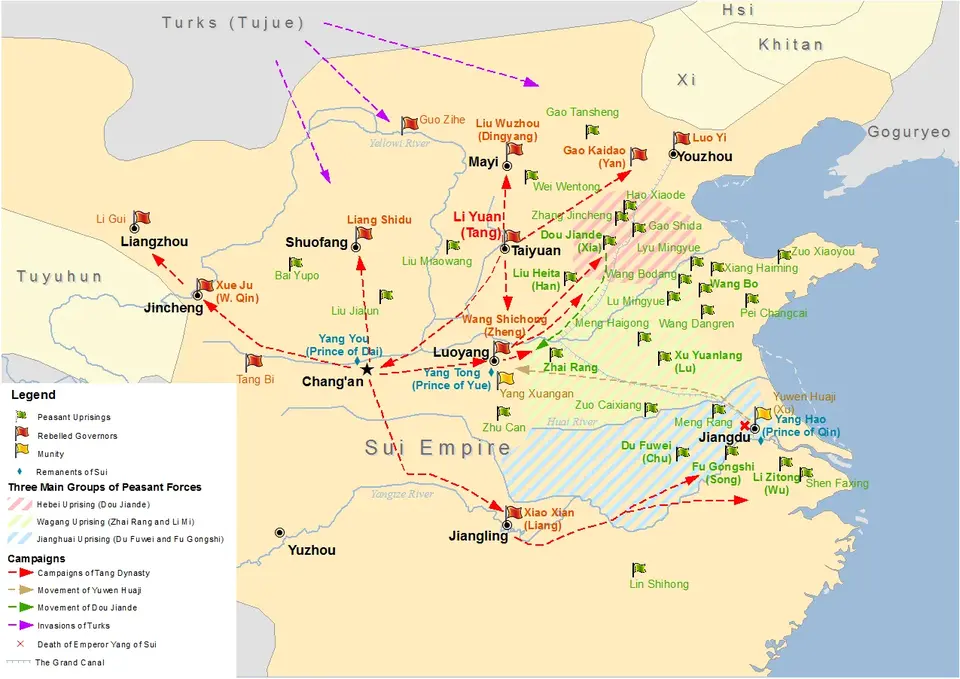
Bidding farewell to his rescuer, Zhai fled into the marshlands. At that time, Emperor Yang's disastrous campaigns against Goguryeo and the immense labor levies for the Grand Canal and eastern capital had pushed common folk to desperation. Arriving at Mount Wagang in southern Dong Commandery, Zhai assembled several hundred fugitives and destitute peasants, hoisting the banner of open rebellion against the Sui dynasty.
Operations on the Canal and Gathering Heroes
Shortly after establishing his camp, Shan Xiongxin, a fearsome warrior from the same commandery renowned for wielding the heavy cavalry lance, arrived with hundreds of local youths. Soon after, the seventeen-year-old Xu Shiji (the future Tang chancellor Li Ji), possessed of sharp military intellect, likewise joined the stronghold. Zhai treated both men with high honor, elevating them to his inner military council.
Surveying the geopolitical landscape, Xu Shiji advised Zhai: "Dong Commandery is our native soil, where our kin and neighbors reside; it is unseemly to pillage our own people. Conversely, Xingyang and Liang Commandery border the Bian Canal, the arterial conduit of imperial river traffic, bustling with daily transports of state grain and merchant wealth. If we station our forces along the commandery borders to intercept government barges and wealthy merchants, our supplies will be inexhaustible without alienating our homeland."
Zhai enthusiastically embraced the strategy and moved his forces toward the canal. Seizing imperial grain and wealth, the Wagang garrison accumulated immense provisions, attracting thousands of dispossessed peasants and warriors. Within a few years, the rebel force swelled to over ten thousand fighters, establishing Mount Wagang as the primary center of anti-Sui resistance across the Central Plains.
Triumph at Dahai Monastery and Seizing the Imperial Granary
In 616, Li Mi, who had previously served as chief strategist for Duke of Chu Yang Xuangan's failed insurrection, sought refuge with the Wagang Army. Belonging to the aristocratic Li clan of Longxi, Li Mi possessed a sophisticated grasp of grand strategy. Initially assigned command of a subordinate unit, Li Mi traveled among regional insurgent bands, convincing them to submit to Wagang authority while articulating grand plans for conquering the empire. Impressed by his strategic clarity, Zhai made Li Mi his chief military strategist.
Concurrently, Emperor Yang dispatched his most formidable military commander, Zhang Xutuo, governor of Qi Commandery, to eradicate the Wagang rebels at Xingyang. Renowned for crushing rebellions across northern China, Zhang was feared by insurgent forces. Li Mi presented an ambush strategy: "Zhang Xutuo is reckless despite his bravery, grown overconfident from unbroken victories. You should engage him frontally with the main force and simulate defeat toward the north; I will station concealed strike units in the dense woods near Dahai Monastery. When he pursues recklessly into the defile, our ambush will encircle and annihilate his command."
Zhai carried out the maneuver precisely. Clashing with Zhang Xutuo near Xingyang, Zhai staged a fighting retreat toward Dahai Monastery. Believing the rebels were broken, Zhang pursued headlong into the wooded ravine. Suddenly, Li Mi's hidden infantry surged from concealment as Zhai reversed his line to counterattack. Imperial forces disintegrated in panic. Although Zhang Xutuo fought fiercely, charging repeatedly into the melee to rescue trapped soldiers, he was encircled and killed. The stunning victory at Dahai Monastery shattered the myth of imperial invincibility, establishing the Wagang Army as the foremost military power in China.
In early 617, Li Mi proposed seizing the Sui dynasty's primary reserve depot—the Xingluo Granary (Luokou Granary, near modern Gongyi, Henan). Surrounded by massive ramparts and holding millions of bushels of grain, it was the logistical anchor of the empire. Zhai and Li Mi led a rapid amphibious assault across several hundred li, overwhelming the surprised garrison. Once in possession of the granary, Zhai ordered the gates thrown open, allowing starving families from surrounding regions to take grain freely. Hundreds of thousands of peasants flooded the roads to gather provisions and pledge allegiance. Within ten days, the Wagang force exploded into an army of hundreds of thousands, severing the link between Emperor Yang's court at Jiangdu and the eastern capital of Luoyang.
Relinquishing Supreme Command and Emerging Rift
With the Wagang forces evolving into a massive rebel coalition, the question of supreme political leadership became paramount. Zhai was broad-minded and modest; recognizing his rustic background and lack of aristocratic prestige necessary to court northern gentries, he resolved that Li Mi, with his illustrious lineage and administrative acumen, was best suited to lead. In February 617, Zhai championed Li Mi's elevation to the title of Duke of Wei.
Establishing his government at Luokou, Li Mi proclaimed himself ruler, appointing Zhai Minister of Education to head the civil administration and ennobling him as Duke of Dong Commandery. While Zhai retained independent command over his original veteran battalions, this dual power dynamic generated mounting friction between the original peasant faction and Li Mi's aristocratic following.
Zhai's elder brother, Zhai Hong, an uncouth and ambitious man, bitterly resented his brother's abdication, frequently admonishing him: "Anyone can take the throne in these chaotic times; why surrender absolute power to an outsider? If you cannot rule, then I should have been made Duke of Wei!" Similarly, veteran officer Wang Ruxin urged Zhai: "You are the founding father of Mount Wagang, yet now you bow to another. You should reclaim command as generalissimo and assume the imperial title yourself." Although Zhai dismissed these notions with laughter, reports reached Li Mi's ears.
Furthermore, clashes flared over the division of spoils between Zhai's veterans and Li Mi's central administration. In one heated exchange, Zhai bluntly confronted Fang Yanzao, a confidant of Li Mi, demanding: "The silks and silver recently taken from Luoyang were all presented to the Duke of Wei; why have none been distributed to me? Do you forget that the Duke owes his position to me?" Hypersensitive and deeply suspicious, Li Mi concluded that Zhai's independent military following posed an existential threat to his authority, resolving to eliminate him.
Banquet Bloodshed and Fractured Movement
In November 617, despite victories outside Luoyang at Huiluo Granary and Shizi River, internal distrust reached an explosive threshold. Li Mi met secretly with his inner circle—Jia Xiong, Fang Yanzao, and Zheng Ting—to orchestrate an assassination.
On the bingzi day of the eleventh lunar month, Li Mi invited Zhai to an intimate banquet within the central command tent. Suspecting nothing, Zhai arrived accompanied only by his brother Zhai Hong, nephew Zhai Mohou, and trusted commanders Shan Xiongxin and Xu Shiji. Mid-feast, Li Mi retrieved an exquisite recurve composite bow, smiling as he handed it to Zhai: "This war bow is exceptionally heavy; none but a warrior of your tremendous strength can draw it to the full. I ask you to test it."
Honest and open, Zhai grasped the weapon and turned sideways to draw the bowstring taut. At that instant, Li Mi's assassin Cai Jiande leaped from behind the partition and thrust a broad blade into Zhai's back, piercing his chest. Zhai collapsed with a cry and expired immediately in a pool of blood.
The tent erupted into violence. Zhai Hong and Zhai Mohou were cut down where they sat. As Xu Shiji rushed toward the entrance, a sentry struck him across the neck with a saber, inflicting a deep wound; he was saved only by the intervention of general Wang Bodang. Shan Xiongxin dropped to his knees, kowtowing to plead for his life, whereupon Li Mi ordered his guards to stand down.
Although Li Mi incorporated Zhai's veteran units into his own battalions, the ruthless bloodbath irrevocably fractured the Wagang movement. The original veteran cadres, while submitting out of necessity, harbored deep bitterness and fear. Barely a year later, during the decisive Battle of Yanshi against Sui warlord Wang Shichong, the demoralized Wagang Army disintegrated under pressure. Zhai Rang's tragic demise was not merely an individual catastrophe, but the fatal turning point that doomed the grand Wagang enterprise.
Major Achievements
Founding Mount Wagang to Galvanize Peasant Resistance
In an era of unchecked imperial oppression under Emperor Yang of Sui, Zhai Rang's bold uprising at Mount Wagang established the most influential rebel bastion in northern China.
Demonstrating exceptional charisma and an open mind, he welcomed warriors like Shan Xiongxin and strategists like the youthful Xu Shiji, while adopting the pivotal strategy of targeting the Bian Canal to secure grain. This enabled the Wagang Army to outgrow rival bands and form the bedrock of late Sui insurrection.
Decisive Ambush at Dahai Monastery and Defeat of Zhang Xutuo
Facing the seemingly invincible imperial commander Zhang Xutuo, Zhai exhibited remarkable battlefield courage and tactical trust. Willing to act as bait, he led his men in a staged retreat to lure the imperial vanguard into the trap at Dahai Monastery.
The total annihilation of Zhang Xutuo's forces permanently altered the balance of power across the Central Plains, shattering the aura of Sui military superiority and making the Wagang Army the premier beacon for anti-dynastic rebellion.
Seizing the Xingluo Granary to Break Imperial Economic Lines
Zhai's endorsement and execution of the lightning raid on the vast Xingluo Granary in 617 represented one of the most consequential strategic strokes of the late Sui civil war.
By throwing open the granary doors to alleviate famine, Zhai saved hundreds of thousands of lives and drew enormous numbers of volunteers to his standard within days, growing his army into a massive force of hundreds of thousands and cutting off the supplies connecting Luoyang and Jiangdu.
Magnanimous Abdication and Tragic Lesson in Power Politics
Zhai Rang's voluntary surrender of supreme command to Li Mi was a rare act of unselfishness among rebel warlords, born of a sincere desire to advance the anti-Sui cause under an experienced leader.
However, his inability to anticipate the cutthroat dynamics of feudal statecraft and factional rivalry left him vulnerable to palace intrigue, resulting in his tragic murder. His fate stands as an enduring historical lesson on the perils of fractured leadership during revolutionary upheaval.