Answering the Summons
Liu Yuan established the Han realm; recruited the forty-year-old secluded scholar Chen Yuanda as Gentleman of the Yellow Gate.
陈元达
Chen Yuanda (died 316 CE), originally surnamed Gao and holding the courtesy name Changhong, was a native of the Rear Division of the Xiongnu in Xinxing Commandery. He was a preeminent senior statesman, legendary outspoken remonstrator, and chief judicial-censorial minister of the Han Zhao (Former Zhao) regime during the Sixteen Kingdoms period. Over his administrative career under founding monarchs Liu Yuan and Liu Cong, he…
Chen Yuanda (died 316 CE), originally surnamed Gao and holding the courtesy name Changhong, was a native of the Rear Division of the Xiongnu in Xinxing Commandery. He was a preeminent senior statesman, legendary outspoken remonstrator, and chief judicial-censorial minister of the Han Zhao (Former Zhao) regime during the Sixteen Kingdoms period. Over his administrative career under founding monarchs Liu Yuan and Liu Cong, he served successively as Gentleman of the Yellow Gate, Chamberlain for Law Enforcement, Left Director of Retainers, and ultimately attained the supreme ranks of Imperial Censor, Privilege of Equal Rank to the Three Excellencies, and Palace Attendant. Born into poverty and orphaned young, Chen Yuanda ploughed the fields by day while reciting classical texts, remaining in secluded scholarly withdrawal until the age of forty. In 304 CE, Liu Yuan founded the Han state and specially summoned him by express courier as Gentleman of the Yellow Gate. Under Liu Cong, Chen Yuanda directed judicial administration and censorial surveillance, executing laws with unyielding impartiality and burning his drafts of memorials after audience so as not to trade upon private favor. As Liu Cong grew increasingly extravagant, tyrannical, and murderous, Chen Yuanda repeatedly risked his life to remonstrate against imperial abuses. When Liu Cong conscripted tens of thousands of laborers to construct the lavish Huangyi Hall for his favorite consort during wartime, Chen Yuanda chained his neck to a courtyard tree within the forbidden grounds, weeping aloud to demand an immediate halt to the project. Enraged, Liu Cong ordered him beheaded and the tree felled, but Empress Liu E intervened from behind the screen, prompting Liu Cong's tearful repentance; the tree was renamed the "Chen Yuanda Tree" and the gate designated the "Gate for Welcoming Worthies." Later, when Liu Cong fell under the complete sway of corrupt eunuchs such as Wang Shen, Chen Yuanda submitted desperate memorials against eunuch domination. Realizing that the dynasty was doomed, Chen Yuanda hanged himself in grief and protest in 316 CE, revered by later historians as the foremost moral remonstrator of the northern Sixteen Kingdoms.
Liu Yuan established the Han realm; recruited the forty-year-old secluded scholar Chen Yuanda as Gentleman of the Yellow Gate.
Promoted to Chamberlain for Law Enforcement upon Liu Yuan's imperial accession, establishing rigorous judicial fairness.
Retained under Liu Cong as Palace Attendant and Left Director of Retainers, relentlessly impeaching corrupt aristocrats.
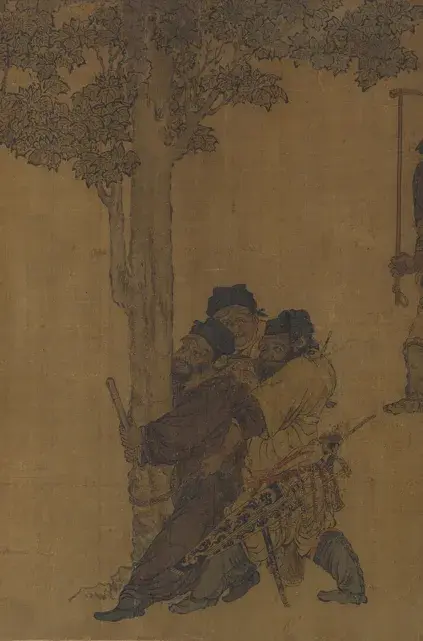
Chained himself to a courtyard tree with an iron lock to halt the lavish construction of Huangyi Hall, winning historical fame.
Intervened during Liu Cong's murderous rages, prostrating himself in blood to save upright councilors and imperial princes.
Elevated to Imperial Censor with the Privilege of Equal Rank to the Three Excellencies, standing at the summit of the censorial apparatus.
Denounced the ascendancy of corrupt palace eunuchs including Wang Shen, warning the throne of impending ruin.
Hanged himself at home after his warnings against eunuch tyranny were rejected, dying a martyr for dynastic integrity.
Chen Yuanda was originally surnamed Gao and belonged to the Rear Division of the Xiongnu in Xinxing Commandery. Because the astrological month of his birth was considered inauspicious to his father according to ancient folk tradition, he adopted the maternal surname Chen. Orphaned at an early age, he endured deep poverty in his youth. Nevertheless, he possessed a natural passion for Confucian classical texts and historical chronicles. He spent decades tilling the soil with his own hands, reciting the Odes and Documents aloud while holding the plough, finding tranquil fulfillment in cultivating moral wisdom.
Chen Yuanda was aloof and proud, refraining from secular associations and remaining in scholarly seclusion until he reached his fortieth year. During the period when Liu Yuan served as Left Worthy Prince of the Five Xiongnu Divisions, word reached him of Chen Yuanda's extraordinary intellectual stature, and Liu Yuan repeatedly dispatched emissaries bearing valuable gifts to invite him into his retinue, but Chen Yuanda declined to emerge.
In 304 CE, Liu Yuan raised troops at Lishi to establish the Han kingdom, proclaiming himself King of Han. Local villagers taunted Chen Yuanda, saying: "In earlier days Lord Liu humbled himself to invite you, yet you treated him with indifference. Now he has claimed kingship and shook the empire; do you not fear destruction?" Chen Yuanda smiled calmly and replied: "How mistaken your words are! Lord Liu possesses transcendent capacity and harbors ambitions to encompass the cosmos; I have recognized his greatness for years. The reason I did not join him previously was because the heavenly season had not arrived. Mark my words: within two or three days, his courier summons will certainly arrive."
That very evening, Liu Yuan's urgent imperial courier reached his cottage, appointing Chen Yuanda Gentleman of the Yellow Gate. Upon arriving at the capital of Pingyang to pay homage, Liu Yuan remarked with a sigh: "Had you come earlier, you would not be holding merely the rank of a court gentleman!" Chen Yuanda answered with serene humility: "I believe every man has his natural capacity; to exceed that capacity invites ruin. Had I entered the palace early, Your Majesty might have granted me supreme ministerial rank, which my novice experience could not bear. By waiting for the proper moment, Your Majesty escapes the criticism of excessive favoritism, and I avoid the disaster of jealousy. Is this not beneficial for both sovereign and subject?" Liu Yuan was overjoyed and held him in profound respect.
Following Liu Yuan's ascension to the imperial throne, Chen Yuanda was promoted to Palace Attendant and Chamberlain for Law Enforcement. In his judicial role, he investigated legal disputes with meticulous discernment and unbending impartiality. He enforced statutory codes with absolute equity, severely punishing powerful nobles who plundered commoners while exonerating innocent peasants caught in regional sweeps, establishing an atmosphere of legal rectitude within the fledgling Han Zhao regime.
In 310 CE, Liu Yuan died, and his eldest son Liu He succeeded him, only to be deposed and slain by Liu Cong, who seized the throne. Recognizing Chen Yuanda's uncompromising integrity, Liu Cong appointed him Left Director of Retainers concurrently with Palace Attendant. The office of Director of Retainers exercised comprehensive censorial jurisdiction over imperial princes, high ministers, and capital dignitaries. In this capacity, Chen Yuanda investigated corruption without fear or favoritism.
Whenever imperial kinsmen or powerful generals violated statutes or deceived the sovereign, Chen Yuanda drafted candid impeachment memorials without hesitation. He conducted his official duties with extreme discretion: after returning from private palace audiences where he submitted remonstrances to the emperor, he invariably burned the drafts of his memorials to ashes, ensuring that not even his closest kin learned of his words, setting an immortal standard of selfless public service.
During the middle period of Liu Cong's reign, the Han Zhao forces captured Luoyang and seized Emperor Huai of Jin. Flushed with victory, Liu Cong succumbed to unrestrained luxury, drunkenness, and sensual indulgence. In 311 CE, to please his favorite consort, Lady Liu (later Empress Wuxuan, Liu E), Liu Cong commanded the expenditure of immense treasury funds and conscripted tens of thousands of laborers to construct the opulent Huangyi Hall within Pingyang Palace. At that time, northern China was devastated by warfare and famine, public coffers were bare, and this extravagant construction provoked widespread indignation among citizens.
Recognizing that this vanity project threatened dynastic survival, Chen Yuanda resolved to remonstrate at the peril of his life. Concealing a heavy iron chain within his robes, he entered the forbidden palace grounds. Walking directly into the courtyard before the grand hall, he wrapped one end of the chain around his own neck and secured the other end firmly to a massive courtyard tree with a padlock. Holding his written remonstrance, he wept aloud toward the throne, pleading with Liu Cong to halt the construction.
Confronted with this dramatic spectacle, Liu Cong was incensed, shouting from the imperial dais: "I am the sovereign of the four seas! Building a single hall for my consort is my private family affair; how does it endanger the altars of state? This insolent slave dares to humiliate me before the court! Guards, drag this wretch away and behead him immediately, and cut down that tree by its roots, so that he has nothing left to chain himself to!"
Witnessing the scene from behind an imperial screen, Lady Liu proved deeply virtuous. She immediately sent confidential eunuchs carrying her personal signet to halt the executioners at the courtyard gates, while drafting an impassioned memorial to Liu Cong. Lady Liu pleaded: "Chen Yuanda is a pillar of the realm who risks his life to speak forthrightly for the eternal stability of Your Majesty's throne. If Your Majesty executes this loyal minister, the empire will brand you a tyrant who murders his advisors, and I would have no face to remain alive!"
Reading Lady Liu's memorial, Liu Cong awoke to his error with deep shame. He descended the palace steps, ordered the chains removed from Chen Yuanda, took the minister's hands, and wept: "I was nearly guilty of slaughtering an irreplaceable loyalist!" Liu Cong ordered the immediate cancellation of Huangyi Hall, designated the tree the "Chen Yuanda Tree," and renamed the palace gate the "Gate for Welcoming Worthies," granting Chen Yuanda one hundred bolts of silk and one hundred bushels of grain in recognition of his unyielding fidelity.
In 314 CE, Chen Yuanda was promoted to Imperial Censor, granted the Privilege of Equal Rank to the Three Excellencies, placing him at the pinnacle of the censorial hierarchy. In his later years, Liu Cong became completely unhinged by debauchery, establishing three empresses simultaneously and executing ministers on minor whims. In court audiences, whenever Liu Cong erupted in murderous rage against forthright advisors, Chen Yuanda would prostrate himself on the flagstones until his forehead bled, contesting every point of law. Liu Cong once remarked with bitter exasperation: "According to imperial rites, you should tremble before me; why is it that I must tremble before you instead?" Chen Yuanda bowed and replied: "An emperor who treats ministers as teachers achieves true kingship; one who treats them as friends achieves hegemony. I only pray Your Majesty emulates Yao and Shun rather than despots who slaughtered advisors; how could I desire that Your Majesty tremble before a humble subject?"
After 315 CE, Liu Cong fell under the insidious influence of senior eunuchs, notably Regular Attendants Wang Shen, Xuan Huai, and Guo Yi, enfeoffing them as full marquises. These corrupt eunuchs sold public offices, accepted bribes, and persecuted honorable officials, plunging the Han Zhao court into moral darkness.
In 316 CE, Chen Yuanda joined Grand Commandant Fan Long in submitting a joint memorial exposing the treasonous corruption of the eunuch clique, warning that Wang Shen and his confederates were subverting the ancestral altars. However, Liu Cong was utterly blinded by his favorites, harshly rebuking Chen Yuanda for slandering loyal servants and elevating the eunuchs to even higher offices.
Retiring from the audience chamber, Chen Yuanda looked up to the heavens and sighed: "The sovereign is hopelessly deceived by palace eunuchs; when the great mansion collapses, a single timber cannot support it. As Imperial Censor, I cannot correct the sovereign's wickedness; how can I bear to sit and watch our temples reduced to rubble!" Returning to his private residence, Chen Yuanda bathed, changed into clean court robes, and hanged himself from the rafters, sacrificing his life in final protest for his country.
News of Chen Yuanda's death plunged the Han Zhao capital into profound mourning; citizens and merchants wept openly in the streets. Stunned and remorseful, Liu Cong ordered a state funeral with grand ministerial honors. Just two years after Chen Yuanda's death, the treason of Jin Zhun erupted, annihilating Liu Cong's progeny and fulfilling Chen Yuanda's tragic prophecy.
Chen Yuanda's dramatic remonstrance stands as one of the most celebrated moral milestones in classical Chinese political history. Faced with the construction of Huangyi Hall amidst wartime famine, he shackled his own neck to a palace tree, defying death to force the cancellation of an extravagant project. This heroic act gave rise to the enduring historical landmarks of the "Chen Yuanda Tree" and the "Gate for Welcoming Worthies," providing generations of scholar-officials with an immortal archetype of selfless courage.
During his tenures as Chamberlain for Law Enforcement and Director of Retainers, Chen Yuanda served as the primary architect of legal discipline within the early Xiongnu-led state. By enforcing codified statutory laws and prosecuting corrupt imperial relatives while burning his private memorial drafts to prevent political patronage, he transformed a turbulent conqueror administration into a disciplined legal order.
In his climactic struggle against the ascendancy of the eunuch faction under Wang Shen, Chen Yuanda demonstrated the ultimate Confucian commitment to moral rectitude. Exhausting every avenue of institutional remonstrance, he chose suicide over silent complicity, issuing a final moral indictment against imperial tyranny that cemented his standing as the foremost heroic remonstrator of the Sixteen Kingdoms.
FIGURES ASSOCIATED WITH THIS DYNASTY