Service to Crown Prince
Selected as Retainer of the Heir Apparent upon Liu Shan's investiture; promoted to Librarian of the Heir Apparent.
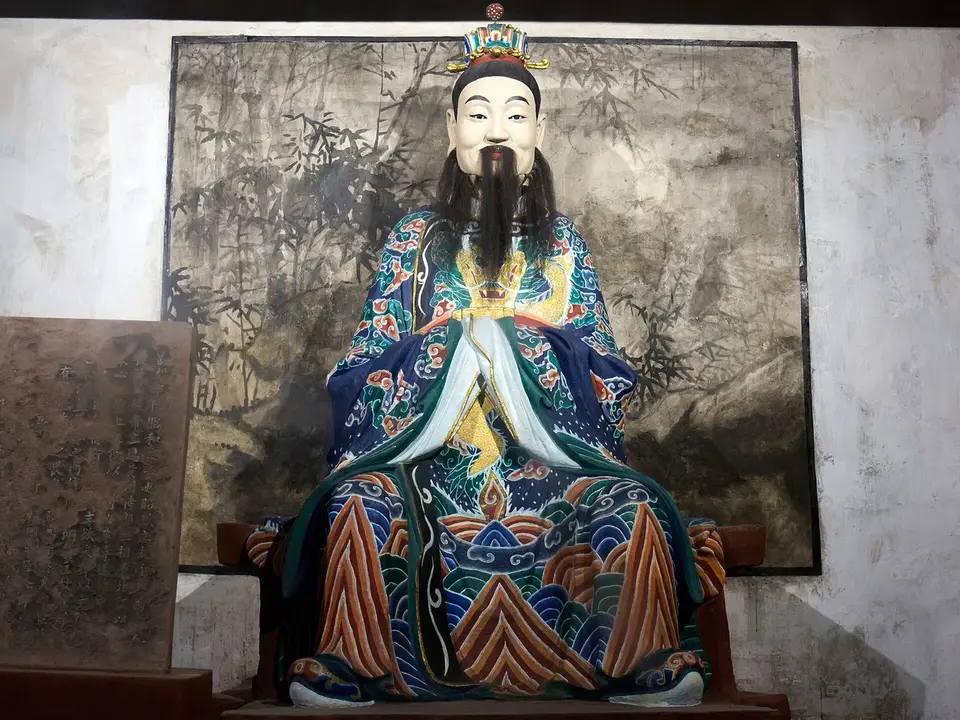
董允
Dong Yun (died 246), courtesy name Xiuzhao, ancestral home in Jiangzhou of Ba Commandery (present-day Chongqing) with subsequent residence in Nanchong of Baxi Commandery (present-day Nanchong, Sichuan Province), was a paramount statesman of the Shu Han regime during the Three Kingdoms Period. Along with Zhuge Liang, Jiang Wan, and Fei Yi, he was revered as one of the "Four Chancellors of Shu Han" (also celebrated as the "Four…
Dong Yun (died 246), courtesy name Xiuzhao, ancestral home in Jiangzhou of Ba Commandery (present-day Chongqing) with subsequent residence in Nanchong of Baxi Commandery (present-day Nanchong, Sichuan Province), was a paramount statesman of the Shu Han regime during the Three Kingdoms Period. Along with Zhuge Liang, Jiang Wan, and Fei Yi, he was revered as one of the "Four Chancellors of Shu Han" (also celebrated as the "Four Heroes"). Born into an honorable official lineage, his father Dong He served as General of the Household Governing the Army. When Liu Shan was designated Crown Prince, Dong Yun was selected as Retainer of the Heir Apparent and later promoted to Librarian of the Heir Apparent. Following Liu Shan's accession to the throne, Dong Yun served as Gentleman Attendant at the Palace Gate and Palace Attendant. Prior to launching the Northern Expeditions, Zhuge Liang singled out Dong Yun alongside Guo Youzhi and Fei Yi in the Memorial on the Expedition as loyal, capable, and pure-minded ministers, entrusting the internal governance of the imperial palace to his care. As Palace Attendant, Dong Yun enforced strict vigilance and upright moral rectitude, firmly rejecting Liu Shan's repeated efforts to expand the imperial harem and sternly checking the corrupt machinations of the eunuch Huang Hao. Under the regencies of Jiang Wan and Fei Yi, Dong Yun was promoted to Bulwark-general of the State and concurrently served as Prefect of the Masters of Writing, playing a vital role in central decision-making while treating junior scholars with genuine humility. Following his death in 246, the populace and scholar-officials of Shu deeply mourned his loss.
Selected as Retainer of the Heir Apparent upon Liu Shan's investiture; promoted to Librarian of the Heir Apparent.
Appointed Gentleman Attendant at the Palace Gate following Liu Shan's accession; later promoted to Palace Attendant.
Highly commended in the Memorial on the Expedition; presided over palace affairs to uphold imperial discipline.
Partnered with Jiang Wan to safeguard state administration; sternly rebuked the scheming eunuch Huang Hao.
Resolutely remonstrated against Liu Shan's plan to expand the palace harem, restricting imperial consorts to no more than twelve.
Granted the title Bulwark-general of the State; consistently declined lavish grants of land and residences.
Concurrently appointed Prefect of the Masters of Writing alongside his duties as Palace Attendant, serving as principal deputy to Fei Yi.
Passed away in office as Palace Attendant and Prefect of the Masters of Writing, deeply mourned across Shu Han.
Dong Yun's ancestral lineage originated from Jiangzhou in Ba Commandery. His father, Dong He, had relocated into Yi Province from Zhijiang in Nan Commandery, eventually serving Liu Bei as General of the Household Governing the Army alongside Zhuge Liang, earning lasting renown for his ascetic frugality and transparent honesty. In his youth, Dong Yun shared a prominent intellectual reputation in Shu alongside Fei Yi, making it difficult even for Dong He to distinguish which of the two possessed greater virtue.
On one occasion, Dong Yun and Fei Yi attended the funeral of Xu Jing's son together. Dong He provided them with a crude, dilapidated carriage. Riding within it, Dong Yun appeared uneasy and self-conscious, while Fei Yi remained completely poised and at ease. Observing their demeanor, Dong He concluded that Fei Yi surpassed Dong Yun in unruffled moral fortitude. Nonetheless, Dong Yun maintained an impeccable reputation for personal rectitude and earnest scholarship.
In 221, when Liu Shan was formally installed as Crown Prince, the court enlisted distinguished young talents to support the Eastern Palace. Dong Yun was chosen as Retainer of the Heir Apparent and soon advanced to Librarian of the Heir Apparent. Following the accession of Liu Shan in 223, Dong Yun was appointed Gentleman Attendant at the Palace Gate, assisting in conveying imperial decrees and advising within the inner court.
In 227, Prime Minister Zhuge Liang prepared to march north to station the army in Hanzhong for the Northern Expeditions. Concerned that Emperor Liu Shan was youthful, gentle, and prone to manipulation by palace sycophants, Zhuge Liang regarded Dong Yun as uniquely upright, discerning, and courageous, making him the ideal guardian for the imperial palace.
In his celebrated Memorial on the Expedition, Zhuge Liang recommended: "Palace Attendants and Gentlemen Attendants Guo Youzhi, Fei Yi, and Dong Yun are honest, experienced, loyal, and pure-minded. The Late Emperor selected them to be bequeathed to Your Majesty. I believe that concerning palace affairs, whether major or minor, Your Majesty should consult them before taking action; they will surely remedy flaws and provide great benefit." As Fei Yi accompanied the northern army as Army Advisor and Guo Youzhi was mild-tempered and reluctant to contest decisions, the full burden of supervising palace security, protocol, and discipline devolved upon Dong Yun alone.
Dong Yun discharged his inner palace duties with relentless vigilance. As Liu Shan matured, the Emperor repeatedly desired to dispatch envoys to select beautiful women from across the country to enlarge the imperial harem. Dong Yun confronted the Emperor with unyielding resolve: "In ancient times, the number of royal consorts never exceeded twelve. Today, the palace establishments are fully equipped and adequate; there must be no further addition!" Confronted by Dong Yun's stern adherence to ritual decorum, Liu Shan yielded and dared not proceed, developing profound awe and trepidation toward him. While Jiang Wan managed outer state administration from the Prime Minister's Bureau, Dong Yun guarded and corrected the Sovereign within the palace, forging seamless internal and external harmony.
Following Zhuge Liang's death in 234, Liu Shan grew increasingly fond of the eunuch Huang Hao. Crafty, flattering, and ambitious, Huang Hao attempted to meddle in court policy. Sensing the perilous threat of eunuch dominance, Dong Yun repeatedly offered stern admonitions to Liu Shan and openly censured Huang Hao whenever the eunuch sought improper influence. Overawed by Dong Yun's intimidating presence and unbending integrity, Huang Hao trembled with fear and dared not commit unlawful deeds throughout Dong Yun's lifetime.
While Jiang Wan served as Prefect of the Masters of Writing and Governor of Yi Province, recognizing Dong Yun's indispensable role in maintaining palace discipline, he petitioned Liu Shan to confer additional noble titles and land endowments upon him. Dong Yun consistently refused all honors and rewards. Throughout his career, he maintained an incorruptible lifestyle, treating subordinate clerks with exceptional warmth and modesty.
On one occasion, Dong Yun arranged an outing and banquet with Prefect of the Masters of Writing Fei Yi and Middle Supervisor of the Army Hu Ji, with carriages and retainers fully harnessed. Just as Dong Yun prepared to step into his carriage, a low-ranking Gentleman of the Household named Dong Hui arrived seeking an audience. Dong Yun immediately ordered the carriage unharnessed to welcome him. Noting his host's postponed departure, the young and junior Dong Hui felt deeply uneasy and requested to take his leave. Dong Yun reassured him: "The original purpose of today's gathering was simply to enjoy conversation with like-minded friends. Now that you have graciously paid a personal visit, we can converse freely. How could I abandon a fruitful discussion at hand to pursue a leisure banquet?" Dong Yun sent apologies to Fei Yi and canceled the excursion, demonstrating his authentic reverence for talent over social rank.
In 243, Dong Yun was granted the rank of Bulwark-general of the State. In 244, as General-in-Chief Jiang Wan was severely incapacitated by illness, the court appointed Fei Yi as General-in-Chief to preside over general military and state administration, while Dong Yun was named Prefect of the Masters of Writing while retaining his duties as Palace Attendant, becoming Fei Yi's primary civil partner in state affairs.
In 246, Dong Yun passed away in office. Following his demise, Chen Zhi took over the post of Palace Attendant. Lacking Dong Yun's moral rigor, Chen Zhi colluded with Huang Hao, enabling the eunuch to manipulate the sovereign, seize imperial power, and ultimately plunge Shu Han into internal decay and ruin. In retrospect, the officials and populace of Shu Han deeply cherished Dong Yun's memory, recognizing that his unyielding supervision had preserved the honor and integrity of the dynasty.
Entrusted with the defense of the inner court by Zhuge Liang in the Memorial on the Expedition, Dong Yun served as an incorruptible guardian against imperial excess. By invoking classical rites to strictly limit the expansion of the royal harem, he curbed the private indulgences of Emperor Liu Shan and established a standard of disciplined governance within the imperial residence.
Recognizing early on the structural peril posed by eunuchs in imperial systems, Dong Yun maintained unremitting pressure against Huang Hao. Through face-to-face confrontations, fearless scolding, and relentless legal scrutiny, he completely blocked Huang Hao from meddling in state affairs for over a decade, preventing the premature decay of the Shu Han court.
In his later years as Prefect of the Masters of Writing and Bulwark-general of the State, Dong Yun assisted Fei Yi in steering national administration during a delicate period of political transition. Rejecting private enrichment and ostentatious honor, he modeled administrative modesty and personal approachability, demonstrating genuine respect for junior scholars and sustaining the institutional zenith of Shu Han governance alongside the other "Four Chancellors."
FIGURES ASSOCIATED WITH THIS DYNASTY