Birth in Ancient Qi
Born in the agricultural plains of Jiaoxi in the Qi state, studying ancient pre-Qin classics and philosophy from youth.
盖公
Gai Gong (盖公, fl. late 3rd to early 2nd century BCE), was a native of Jiaoxi in the ancient state of Qi (modern Gaomi and Anqiu area, Weifang, Shandong Province). He was an illustrious early Western Han Dynasty philosopher, the foremost master of the Qi Huang-Lao Daoist school, and the foundational theoretical architect behind the early Han policy of "governing through tranquility" (Huang-Lao zhi zhi) and the subsequent "Rule…
Gai Gong (盖公, fl. late 3rd to early 2nd century BCE), was a native of Jiaoxi in the ancient state of Qi (modern Gaomi and Anqiu area, Weifang, Shandong Province). He was an illustrious early Western Han Dynasty philosopher, the foremost master of the Qi Huang-Lao Daoist school, and the foundational theoretical architect behind the early Han policy of "governing through tranquility" (Huang-Lao zhi zhi) and the subsequent "Rule of Wen and Jing." Gai Gong inherited an unbroken scholarly transmission from the Warring States Daoist recluse Yuechen Gong, whose intellectual genealogy traced through Anqi Sheng back to the venerable Heshang Zhangren, synthesizing archaic Huang-Lao non-action with pragmatic statecraft. In 194 BCE (first year of Emperor Hui of Han), Cao Shen, Chancellor of the Principality of Qi and founding merit general of the Han Dynasty, sought counsel to restore the war-devastated territory. Learning of Gai Gong's profound reputation, Cao Shen invited him to the capital of Linzi with elaborate ceremonial gifts. In their historic meeting, Gai Gong presented his core governing doctrine: "The way of governance values tranquility, and the people will settle themselves." He advised that the sovereign must practice non-interference, simplify legal codes, reduce taxes and labor corvees, and allow agrarian households to recuperate naturally. Deeply persuaded, Cao Shen vacated his principal hall to house Gai Gong as honored state mentor. Cao applied these tenets in Qi for nine years with immense success before carrying them to the imperial court as Chancellor of the Western Han, instituting the enduring statecraft known as "Cao Shen Following Xiao He's Precedents" (Xiao Gui Cao Sui). Gai Gong declined political office to live in rustic retirement along the Wei River, commemorated centuries later by Northern Song poet Su Shi in his celebrated Record of the Hall of Master Gai.
Born in the agricultural plains of Jiaoxi in the Qi state, studying ancient pre-Qin classics and philosophy from youth.
Apprenticed under the Qi master Yuechen Gong, inheriting the esoteric Huang-Lao non-action doctrine stemming from Heshang Zhangren.
Following the founding of the Han Dynasty, chose rustic retirement along the Wei River in Jiaoxi, teaching students and declining office.
Invited by Qi Chancellor Cao Shen to Linzi, articulating the core doctrine that governance values tranquility so the people settle themselves.
Cao Shen implemented Gai Gong's policies across Qi for nine years, establishing an era of regional prosperity and agrarian peace.
Cao Shen succeeded Xiao He as Imperial Chancellor of Han, implementing Gai Gong's non-action philosophy empire-wide.
Retired permanently to Mount Gaigong in eastern Shandong, passing away in tranquility and interred along the Wei River.
Gai Gong lived through the tumultuous transition from the Warring States period through the Qin Dynasty and into the early Western Han. He was born in Jiaoxi in the state of Qi (modern Gaomi and Anqiu, Shandong Province). During the late Zhou era, Qi was the intellectual capital of China, home to the Jixia Academy where Daoist, Legalist, and Confucian thinkers debated. Gai Gong possessed a contemplative nature, dedicating his life to the moral and cosmological doctrines of the Daodejing rather than seeking bureaucratic office.
He studied under Yuechen Gong, a prominent Warring States Daoist thinker. In regional intellectual history, the Qi Huang-Lao tradition preserved a rigorous master-disciple lineage: beginning with the archaic hermit Heshang Zhangren, it passed to Anqi Sheng, Mao Menggong, Yue Xiagong, Yuechen Gong, and ultimately to Gai Gong. This school synthesized the Laozi doctrine of natural non-action (wuwei) with realistic legal administrative techniques, asserting that government should remain minimal, unburdensome, and predictable so that society could self-regulate. Following the devastation of the Chu-Han Contention, Gai Gong established a quiet retreat along the Wei River in Jiaoxi, where his moral reputation spread widely.
In 202 BCE, Emperor Gaozu of Han enfeoffed his eldest son Liu Fei as Prince of Qi, governing seventy-three cities from Linzi, and assigned founding general Cao Shen to serve as Chancellor of Qi. Having endured decades of destructive warfare, the population of Qi was decimated, farmlands lay overgrown with weeds, and urban commerce was paralyzed. Eager to restore order, Cao Shen convened hundreds of local Confucian scholars and advisors. However, the scholars offered conflicting counsel, with some demanding the immediate imposition of complex ancient rituals and others urging severe penal measures, leaving Cao Shen undecided.
Learning that Master Gai was a reclusive master of Huang-Lao thought residing in Jiaoxi, Cao Shen dispatched messengers with lavish gifts to invite him to Linzi. When Gai Gong arrived, they engaged in a prolonged political dialogue that later historians compared to Zhuge Liang's Longzhong Plan. Addressing the exhausted condition of post-war society, Gai Gong summarized his administrative philosophy in eight enduring words: "The way of governance values tranquility, and the people will settle themselves."
Gai Gong explained that the Qin Dynasty collapsed because its laws were tyrannical, its taxes exorbitant, and its endless corvee levies drained society to satisfy imperial ambition. Having survived catastrophe, the common people desperately craved stability. If the government continued to agitate them with constant decrees, labor levies, and artificial moral campaigns, social collapse was inevitable. The supreme art of governing lay in the ruler subduing his own activism, pruning administrative interferences, minimizing taxes and punishments, and granting agrarian families the liberty to cultivate and trade unhindered.
Cao Shen was profoundly enlightened by Gai Gong's words. In an extraordinary gesture of reverence, the chancellor vacated his primary administrative mansion, installing Gai Gong as his personal honored teacher while conducting official affairs from side quarters. Guided by Gai Gong, Cao Shen overhauled provincial administration across Qi under the motto of "simplifying laws, reducing penalties, and resting the people." He eliminated intrusive regulations, curtailed forced labor, and avoided meddling in private agrarian trade.
Cao Shen governed Qi using Gai Gong's Huang-Lao principles for nine consecutive years. Without violent coercion or administrative upheaval, Qi transformed from a ruined landscape into the wealthiest, most populous, and most politically harmonious territory in the empire, earning Cao Shen renown as a model chancellor. In 190 BCE, following the death of Imperial Chancellor Xiao He, Cao Shen was summoned to the imperial capital of Chang'an to become Chancellor of the Han Empire. Adhering faithfully to Gai Gong's instruction, Cao Shen preserved the administrative precedents established by Xiao He, prohibiting minor officials from generating disruptive decrees—a policy celebrated as "Cao Shen Following Xiao He's Precedents" (Xiao Gui Cao Sui). This tranquil doctrine became the foundational policy of the Han state, enabling decades of unhindered economic recovery that culminated in the golden age of the "Rule of Wen and Jing."
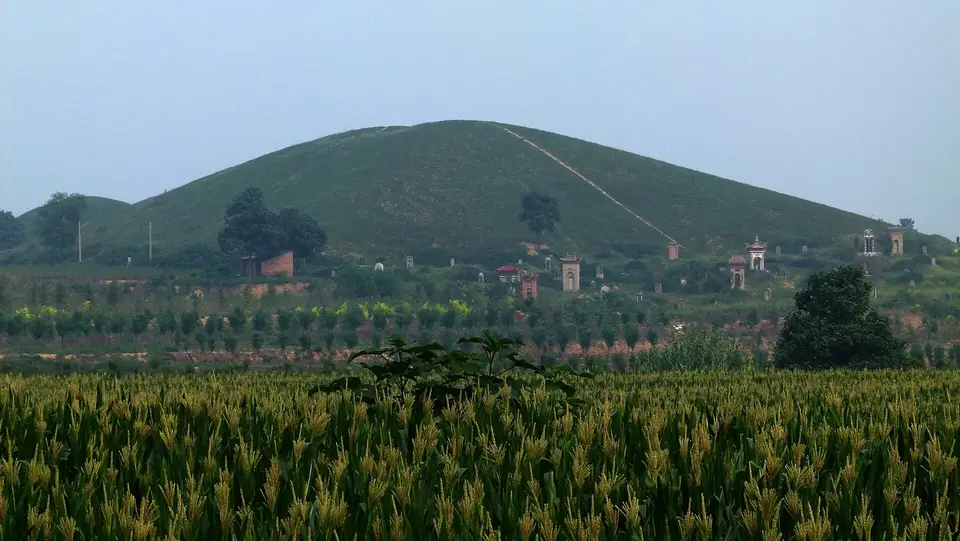
Gai Gong was indifferent to worldly fame and material riches. Having imparted the theoretical blueprint for national recovery, he declined Cao Shen's urgent offers of high provincial office. Instead, he returned quietly to his rural retreat in Jiaoxi, living as an independent recluse. Following his peaceful passing, he was laid to rest on Mount Gaigong along the western bank of the Wei River (modern Xiashan Reservoir area, Weifang), where local communities erected shrines to honor his wisdom.
During the Xining era of the Northern Song Dynasty, eminent poet and statesman Su Shi served as Prefect of Mizhou, whose jurisdiction encompassed ancient Jiaoxi. Admiring Gai Gong's political philosophy amidst contemporary political controversies over regulatory overreach, Su Shi rode along the Wei River to locate Gai Gong's tomb. When he found the ancient grave obscured by time, Su Shi constructed the "Hall of Master Gai" beside the Chaoran Terrace in Mizhou, penning his famous essay Record of the Hall of Master Gai (Gaigong Tang Ji) to celebrate the ancient philosopher who restored an empire through tranquility.
Gai Gong's crowning contribution to Chinese political theory was his formulation of the principle that "governing values tranquility so that the people settle themselves." Recognizing that post-war societies suffered from administrative exhaustion rather than a lack of laws, he established that the ultimate virtue of rulership lay in restraint, light taxation, and the avoidance of disruptive state interventions. This insight dismantled the ideological monopoly of harsh Qin Legalism, providing the foundational theoretical framework for early Western Han governance.
Under Gai Gong's direct mentoring, Chancellor Cao Shen translated metaphysical Huang-Lao philosophy into concrete regional administration. By eliminating superfluous bureaucratic intrusions and maintaining minimal penal enforcement, the government allowed agrarian households to direct their energies toward production. Within a decade, Qi emerged as the most prosperous region of the early Han Empire, establishing an enduring historical benchmark for provincial post-war rehabilitation.
Gai Gong's intellectual influence extended from regional governance to imperial statecraft. When Cao Shen assumed the imperial chancellorship in Chang'an, he applied Gai Gong's non-action tenets across the entire Chinese empire under the policy of "Cao Shen Following Xiao He's Precedents." This policy of administrative restraint was subsequently embraced by Emperor Wen, Emperor Jing, and Empress Dou, providing half a century of uninterrupted social peace that enriched national granaries and established the celebrated "Rule of Wen and Jing."
In an era when scholars aggressively sought bureaucratic titles, Gai Gong embodied the loftiest Daoist virtues of detachment. Having served as the intellectual architect of dynastic recovery, he refused high salaries, aristocratic honors, and bureaucratic office, retiring to his rural homestead to live in obscurity. His choice fulfilled the ancient ideal of achieving great merit without claiming possession, winning the enduring veneration of later historians and philosophers.
In the eleventh century, Northern Song literary master Su Shi found enduring inspiration in Gai Gong's life. While serving as Prefect of Mizhou, Su Shi erected the Hall of Master Gai and composed the classical essay Record of the Hall of Master Gai. Su Shi argued that the seventy years of peace and prosperity enjoyed by the early Han Dynasty traced directly to Gai Gong's counsel along the Wei River, cementing Gai Gong's place in Chinese cultural memory as an exemplar of humane, non-intrusive governance.
FIGURES ASSOCIATED WITH THIS DYNASTY