Entry into the Palace
Recommended by the Goryeo eunuch Tumander to serve tea to Emperor Huizong; suffered flogging and branding by Primary Empress Danashiri out of jealousy.
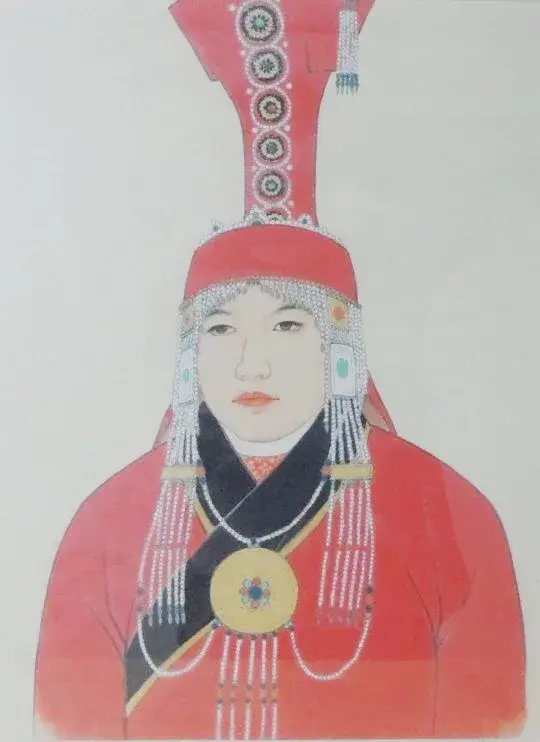
完者忽都
Öljei Khutugh (完者忽都, c. 1315 – 1369 or early 1370), née Ki and commonly known as Empress Ki, a native of Haengju in Goryeo (modern Goyang, Gyeonggi Province, South Korea), was the youngest daughter of the Goryeo official Ki Ja-o (posthumously enfeoffed by the Yuan as King of Rong'an and King of Jing), the third Primary Empress of Emperor Huizong (Toghon Temür) of the Yuan dynasty, and the mother of Emperor Zhaozong…
Öljei Khutugh (完者忽都, c. 1315 – 1369 or early 1370), née Ki and commonly known as Empress Ki, a native of Haengju in Goryeo (modern Goyang, Gyeonggi Province, South Korea), was the youngest daughter of the Goryeo official Ki Ja-o (posthumously enfeoffed by the Yuan as King of Rong'an and King of Jing), the third Primary Empress of Emperor Huizong (Toghon Temür) of the Yuan dynasty, and the mother of Emperor Zhaozong (Ayushiridara) of the Northern Yuan. Entering the Yuan palace around 1333 as a Goryeo tribute woman to serve tea to the young emperor, she won Toghon Temür's deep favor through her intelligence and endured brutal flogging and branding at the hands of Primary Empress Danashiri. After giving birth to the emperor's eldest son Ayushiridara in the winter of 1339 and following the fall of the regent Bayan in early 1340, she was invested as Second Empress residing in the Xingsheng Palace, with the Bureau of Empress's Administration reorganized as the Zizhengyuan under her control. Initially cultivating the image of a virtuous empress—studying the Book of Filial Piety for Women, supporting the return of Chief Councillor Toqto'a in 1349, and relieving famine victims and burying over 100,000 starvation dead in Daidu in 1358—she built a powerful political faction through Goryeo eunuchs such as Gao Longpu and Park Bulhwa and a network of Goryeo palace women. After King Gongmin of Goryeo exterminated her brother Ki Cheol and the Ki clan in Goryeo in 1356, she conspired from 1359 with Crown Prince Ayushiridara to force Emperor Huizong to abdicate, driving Left Chief Councillor He Weiyi (Taiping) to his death, launching a disastrous 10,000-man expedition against Goryeo in 1364, and triggering a destructive civil war with the warlord Bolad Temür, who confined her outside the palace for a hundred days in 1365. Following Bolad Temür's assassination and the death of Primary Empress Bayan Khutugh, she was formally invested as Primary Empress in the twelfth month of 1365 with the Mongol name Öljei Khutugh, fled north to Shangdu when Ming forces approached Daidu in 1368, and died shortly thereafter.
Recommended by the Goryeo eunuch Tumander to serve tea to Emperor Huizong; suffered flogging and branding by Primary Empress Danashiri out of jealousy.
Following the execution of Empress Danashiri, Emperor Huizong wished to make Lady Ki empress, but was blocked by Chief Councillor Bayan, who insisted on selecting Bayan Khutugh of the Qonggirad clan.
Gave birth in winter to the emperor's eldest son, Ayushiridara.
Following Bayan's downfall in the second month, was invested in the fourth month as Second Empress at the Xingsheng Palace; established the Zizhengyuan in the twelfth month and secured the posthumous title King of Rong'an for her father Ki Ja-o.
Having fostered Prince Ayushiridara in Toqto'a's household, actively promoted Toqto'a's reappointment as Right Chief Councillor.
In the fifth month, King Gongmin of Goryeo executed her elder brother Ki Cheol and wiped out the Ki family in Goryeo.
Ordered palace gruel kitchens to feed starving residents during the Daidu famine and commissioned Zizhengyuan Commissioner Park Bulhwa to bury over 100,000 famine victims outside the eleven city gates.
Conspired with Crown Prince Ayushiridara to compel Emperor Huizong to abdicate, resulting in the removal and death of Left Chief Councillor He Weiyi (Taiping) the following year.
Sent Choe Yu with 10,000 troops in the first month to install Prince Deokheung on the Goryeo throne, suffering total defeat at Dalcheon; clashed with warlord Bolad Temür, who confined her outside the palace for a hundred days in the spring of 1365.
Following Bolad Temür's assassination in the seventh month and Empress Bayan Khutugh's death in the eighth month, received the imperial seal and investiture book as Primary Empress in the twelfth month, renaming the Zizhengyuan the Chongzhengyuan.
Fled north from Daidu to Shangdu with Emperor Huizong and the court in the intercalary seventh month as Ming armies approached; died around 1369 or early 1370.
Although the History of Yuan describes her family as "humble," Goryeo historical records demonstrate that Öljei Khutugh belonged to the prominent military-aristocratic Ki clan of Haengju (modern Goyang, Gyeonggi Province, South Korea), which had produced several chief ministers under the Goryeo military regime since the late twelfth century. Her great-great-grandfather Ki Yun-suk had served as Manager of Affairs with the Secretariat-Chancellery and Minister of Personnel, her great-grandfather Ki Hong-yeong as General of the Left and Right Guards, and her grandfather Ki Gwan as Right Commissioner of the Three Offices and Grand General; her father Ki Ja-o rose through hereditary privilege to Supernumerary Gentleman of the Ministry of War (rank 6a) and Defense Commander of Seonju, dying of illness in 1328. Born to Ki Ja-o and Lady Yi (daughter of National University Libationer Yi Haeng-geom) after 1309 on the fifteenth day of the sixth month, she was the youngest daughter of the family.
Around 1333 (4th year of the Zhishun era), Lady Ki entered the Yuan imperial palace in Daidu as a Goryeo tribute woman. That same year, Toghon Temür ascended the throne as Emperor Huizong (Shundi) and invested Danashiri, daughter of the Qipchaq strongman El Temür, as Primary Empress. Recommended by the Goryeo-born eunuch Tumander (originally surnamed Jeong), Commissioner of the Bureau of Empress's Administration, the clever and graceful Lady Ki was assigned to serve tea to Emperor Huizong and soon won his ardent favor. Arrogant and jealous, Empress Danashiri despised the young emperor and vented her fury on Lady Ki, flogging her day and night and on one occasion summoning her at night to kneel under interrogation while branding her flesh with hot irons. When the Astronomical Bureau reported the next morning that "Mars invaded the constellation of the Imperial Consorts last night," Emperor Huizong—then biding his time under the dominance of El Temür's clan—said nothing, but cherished Lady Ki all the more deeply while conceiving an implacable hatred for Danashiri.
In the sixth month of 1335 (3rd year of the Yuantong era), after Danashiri's brother Tangqishi was executed for treason and Danashiri herself was deposed and poisoned, Emperor Huizong wished to install Lady Ki as Primary Empress. However, the new strongman, Grand Preceptor and Right Chief Councillor Bayan, firmly objected on the grounds that Yuan dynastic law reserved the primary empressship for noblewomen of the Qonggirad clan and that Kublai Khan had established an ancestral rule against sharing state affairs with Goryeo women. Forced to yield, Emperor Huizong invested the Qonggirad noblewoman Bayan Khutugh as Primary Empress, yet Lady Ki remained his favorite and gave birth to his eldest son, Ayushiridara, in the winter of 1339 (5th year of the Zhiyuan era).
In the second month of 1340 (6th year of the Zhiyuan era), Emperor Huizong overthrew Bayan with the assistance of Toqto'a and assumed personal rule. In the fourth month, acting on the advice of Academician Shalaban, the emperor invested Lady Ki as "Second Empress," residing in the Xingsheng Palace; in the twelfth month, he reorganized the Bureau of Empress's Administration into the "Zizhengyuan" exclusively for her, assigning it the revenues of the Zhaogong Myriarchy and the wealthy Jiangnan prefecture of Jiqing Circuit (modern Nanjing, Jiangsu Province). He simultaneously lavished honors upon her family in Goryeo: posthumously enfeoffing her father Ki Ja-o as King of Rong'an (later King of Jing) with a spirit-way stele composed by Hanlin Academician Ouyang Xuan, titling her mother Lady Yi Grand Consort of the King of Rong'an, and appointing her elder brothers Ki Cheol as Participant in Determining Governmental Matters of the Branch Secretariat for Eastern Expeditions and Ki Won as Hanlin Academician.
In the early years after her investiture, Empress Ki carefully cultivated the persona of a model consort. In her leisure hours she read the Book of Filial Piety for Women (Nü Xiaojing) and historical annals, inquiring after the deeds of virtuous empresses of past dynasties; whenever rare delicacies were presented as tribute from the provinces, she sent envoys to offer them at the Imperial Ancestral Temple before tasting them herself. She insisted that Prince Ayushiridara study the Confucian teachings of Confucius and Mencius, rebuffing the Tibetan Buddhist Imperial Preceptor who opposed Confucian education for the heir apparent. Having fostered Ayushiridara in the residence of the capable minister Toqto'a, she played a key role in 1349 (9th year of the Zhizheng era) in securing Toqto'a's recall as Right Chief Councillor. During the catastrophic famine that struck Daidu in 1358 (18th year of the Zhizheng era), Empress Ki ordered the palace to distribute rice gruel to starving citizens and provided gold, silver, grain, and silk to Zizhengyuan Commissioner Park Bulhwa to purchase burial grounds outside the eleven gates of Daidu, interring more than 100,000 famine victims and sponsoring Buddhist Water-and-Land Assemblies for their souls. When Emperor Huizong neglected state affairs to indulge in mechanical carpentry and palace "Tantra Dances," she tugged at his sleeve in remonstrance—provoking him to shout angrily, "Am I the only one in past and present?" and stay away from her palace for two months.
Using the Zizhengyuan as her institutional base, Empress Ki steadily expanded her political reach. She appointed the Goryeo-born eunuchs Gao Longpu and Park Bulhwa to head the Zizhengyuan, forming the influential "Zizhengyuan Faction," and brought numerous beautiful girls from Goryeo to be trained in palace etiquette before presenting them as consorts to powerful Yuan princes and ministers, creating an extensive political network while popularizing Goryeo attire, footwear, utensils, and cuisine across the Yuan capital.
In Goryeo, however, her brothers Ki Cheol, Ki Won, Ki Ju, and Ki Ryun abused her imperial backing to seize lands and slaves at will, domineering over the Goryeo court. Concerned that her relatives' excesses would tarnish her position, Empress Ki issued an edict to Goryeo in 1344 warning her kinsmen not to seize people's lands or servants on pain of punishment, yet the abuses continued unabated: in 1347 her cousin Ki Sam-man died after being flogged by the Goryeo Reform Directorate for land grabbing, and in 1352 Ki Won was killed during the coup of Jo Il-sin. In the fifth month of 1356 (16th year of the Zhizheng era), taking advantage of the Red Turban rebellions sweeping Yuan China (during which Zhu Yuanzhang captured Empress Ki's appanage of Jiqing Circuit in March 1356), King Gongmin of Goryeo launched a decisive coup, executing Ki Cheol and exterminating the entire Ki faction in Goryeo, while Empress Ki's mother Lady Yi died of grief and shock. Although Emperor Huizong initially imprisoned Goryeo envoys and threatened to send 800,000 troops, domestic rebellions forced the Yuan court to pardon King Gongmin, leaving Empress Ki consumed with a desire for vengeance.
By 1359 (19th year of the Zhizheng era), as Emperor Huizong grew increasingly indolent, Empress Ki conspired with Crown Prince Ayushiridara to compel the emperor to abdicate in his son's favor. Through Zizhengyuan Commissioner Park Bulhwa, they summoned Left Chief Councillor He Weiyi (Taiping) to the palace to propose the abdication; when He Weiyi refused to comply, mother and son engineered his dismissal in 1360 and hounded him to his death, installing their ally Chosbal (ShuosiJian) as Right Chief Councillor against the emperor's maternal uncle Laodisha. When Censor-in-Chief Fojianu refused to shield the impeached Park Bulhwa, Empress Ki had Fojianu impeached and banished to Chaohe.
In 1363 (23rd year of the Zhizheng era), Empress Ki pressed Crown Prince Ayushiridara to avenge her slaughtered family by invading Goryeo. Despite the personal appeals of her cousin Yi Gong-su, sent as envoy by King Gongmin, she insisted on war: the Yuan court deposed King Gongmin, installed Prince Deokheung (Tasi Temür) as the new King of Goryeo with the Ki clan's grandson Sambonu as crown prince, and in the first month of 1364 dispatched the Goryeo turncoat Choe Yu with 10,000 Yuan troops across the Yalu River. After briefly taking Seonju, the Yuan expeditionary force was annihilated at Dalcheon by the Goryeo generals Choe Yeong and Yi Seong-gye, with barely seventeen horsemen escaping back to Daidu, leaving Empress Ki deeply humiliated.
Turning immediately against the Datong warlord Bolad Temür—the last military obstacle to the Crown Prince's takeover and the protector of Laodisha—Ayushiridara stripped Bolad Temür of his command in the third month of 1364. Bolad Temür marched on Daidu to "clear the emperor's side," forcing Emperor Huizong to hand over Chosbal and Park Bulhwa for execution. When the Crown Prince resumed hostilities in the fifth month, Bolad Temür routed his forces, drove the Crown Prince to flee to Köke Temür (Wang Baobao) in Taiyuan, and occupied Daidu as chief councillor. In the third month of 1365 (25th year of the Zhizheng era), Bolad Temür forged an imperial edict expelling Empress Ki from the palace and confining her outside the Houzai Gate in the Directorate General of Artisans under the guard of Yao Bayan Bukha; on the second day of the fourth month, he forced her back to the palace to hand over her empress seal so he could forge letters luring the Crown Prince back, then returned her to confinement. Presenting Goryeo beauties to Bolad Temür to soften his vigilance, she secured her return to the palace after a hundred days. Ten days later, on the twenty-ninth day of the seventh month, Emperor Huizong had Bolad Temür assassinated. When Empress Ki sent orders urging the returning Crown Prince to use Köke Temür's army to force the emperor's abdication, Köke Temür refused and dispersed his troops thirty li outside Daidu, igniting renewed civil war between the Crown Prince's faction and Köke Temür.
After Primary Empress Bayan Khutugh died of illness in the eighth month of 1365 following the trauma of Bolad Temür's coup, the Secretariat petitioned in the twelfth month to elevate Second Empress Ki to Primary Empress and rename the Zizhengyuan the Chongzhengyuan (concurrently overseeing the Zhongzhengyuan). Emperor Huizong granted her the golden seal and investiture book of Primary Empress, bestowing upon her the Mongol name "Öljei Khutugh."
While the Yuan court was paralyzed by internal warfare, Zhu Yuanzhang launched a 250,000-man northern expedition in the tenth month of 1367 and founded the Ming dynasty in early 1368. On the night of the twenty-eighth day of the intercalary seventh month of 1368 (28th year of the Zhizheng era), as Ming armies reached Tongzhou, Emperor Huizong fled north through the Jiande Gate toward Shangdu accompanied by Empress Öljei Khutugh, Crown Prince Ayushiridara, and over a hundred officials. Even during the flight south of the Central Capital, she urged her son to order Naghachu to attack Goryeo once more to avenge her family, though Ayushiridara declined. According to the New History of Yuan (Xin Yuan Shi) and contemporary records, she died in late 1369 or early 1370 before the fall of Yingchang, around the age of fifty-five.
Öljei Khutugh was the only Goryeo tribute woman in Mongol-Yuan history to overturn the dynastic monopoly of the Qonggirad consort clan and rise to Second Empress and Primary Empress. Through the Zizhengyuan—funded by the revenues of the Zhaogong Myriarchy and Jiqing Circuit and staffed by Goryeo eunuchs—and through marriages linking Goryeo palace women to top Yuan nobles, she exercised vast influence over court appointments for nearly three decades, while sparking a vogue for Goryeo clothing, hats, shoes, utensils, cakes, and music across the Yuan capital.
During the devastating Daidu famine of 1358, Öljei Khutugh organized palace gruel kitchens to feed refugees and funded the burial of over 100,000 starvation victims outside the eleven gates of Daidu. In state politics, however, her relentless drive from 1359 onward to force Emperor Huizong's abdication and avenge her Goryeo kinsmen led directly to the purge of capable ministers, the disastrous 1364 invasion of Goryeo, and the internecine civil war between Bolad Temür and Köke Temür, fatally exhausting the military strength of the Yuan empire on the eve of the Ming northern expedition.
FIGURES ASSOCIATED WITH THIS DYNASTY