Peasant Birth
Born into a farming family in Cheng County, Donghai Commandery; engaged in manual labor while studying classics.
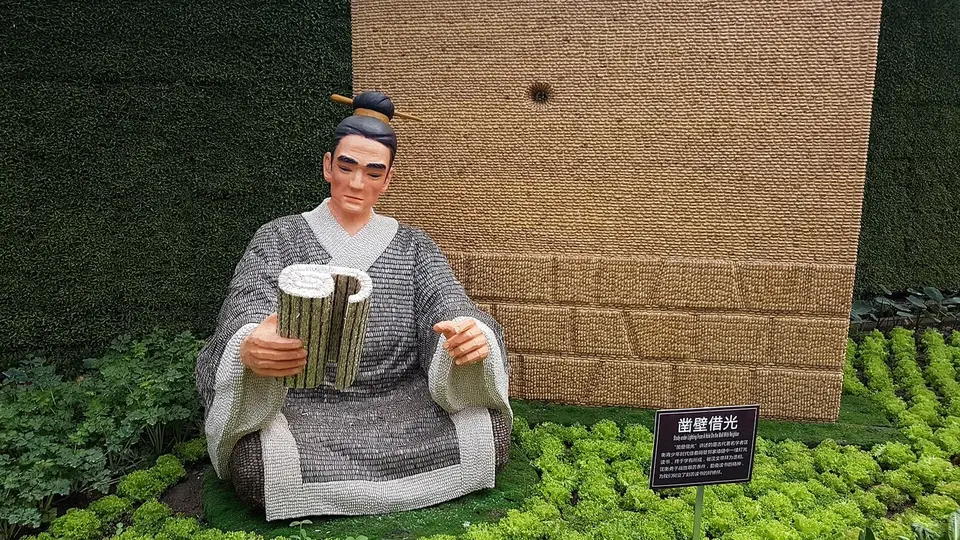
匡衡
Kuang Heng (匡衡, dates of birth and death unknown), courtesy name Zhigui (稚圭), childhood name Kuang Ding (匡鼎), was a native of Cheng County, Donghai Commandery (modern Yicheng District, Zaozhuang, Shandong Province). He was an illustrious Confucian scholar, statesman, and master of the Classic of Poetry (Shijing) during the late Western Han dynasty, rising from agricultural poverty to Chancellor and ennobled as the…
Kuang Heng (匡衡, dates of birth and death unknown), courtesy name Zhigui (稚圭), childhood name Kuang Ding (匡鼎), was a native of Cheng County, Donghai Commandery (modern Yicheng District, Zaozhuang, Shandong Province). He was an illustrious Confucian scholar, statesman, and master of the Classic of Poetry (Shijing) during the late Western Han dynasty, rising from agricultural poverty to Chancellor and ennobled as the Marquis of Le'an. Hailing from a peasant family, Kuang suffered extreme destitution in childhood. Unable to afford lamp oil, he carved a small aperture in his mud wall to catch candlelight from his neighbor's house, inspiring the famous Chinese idiom "boring a hole in the wall to steal light" (zaobi touguang). Kuang dedicated his scholarship to the Classic of Poetry, attaining unparalleled exegetical depth and synthesizing the Lu and Qi traditions. His lectures in Chang'an earned universal acclaim among scholars, commemorated in the contemporary saying: "Do not lecture on the Odes until Kuang Ding arrives; when Kuang expounds the Odes, all faces break into smiles." Under Emperor Xuan, Kuang passed civil exams in the lower tier, serving humbly as an archivist. With the accession of Emperor Yuan, an avid patron of Confucianism, Kuang rose rapidly upon recommendations from Grand Minister of War Shi Gao and Xiao Wangzhi, advancing to Erudite, Palace Attendant, Junior Tutor to the Crown Prince, and Censor-in-Chief. In 34 BCE (the 5th year of the Jianzhao era), he succeeded Wei Xuancheng as Chancellor, ennobled as Marquis of Le'an. As Chancellor, Kuang advocated statecraft rooted in ritual decorum, classical righteousness, and fiscal retrenchment. He reformed the imperial sacrificial system, abolishing extravagant cults at Ganquan and Fenyin to establish the orthodox suburban sacrifices at the southern and northern outskirts of Chang'an, an institutional standard that endured for two millennia. However, during Emperor Yuan's illness, Kuang compromised with the influential eunuch Shi Xian to preserve his office, only submitting memorials to impeach Shi after Emperor Cheng mounted the throne, drawing moral censure from contemporary scholars. In 30 BCE (the 3rd year of the Jianshi era), Kuang was impeached by judicial censors for illegally expanding his private fiefdom by more than four hundred qing of arable land. Dismissed from the premiership and stripped of his noble title, he was relegated to commoner status and returned to his native Cheng County, where he passed away in retirement. Kuang's career epitomized both the scholarly triumphs and political vulnerabilities of Confucian scholar-officials during the Western Han dynasty.
Born into a farming family in Cheng County, Donghai Commandery; engaged in manual labor while studying classics.
Too poor to buy oil, bored a hole through a neighbor's wall to study by candlelight; mastered the Classic of Poetry.
Traveled to Chang'an; passed imperial examinations in the third rank and appointed ritual archivist in the Ministry of Ceremonies.
Recommended by Shi Gao upon Emperor Yuan's accession; appointed Erudite and Palace Attendant.
Promoted to Junior Tutor to the Crown Prince; instructed Crown Prince Liu Ao (Emperor Cheng) in the Confucian classics.
Promoted to Censor-in-Chief (Imperial Counselor), entering the supreme ministerial triumvirate.
Succeeded Wei Xuancheng as Chancellor of the Western Han; created Marquis of Le'an with a fief of six hundred households.
Emperor Cheng ascended the throne; Kuang submitted memorials indicting the corrupt eunuch director Shi Xian.
Impeached for unlawfully annexing four hundred qing of commandery farmland; stripped of chancellorship and noble rank.
Retired to Cheng County, gathering students to lecture on the Odes; passed away at his home.
Kuang Heng was born into an ordinary farming household in Cheng County, Donghai Commandery. In Han society, peasant youths without noble ancestry faced a lifetime of agricultural toil. Endowed with an insatiable passion for learning, Kuang was hindered by extreme poverty, lacking even the money to purchase lamp oil or candles.
To study after dark, the young Kuang hollowed out a small crevice in his plaster wall, using the faint rays of candlelight escaping from his wealthier neighbor's home to read through the night. Lacking books of his own, Kuang offered his labor to affluent local families with private libraries. When asked what wages he sought, Kuang replied: "I ask for no silver; I desire only permission to read your household books as my compensation." Deeply moved by his scholarly devotion, the householder granted him unrestricted access to his library.
Kuang concentrated his intellectual energy on the Confucian Classic of Poetry (Shijing), penetrating the moral and political nuances of the Airs, Odes, and Hymns. Amidst competing schools of Han classical exegesis, Kuang integrated the Lu and Qi interpretive traditions, delivering lectures characterized by elegant prose and penetrating philosophical analysis. Scholars in Chang'an and eastern commanderies held him in profound esteem, creating the enduring popular proverb: "Do not expound the Odes until Kuang Ding arrives; when Kuang expounds the Odes, all faces break into smiles."
Despite his renown, Kuang's early administrative career was stalled by bureaucratic formalism. Han civil service examinations required candidates to pass policy tests administered by the Ministry of Ceremonies. Kuang's uncompromising intellectual independence failed to align with rigid examination criteria; he took the examination nine times, never achieving higher than the third tier (C class). By administrative statute, third-tier scholars were assigned only as ritual clerks (zhanggu) in the Ministry of Ceremonies, earning meager stipends and managing minor sacrificial duties. Eventually, he was transferred to serve as regional instructor in Pingyuan Commandery.
In Pingyuan, Kuang dedicated himself to educating local scholars, gaining wide acclaim throughout eastern China. Toward the end of Emperor Xuan's reign, senior officials recommended him to the throne, but Emperor Xuan favored Legalist administrative methods and refrained from appointing him.
The situation transformed when Emperor Yuan ascended the throne in 48 BCE. Revering Confucian governance, Emperor Yuan issued edicts seeking eminent classical scholars. The emperor's maternal grand-uncle, Grand Minister of War Shi Gao, and tutor Xiao Wangzhi urgently commended Kuang. Summoned to the imperial palace, Kuang discoursed on the moral governance of the Odes and contemporary statecraft with sparkling brilliance. Delighted by his learning, Emperor Yuan appointed him Erudite, subsequently naming him Palace Attendant.
In 42 BCE (the 2nd year of the Yongguang era), Kuang was promoted to Junior Tutor to the Crown Prince, charged with educating Crown Prince Liu Ao (the future Emperor Cheng) in the classics. Kuang presented foundational memorials on royal marriage ethics and ritual governance, emphasizing moral leadership and benevolence. In 36 BCE (the 3rd year of the Jianzhao era), Kuang was elevated to Censor-in-Chief.
In 34 BCE (the 5th year of the Jianzhao era), Chancellor Wei Xuancheng died in office. Emperor Yuan promoted Kuang to Chancellor, elevating him to the peerage as Marquis of Le'an with a fief of six hundred households. The peasant boy who had borrowed candlelight stood at the pinnacle of imperial governance.
As Chancellor, Kuang implemented sweeping Confucian ritual reforms. Investigating Western Zhou precedents, he observed that Han imperial sacrifices were decentralized and fiscally wasteful, with the emperor making costly journeys to Ganquan to sacrifice to Heaven and to Fenyin to sacrifice to Earth, mingling imperial rites with regional sorcery. Kuang and Censor-in-Chief Zhang Tan submitted memorials recommending that the suburban sacrifices be permanently relocated to the southern and northern outskirts of the capital Chang'an, establishing the orthodox suburban sacrificial system that endured across dynasties for over two thousand years. Concurrently, he abolished thousands of uncanonical shrines across the empire, reducing massive imperial expenditures.
However, during Emperor Yuan's declining health, the eunuch Palace Director of the Secretariat, Shi Xian, monopolized court patronage and persecuted upright ministers such as Xiao Wangzhi. As the head of the civil administration, Kuang chose political survival over moral defiance, compromising with Shi Xian and failing to oppose his excesses, which cast a shadow over his moral reputation.
In 33 BCE, Emperor Yuan passed away and Crown Prince Liu Ao mounted the throne as Emperor Cheng. With the rise of the consort clan of Empress Wang, Shi Xian lost his inner court patron.
Sensing the political shift, Kuang and Censor-in-Chief Zhang Tan submitted an indictment exposing Shi Xian's crimes. Emperor Cheng dismissed Shi Xian, who died of starvation on his way into exile. However, upright officials, including Metropolitan Censor Wang Zun, despised Kuang's opportunism, publicly indicting the chancellor for pandering to corrupt favorites while in power and striking them only after their downfall. Emperor Cheng pardoned Kuang out of respect for his former teacher.
In 30 BCE (the 3rd year of the Jianshi era), a land dispute ended Kuang's career. When Kuang was ennobled as Marquis of Le'an, boundary surveys contained clerical ambiguities. Aware that local surveyors had mistakenly included over four hundred qing of fertile farmland from Pingling Canal within his private estates, Kuang deliberately concealed the error, collecting private grain rents amounting to tens of thousands of bushels for his own household.
Censor Wang Jun and the Privy Purse submitted an indictment against Chancellor Kuang for unlawfully annexing state land and embezzling revenues. Confronted with undeniable documentary evidence, Emperor Cheng dismissed Kuang from the chancellorship, revoked the marquisate of Le'an, and banished him as a commoner to his native Cheng County.
Returning to Donghai, Kuang spent his remaining years in rural seclusion. Maintaining his scholarly vocation, he opened his doors to teach the Classic of Poetry to aspiring students from across Shandong. He died peacefully at home several years later. While posterity lamented his political lapses, his legendary diligence in "boring the wall to steal light" and his institutionalization of suburban sacrifices remain celebrated in Chinese cultural history.
Born into rural poverty, Kuang overcame destitution by boring a hole in his wall to study by borrowed candlelight and trading manual labor for reading privileges, establishing the premier cultural symbol of academic perseverance for generations of Chinese scholars.
Kuang synthesized the interpretive traditions of the Classic of Poetry, delivering lectures renowned for clarity and moral insight. His scholarship dominated Western Han academia, celebrated in the saying that Kuang's expositions "brought smiles to every listener's face."
Under Emperor Yuan, Kuang reformed the imperial cults by abolishing regional sacrifices at Ganquan and Fenyin, relocating the sacrifices to Heaven and Earth to the southern and northern suburbs of the imperial capital of Chang'an and eliminating uncanonical shrines, establishing an institutional model that governed Chinese statecraft for two millennia.
During his tenure as Censor-in-Chief and Chancellor, Kuang advocated benevolent rule, frugal administration, and ritual propriety, submitting pivotal memorials that guided the institutional Confucianization of the Western Han court.
FIGURES ASSOCIATED WITH THIS DYNASTY