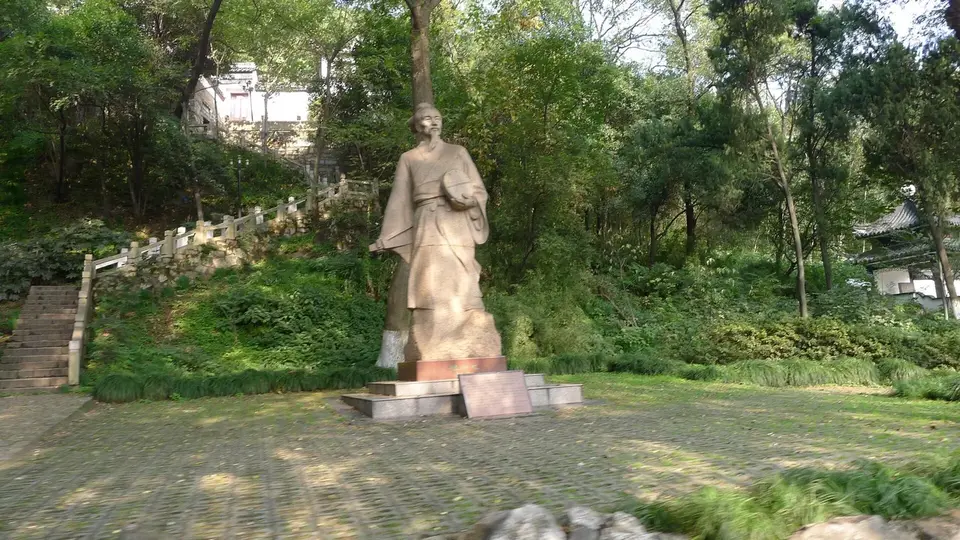
Biography
Ancestral Migration and Heritage of Practical Learning
Zu Chongzhi traced his ancestral roots to Qiu County, Fanyang Commandery (modern Laishui County, Baoding, Hebei), belonging to an eminent northern scholar-gentry clan of the Western Jin period. Following the Yongjia disorders at the close of the Western Jin dynasty, when warfare engulfed the Central Plains, the Zu family migrated south across the Yangzi River alongside thousands of northern expatriates, settling in Jiankang (modern Nanjing, Jiangsu), the imperial capital of the Eastern Jin and southern dynasties. For generations, the Zu clan was renowned for technical mastery and scientific inquiry. Zu's grandfather, Zu Chang, served as Chamberlain for the Palace Buildings (Dajiang Qing) under the Liu Song dynasty, directing imperial architecture, dynastic tombs, palaces, city fortifications, and national hydraulic networks. Zu's father, Zu Shuo, served as Court Gentleman for Attendance (Fengchaoqing), celebrated for his erudition in Confucian texts, astronomical observation, and mathematics.
In 429 (the sixth year of the Yuanjia reign of Emperor Wen of Song), Zu Chongzhi was born into the family's residence in Jiankang. From his early childhood, Zu grew up within an intellectually demanding environment focused on practical sciences. His grandfather Zu Chang frequently took him to construction sites, employing compasses, squares, and architectural models to explain geometrical principles, while lecturing on celestial motions and seasonal constellations. His father Zu Shuo systematically instructed him in the Thirteen Classics, the Zhoubi Suanjing, and the Nine Chapters on the Mathematical Art. Naturally gifted and untiringly industrious, the young Zu displayed an intense passion for the fundamental laws governing the natural universe.
In his later prefaces, Zu reflected that from earliest youth he had "devoted himself to numerical sciences, investigating ancient and contemporary records." He not only examined all available astronomical treatises, armillary records, and mathematical tracts from the pre-Qin period down to the Northern and Southern dynasties, but also developed a rigorous ethos of empirical verification. He insisted that "nothing should be asserted without evidence; whatever is recorded must be substantiated," rejecting ancient dogmas unless confirmed by empirical measurements and mathematical derivation.
Hualin Scholarship and the New Calendar
Due to his burgeoning reputation in mathematics and astronomy, Zu attracted the attention of the Liu Song court during his early twenties. During the Daming reign of Emperor Xiaowu, an imperial decree summoned Zu to the Hualin Academic Secretariat, the state's highest research institution, and subsequently to the Zongming Academy. The Zongming Academy served as the foremost imperial university and research complex of the Southern Dynasties, organized into four specialized faculties: Dark Learning, Confucianism, Literature and History, and Astronomy-Mathematics. Within this scholarly complex, Zu enjoyed unrestricted access to classified astronomical logs, imperial palace almanacs, and rare technical manuscripts salvaged from northern war zones, providing him with unprecedented resources to expand his scientific research.
In 461, at thirty-three, Zu left the capital to serve as Attendant Clerk (Congshishi) and Military Staff Officer (Gongfu Canjun) under the Regional Inspector of Nanxuzhou (modern Zhenjiang, Jiangsu). Despite administrative burdens and regional tensions, Zu maintained his scientific schedule. Designing compact gnomons, armillary spheres, and sundials, he weathered harsh elements on Mount Jiao and along the banks of the Yangzi River, recording midnight planetary positions and measuring solar shadows during the winter solstices. Through meticulous analysis of thousands of observational data points, Zu detected glaring deficiencies in the reigning Yuanjia Calendar devised by He Chengtian: calculated winter solstices lagged behind reality by an entire day, and solar eclipse predictions repeatedly failed.
Resolving to overhaul dynastic timekeeping, Zu incorporated the phenomenon of the "precession of the equinoxes" discovered by Eastern Jin astronomer Yu Xi, which recognized that the westward drift of equinoctial points caused the sidereal year to diverge from the tropical year. After years of computational labor, Zu completed the Daming Calendar in 462. The work introduced two historic innovations: first, it was the earliest calendar in human history to officially integrate precession into its celestial mechanics, determining that the sun shifted one ancient degree every forty-five years and eleven months; second, it dismantled the archaic nineteen-year intercalary cycle (with seven leap months) used since antiquity, establishing a refined cycle of 144 leap months across 391 years, aligning lunar months with tropical years to an unprecedented degree of accuracy.
Court Debate and Governance in Louxian
In May 462, Zu presented the Daming Calendar to Emperor Xiaowu, requesting its formal imperial adoption. However, this scientific breakthrough encountered ferocious resistance from entrenched court conservatives led by the emperor's favored attendant and grandee, Dai Faxing. In open court, Dai attacked the new calendar, invoking theological dogmas: "The movements of the heavens are natural and beyond human reckoning; the winter solstice has remained unmovable since antiquity—how dare anyone introduce precession?" He went so far as to accuse Zu of subverting ancient orthodoxy.
Undaunted by political pressure, the thirty-four-year-old mathematician mounted a brilliant rebuttal in his treatise Refutation of Dai Faxing's Memorial. Marshaling decades of observational measurements, Zu dismantled Dai's arguments point by point. He declared: "Let us examine clear evidence to verify reality! What use are empty phrases and baseless assertions?" He argued that celestial motions followed intelligible natural laws accessible to empirical calculation rather than divine caprice, insisting that astronomy must "derive correctness from heaven and verify it by the sun." His logical and numerical rigor triumphed completely. Convinced by the evidence, Emperor Xiaowu planned to promulgate the Daming Calendar in 465, but the monarch's unexpected death plunged the court into political chaos, temporarily suspending the reform.
In 464, Zu was assigned away from the capital to serve as Magistrate of Louxian (modern Kunshan, Jiangsu). Governing with fairness and compassion, he organized local hydraulic projects, dredging agricultural waterways around Lake Tai to safeguard peasant livelihoods. During his leisure hours, Zu utilized the peaceful regional environment to tackle the most demanding mathematical challenge of the ancient world: computing the precise upper and lower limits of pi ($\pi$) and formulating the volumetric geometry of the sphere, completing his world-renowned calculations during and immediately after his Louxian tenure.
Mechanical Inventions and Southern Qi Service
During the Yuanhui era, Zu was recalled to Jiankang as Supervisor of Receptionists (Yezhe Puye). Amidst violent factional struggles within the Liu Song imperial house, which eventually culminated in the founding of the Southern Qi dynasty by Xiao Daocheng, Zu remained dedicated to scholarship, translating theoretical mechanics and geometry into ingenious engineering applications.
According to historical records in the Book of Southern Qi, the ancient south-pointing carriage invented by Cao Wei engineer Ma Jun had been destroyed during the wars of the Sixteen Kingdoms. Near the end of the Liu Song reign, northern artisans attempted to assemble wooden models, but their crude gears failed whenever the vehicle turned. In 478, Senior Official Wang Sengqian and the Prince of Qi commissioned Zu to reconstruct the device. Analyzing differential gear mechanics and gear teeth ratios, Zu constructed an all-bronze differential gear system. When tested publicly at the Houzhu grounds in Jiankang before imperial officials and foreign envoys, the carved wooden figure atop the carriage pointed southward with unwavering precision, regardless of how erratically the vehicle turned.
Between 479 and 482, during the Jianyuan era of the Southern Qi, Zu designed and constructed the "thousand-li boat" on the waters off Xinting along the Yangzi River. Dispensing with reliance on fickle winds and manual oars, the vessel featured rotating wooden paddle wheels mounted along its flanks, propelled by interior treadmill pedals. During river trials, the vessel sped across the waters, covering over a hundred li in a single day, serving as an early mechanical forerunner of the paddle-wheel steamboat. Furthermore, Zu constructed a water-powered multi-pestle grain mill (shuiduimo) at the Leyou Pleasure Grounds in Jiankang, using hydraulic wheels to drive multiple mortars and millstones simultaneously, significantly increasing processing efficiency for grain. He also cast a precision bronze balance vessel (qiqi) for Emperor Gao of Qi, which tilted when empty, stood upright when half full, and overturned when filled to the brim, demonstrating practical mastery of the mechanics of center of gravity.
Frontier Strategy and Enduring Legacy
Between 494 and 498, during the Longchang and Jianwu eras, the aging scientist was appointed Colonel of Changshui, a prestigious fourth-rank imperial military post. During his final decade, as internal strife eroded Southern Qi stability and northern border warfare flared, Zu demonstrated the visionary statecraft of a patriotic scholar.
Troubled by agricultural neglect along the defense lines, Zu composed his celebrated treatise On Pacifying the Frontiers (Anbian Lun). He argued that national defense rested fundamentally upon agrarian productivity, urging the court to establish military and civilian farming colonies (tuntian) across the Huai and Yangzi valleys, reclaim abandoned fields, and construct irrigation canals to secure strategic grain reserves while training disciplined naval and infantry forces. Emperor Ming of Qi admired the treatise and considered dispatching Zu to inspect provincial irrigation works, but factional paralysis prevented the policy from being fully enacted.
In his final years, Zu worked alongside his son Zu Geng to compile their mathematical discoveries into the twelve-volume treatise Zhui Shu (Art of Stitching). Zu was also an expert in musical temperament, calibrating the twelve pitch-pipes, while penning philosophical commentaries on the I Ching, Laozi, Zhuangzi, Analects, and Classic of Filial Piety, alongside the supernatural fiction collection Records of Anomalies (Shuyi Ji).
In 500, during the reign of the Marquis of Donghun, Zu passed away peacefully at his Jiankang residence at the age of seventy-two. A decade after his death, following persistent appeals by his son Zu Geng, Emperor Wu of Liang officially promulgated the Daming Calendar in 510, where it remained in use for over sixty years. Zu's lifelong pursuit of empirical truth established a monument of scientific excellence in human history.
Major Achievements
Calculation of Pi and the Milü Ratio
Zu Chongzhi's most celebrated mathematical achievement was his unprecedented calculation of the numerical limits of pi ($\pi$) to seven decimal places, establishing a world record that remained unbroken for nearly a thousand years.
Pi is the fundamental constant governing circular geometry and hydraulic engineering. Prior to Zu, the third-century mathematician Liu Hui had established the circle-division method (geyuan shu), inscribing regular polygons within a circle to approximate its circumference and arriving at a value of 3.1416. Working in an era preceding electronic calculators and modern abacuses, Zu relied solely on wooden and bamboo counting rods (suanchou). Beginning with an inscribed regular hexagon, he performed twelve successive operations involving extraction of square roots, extending his calculations to inscribed polygons of 24,576 sides and 61,440 sides.
Through painstaking numerical precision, Zu formulated the immortal inequality: $3.1415926 < \pi < 3.1415927$. He accurately established the lower bound (3.1415926) and upper bound (3.1415927), fixing the first seven decimal digits of pi. It was not until the fifteenth century that Persian mathematician Al-Kashi and sixteenth-century European scholars surpassed this accuracy. Furthermore, Zu derived two fractions for practical computation: the "approximate ratio" (yuelü) of $22/7 \approx 3.14$, and the "close ratio" (milü) of $355/113 \approx 3.14159292$. In Western mathematical historiography, this close fraction was only rediscovered in 1573 by Valentinus Otho and Adriaan Anthonisz, over eleven centuries later. In international mathematics, $355/113$ is universally honored as "Zu's Ratio."
The Daming Calendar and Precession of the Equinoxes
In astronomy, Zu Chongzhi's Daming Calendar represented the highest theoretical peak of ancient observational astronomy, transforming traditional timekeeping into a precise mathematical science.
In formulating the calendar, Zu became the first astronomer to systematically integrate the precession of the equinoxes into calendrical algorithms. He recognized that the sidereal year (the sun's return to the same position relative to fixed stars) differed slightly from the tropical year (the cycle of the solstices), calculating that equinoctial points drifted westward by one ancient degree every forty-five years and eleven months. Incorporating this mechanism prevented cumulative seasonal drift, establishing the standard architecture for all subsequent Chinese imperial calendars.
Moreover, Zu discarded the traditional nineteen-year intercalary cycle that had been observed since the Spring and Autumn period, which accumulated a full day of error every two centuries. He devised a cycle of 144 leap months across 391 years. His calculations determined the length of the tropical year to be 365.24281481 days—differing from modern atomic measurements (365.24219878 days) by merely fifty seconds, an error of less than six parts in one hundred thousand. His calendar also derived exact formulas for predicting the timing and magnitude of solar and lunar eclipses, standing as an enduring triumph of fifth-century science.
The Zhui Shu and Zu Geng's Principle
In geometric theory and higher mathematics, Zu Chongzhi and his son Zu Geng made pioneering contributions that advanced Chinese mathematics toward the threshold of calculus.
Zu synthesized his mathematical discoveries into the twelve-volume treatise Zhui Shu (Zhui Shu). Dealing with cubic equations, limits, and spherical geometry, the work was deemed so advanced that during the Tang dynasty it was assigned as the supreme mandatory textbook at the Imperial Academy (Guozijian), requiring four full years of specialized study—the longest curriculum among the Ten Computational Canons. The treatise eventually disappeared during the Song dynasty because its mathematical sophistication exceeded the comprehension of ordinary imperial examiners.
Crucially, in resolving the calculation of spherical volume, the father and son established Zu Geng's principle. Advancing beyond Liu Hui's mou he fang gai (bicylinder) model, they articulated the foundational axiom: "If blocks are constructed of the same height, and at equal heights their horizontal cross-sectional areas are identical, then their total volumes cannot be different." Applying this theorem, they deduced the volume formula of the mou he fang gai and derived the volume of a sphere as $V = \frac{4}{3}\pi R^3$. This theorem preceded Italian mathematician Bonaventura Cavalieri's formulation of the principle in 1635 by more than 1,100 years, marking a golden age of ancient geometry.
Engineering Inventions and Mechanical Systems
Zu was an accomplished mechanical engineer whose practical inventions elevated ancient automation and transport technology.
In directional mechanics, Zu reconstructed the legendary south-pointing carriage (south-pointing carriage) in 478. Employing all-bronze differential gear trains and clutches, he ensured that internal mechanical linkages automatically counteracted turns and uneven road surfaces, keeping the mounted figure pointing steadily toward the south.
In naval transport, Zu invented the "thousand-li boat," a paddle-wheel vessel powered by foot treadmills that attained speeds exceeding one hundred li per day along the Yangzi River, anticipating modern paddle-wheel navigation. Additionally, his water-powered milling complexes (shuiduimo) in Jiankang utilized flowing waterways to power multiple processing stones, dramatically increasing agrarian efficiency, while his reconstructed bronze balance vessels (qiqi) demonstrated delicate control of liquid center of gravity.