Biography
Early Campaigns and Distinctions in the Battle of Songjin
Zhang Lu was born into an influential family with ancestral roots in Feng County, Pei. During the reign of Emperor Shundi of the Eastern Han, his grandfather Zhang Daoling entered Shu, secluded himself on Mount Heming in Dayi to cultivate the Tao, and founded the Way of the Five Pecks of Rice, requiring initiates to contribute grain to support religious and social welfare activities. Following Zhang Daoling's death, his son Zhang Heng succeeded him as the Inheriting Master. Upon Zhang Heng's passing, Zhang Lu assumed leadership of the movement as the Third Celestial Master, known to adherents as the Lineage Master.
During the chaotic twilight of the Han Dynasty, Zhang Lu's mother possessed remarkable vitality, youthful appearance, and proficiency in occult arts. She maintained regular contact with the household of Yizhou Governor Liu Yan, earning the governor's deep trust and favor. Leveraging his mother's close standing and his own substantial influence among religious followers across Ba and Shu, Zhang Lu was selected by Liu Yan as a trusted military officer for northern operations.
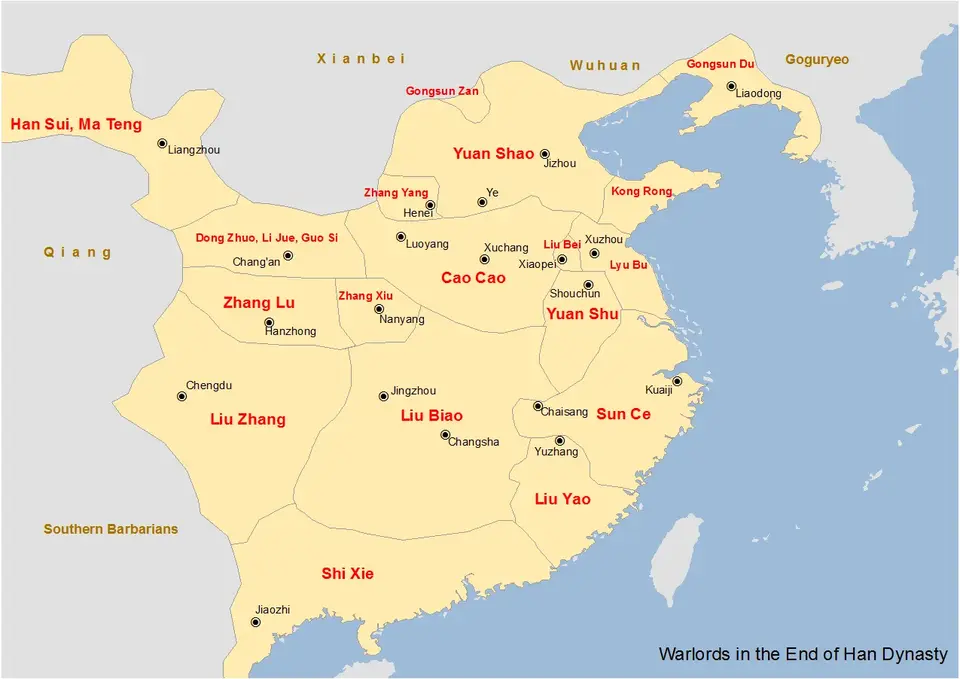
In 191, Liu Yan appointed Zhang Lu as Commander of Righteousness, directing him to join forces with Major Zhang Xiu to launch a surprise attack against Su Gu, the imperial Administrator of Hanzhong. The joint expedition overwhelmed Su Gu's forces, and Su Gu was captured and killed. After securing Hanzhong, Zhang Lu followed Liu Yan's secret instructions by destroying the cliffside plank roads traversing the Xiegu Valley and intercepting imperial emissaries traveling between Chang'an and Chengdu. Liu Yan subsequently submitted deceitful memorials to the imperial court, claiming that religious bandits had blocked the passes and severed communication with the capital.
Soon afterward, in order to consolidate military command and assert sole authority over the religious movement, Zhang Lu turned against Zhang Xiu, killing him and absorbing his troops and congregations into his own ranks, thereby establishing undisputed personal control over the entire Hanzhong basin.
Territorial Independence and Theocratic Administration
In 194, Liu Yan died of a malignant ulcer in Chengdu, and his mild-mannered younger son Liu Zhang succeeded him as Governor of Yizhou. Perceiving Liu Zhang to be weak and indecisive, Zhang Lu leveraged the natural defenses and economic self-sufficiency of Hanzhong to declare practical autonomy, refusing to execute administrative directives from Chengdu.
Simultaneously, prominent chieftains of indigenous Ba tribes residing along the borders of Hanzhong and Ba Commandery—including Du Huo, Pu Hu, and Yuan Yue—pledged fealty to Zhang Lu, drawn by his equitable administration and religious teachings. Incensed by this insubordination and the loss of tribal allegiances, Liu Zhang ordered the execution of Zhang Lu's mother and younger brother who were residing in Chengdu. This violent act transformed the political disagreement into an irreconcilable personal feud.
To subjugate Hanzhong, Liu Zhang repeatedly dispatched armies led by generals Pang Xi and Li Si. However, Zhang Lu made effective use of mountainous terrain to ambush invading columns, decisively routing Yizhou forces on every occasion. As popular sentiment throughout northern Ba increasingly tilted in favor of Zhang Lu, Liu Zhang was compelled to appoint Pang Xi as Administrator of Baxi, garrisoning Langzhong in a defensive posture, while deploying officers Yang Huai and Gao Pei to guard the Baishui pass, leaving Zhang Lu in secure control of the region.
Having consolidated his territorial base, Zhang Lu instituted an innovative theocratic governance structure. He dismantled traditional Han bureaucratic offices, assigning civil administration directly to Taoist religious officiants. New initiates were designated as "Ghost Soldiers," dedicated practitioners were promoted to "Libationers," and regional leaders were elevated to "Chief Libationers" entrusted with tax collection, public order, and military mobilization.
In daily administration, Libationers instructed the public in recitation of the Daodejing, promoting honesty, temperance, and community cooperation. When individuals fell ill or committed minor infractions, they were not subjected to physical punishment or expensive medicine, but were sent into "Quiet Chambers" to reflect on their transgressions. Libationers would then write petitions to the deities of Heaven, Earth, and Water seeking spiritual forgiveness. This synthesis of religious faith, moral suasion, and community autonomy produced exceptional social stability throughout decades of nationwide civil war.
Rejecting Kingship and Preserving Regional Peace
As northern China plunged into warfare following Dong Zhuo's disruption of the imperial capital, Cao Cao took control of the imperial court but lacked the resources to project force into the mountainous southwest. To conciliate Hanzhong and balance against Liu Zhang, Cao Cao issued an imperial decree appointing Zhang Lu as General of Pacifying the People and Administrator of Hanning, renaming Hanzhong Commandery as Hanning. Zhang Lu accepted the titles while maintaining practical independence, treating imperial envoys with dignified detachment.
With peace sustained within the region, commerce flourished, agricultural reserves multiplied, and municipal treasuries grew abundant. During agricultural excavations, a farmer unearthed a luminous jade seal. Seeing this as an auspicious omen of dynastic destiny, military commanders and religious officiants enthusiastically petitioned Zhang Lu to declare himself King of Hanning, proposing ceremonial robes and royal regalia.
At this critical juncture, Meritorious Officer Yan Pu offered courageous and farsighted counsel. Yan Pu advised Zhang Lu that Hanning possessed over one hundred thousand households, vast material wealth, and formidable natural barriers; by preserving moderate Taoist governance and protecting the borders, the region could enjoy lasting peace. Conversely, declaring kingship prematurely would invite condemnation from warlords nationwide and make Hanzhong the primary target of northern and southern invasions.
Zhang Lu recognized the wisdom of Yan Pu's counsel, sternly prohibiting any further discussion of royal elevation. By remaining an administrative governor and religious teacher, Zhang Lu successfully averted premature clashes with dominant political factions, securing more than a decade of uninterrupted prosperity for his people.
Regional Devastation in Guanzhong and Sheltering Refugees
In 211, after defeating remaining warlords in northern China, Cao Cao ordered Zhong Yao and Xiahou Yuan to march toward the Hanzhong border under the pretext of attacking Zhang Lu. Suspecting that Cao Cao intended to annex the northwestern territories through subterfuge, regional commanders Ma Chao and Han Sui organized an alliance across Liangzhou and Guanzhong to resist the imperial army.
Following Cao Cao's decisive victory at Tong Pass and the Wei River, imperial forces conducted harsh pacification operations across Guanzhong. Confronted with famine and military reprisals, tens of thousands of gentry families and commoners fled across the Qinling Mountains via the Ziwu and Tangluo trails, seeking sanctuary in the peaceful valleys of Hanzhong.
Rather than closing his borders, Zhang Lu welcomed the displaced populations. He ordered local Libationers to open state granaries, providing provisions and allocating fertile uncultivated land along the Han River. Displaced scholars and craftsmen were integrated into the community with great respect, expanding Hanzhong's population and economic capacity to historic heights.
However, surrounding political developments soon intensified pressure on the borders. Alarmed by Cao Cao's movements, Liu Zhang invited Liu Bei into Sichuan to counter Zhang Lu, only for Liu Bei to turn his forces southward to conquer Chengdu. During this conflict, Eastern Wu commander Lu Dai led two thousand soldiers upstream in an attempt to capture Zhang Lu through deceit, but Zhang Lu detected the ruse and closed border passes. Defeated in Liangzhou, Ma Chao fled to Hanzhong in 214 and was granted troops by Zhang Lu to strike Qishan, but after failing to gain ground, Ma Chao recognized that Zhang Lu harbored no expansionist ambitions and secretly defected to Liu Bei.
The Battle of Yangping Pass and Withdrawal to Bazhong
In the spring of 215, having consolidated control over Guanzhong and seeing Sichuan fall into Liu Bei's hands, Cao Cao launched a personal campaign of one hundred thousand veteran troops to conquer Hanzhong. The imperial expedition traversed the San Pass, pacified resisting Di tribes, and arrived at the northern entrance of Yangping Pass (west of present-day Mian County, Shaanxi).
Aware of Cao Cao's overwhelming military superiority, Zhang Lu initially contemplated submitting peacefully to avoid unnecessary bloodshed. However, his younger brother Zhang Wei adamantly opposed capitulation. Zhang Wei gathered tens of thousands of elite mountain troops, constructing continuous ramparts extending over ten li along the steep ridges of Yangping Pass to bar the canyon routes.
Cao Cao mounted multiple ferocious assaults against the fortifications, but Zhang Wei and officers Yang Ang and Yang Ren inflicted devastating casualties using defensive rockfalls and archery from commanding heights. Facing severe logistical difficulties and heavy losses, imperial commanders Xiahou Dun and Xu Chu urged an immediate retreat. Unable to breach the passes, Cao Cao reluctantly ordered front-line units to disengage and begin withdrawing.
During the chaotic nocturnal withdrawal, an unexpected disturbance changed the course of the campaign. A herd of wild deer charged into Zhang Wei's encampment, triggering widespread alarm. Simultaneously, imperial general Jie Jun, having lost his direction in the dark, inadvertently led his rear detachment into the center of the defensive fortifications. Believing that Cao Cao's main army had conducted a miraculous encirclement, Zhang Wei's defenders collapsed in panic. Observing the turmoil, Xiahou Dun and Xu Chu reversed their units and launched an immediate assault, killing Yang Ren and capturing the heights, leaving the gates of Hanzhong completely exposed.
Surrender to Cao Cao and Life as an Imperial Aristocrat
The fall of Yangping Pass sent shockwaves through Nanzheng. Realizing that military resistance was no longer viable, Zhang Lu prepared to formally surrender. His advisor Yan Pu intervened once more, suggesting that an immediate panic-driven capitulation would be viewed as an act of desperation, diminishing his political standing. Yan Pu recommended withdrawing south into the mountainous terrain of Bazhong among loyal Ba tribesmen, and then offering submission from a composed posture. Zhang Lu agreed with this calculated approach.
Prior to evacuating Nanzheng, military subordinates urged Zhang Lu to burn down the municipal granaries, armories, and treasury vaults to deprive Cao Cao of supplies. Zhang Lu angrily rejected the suggestion, stating that public stores were accumulated from the sweat of the people and belonged to the state, and that destruction of public property was unacceptable for anyone intending to submit. He ordered all granaries and warehouses cleaned, sealed with official insignias, and preserved intact before leading his followers south.
Upon entering Nanzheng, Cao Cao inspected the orderly streets and found the public treasuries undamaged, with seals undisturbed and grain stockpiles intact. Moved by Zhang Lu's benevolent discipline, Cao Cao remarked to his generals that Zhang Lu truly harbored loyalty to the realm. Cao Cao strictly forbade his soldiers from looting the civilian population and dispatched high commissioners to Bazhong to extend an honorable pardon and welcome Zhang Lu into the imperial fold.
In the winter of 215, Zhang Lu led his family and officials out of the mountains to submit to Cao Cao. Cao Cao greeted him with personal honors, appointing him General Who Subdues the South and enfeoffing him as Marquis of Langzhong with a substantial estate of ten thousand households. His five sons and advisor Yan Pu were likewise elevated to column marquises. To seal their political bond, Cao Cao arranged for his son Cao Yu, Prince of Yan, to marry Zhang Lu's daughter.
In 216, Zhang Lu died of illness after relocating to the northern capital of Ye. The imperial court bestowed the posthumous title of Marquis Yuan. Through the aristocratic standing and royal connections secured by Zhang Lu, the Way of the Five Pecks of Rice gained acceptance among northern elites, establishing the foundation for the nationwide development of Taoism during the Wei and Jin eras.
Major Achievements
Establishing an Autonomous Theocratic Society in Hanzhong
In an era defined by brutal civil conflicts and relentless pillaging by competing warlords, Zhang Lu preserved stability and prosperity in the Hanzhong basin for nearly thirty years through an innovative theocratic governance system.
Unlike contemporaneous despots such as Dong Zhuo and Li Jue, who devastated metropolitan regions through extortion and terror, Zhang Lu integrated religious ethics into local public administration. He replaced abusive bureaucratic functionaries with Taoist Libationers responsible for encouraging agriculture, arbitrating civil disputes, and providing moral education. Adherents and citizens internalized ethical principles promoting honesty and mutual assistance. This system, which transformed spiritual faith into civic responsibility, suppressed crime and made Hanzhong a renowned refuge amidst prevailing turmoil.
Pioneering Charity Inns and Benevolent Judicial Principles
Zhang Lu's institutional innovations in public welfare and penal reform represent a distinctive chapter in early Chinese administrative history. To assist travelers, merchants, and displaced persons traveling along rugged mountain roads, he established "Charity Inns" throughout Hanzhong.
These stations were stocked with complimentary grain and meat, allowing passersby of any social station to satisfy their hunger free of charge under the condition that they take only what was needed for immediate sustenance. Supported by religious taboos warning that excessive greed would bring divine disfavor, this communal assistance system operated effectively for decades without requiring extensive administrative policing.
In judicial matters, Zhang Lu abandoned the harsh bodily mutilations common in late Han criminal justice, enacting a policy of pardoning minor offenses up to three times. Repeat offenders were required to perform community labor by repairing one hundred paces of public highway to atone for their crimes. Furthermore, seasonal bans prohibited alcohol consumption and the slaughter of animals during spring and summer to protect ecological reproduction. These compassionate measures earned immense loyalty from both Han citizens and indigenous Ba tribes.
Preserving State Assets and Peaceful Surrender to Cao Cao
During the crisis of 215, Zhang Lu demonstrated moral restraint and political maturity rarely exhibited by regional warlords. Following the breach of Yangping Pass, when subordinates proposed torching the state granaries of Nanzheng to hinder the enemy, Zhang Lu steadfastly refused to destroy resources vital to civilian survival.
By securing and sealing all municipal stores before his withdrawal, Zhang Lu protected the livelihoods of local residents and demonstrated genuine fidelity to the public interest. His dignified surrender from Bazhong preserved Hanzhong from devastating sieges and punitive massacres, facilitating the peaceful integration of a strategic region into Cao Cao's domain while securing generous terms for his own people and family.
Laying the Historical Foundation for the Diffusion of Taoism
Zhang Lu's relocation to the northern capital under imperial patronage marked a decisive turning point in the history of Chinese religion. Prior to 215, the Way of the Five Pecks of Rice had been confined to the regional periphery of Sichuan and Shaanxi, dismissed by Confucian elites as a subversive, vulgar peasant cult.
Following his honorable surrender, Zhang Lu's elevated status as a premier marquis and imperial relative transformed the social standing of the movement. Northern aristocratic clans, including prominent lineages such as the Wang of Langya and the Xie of Chenjun, embraced the faith during the Wei, Jin, and Northern and Southern Dynasties. Through this political integration, the movement shed its association with rebellion, developing into the orthodox Zhengyi Taoist tradition that influenced Chinese religious culture for centuries.