Surrender of Fucheng
Captured by Liu Xiu's scouts while inspecting county fortifications; impressed by Liu Xiu's virtue, he surrendered five counties and became Registrar.
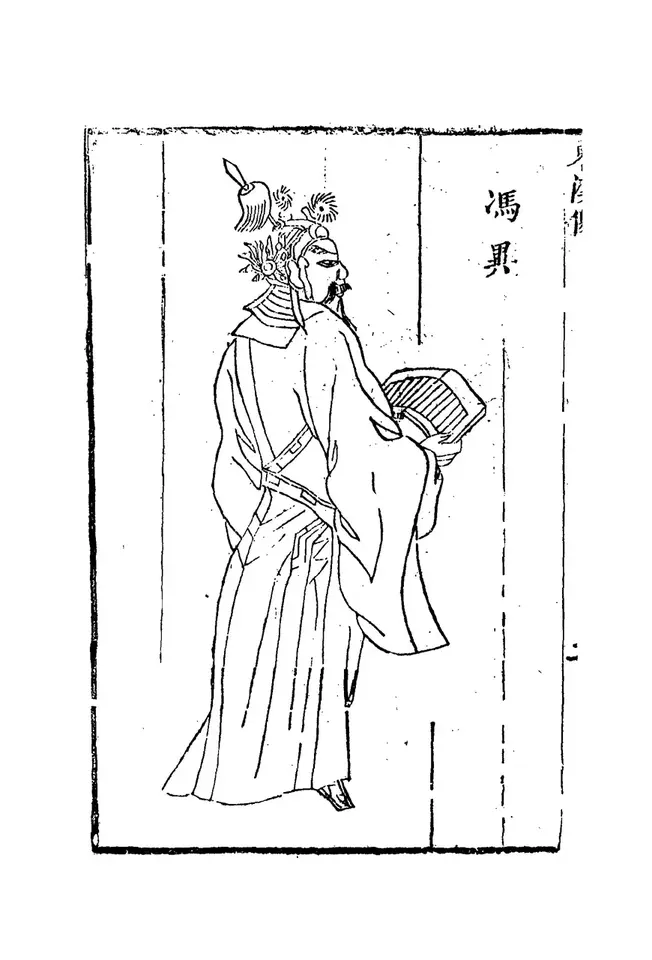
冯异
Feng Yi (冯异, died 34 AD), courtesy name Gongsun, was a native of Fucheng County in Yingchuan Commandery (present-day east of Baofeng, Henan). He was a preeminent founding commander and strategist of the Eastern Han dynasty, serving as one of Emperor Guangwu's (Liu Xiu) most indispensable military pillars and ranking seventh among the illustrious Twenty-Eight Generals of the Cloud Platform. Well-versed in the Zuo Zhuan…
Feng Yi (冯异, died 34 AD), courtesy name Gongsun, was a native of Fucheng County in Yingchuan Commandery (present-day east of Baofeng, Henan). He was a preeminent founding commander and strategist of the Eastern Han dynasty, serving as one of Emperor Guangwu's (Liu Xiu) most indispensable military pillars and ranking seventh among the illustrious Twenty-Eight Generals of the Cloud Platform. Well-versed in the Zuo Zhuan and Sun Tzu's The Art of War from youth, Feng Yi served as a local commandery clerk under the Xin dynasty before pledging his allegiance to Liu Xiu, playing an instrumental role in securing Hebei, guarding Mengjin against Green Forest Army, annihilating the Red Eyebrow insurgents, and pacifying the Guanzhong and Longyou frontiers. During Liu Xiu's perilous northern march across Hebei, Feng Yi demonstrated unyielding devotion, preparing hot bean porridge at Wuqi Pavilion in Raoyang and offering coarse wheat porridge along the Hutuo River in freezing winter blizzards. In the early Jianwu era, Feng Yi was appointed General of Mengjin, utilizing diplomatic alienation tactics to fracture the defense alliance of Gengshi generals in Luoyang and conquering thirteen counties east of Chenggao. In 27 AD, Feng Yi was elevated to Senior General Who Conquers the West; stepping into the breach after imperial defeats, he rallied scattered formations and deployed disguised ambush units at Xiaodi, completely crushing the Red Eyebrow army and accepting the surrender of over eighty thousand soldiers. Stationed in Guanzhong for several years, he restored civic order, rehabilitated farmlands, and maintained immaculate military discipline, earning boundless local devotion. During operations in Longyou, he assumed administrative oversight of Tianshui and Anding commanderies, checking warlord Wei Xiao repeatedly until passing away from illness while commanding the siege of Luomen in 34 AD. Celebrated for his exceptional modesty, Feng Yi routinely withdrew to sit alone beneath a large tree while other generals boasted of their battlefield triumphs, earning the enduring military moniker "Big Tree General."
Captured by Liu Xiu's scouts while inspecting county fortifications; impressed by Liu Xiu's virtue, he surrendered five counties and became Registrar.
Accompanied Liu Xiu north; served bean porridge at Wuqi Pavilion and wheat porridge at the Hutuo River; recruited troops in Hejian and was ennobled as Marquis of Ying.
Commissioned as General of Mengjin; alienated Gengshi generals Li Yi and Zhu Wei, slew Wu Bo, and secured thirteen counties east of Henan.
Feoffed as Marquis of Yangxia; replaced Deng Yu to oversee military affairs in Guanzhong, winning popular acclaim through strict discipline.
Appointed Senior General Who Conquers the West; rallied forces at Huixi and decisively routed the Red Eyebrow main force through disguised ambushes at Xiaodi.
Visited the capital at Luoyang where Emperor Guangwu lauded his devotion; dispatched to relieve Xunyi, routing Wei Xiao's general Xing Xun.
Assumed command of the late Ji Zun's expeditionary forces; concurrently administered Tianshui Commandery, executing Shu commander Zhao Kuang.
Directed the protracted siege of Luomen; died in military camp from severe exhaustion and illness, posthumously honored as Marquis Jie.
During the turbulent collapse of the Xin dynasty, agrarian uprisings erupted across the Central Plains. In his youth, Feng Yi displayed a profound passion for scholarly study, specializing in the classical historical commentary Zuo Zhuan and the military treatise The Art of War, attaining mastery over strategic maneuvers and statecraft. In the late Tianfeng and Dihuang eras of Wang Mang's reign, Feng Yi served as a commandery clerk in Yingchuan, earning high esteem for administrative efficiency and personal integrity. In 23 AD, the Green Forest insurgents acclaimed Liu Xuan as the Gengshi Emperor and dispatched expeditionary columns under Liu Xiu and Wang Chang to conquer Yingchuan Commandery. At that juncture, Feng Yi was supervising the military defenses of Fucheng and four adjacent counties, coordinating with County Magistrate Miao Meng to mount a resolute defense behind fortified walls. Liu Xiu launched multiple assaults against Fucheng without success, eventually encamping his forces at Jinche Township along the county border.
During an inspection of county outposts in plainclothes, Feng Yi was captured by Liu Xiu's forward cavalry scouts. Recognizing the prisoner, Feng Yi's paternal cousin Feng Xiao and fellow townsmen Ding Chen and Lu Yan—all of whom were serving in Liu Xiu's vanguard—immediately commended Feng Yi's extraordinary talents to their commander. Liu Xiu personally granted Feng Yi an audience and was impressed by his strategic intellect, expressing a desire to enlist him into his staff. Feng Yi frankly stated that his elderly mother remained within Fucheng, requesting permission to return home in order to persuade Magistrate Miao Meng and deliver the five counties under his supervision. Recognizing his filial devotion and integrity, Liu Xiu immediately released him without conditions.
Returning to Fucheng, Feng Yi persuaded Miao Meng to yield the territory to Liu Xiu. However, news arrived that Liu Xiu's elder brother, Liu Yan, had been murdered in Wancheng by the jealous Gengshi Emperor. Liu Xiu hastily withdrew his forces from Fucheng to plead his case at the imperial court. Feng Yi, dedicated exclusively to Liu Xiu's personal character, refused to surrender the citadel to other Gengshi commanders, maintaining a strict defense and repelling more than ten assaults by rival insurgent detachments. In the ninth month of that year, Wang Mang's regime collapsed, and the Gengshi Emperor prepared to transfer the capital to Luoyang, dispatching Liu Xiu as Director of Retainers to restore imperial palaces. When Liu Xiu marched north through Fucheng, Feng Yi threw open the city gates in formal submission. Delighted by his steadfast fidelity, Liu Xiu commissioned Feng Yi as Registrar on the spot.
Following Liu Xiu to Luoyang, Feng Yi recommended prominent scholars and warriors from his native region, including Tiao Qi, Shu Shou, Duan Jian, and Zuo Long, all of whom received trusted appointments. Aware that the Gengshi leadership deeply distrusted Liu Xiu, the court hesitated to grant him autonomous command over newly conquered regions. The Gengshi Emperor contemplated dispatching Liu Xiu to pacify Hebei, but powerful ministers vigorously opposed the initiative. Assessing the delicate factional dynamics, Feng Yi advised Liu Xiu to secretly present lavish gifts to Grand Chancellor Cao Jing and his son, Imperial Secretary Cao Xu, who held immense sway over the monarch. Through the intervention of the Cao clan, Liu Xiu finally secured an imperial commission to pacify the northern frontier. Before embarking, Feng Yi urged Liu Xiu to win the hearts of the northern populace through benevolent governance, tax relief, and amnesty, thereby laying an independent dynastic foundation. Upon reaching Handan, Liu Xiu dispatched Feng Yi and Tiao Qi to tour the commanderies, releasing unjust prisoners, comforting the impoverished, and discreetly appraising the political allegiance of local administrators.
In early 24 AD, the diviner Wang Lang staged an armed rebellion in Handan, claiming imperial Han lineage and rallying northern warlords. Liu Xiu and his small retinue were forced to flee southward from Ji in desperate haste. Caught in severe winter blizzards and pursued closely by hostile cavalry, the entourage reached Wuqi Pavilion in Raoyang late at night, utterly exhausted and freezing. Venturing into abandoned farmsteads, Feng Yi secured a handful of wild beans and boiled a hot pot of bean porridge for Liu Xiu. The sovereign drank it eagerly, remarking to his commanders: "Only through Gongsun's hot bean porridge have my hunger and bitter cold been lifted." Arriving at Nangong County amidst torrential storms, the party sought shelter beneath a roadside hovel, where Feng Yi once again braved the elements to prepare hot wheat porridge to sustain the imperial party.
Once established in Xindu, Liu Xiu tasked Feng Yi with raising reinforcements across Hejian Commandery. Enforcing rigorous discipline, Feng Yi rapidly recruited several thousand combat veterans, earning promotion to Adjutant General. Feng Yi then spearheaded the offensive that captured Handan and executed Wang Lang, followed by the decisive defeat of the Tiejing peasant insurgents across Jizhou. In recognition of his battlefield brilliance, Feng Yi was formally enfeoffed as Marquis of Ying.
With Hebei firmly secured, the Gengshi Emperor grew increasingly alarmed, ordering King of Wuyin Li Yi, King of Linqiu Tian Li, Grand Minister of War Zhu Wei, and White Tiger Duke Chen Qiao to concentrate three hundred thousand elite soldiers to hold Luoyang. To neutralize the southern threat while he concluded campaigns in the north, Liu Xiu designated Kou Xun as Grand Administrator of Henei and appointed Feng Yi as General of Mengjin, commanding the joint garrisons of Henei and Weijun to guard the Yellow River crossings.
Upon arriving at Mengjin, Feng Yi discovered severe friction and mutual suspicion between the enemy commanders Zhu Wei and Li Yi. Exploiting Li Yi's former comradeship with Liu Xiu during the initial Nanyang rebellion, coupled with Li Yi's guilt over complicity in Liu Yan's execution, Feng Yi addressed a strategic missive to Li Yi. The letter outlined the impending collapse of Chang'an and the unstoppable ascent of Liu Xiu, urging Li Yi to choose wisdom over disaster. Swayed by the strategic analysis and seeking personal preservation, Li Yi pledged non-aggression and opened clandestine correspondence with Feng Yi.
Taking advantage of Li Yi's military passivity, Feng Yi launched sudden offensives northward against Tianjing Pass, capturing two strategic walled towns in Shangdang Commandery. He then wheeled southward across the Yellow River, sweeping through thirteen counties east of Chenggao and capturing fortified gentry strongholds, securing the surrender of over one hundred thousand soldiers and civilians. When Gengshi Grand Administrator Wu Bo led an army to crush the capitulating towns, Feng Yi crossed the river to relieve them, engaging Wu Bo at Shixiang and slaying him in open combat, while Li Yi kept his gates firmly shut.
Feng Yi forwarded the intelligence to Hebei. To completely shatter the enemy alliance, Liu Xiu intentionally leaked the private correspondence between Feng Yi and Li Yi. Infuriated by the betrayal, Zhu Wei assassinated Li Yi, throwing the Luoyang command into pandemonium. Zhu Wei launched a desperate counteroffensive, ordering Su Mao across the Yellow River toward Wenxian while he struck Pingyin to pin down Feng Yi. Joining forces with Kou Xun, Feng Yi routed Su Mao's crossing force, then rapidly crossed the river to pursue Zhu Wei to the ramparts of Luoyang, encircling the capital walls before returning triumphantly to camp. When news reached Hebei, the assembled commanders urged Liu Xiu to claim the throne. Summoning Feng Yi to the field headquarters at Hao, Liu Xiu heeded his council regarding imperial legitimacy and ascended the throne as Emperor Guangwu in the sixth month of 25 AD.
In 26 AD, Emperor Guangwu confirmed Feng Yi's ennoblement as Marquis of Yangxia. At that time, the Guanzhong region was ravaged by catastrophic famine and war; local warlord Yan Cen marauded west of Chang'an, regional magnates entrenched themselves in fortified estates, and the Red Eyebrow insurgents were withdrawing eastward in massive formations. Chancellor Deng Yu had campaigned in the west for months without decisive success, leaving the imperial frontier in grave peril. Emperor Guangwu ordered Feng Yi to relieve Deng Yu and assume supreme command over western military operations. At Henan, the Emperor personally bestowed a seven-foot ceremonial sword upon Feng Yi, enjoining him: "The objective of this western campaign is not indiscriminate conquest and slaughter, but the pacification and comfort of the common folk. You possess natural restraint; ensure that the people of the commanderies are spared the ravages of war." Feng Yi marched west with iron discipline, offering amnesty and protection, which induced thousands of local clans to submit. Confronting the retreating Red Eyebrow army at Huayin, Feng Yi held his defensive perimeter for over sixty days, accepting the surrender of five thousand insurgent warriors.
In the spring of 27 AD, Emperor Guangwu promoted Feng Yi to Senior General Who Conquers the West. Chancellor Deng Yu and General of Chariots and Cavalry Deng Hong retreated to Huayin, demanding an immediate joint offensive against the Red Eyebrow vanguard. Deng Hong attacked rashly and suffered a catastrophic defeat. Feng Yi led forward relief columns, successfully halting the enemy advance. Feng Yi cautioned Deng Yu to rest the exhausted troops, but Deng Yu insisted on pressing the pursuit. The Red Eyebrow warriors turned in ferocious counterattack at Huixi, crushing the Han legions and forcing Deng Yu to flee alone toward Yiyang.
His horse killed beneath him, Feng Yi scaled the steep cliffs of Huixi on foot alongside a handful of guards. Showing peerless composure in extreme crisis, he established a camp along the slopes of Huixi, gathering broken detachments and mobilizing several tens of thousands of local militia retainers. Recognizing that the Red Eyebrows were starving and disordered despite their tactical ferocity, Feng Yi conceived an ingenious ambush. He selected elite strike units, dressed them in the distinctive ochre garments and red turbans of the Red Eyebrows, and concealed them within the valleys flanking Xiaodi. When Feng Yi engaged the enemy main body the following morning, both armies fought to exhaustion. Suddenly, Feng Yi's disguised shock troops emerged from the mountain passes, waving identical banners and striking the enemy flanks. Unable to distinguish friend from foe, the Red Eyebrows collapsed into total chaos, suffering a crushing defeat across the valley. Feng Yi pursued the broken remnants to Yiyang, where Emperor Guangwu's grand army sealed their escape, forcing over eighty thousand insurgents to surrender unconditionally. Emperor Guangwu issued an imperial praise decree: "Though your wings were clipped at Huixi, you soared victorious at Mianchi; truly, what was lost at sunrise was regained at sunset."
Following the submission of the Red Eyebrow host, Guanzhong remained deeply fragmented. Self-proclaimed warlords and local barons commanded armed strongholds numbering from thousands to tens of thousands, raiding neighboring districts while famine reached such horrors that human flesh was traded in markets. Self-styled Prince of Wu'an Yan Cen formed an alliance to besiege Feng Yi's headquarters in the Shanglin Park. Enforcing a policy of military deterrence and compassionate reconciliation, Feng Yi repelled Yan Cen, decapitating over a thousand enemy warriors and dispatching generals Deng Ye and Yu Kuang to intercept his retreat, securing the surrender of eight thousand men under Su Chen. Emperor Guangwu sent Zhao Kuang as Right Fufeng to transport emergency grain reserves, bringing immense relief to the troops.
During his three years governing Guanzhong, Feng Yi enforced strict laws, eradicating predatory bandits while honoring compliant gentry. Prominent insurgent leaders were escorted honorably to Luoyang for civil employment, while common peasant fighters were disbanded to reclaim barren farmlands. Repeated invasions launched from Sichuan by warlord Gongsun Shu were systematically repulsed by Feng Yi and Zhao Kuang. Through his administrative wisdom, the desolate wastes of Guanzhong were restored to flourishing agricultural fertility.
His immense prestige and universal popularity in the western capital gave rise to local ballads styling him the "King of Xianyang." Malicious courtiers submitted secret memorials to the throne, accusing Feng Yi of autocratic usurpation and arbitrary justice. Emperor Guangwu forwarded all accusatory rolls directly to Feng Yi without opening an investigation. Terrified, Feng Yi submitted an earnest memorial reiterating his lifelong loyalty and humility. Emperor Guangwu replied with an affectionate edict: "Between you and the state, our duty is sovereign and subject, but our love is father and son; what suspicion could ever breed fear?" In the spring of 30 AD, Feng Yi attended court in Luoyang, where Emperor Guangwu showered him with imperial brocades and gold, publicly declaring before all ministers: "This is the loyal servant who served me bean porridge at Wuqi and wheat porridge at the Hutuo River during our darkest hours in Hebei; his toil cleared the thorns and brambles to secure our realm."
In the summer of 30 AD, warlord Wei Xiao of Longyou launched a major rebellion against the Han dynasty, defeating multiple imperial detachments. Emperor Guangwu directed Feng Yi to march upon Xunyi. Before Feng Yi's arrival, Wei Xiao detached generals Xing Xun and Wang Yuan with twenty thousand shock troops to seize Xunyi as a gateway to the capital region. Observing the enemy's momentum, Han subordinates urged a temporary withdrawal. Feng Yi firmly rejected retreat, arguing that Xunyi was the northern shield of the capital and that taking high ground in advance guaranteed victory. Marrying speed with secrecy, Feng Yi entered Xunyi under cover of night, shutting the gates and keeping his banners hidden. When Xing Xun marched carelessly to the foot of the walls, Feng Yi suddenly raised war banners and struck with thunderous war drums, routing the enemy force over several dozen leagues. Warlords throughout Beidi Commandery abandoned Wei Xiao to submit to Han authority. Emperor Guangwu appointed Feng Yi as Acting Grand Administrator of Beidi. Feng Yi subsequently absorbed over ten thousand nomadic Qingshan Hu warriors, repelling northern raids by Lu Fang and Xiongnu auxiliaries, and later took charge of Anding Commandery.
In 33 AD, following the death of Senior General Ji Zun, Emperor Guangwu transferred Ji Zun's expeditionary legions to Feng Yi's command. After Wei Xiao's demise, his son Wei Chun entrenched himself at Jixian with Sichuan reinforcements under Gongsun Shu's general Zhao Kuang. Emperor Guangwu ordered Feng Yi to take concurrent command of Tianshui Commandery. After a grueling year of siege warfare, Feng Yi intercepted and decapitated Zhao Kuang. In the summer of 34 AD, Feng Yi led the allied armies in besieging Luomen. Before the fortress could fall, Feng Yi succumbed to severe physical exhaustion and chronic camp illness, passing away peacefully within his command pavilion. Emperor Guangwu mourned him bitterly, conferring the posthumous title of Marquis Jie.
Feng Yi's battlefield leadership at the Battle of Xiaodi in 27 AD represents one of the most brilliant tactical reversals in Chinese military history. Stepping into supreme command after imperial forces were shattered at Huixi, Feng Yi preserved absolute strategic composure amidst overwhelming catastrophe.
Exploiting the uniform ochre attire of the Red Eyebrow insurgents, Feng Yi orchestrated a masterclass in tactical deception. By deploying identical red garments on his hidden vanguard units and coordinating a synchronized flank assault when the enemy was physically depleted, he induced complete organizational panic within the rebel host. This single victory eliminated the greatest peasant military force born of Wang Mang's civil wars, resolving the existential crisis of the infant Eastern Han dynasty.
Governing Guanzhong in the immediate aftermath of decade-long warfare, Feng Yi displayed the comprehensive statecraft of a true statesman. Rather than relying upon punitive slaughter, he prioritized the restoration of human livelihoods, legal fairness, and agricultural recovery.
By suppressing predatory bandits, integrating armed gentry clans into imperial service, and demobilizing insurgent peasant armies back to agriculture, he transformed a starving wilderness into a prosperous base of imperial logistics. His enlightened governance not only permanently shielded the imperial core from western incursions, but also created the indispensable logistical springboard for Emperor Guangwu's ultimate subjugation of Longyou and Shu.
Throughout his illustrious military career, Feng Yi embodied the highest ideals of Confucian modesty and unblemished loyalty. Whenever fellow generals convened in camp to boast of their battle deeds and claim precedence, Feng Yi invariably walked away to sit in solitary contemplation beneath a large tree, leading the common soldiery to bestow upon him the affectionate title "Big Tree General."
When meeting peer commanders on the road, he invariably ordered his carriage to give way, demonstrating an innate absence of arrogance. Despite commanding immense military authority and winning universal adoration along the western frontiers, he responded to court slander with humble introspection and absolute transparent submission. His life established the timeless archetype of the modest, self-effacing scholar-general (rujiang) in traditional Chinese statecraft.
FIGURES ASSOCIATED WITH THIS DYNASTY