Birth in Huguang
Born in Huarong, Huguang, diligently studying the Confucian canon alongside statecraft, geography, and frontier military defense.
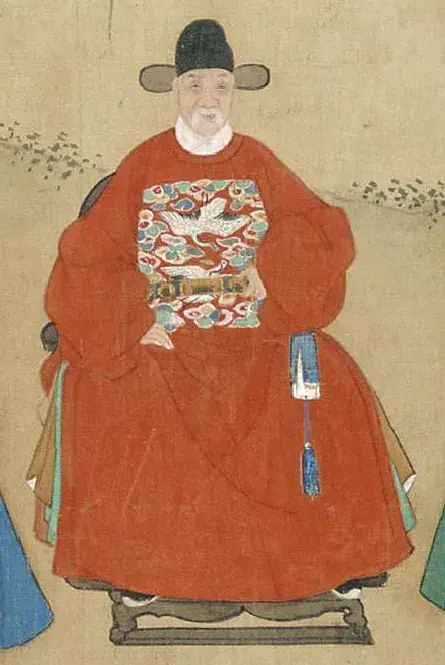
刘大夏
Liu Daxia (1437–1516), courtesy name Shiyong, art name Dongshan Jushi, was a native of Huarong, Huguang, and a distinguished statesman and military administrator during the mid-Ming dynasty. Passing the palace examination as a jinshi in 1464, he served in the Ministry of War as Secretary and Director. Under Supreme Commander Xiang Zhong during the Chenghua era, Liu participated in pacifying displaced populations in Jingxiang…
Liu Daxia (1437–1516), courtesy name Shiyong, art name Dongshan Jushi, was a native of Huarong, Huguang, and a distinguished statesman and military administrator during the mid-Ming dynasty. Passing the palace examination as a jinshi in 1464, he served in the Ministry of War as Secretary and Director. Under Supreme Commander Xiang Zhong during the Chenghua era, Liu participated in pacifying displaced populations in Jingxiang and subduing western border unrest, demonstrating exceptional strategic acumen. During the Hongzhi reign, Liu was entrusted with containment operations along the Yellow River, constructing extensive dikes at Zhangqiu to restore grain transport. Later, as Supreme Commander of Guangdong and Guangxi, he pacified local rebellions and stabilized the southern frontier. In 1501, he was elevated to Minister of War, winning the profound trust of Emperor Xiaozong. Liu reformed military corruptions, reduced sinecures, and restrained palace favorites, being acclaimed alongside Wang Shu and Ma Wensheng as one of the "Three Worthies of the Hongzhi Era." Persecuted and exiled to Suzhou in Gansu by the eunuch dictator Liu Jin during the early Zhengde reign, he was later pardoned and died at home in 1516. He was posthumously granted the title Grand Preceptor and the posthumous name Zhongxuan.
Born in Huarong, Huguang, diligently studying the Confucian canon alongside statecraft, geography, and frontier military defense.
Passed the imperial examinations as a jinshi and received appointment as Secretary in the Bureau of Operations in the Ministry of War.
Assisted Censor-in-Chief Xiang Zhong in settling over one hundred thousand displaced refugees in the Jingxiang basin, advancing to Bureau Director.
Commissioned to repair the catastrophic levee breaches at Zhangqiu in Shandong, constructing major embankments and floodgates to control the Yellow River.
Promoted to Vice Censor-in-Chief and Supreme Commander of Liangguang, resolving ethnic uprisings and frontier chieftain disputes with both firmness and clemency.
Appointed Minister of War, reforming defense administrations, reorganizing the capital garrisons, and serving as a pillar of the Hongzhi restoration.
Framed on fabricated charges by the despotic eunuch Liu Jin, sentenced to prison, and subsequently banished to military penal servitude in Suzhou Guard.
Passed away at his ancestral residence in Huarong at the age of eighty; the imperial court posthumously bestowed upon him the rank of Grand Preceptor and the title Zhongxuan.
Liu Daxia was born in 1437 into a scholarly gentry family in Huarong, Huguang. In 1464, he achieved the jinshi degree and was appointed Secretary in the Bureau of Operations within the Ministry of War. In this post, he meticulously cataloged defensive installations, fortress structures, grain logistics, and military personnel quotas across the northern borders. In the early Chenghua era, the ambitious eunuch Wang Zhi sought to retrieve the maritime archives of Zheng He's voyages to advocate for overseas military expeditions. Recognizing the crushing economic burdens such ventures imposed upon the populace, Liu concealed these navigational records, dissuading the throne from costly external adventures. In 1476, Liu accompanied Xiang Zhong in pacifying the vast displaced migrant populations in Jingxiang, establishing Yunyang Prefecture to secure the central river basins. For his contributions, he was promoted to Director of the Bureau of Communications.
Between the late Chenghua and early Hongzhi periods, Liu Daxia served as Right Administration Vice Commissioner of Fujian and Right Administration Commissioner of Guangdong. In 1493, the Yellow River ruptured its banks at Zhangqiu in Shandong, severing the Grand Canal transportation corridor and inflicting widespread famine across the Central Plains. Emperor Xiaozong specially appointed Liu as Assistant Censor-in-Chief to oversee the hydraulic emergency. Directly braving torrential floods, Liu supervised soldiers and civilian laborers in throwing up massive levees, dredging silted channels, and diverting excessive waters toward the Huai River and the sea. In 1495, he was elevated to Vice Censor-in-Chief and Supreme Commander of Guangdong and Guangxi. In the south, he reorganized coastal defense divisions, redressed judicial abuses, and harmonized tribal disputes in Hainan and Guangxi, securing sustained peace for the southern territories.
In 1501, when Ma Wensheng was transferred to the Ministry of Personnel, Emperor Xiaozong recalled Liu Daxia to the capital to assume the portfolio of Minister of War. Liu instituted decisive administrative reforms: he excised thousands of fictitious names from capital garrison payrolls, prohibited royal relatives and nobles from encroaching upon military farmlands, promoted capable border commanders, and rationalized supply procurement. Alongside Ma Wensheng and Han Wen, Liu served as a chief confidant to the emperor, frequently attending private imperial audiences. Following Emperor Wuzong's accession in 1506, the notorious eunuch Liu Jin grasped dictatorial power. Liu Daxia repeatedly pleaded for retirement and returned home. Resentful of righteous ministers, Liu Jin concocted charges accusing Liu of past dereliction on the border in 1508, throwing him into the imperial prison and banishing him to punitive exile in Suzhou, Gansu. There, Liu conducted classical lectures with serenity. Following Liu Jin's execution, Liu was pardoned and rehabilitated, eventually passing away at his hometown in 1516, aged eighty.
The rupture of the Yellow River at Zhangqiu in 1493 was one of the most perilous logistical crises of the mid-Ming dynasty. Liu Daxia personally traversed the flood zones, discarding futile attempts at direct plugging and adopting the strategic principle of diversion and drainage. He engineered the massive Huanglinggang embankment and the stone-reinforced dikes at Zhangqiu, while erecting floodgates to regulate water volume. His engineering feats preserved the grain barges and stabilized the riparian population, prompting grateful locals to erect commemorative shrines in his honor.
During his five-year tenure as Minister of War, coinciding with the peak of the Hongzhi restoration, Liu resolutely rejected private patronage requests from aristocratic clans. He eliminated over ten thousand fraudulent names from the military registries of the two capitals and instituted strict meritocratic evaluations for frontier garrisons, eradicating bribery in officer postings. Renowned for his personal incorruptibility and austere lifestyle, Liu commanded unmatched moral authority among civil bureaucrats, anchoring the integrity of the imperial administration.
FIGURES ASSOCIATED WITH THIS DYNASTY