Born in Songcheng
Born into a scholarly family; exhibited extraordinary memory, mastering canonical classics from childhood.
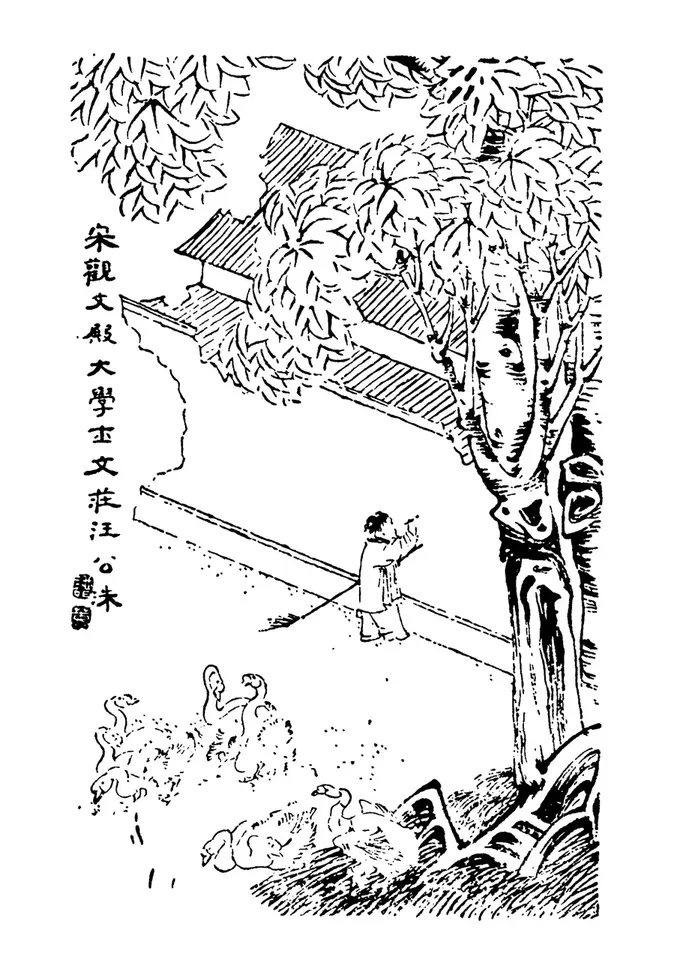
王洙
Wang Zhu (王洙, 997–1057), courtesy name Yuanshu (also written as Yuanshu 源叔), was a native of Songcheng in Yingtian Prefecture (modern Shangqiu, Henan Province). He was an eminent classical scholar, master bibliographer, celebrated bibliophile, and critical philologist of the reign of Emperor Renzong of the Northern Song Dynasty, serving as Hanlin Academician, Academician Reader-in-Waiting, and Drafter of Edicts. Gifted from…
Wang Zhu (王洙, 997–1057), courtesy name Yuanshu (also written as Yuanshu 源叔), was a native of Songcheng in Yingtian Prefecture (modern Shangqiu, Henan Province). He was an eminent classical scholar, master bibliographer, celebrated bibliophile, and critical philologist of the reign of Emperor Renzong of the Northern Song Dynasty, serving as Hanlin Academician, Academician Reader-in-Waiting, and Drafter of Edicts. Gifted from early childhood with photographic memory and intellectual brilliance, he mastered Confucian classics, dynastic histories, musical theory, mathematical astronomy, philological glossing, and ancient cosmological calculations. Passing the imperial Jinshi examination with highest honors during the Tiansheng era, he served successively as County Sheriff of Shucheng, Direct Lecturer of the Directorate of Education, Collator of the Institute of History, and Drafter of Edicts, rising to Hanlin Academician and serving as prefect of Haozhou, Xiangzhou, Xuzhou, and Bozhou. Posthumously, he was elevated to Minister of Rites and granted the posthumous name Wen. In the history of traditional Chinese medicine and bibliography, Wang Zhu occupies a monumental position. While examining decaying manuscripts within the imperial palace archives, he discovered a worm-eaten manuscript entitled Jingui Yuhan Yaolüe Fang (Essentials from the Golden Casket and Jade Casket / Prescriptions from the Golden Casket and Jade Container) in three volumes, identifying it as the long-lost treatise on miscellaneous internal diseases by the Eastern Han medical master Zhang Zhongjing. His preservation and preliminary collation formed the basis for the government medical bureau's subsequent publication of the classic Jin Kui Yao Lue (Essential Prescriptions of the Golden Coffer / Essential Prescriptions from the Golden Coffer), securing him everlasting renown as a foundational benefactor of Zhang Zhongjing's clinical tradition. In bibliographic science, Wang Zhu co-directed the seven-year compilation of the sixty-volume Chongwen Zongmu (Chongwen General Catalogue) alongside Wang Yaochen and Ouyang Xiu, establishing the institutional catalog of the imperial libraries of the Song dynasty, and co-compiled the military encyclopedia Sanchao Jingwu Shenglüe (Comprehensive Military Classic of the Three Reigns). He also participated in the authoritative collation of the Nine Classics, the Records of the Grand Historian, and the Book of Han. As a statesman, Wang Zhu demonstrated steadfast diplomatic courage when dispatched as an envoy to the Khitan Liao court, resolutely rejecting improper demands by Liao ministers to sketch Emperor Renzong's imperial portrait. Domestically, he campaigned for agrarian tax justice, proposing the implementation of the "Thousand-Pace-Square Method" ("Thousand-Pace Square Method") across all prefectures to equalize land tax burdens. In 1044, he was demoted following the political scandal surrounding Su Shunqin's sacrificial banquet at the Courier Bureau. A passionate bibliophile, Wang Zhu amassed a private library exceeding forty-three thousand volumes, pioneering advanced cotton-paper transcription, yellow-silk mounting, and book preservation techniques. Revered for his encyclopedic learning and archival rigor, Wang Zhu stands as one of the preeminent scholarly figures of the Northern Song renaissance.
Born into a scholarly family; exhibited extraordinary memory, mastering canonical classics from childhood.
Refused to change his examination sponsor when his fellow applicant was accused, forfeiting his examination attempt.
Attained the Jinshi degree with highest honors; appointed County Sheriff of Shucheng, later promoted to historical and educational bureaus.
Appointed alongside Wang Yaochen and Ouyang Xiu to collate imperial collections and compile the Chongwen Zongmu.
Completed the sixty-volume Chongwen Zongmu after seven years; appointed Auxiliary Academician of Longtu Pavilion.
Discovered the worm-eaten text of Zhang Zhongjing's medical treatise in the imperial library, reviving internal medicine.
Implicated in Su Shunqin's banquet scandal amid factional strife; demoted to serve as prefect of Haozhou and Xiangzhou.
Dispatched as imperial envoy to Liao; adamantly refused improper demands to sketch and worship imperial portraits.
Elevated to Hanlin Academician and Reader-in-Waiting; proposed the Thousand-Pace Square land tax reform.
Died while in active official service at age sixty-one; posthumously honored as Minister of Rites, and granted the posthumous name Wen.
Wang Zhu, courtesy name Yuanshu, was born into a distinguished scholarly lineage in Songcheng, Yingtian Prefecture. From early youth, he exhibited remarkable intellectual quickness and an astonishing memory, capable of committing canonical texts and historical commentaries to memory upon a single reading. Beyond the core Confucian classics, he immersed himself in musical pitch pipes, mathematical algorithms, ancient phonology, semantic glosses, astronomy, and divinatory cosmologies, becoming celebrated throughout northern scholarly circles as a universal polymath.
When he first stood for the provincial civil service examinations, he was sponsored jointly with a fellow scholar named Guo Zhen. Shortly before the testing, an informant accused Guo Zhen of concealing the fact that he had not completed the formal mourning period for his grandmother, a violation that carried legal liability for the sponsoring examiner. The examiner, holding deep respect for Wang Zhu's talents, summoned him secretly and advised: "Guo Zhen is under investigation, and liability will attach to my sponsorship. I will revoke my guarantee for you; find another sponsor immediately to avoid disqualification."
Wang Zhu declined the offer with dignity, stating: "Sponsorship of a scholar involves mutual integrity and trust. If you maintain the guarantee, I shall share whatever outcome befalls brother Guo; if you abandon it, I am prepared to accept disqualification. I will never change sponsors in the face of trouble merely to save myself!" Consequently, both scholars were disqualified from the examination that year. His unbending integrity won widespread admiration. Several years later, Wang Zhu sat for the imperial examinations during the Tiansheng era, passing in the highest tier of the Jinshi list, and entered official life as County Sheriff of Shucheng.
Recognized for his philological acumen and encyclopedic command of ancient texts, Wang Zhu was soon summoned to the capital. He was appointed successively as Investigator in the Ministry of Personnel, Direct Lecturer of the Directorate of Education, and Collator in the Institute of History, before advancing to Drafter of Edicts. While serving in the historical institute, he was commissioned to collate the standard authoritative texts of the Nine Classics, the Records of the Grand Historian, and the Book of Han, eliminating historical textual corruptions and establishing foundational recensions for later printing.
In 1034, Emperor Renzong reviewed the holdings of the imperial libraries, including the Zhaowen Institute, the Institute of History, the Academy of Scholarly Worthies, and the Secret Pavilion, discovering that centuries of warfare had left the imperial collection riddled with lacunae, corruptions, and forged titles. The emperor commissioned Hanlin Academician Zhang Guan, Drafter Li Shu, and Song Qi to supervise a comprehensive inventory, while assigning Wang Yaochen, Wang Zhu, and Ouyang Xiu to carry out the actual collation, classification, and drafting of descriptive abstracts.
Following the fourfold classification structure of the Tang dynasty Kaiyuan Sibu Shumu, Wang Zhu worked through tens of thousands of volumes over seven years, examining authorship, cataloging editions, and composing evaluative abstracts. In the twelfth month of 1041, the team presented the completed sixty-volume Chongwen Zongmu to the throne. Emperor Renzong commended the work, and Wang Zhu was elevated to Auxiliary Academician of Longtu Pavilion and Concurrent Associate Director of the Court of Imperial Sacrifices.
While serving within the imperial library pavilions, Wang Zhu achieved an extraordinary breakthrough that altered the history of Chinese medicine. The imperial archives held thousands of ancient texts, many left untended in storage corners where bookworms flourished. While inspecting damaged shelves in the deep interior of the pavilion, Wang Zhu uncovered three worm-eaten bamboo and paper scrolls bearing the title Prescriptions from the Golden Casket and Jade Container.
Possessing deep knowledge of medical literature, Wang Zhu recognized that these damaged manuscripts represented the lost clinical treatises on miscellaneous internal illnesses from the Eastern Han master Zhang Zhongjing's Treatise on Cold Damage and Miscellaneous Diseases. The first scroll addressed febrile cold damage, the middle scroll detailed dozens of internal diseases, and the third scroll recorded therapeutic prescriptions, including an unprecedented section on gynecological disorders.
Recognizing that this work constituted a priceless treasure of ancient clinical wisdom, Wang Zhu transcribed the text, preserved the fragile fragments, and arranged their sequence. Decades later during the Jiayou era, when the imperial government established the Bureau for the Collation of Medical Books, scholars Lin Yi and Gao Baoheng used Wang Zhu's recovered manuscript as the sole foundational source, removing the cold damage portion to avoid duplication with the Shanghan Lun and editing the remaining clinical chapters into the twenty-five treatises of the Jin Kui Yao Lue. Through Wang Zhu's accidental archival discovery, the foundational system of clinical syndrome differentiation and internal medicine was permanently preserved for posterity.
In diplomatic affairs, Wang Zhu demonstrated courage and statecraft. In 1050, serving as Academician Reader-in-Waiting, he was dispatched as chief imperial envoy to the Khitan Liao Empire, meeting Liao dignitaries at Gehuadian. During an official banquet, Liao Chancellor Liu Liufu attempted to intimidate him, announcing: "Our court painter Yelu Fang visited Song China and secretly painted your emperor's portrait; he intends to bring the portrait to your guesthouse today for your embassy to worship."
Wang Zhu sternly rebuked the maneuver: "A frontier guesthouse is no sacred palace hall for viewing the portrait of the Son of Heaven; such an act violates ritual and dishonors our sovereign!" When Liu Liufu claimed the likeness was imperfect and proposed sending Yelu Fang back to the Song capital to produce a fresh portrait, Wang Zhu rejected the request, preserving imperial dignity and commanding the respect of the northern court.
Domestically, Wang Zhu championed agrarian reform. Observing that extensive land consolidation by wealthy families had shifted the tax burden onto impoverished peasants who owned little land, he investigated the measurement methods devised by mathematicians Guo Zi and Sun Lin. He submitted a memorial urging Emperor Renzong to adopt the "Thousand-Pace Square Method" across the empire, using a standardized grid of one thousand paces square to measure land boundaries and balance tax assessments. His proposal served as the conceptual and practical precursor to Wang Anshi's later Square Fields and Equitable Taxation Law.
During the factional struggles of Emperor Renzong's reign, Wang Zhu was drawn into court conflict. In 1044, scholar Su Shunqin used proceeds from the sale of discarded Courier Bureau paper to host a traditional sacrificial banquet, inviting Wang Zhu, Mei Yaochen, and local courtesans. Conservative Censor-in-Chief Wang Gongchen seized upon the event to launch a purge against reformers associated with Fan Zhongyan. Wang Zhu was stripped of his capital posts and demoted to serve as prefect of Haozhou, subsequently governing Xiangzhou, Xuzhou, and Bozhou.
In 1054, following controversies surrounding the funeral rites of Emperor Renzong's beloved Consort Zhang (posthumously honored as Empress Wencheng), Wang Zhu returned to the capital as Hanlin Academician and Academician Reader-in-Waiting, delivering daily lectures on the classics to Emperor Renzong. In 1057, he passed away in office at the age of sixty-one. Emperor Renzong mourned his death, posthumously promoting him to Minister of Rites and conferring upon him the posthumous title Wen.
Wang Zhu occupies an irreplaceable position in the history of traditional Chinese medicine for discovering and preserving the lost text of Zhang Zhongjing's clinical treatises on miscellaneous internal illnesses.
Following the fall of the Han dynasty, Zhang Zhongjing's comprehensive medical work was fragmented. While Wang Shuhe compiled the Shanghan Lun, the treatises on non-febrile internal medicine were largely lost to physicians of the Sui and Tang periods. By rescuing the worm-eaten manuscript of Prescriptions from the Golden Casket and Jade Container from the imperial library and establishing its textual authenticity, Wang Zhu provided the essential recension that allowed imperial scholars to publish the Jin Kui Yao Lue. This discovery restored the clinical foundation of internal medicine, earning Wang Zhu universal reverence as an indispensable guardian of traditional clinical practice.
As a primary editorial director, Wang Zhu spearheaded the compilation of the sixty-volume Chongwen Zongmu, the first comprehensive official catalog of the Northern Song Dynasty.
Collaborating with Wang Yaochen and Ouyang Xiu, he established a fourfold system comprising forty-five classes, cataloging over thirty thousand volumes across the imperial libraries. Wang Zhu personally verified authorship, analyzed variant editions, and composed critical bibliographic abstracts for every title. The Chongwen Zongmu established the structural framework for institutional bibliography throughout the Song dynasty and served as an essential model for the Qing dynasty Siku Quanshu Zongmu Tiyao.
Wang Zhu was an influential early reformer of imperial fiscal administration. Recognizing that land concealment by powerful lineages exacerbated inequalities in the double-tax system, he advocated the official adoption of the "Thousand-Pace Square Method."
He demonstrated that dividing farmland into standardized geometric squares of one thousand paces provided an objective basis for land measurement and tax quotas. His advocacy challenged aristocratic tax evasion and pioneered the application of geometric survey methods to imperial revenue administration, directly inspiring the subsequent fiscal reforms of Wang Anshi.
During his embassy to the Khitan Liao Empire in 1050, Wang Zhu defended dynastic sovereignty through diplomatic skill and ceremonial steadfastness.
When Liao Chancellor Liu Liufu attempted to display a clandestinely sketched portrait of Emperor Renzong in a frontier guesthouse, Wang Zhu refused to allow the sacred image of his monarch to be compromised. His resistance and refusal to allow Liao court painters entry into Song territory defeated northern diplomatic machinations and safeguarded imperial honor.
Wang Zhu was one of the foremost private bibliophiles of the Northern Song Dynasty, amassing a personal library of over forty-three thousand volumes.
His bibliophilic methodology was renowned for its archival rigor: he collated every newly acquired text against multiple editions before having it transcribed onto durable cotton paper from Puqi, restricting each volume to forty leaves for ease of handling. Additionally, he mounted more than five thousand volumes in yellow silk as permanent "Town Library Books." He developed advanced preservation techniques against insect infestation and paper decay, instructing contemporary collectors such as Song Shou and influencing private archival practices throughout the Song period.
FIGURES ASSOCIATED WITH THIS DYNASTY