Capture of Wan and Kunyang
Rescued by Liu Ci at Wan; commissioned as Major General and took part in the decisive Battle of Kunyang.
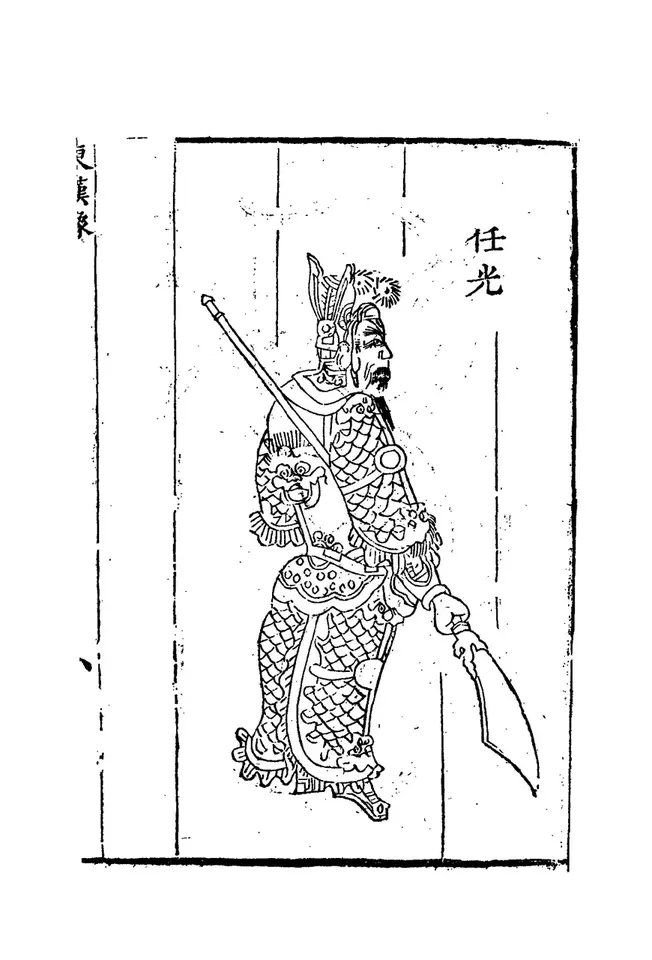
任光
Ren Guang (任光, died 29 CE), styled Boqing, native to Wan County in Nanyang Commandery (modern Wancheng District, Nanyang, Henan Province), was an eminent founding general of the Eastern Han dynasty, ranked 24th among the celebrated Yuntai Twenty-Eight Generals. Known in his youth for his generosity, upright conduct, and administrative diligence as a local clerk, Ren Guang joined the insurgent Han coalition in 23 CE after…
Ren Guang (任光, died 29 CE), styled Boqing, native to Wan County in Nanyang Commandery (modern Wancheng District, Nanyang, Henan Province), was an eminent founding general of the Eastern Han dynasty, ranked 24th among the celebrated Yuntai Twenty-Eight Generals. Known in his youth for his generosity, upright conduct, and administrative diligence as a local clerk, Ren Guang joined the insurgent Han coalition in 23 CE after being spared by Liu Ci following the capture of Wan. He subsequently participated in the momentous Battle of Kunyang, which shattered the main armies of the Xin dynasty. Under the Gengshi Emperor, Ren Guang was appointed Governor of Xindu. In late 23 CE, when the usurper Wang Lang proclaimed himself emperor in Handan, nearly all commanderies across Hebei defected. Liu Xiu, isolated and pursued by enemy forces after his flight from Ji, was on the brink of total destruction. In this supreme crisis, Ren Guang, together with Commandery Commandant Li Zhong and Magistrate Wan Xiu, remained unswervingly loyal to Liu Xiu. Ren Guang executed Wang Lang's envoys and mobilized four thousand elite troops to defend Xindu as an isolated bastion, opening its gates to welcome the desperate Liu Xiu. Elevated to General-in-Chief of the Left and enfeoffed as the Marquis of Wucheng, Ren Guang devised the critical strategy of mobilizing emergency shock troops (benming bing) through intimidation and psychological deception, including the nocturnal firing of the Tangyang marshes, rapidly expanding Liu Xiu's host into a victorious army of tens of thousands that conquered Handan and slew Wang Lang. Following Liu Xiu's ascension, Ren Guang was awarded the marquisate of Aling with an expansive domain of ten thousand households. In 29 CE, he was summoned to the imperial capital and granted the honor of Regular Palace Attendant, passing away in the winter of that year. Emperor Ming later commemorated his likeness in the southern palace's Yuntai Pavilion.
Rescued by Liu Ci at Wan; commissioned as Major General and took part in the decisive Battle of Kunyang.
Appointed Governor of Xindu by the Gengshi Emperor, administering local rehabilitation.
Executed Wang Lang's envoys and fortified Xindu with four thousand troops while the rest of Hebei capitulated.
Opened the city gates to rescue Liu Xiu; appointed General-in-Chief of the Left and Marquis of Wucheng.
Formulated the shock troop recruitment stratagem and set fire to Tangyang's outskirts, securing its bloodless surrender.
Awarded a ten-thousand-household domain as Marquis of Aling for his indispensable contributions to the restoration.
Summoned to the capital as Regular Palace Attendant; died peacefully in office and later ranked 24th at Yuntai.
Ren Guang was born in Wan County, Nanyang Commandery (modern Nanyang, Henan Province). From his early youth, he was widely beloved throughout his native community for his honest, unpretentious demeanor and sincere benevolence toward elders and peers. Upon reaching adulthood, he acquired thorough training in administrative law and local fiscal records, serving successively as a Village Chief (xiang sefu) and as a clerk in the commandery and county offices, establishing a solid reputation for grassroots capability.
During the late Dihuang era of the Xin dynasty, social unrest engulfed the empire as the Green Wood (Lülin) and Red Eyebrows (Chimei) rebellions erupted across the Central Plains. Han imperial clan members, led by the brothers Liu Yan and Liu Xiu, raised righteous banners in Nanyang. In the fifth month of the first year of Gengshi (23 CE), the Han armies besieged the heavily fortified city of Wan, prompting Xin garrison commander Cen Peng to surrender.
As insurgent troops poured through the broken gates, an unruly soldier spotted Ren Guang dressed in clean, formal administrative robes. Coveting the fine clothing, the soldier prepared to execute Ren Guang on the spot, ordering him to strip off his robes so as not to stain them with blood. At that critical moment, Han general Liu Ci, a cousin of Liu Yan serving as Minister of the Imperial Household, rode past on patrol. Observing Ren Guang's dignified composure and noble elder-like bearing, Liu Ci intervened and ordered the soldier to stand down, sparing Ren Guang's life.
Recognizing Ren Guang's talent, Liu Ci recruited him onto his private staff as an Assistant for Pacification (Anji Yuan). Following Liu Ci's recommendation, the Gengshi Emperor Liu Xuan commissioned Ren Guang as a Major General. Shortly thereafter, Wang Mang mobilized four hundred and twenty thousand imperial troops under Wang Yi and Wang Xun to annihilate the Han forces at Kunyang. Liu Ci's detachment was ordered north to relieve Kunyang, bringing Ren Guang directly into the decisive Battle of Kunyang alongside Liu Xiu. In this historic confrontation, Ren Guang fought valiantly, helping crush the massive Xin host and ending Wang Mang's reign.
In the autumn of 23 CE, the Gengshi Emperor established his capital at Luoyang and dispatched trusted civil governors to stabilize key regional centers. Ren Guang was appointed Governor of Xindu Commandery in Hebei. In the tenth month of that year, the Gengshi Emperor commissioned Liu Xiu as Grand Minister of War (Da Sima) and sent him north across the Yellow River to pacify the northern commanderies.
However, shortly after Liu Xiu's arrival in Hebei, Wang Lang, a soothsayer claiming to be Liu Ziyu, a lost son of Emperor Cheng of Han, declared himself emperor at Handan with the backing of powerful local lineages. Driven by political opportunism, commanderies and kingdoms across Hebei rapidly surrendered to Wang Lang. Isolated and pursued by rebel cavalry after an attempted betrayal in Ji, Liu Xiu was forced to flee southward in winter blizzards, starving, exhausted, and desperately searching for a defensible haven.
With virtually the entire northern region capitulating to Wang Lang, Xindu Commandery stood completely isolated. In this terrifying crisis, Ren Guang exhibited unshakeable loyalty and fortitude. Gathering Commandery Commandant Li Zhong, Magistrate Wan Xiu, and senior staff members, Ren Guang cut his finger to swear a solemn blood covenant, vowing to defend Xindu to the death in anticipation of Liu Xiu's return.
When Wang Lang dispatched an administrative clerk from Fulian County carrying imperial proclamations to demand Xindu's surrender, Ren Guang ordered the emissary seized and publicly beheaded in the central marketplace, demonstrating his defiance to the soldiers and citizens of the commandery. He immediately mobilized four thousand elite troops to fortify the city walls and defensive gates.
In the spring of 24 CE, Liu Xiu and his few dozen frostbitten companions reached Xiabo, utterly lost and despairing of survival. At a crossroads west of the town, an elderly traveler in white robes appeared, shouting: "The Governor of Xindu, Ren Guang, still holds the city for the Great Han! It lies eighty leagues to the south!" Rejoicing, Liu Xiu galloped toward Xindu. Hearing of his arrival, Ren Guang, Li Zhong, and Wan Xiu threw open the city gates and led their staff to kneel by the roadside, while the garrison and citizens shouted "Ten thousand years!" in jubilation. Ren Guang's isolated stronghold preserved Liu Xiu's life and served as the indispensable foundation for the Han restoration.
Although secure inside Xindu, Liu Xiu was acutely aware that a few thousand exhausted troops could not withstand the tens of thousands commanded by Wang Lang. Liu Xiu anxiously consulted Ren Guang: "Boqing, our numbers are so small that I contemplate leading our troops to join the peasant insurgent camps of Chengtou Zilu and Li Zidu. What is your judgment?"
Ren Guang rejected the idea emphatically: "Your Excellency must never do so! Leaders like Chengtou Zilu and Li Zidu are mere lawless bandits without grand vision or moral discipline. If you place yourself in their hands, you will become their hostage rather than their master, inviting certain doom!"
Liu Xiu asked: "Yet our troops are scarce; how can we confront Wang Lang?"
Ren Guang presented a shrewd military expedient: "We should immediately mobilize emergency shock troops (benming bing) from the surrounding districts. Furthermore, we should issue a severe manifesto declaring that if any county refuses to open its gates, our victorious troops will be granted full license to plunder its treasuries upon conquest! Men across the world covet wealth; under such proclamations, recruits will enlist in vast numbers!"
Embracing the plan, Liu Xiu commissioned Ren Guang as General-in-Chief of the Left and enfeoffed him as the Marquis of Wucheng, simultaneously elevating Li Zhong and Wan Xiu as ranking generals and peers. Ren Guang drafted a terrifying psychological proclamation: "The Grand Minister of War Liu Xiu, leading one million allied troops under Chengtou Zilu and Li Zidu, marches from the east to exterminate the Handan rebels!"
Advancing toward Tangyang County under cover of darkness, Liu Xiu and Ren Guang executed another psychological stratagem. Ren Guang ordered his soldiers to set fire to dry grasses and massive lakeside trees across the countryside. Enormous columns of flame and black smoke soared into the night sky, illuminating the water and marshlands like thousands of giant torches. Terrified citizens and defenders on the walls of Tangyang, believing that the dreaded million-strong bandit army had arrived, panicked completely. Local magistrates and garrison officers fled outside the walls and surrendered without offering resistance. Exploiting this momentum, Ren Guang and Liu Xiu swept through neighboring commanderies, raising an army of tens of thousands within weeks.
As Liu Xiu's northern offensive besieged Handan, Wang Lang launched a counter-strike against Xindu to sever the Han rear, capturing the replacement governor Zong Guang and the families of Li Zhong and Pi Tong. Liu Xiu dispatched Ren Guang to relieve the city, but Ren Guang's raw recruits broke ranks and fled on the march. Escaping alone, Ren Guang rejoined Liu Xiu's main army outside Handan just as relief forces dispatched by the Gengshi Emperor recaptured Xindu.
In the fifth month of 24 CE, Han armies stormed Handan, capturing and executing Wang Lang. Liu Xiu reappointed Ren Guang as Governor of Xindu to oversee regional pacification. In 25 CE, Liu Xiu assumed the imperial throne as Emperor Guangwu. During the second grand conferral of meritorious awards in 26 CE, Emperor Guangwu, remembering Ren Guang's decisive loyalty at Xindu, promoted him to Marquis of Aling, granting him an immense hereditary fief of ten thousand households.
Governing Xindu with benevolence and administrative prudence, Ren Guang restored agriculture, cleared ruined farmlands, and stabilized the frontier. In 29 CE, Emperor Guangwu summoned him to the imperial capital of Luoyang, honoring him with the rank of Regular Palace Attendant (Fengchaoqing), granting him direct participation in court councils.
In the winter of 29 CE, Ren Guang passed away peacefully in his metropolitan residence. Emperor Guangwu mourned him deeply, conferring generous burial honors, with his son Ren Wei inheriting the Aling peerage. In 60 CE, Emperor Ming commemorated the twenty-eight paramount founding generals by painting their portraits within the Yuntai Pavilion of the Southern Palace, with Ren Guang immortalized at rank twenty-four for his decisive defense of Xindu.
Fan Ye recorded in the Book of the Later Han (Hou Hanshu, Biographies of Ren, Li, Wan, and Pi): "Ren Guang and Pi Tong recognized the subtle tides of destiny, throwing open the gates of fortified strongholds. When imperial forces returned in distress, on which two governors could they rely? Ren Guang's loyalty laid the very foundation of the restoration."
Wu Weiye noted in Miscellaneous Notes of Zaolin (Zaolin Zazu): "Ren Guang assisted in establishing peaceful order, leading his soldiers through personal prestige as a true champion of his age. The opening and closing of Xindu's gates held the very life and death of the Han house; among the foundations of Emperor Guangwu's restoration, Ren Guang stands foremost!"
The Ming philosopher Wang Fuzhi observed in On Reading the Comprehensive Mirror for Aid in Government (Du Tongjian Lun): "When Guangwu rose in Hebei, had not Ren Guang and Li Zhong held Xindu in anticipation, he would have wandered as a solitary ghost. Ren Guang's recruitment of shock troops and use of deceptive stratagems was pragmatic, yet his devotion in sharing life and death with a single fortress was truly the mark of a grand minister."
FIGURES ASSOCIATED WITH THIS DYNASTY