Birth and Heritage
Born into an esteemed scholar-gentry house in Xiangyang; acquired the sobriquet White Eyebrows due to white hairs in his brows.
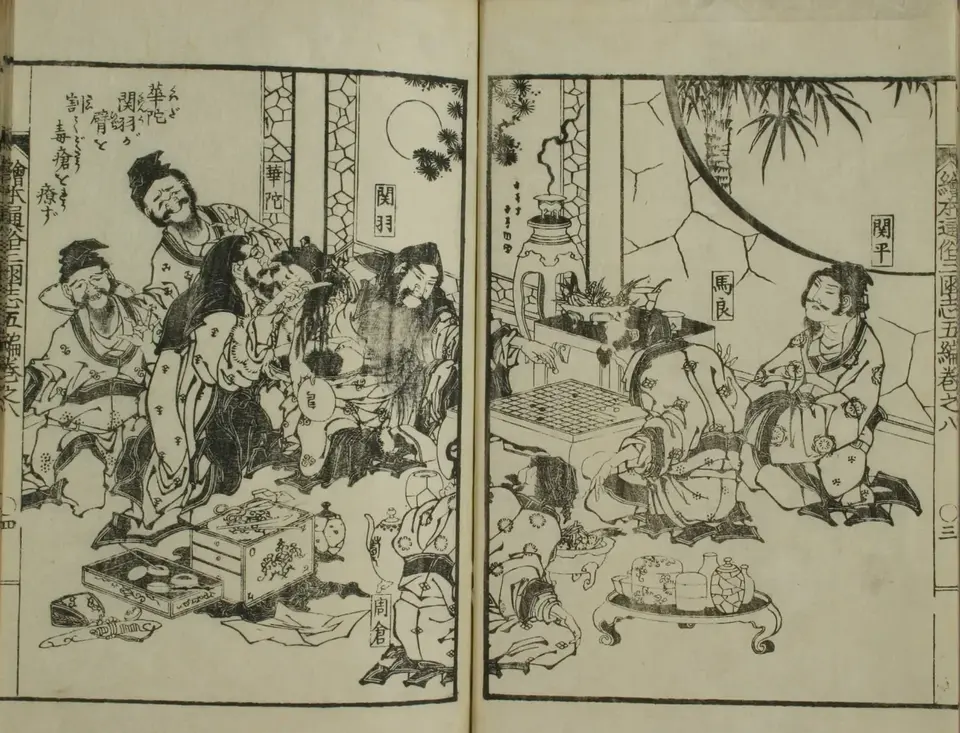
马良
Ma Liang (马良, 187–222), courtesy name Jichang (季常), was an esteemed statesman, strategist, and diplomat of the Shu Han state during the Three Kingdoms Period. Originating from an eminent lineage in Yicheng of Xiangyang Commandery, he and his four brothers all achieved literary fame and administrative distinction. Because Ma Liang possessed white strands in his eyebrows and exhibited superior intellect and moral…
Ma Liang (马良, 187–222), courtesy name Jichang (季常), was an esteemed statesman, strategist, and diplomat of the Shu Han state during the Three Kingdoms Period. Originating from an eminent lineage in Yicheng of Xiangyang Commandery, he and his four brothers all achieved literary fame and administrative distinction. Because Ma Liang possessed white strands in his eyebrows and exhibited superior intellect and moral virtue, a popular local proverb declared: "Among the five Changs of the Ma family, White Eyebrows is the finest." He joined Liu Bei's administration at an early stage and maintained a profound, brotherly friendship with Chancellor Zhuge Liang. Following Liu Bei's conquest of Yizhou in 211, Ma Liang remained in Jingzhou to assist senior general Guan Yu before being summoned to the central administration as a junior clerk in the Left General's staff. In foreign affairs, he undertook a critical diplomatic mission to Eastern Wu, winning the profound admiration of Sun Quan through his articulate eloquence and composed demeanor. Following the establishment of Shu Han in 221, Emperor Liu Bei appointed him Palace Attendant. During the Battle of Yiling in 222, Ma Liang traveled into the rugged mountains of Wuling to pacify and recruit the indigenous Wuling Man tribes, successfully securing their formal allegiance and military support. Later that year, when the Shu armies collapsed under Lu Xun's catastrophic fire attack, Ma Liang was killed in battle at the age of thirty-six, dying in the line of duty.
Born into an esteemed scholar-gentry house in Xiangyang; acquired the sobriquet White Eyebrows due to white hairs in his brows.
Recruited as Provincial Attendant by Liu Bei in Jingzhou, forming an intimate intellectual bond with Zhuge Liang.
Remained behind to assist Guan Yu as Liu Bei campaigned in Yizhou, corresponding with Zhuge Liang on administrative strategy.
Transferred to Chengdu following the pacification of Yizhou, appointed Clerk in the Left General's Staff.
Dispatched as official envoy to Eastern Wu, drafting his own credential and receiving an honorable reception from Sun Quan.
Elevated to Palace Attendant following Liu Bei's accession as Emperor of Shu Han, advising on imperial policy.
Accompanied the eastern expedition against Wu, venturing into Wuling to enlist the tribal chieftains of the Five Streams.
Slain in combat amidst the catastrophic defeat at the Battle of Yiling at the age of thirty-six.
Ma Liang was born into an illustrious scholar-official lineage residing in Yicheng County within Xiangyang Commandery. The Ma family was celebrated throughout the southern regions for producing exceptional scholars. Ma Liang had four brothers, all of whose courtesy names incorporated the character "Chang," namely Bochang, Zhongchang, Shuchang, Jichang (Ma Liang), and Youchang (Ma Su). Among the five brothers, Ma Liang was distinguished from birth by white strands interspersed within his eyebrows. Beyond this striking physical trait, he demonstrated profound mastery of historical texts, exceptional strategic acumen, and an impeccably upright moral character, standing out as the most accomplished of his kin. Consequently, a well-known proverb circulated among the gentry of Jingzhou: "Among the five Changs of the Ma family, White Eyebrows is the finest."
In 208, following the decisive Battle of Red Cliffs, Liu Bei pacified the southern commanderies of Jingzhou and assumed the post of Governor of Jingzhou, establishing administrative offices at Gong'an. Recognizing Ma Liang's exceptional reputation, Liu Bei recruited him into his provincial staff as an attendant. During this period, Ma Liang formed an intimate friendship with Military Advisor Zhuge Liang, who was directing regional finance and logistics. Their intellectual rapport and mutual dedication to the restoration of the Han dynasty were so profound that Ma Liang formally addressed Zhuge Liang as "Respected Elder Brother" in his private correspondence, and Zhuge Liang regarded him as an indispensable confidant.
In 211, Liu Zhang, the Governor of Yizhou, dispatched Fa Zheng to invite Liu Bei into Sichuan to counter the northern threat posed by Zhang Lu. While Liu Bei led Pang Tong and Huang Zhong westward, Zhuge Liang, Guan Yu, Zhang Fei, and Ma Liang stayed behind to secure Jingzhou. When hostilities subsequently erupted between Liu Bei and Liu Zhang, Zhuge Liang led reinforcements up the Yangtze River, leaving Ma Liang at Gong'an to assist General of the Vanguard Guan Yu in maintaining administrative order. Upon hearing that Liu Bei's armies had captured the strategic fortress of Luocheng, Ma Liang sent an eloquent missive to Zhuge Liang, praising his visionary statecraft and emphasizing that enduring political success depended entirely upon recruiting virtuous scholars and rectifying social morality. Following the final conquest of Chengdu, Liu Bei assumed the title of Left General and promoted Ma Liang to his central headquarters as a junior clerk.
In the late Jian'an era, territorial friction over the southern territories of Jingzhou generated profound tension between Liu Bei and Sun Quan. Seeking to avert premature military conflict and repair diplomatic channels, Liu Bei and Zhuge Liang resolved to dispatch a high-ranking envoy of extraordinary cultural polish and persuasive tact to the court of Eastern Wu, ultimately selecting Ma Liang for the delicate mission.
Prior to his departure, Ma Liang was conscious of the enormous prestige Zhuge Liang enjoyed throughout the southern regions. He approached Zhuge Liang and said: "Having received imperial commands to harmonize the friendly alliance between our two states, I request that you draft an introductory recommendation to General Sun Quan on my behalf." Zhuge Liang smiled and remarked: "You are fully capable of drafting this credential yourself." Ma Liang took up his brush without hesitation and wrote: "Our sovereign specifically dispatches his officer Ma Liang to pay respect and renew our alliance, seeking to perpetuate the glorious accords of ancient antiquity. This emissary is a man of upright virtue who has long served in Jingchu. He rarely commits reckless errors and embodies balanced, thorough virtue. It is humbly hoped that Your Excellency will graciously receive him so that his mission may reach a fruitful conclusion."
When Ma Liang arrived in Eastern Wu and delivered the credential, Sun Quan was thoroughly impressed by its refined prose and dignified phrasing. Throughout the embassy, Ma Liang conducted himself with aristocratic grace, rigorously maintaining the dignity of Liu Bei's regime while projecting genuine goodwill toward the host nation. Sun Quan treated him with extraordinary honors, hosting banquets in his honor and praising his decorum. Ma Liang's performance temporarily mitigated border tensions along the Yangtze River, demonstrating his mastery of interstate diplomacy.
In late 219, Sun Quan launched a surprise amphibious assault on Jingzhou, resulting in the defeat and execution of Guan Yu and the loss of the southern territories. In 220, Cao Pi forced the abdication of Emperor Xian and founded Cao Wei. In 221, Liu Bei proclaimed himself Emperor of Shu Han in Chengdu to preserve the legitimate succession of the Han house. During the subsequent distribution of court honors, Liu Bei elevated Ma Liang to Palace Attendant, placing him within the inner sanctum of imperial policy and confidential planning.
Determined to avenge Guan Yu and reclaim the critical strategic basin of Jingzhou, Liu Bei rejected the prudent warnings of Zhuge Liang and Zhao Yun, launching a massive expedition against Eastern Wu in the autumn of 221. In the spring of 222, imperial forces pushed down the Yangtze River gorges, capturing frontier outposts and establishing advanced positions between Yidao and Xiaoting. To protect his southern operational flank and recruit auxiliary combat units, Liu Bei recognized the vital importance of the Wuling Man (also known as the Five Streams Man), indigenous tribal confederacies inhabiting the deep mountain ranges of southern Jingzhou who were renowned for ferocious combat ability.
Given Ma Liang's deep familiarity with the customs and regional leaders of Jingzhou, Liu Bei commissioned him as imperial envoy to ride into the mountainous interior of Wuling alone. Traveling across treacherous terrain, Ma Liang met directly with the paramount tribal chieftains, explaining the righteousness of the Han cause and distributing official Shu Han seals and imperial patents. Swayed by Ma Liang's sincerity and moral authority, the tribal leaders unanimously accepted imperial vassalage, pledged allegiance to Liu Bei, and mobilized thousands of elite tribal warriors to reinforce the frontline encampments at Yiling.
By the summer of 222, Liu Bei had extended his operational lines for hundreds of miles along the forested banks of the Yangtze River, maintaining a protracted standoff against Wu forces. Sensing that the Shu troops were exhausted, demoralized, and vulnerable to environmental encirclement, Wu Commander-in-Chief Lu Xun executed a coordinated fire attack against the wooden stockades.
Fanned by gale-force winds, blazing infernos engulfed the Shu defenses, creating catastrophic panic throughout the ranks. Wu amphibious forces launched a devastating simultaneous assault, shattering Liu Bei's defensive formations and routing his divisions. Senior commanders including Zhang Nan, Feng Xi, and Fu Rong were killed while covering the retreat. Ma Liang, who had recently rejoined the imperial field staff following his successful diplomatic mission in Wuling, was trapped within the collapsing perimeter. Surrounded by overwhelming enemy forces, Ma Liang refused to surrender and perished fighting amidst the chaotic melee at the age of thirty-six.
Following his retreat to Baidicheng, Liu Bei was devastated by the news of Ma Liang's heroic death. In recognition of his selfless loyalty and sacrifice, the emperor issued an imperial decree appointing Ma Liang's young son, Ma Qi, as a Gentleman of the Masters of Writing. Ma Liang's brief yet illustrious life came to represent the highest ideals of scholarly dedication and chivalric loyalty in early Three Kingdoms history.
In 211, while stationed in Jingzhou, Ma Liang addressed a famous theoretical letter to Zhuge Liang analyzing the governance of Yizhou. He correctly identified that long-term dynastic restoration could never rely merely on military force, but necessitated the widespread recruitment of upright scholars and the cultivation of an ethical civil bureaucracy.
This correspondence illustrated Ma Liang's deep philosophical alignment with Zhuge Liang's administrative model. Rather than functioning solely as an operational advisor, Ma Liang possessed the strategic vision of a grand chancellor. His counsel influenced the foundational principles of Shu Han domestic administration, which emphasized institutional rigor paired with popular moral instruction.
Ma Liang's solitary mission to the Five Streams Man during the campaign of 222 stood as a masterpiece of regional diplomacy. The mountain tribes of southern Jingzhou had resisted Han central authority for centuries, frequently engaging in violent insurgencies against regional inspectors.
Undeterred by geographical hazards, Ma Liang penetrated the remote highlands and successfully integrated the tribal leaders into the imperial framework. By securing their collective allegiance and enlisting their warriors, he neutralized Eastern Wu's southern defensive buffer and opened a vital auxiliary front. His achievement proved his unmatched capacity for inter-ethnic conciliation and geopolitical maneuvering under high-stress wartime conditions.
Throughout his career serving Liu Bei, Ma Liang maintained absolute integrity, modesty, and personal unselfishness. Revered among the Jingchu intelligentsia as the most exemplary of the five Ma brothers, he commanded universal respect across factional boundaries.
When the disaster of Yiling unfolded, Ma Liang stood his ground alongside the frontline forces rather than seeking personal flight. His death in the field at the age of thirty-six demonstrated the supreme Confucian virtue of sacrificing life for righteousness. His tragic demise was mourned as an irreplaceable loss to the nascent Shu Han administration.
FIGURES ASSOCIATED WITH THIS DYNASTY