Biography
Service in Liaodong and Relieving the Capital
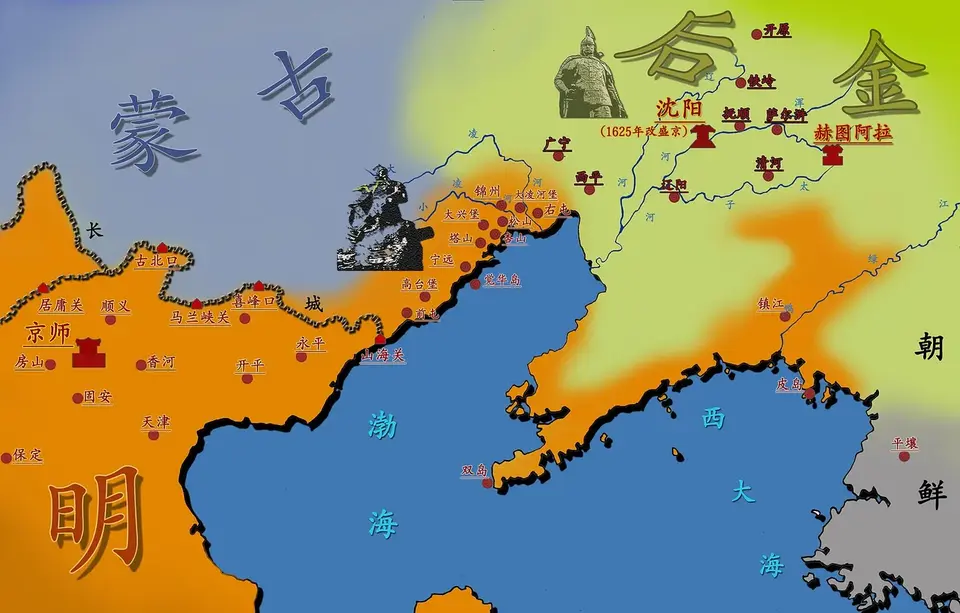
Cao Wenzhao was born in Datong, Shanxi, into a family steeped in border martial traditions. From his youth, he trained extensively in horsemanship and archery, exhibiting steady resolve, intrepid personal bravery, and a natural grasp of operational strategy. During the late Wanli and Tianqi reigns, the frontier crisis in Liaodong intensified following Ming defeats at Sarhu and Shenyang. Cao enlisted in the Liaodong forward garrisons, serving under Military Commissioner Xiong Tingbi and Grand Secretary Sun Chengzong. In prolonged patrol operations and counter-reconnaissance skirmishes outside the passes, Cao fought with reckless abandon, frequently leading cavalry charges against enemy vanguards. His valor impressed Sun Chengzong, who promoted him through merit to Mobile Corps Commander, placing him in charge of drilled shock cavalry.
In November 1629, Hong Taiji led tens of thousands of Manchu and Mongol cavalry across the Great Wall at Da'ankou and Longjingguan, advancing directly to besiege Beijing. The capital was placed under emergency martial law. Supreme Commander Yuan Chonghuan led elite Guanning cavalry forces from Shanhaiguan in a frantic forced march to relieve the court. Cao accompanied the relief columns and engaged Later Jin shock troops in brutal close-quarters combat outside Guangqu and Zuo'an gates. Wielding a heavy spear and thrusting through enemy cavalry squadrons, Cao felled several enemy officers, winning acclaim across the capital.
In early 1630, following Yuan Chonghuan's imprisonment, command of the imperial relief armies passed to Minister of War Ma Shilong. Recognizing Cao's unique combination of ferocity and strategic foresight, Ma entrusted him with the Chongzhen Emperor's imperial sword of state. Ma appointed Cao forward shock commander, ordering him to lead Assistant Regional Commanders Wang Chengyin and Zhang Shujia, alongside Major Zuo Liangyu, to lay an ambush at Kusshu and Hongqiao east of Yutian. When Later Jin forces traversed the valley, Cao sprang the trap; after hours of fierce hand-to-hand combat, the Ming forces decapitated hundreds of enemy warriors, earning Cao promotion to Assistant Regional Commander.
Subsequently, Cao led his cavalry from the cliffs of Daqianshan, advancing aggressively toward Zunhua. Coordinating closely with Ma Shilong and Zu Dashou, he utilized artillery and coordinated cavalry maneuvers to storm Da'an Castle and recapture the strategic passes at Nianyu. For his pivotal role in liberating the four northern cities of Zunhua, Qian'an, Luanzhou, and Yongping, the court conferred upon him the title of Assistant Commissioner of the Chief Military Commission.
Operations in Guanzhong and Annihilation of Rebel Chieftains
In July 1630, severe famine sparked massive peasant rebellions across northern Shaanxi. Insurgent confederacies led by Wang Jiayin, Wang Er, Gao Yingxiang, and Shen Yikui proliferated, overrunning undefended county seats and routing local garrisons. The Chongzhen Emperor ordered elite Guanning units from Liaodong deployed westward. Cao was promoted to Deputy Brigade General of Yansui East Route, tasked with leading Guanning cavalry veterans into Shaanxi. Upon arriving in the frontier garrisons, Cao enforced rigid discipline and ceaseless archery drills, rapidly restoring morale to the dispirited provincial ranks.
In the spring of 1631, Wang Jiayin, the most influential early rebel leader, captured the walled city of Hequ in Shanxi, utilizing the Yellow River crossings and formidable ramparts to coordinate with northern Shaanxi insurgent encampments. In April, Cao conducted an arduous forced march, surrounding Hequ with circumvallation lines and bombarding the battlements day and night with siege engines. When the ramparts were breached, Cao personally led the assault into the city, wiping out the defenders and recapturing Hequ. Wang Jiayin fled south into the rugged canyons of Mount Yangcheng. Cao pursued relentlessly across precipitous peaks with light cavalry. Trapped without escape, Wang's subordinates Zhang Liwei and Zhang Feiyan mutinied and decapitated Wang Jiayin, surrendering his head to Cao's camp. For this signal achievement, Cao was elevated to Regional Commander of Lintao.
Shortly thereafter, insurgent leader Dian Deng Zi crossed from Shaanxi into southern Shanxi with several thousand veteran troops. Cao pursued across hundreds of miles, intercepting the rebels at Jishan. Projecting the overwhelming might of imperial arms, Cao persuaded seven hundred insurgents to lay down their weapons; although Dian Deng Zi slipped away in the chaos, Cao deployed scouting parties who tracked him into dense mountain forests, capturing and executing him in front of the assembled troops.
In May 1631, rebel commanders Li Laochai and Duxinglang seized Zhongbu County in Shaanxi. Shaanxi Governor Lian Guoshi and Yansui Regional Commander Wang Chengen encircled the stronghold. Rebel chieftains Hao Lin'an and Liu Daojiang marched massive reinforcements from Qingyang to relieve Zhongbu. Cao, returning west from southern Shanxi, joined forces with Yulin Administrative Vice Commissioner Zhang Fuzhen to intercept the relief columns. Cao charged headlong into the insurgent formations, personally slaying Li Laochai and his primary lieutenant Yitiaolong. The remaining rebels fled in disarray into the Moyun Valley, where Cao blockaded the gorge and eliminated the encircled force.
Following this victory, Cao coordinated with mobile commanders Zuo Guangxian, Cui Zongyin, and Li Guqi to mount coordinated sweep operations across Suide, Yijun, Qingjian, and Mizhi. In successive battles at Huainingchuan, Heiyuqian, Fengjiagou, and Mianhuyu, Cao's cavalry achieved four consecutive triumphs, decapitating rebel leader Saodiwang and accepting the surrender of thousands.
Meanwhile, Shen Yikui's surviving lieutenants—Hongjunyou, Li Dusi, Du San, and Yang Laochai—concentrated tens of thousands of fighters at Zhenyuan, intending to seize Pingliang. Governor Lian Guoshi ordered Gansu Regional Commander Yang Jiamo and Vice Commander Wang Xingshan to block strategic passes. Observing the formidable defenses at Pingliang, the rebels turned toward Qingyang. Anticipating this maneuver, Cao detached elite cavalry unencumbered by baggage, traversing treacherous mountain trails from Longzhou amidst heavy rain to join Yang and Wang. Striking during a torrential downpour, the combined Ming forces shattered multiple rebel camps at Baimacheng. Li Dusi and Du San were captured and executed, while Hongjunyou was shot from his horse and killed. Through these relentless operations, primary rebel strongholds across Shaanxi were systematically subdued, cementing Cao's reputation as the premier field commander of the realm.
Campaigns in Shanxi and Henan
In 1632, pressured by sustained government offensives in Shaanxi, major insurgent coalitions under Zijinliang (Wang Ziyong), Huntianwang, Mantianxing, Laohuihui, and Chuangxiang crossed the Yellow River eastward into Shanxi. Exploiting sparse garrisons, they raided across Pingyang, Zezhou, and Lu'an prefectures, severing key transport arteries and directly threatening the provincial capital of Taiyuan and the state salt pans at Yuncheng. Shanxi Governor Xian Kejin and Regional Commander Zhang Yingchang suffered successive defeats. An incensed Chongzhen Emperor dismissed Zhang and appointed Cao Regional Commander of Shanxi, ordering him across the river to restore order.
Cao led his troopers into Shanxi with trademark aggressiveness. Engaging rebel columns along the Fen River, he won successive canyon engagements at Jingle, Liaozhou, and Heshun, cutting down dozens of rebel captains. Aware of Cao's approach, insurgent units scattered into mountain defiles, crying in dismay that General Cao had arrived. Finding it impossible to establish permanent bases in Shanxi, the rebel coalitions drifted southeastward into the rugged Taihang Mountains, moving along narrow mountain trails toward the Yellow River to invade the central plains of Henan.
In early 1633, hundreds of thousands of confederated rebels crossed the Taihang range, laying siege to Huaiqing Prefecture (modern Qinyang, Henan) and surrounding the adjacent county seats of Xiuwu and Wuzhi. Huaiqing served as the northern shield of Henan; its fall would leave Luoyang and Kaifeng defenseless. Henan Governor Xuan Mo dispatched frantic pleas for aid, prompting the court to order Cao across the Taihang Mountains to break the siege.
Cao mobilized instantly, leading over one thousand elite Guanning cavalry through freezing snowdrifts over the Taihang summits. Arriving outside Huaiqing, he found the countryside blanketed by dozens of rebel encampments. Assessing the enemy formations as loosely coordinated, Cao resolved to decapitate their command structure. Leading one hundred shock troopers in person, he plunged straight toward the enemy commander's banners. Taken completely by surprise, the insurgents panicked and broke, trampling one another in a frantic retreat. Cao captured three entrenched camps in rapid succession, lifting the siege of Huaiqing in a single afternoon.
Pursuing the routed forces eastward toward Xiuwu, Cao clashed with the main body of Hunshiwan at Fangzhuang. Charging into the enemy lines, his cavalry decapitated over one thousand insurgents and shattered an army of tens of thousands. Other rebel detachments under Xue Rengui fled toward Mengxian and Wenxian in hopes of crossing the Yellow River. Cao's cavalry shadowed them along the riverbanks, launching an intercepting strike at Mengxian ferry that captured hundreds and forced remnant insurgents to disperse into marshlands.
Despite Cao's heroic sacrifices at the front, factional strife in the capital undermined his position. Censors and Henan provincial officials, resentful of an outside general claiming top military credit, maliciously accused Cao of allowing enemies to escape and falsifying body counts. The suspicious Chongzhen Emperor reprimanded Cao, stripping him of three official ranks and compelling him to serve in the field under sentence of probationary redemption. Enduring this profound injustice without complaint, Cao remained dutifully at his post along the Yellow River.
Command at Datong and Frontier Fortifications
In the summer of 1634, Later Jin armies breached Great Wall fortifications across Xuanfu and Datong, pillaging border bastions and killing the regional commander. Paralyzed with panic, frontier officials could offer no effective resistance. Senior court ministers acknowledged that only Cao Wenzhao possessed the prestige and martial rigor to overawe the northern invaders. The Chongzhen Emperor restored his official ranks and appointed him Regional Commander of Datong.
Returning to his native Datong, Cao encountered collapsed wall battlements, unpaid soldiers, and rampant desertion. He instituted swift disciplinary reforms, executing corrupt quartermasters and purging incompetent officers. Personally surveying every mountain pass along the outer Great Wall, he directed the construction and repair of dozens of watchtowers, mounting red-coat cannons and breech-loading swivel guns while instituting continuous patrols. That autumn, when Later Jin raiding detachments probed the Datong sector, Cao anticipated their movements, staging ambushes in narrow gorges that decapitated dozens of elite horsemen. The Xuan-Da frontier enjoyed a period of stability under his watchful command.
The Ambush at Dagou Temple and Heroic Demise
In early 1635, the strategic landscape shifted drastically following the failure of Supreme Commander Chen Qiyu's pacification policy at Chexiang Gorge. The released rebel leaders repudiated their surrenders and convened the famous conference at Xingyang, choosing Gao Yingxiang as alliance leader and dividing into thirteen confederated armies. After sacking Fengyang and burning the imperial ancestral tombs, vast rebel columns swung westward into Shaanxi, capturing multiple counties and threatening Xi'an, Pingliang, and Qingyang. Minister of War and Supreme Commander of Shaanxi and the Three Frontiers Hong Chengchou submitted an urgent petition pleading for Cao Wenzhao's immediate deployment to direct field operations.
The Chongzhen Emperor ordered Cao to march three thousand Guanning cavalry westward with utmost haste. Reaching Pingliang, Cao conferred with Hong Chengchou. At that moment, tens of thousands of rebel fighters were besieging Zhenyuan in Gansu. Hong ordered Cao to lead the relieving vanguard. Learning that General Cao was approaching, rebel chieftains concluded that a direct frontal battle would be disastrous; instead, they engineered a massive canyon ambush at Dagou Temple, twenty li outside Zhenyuan. Concealing over ten thousand veteran cavalry and tens of thousands of foot soldiers along the wooded ridges, they deployed several thousand dispirited troops in the valley to feign retreat.
Anxious to relieve the garrison, Cao marched his cavalry one hundred li without pause, plunging straight into the gorge at Dagou Temple. As the Ming vanguard entered the narrow canyon, signal guns fired from the surrounding cliffs. Boulders and logs rained down upon the column, while thousands of rebel cavalry surged from hidden ravines, cutting off both ends of the gorge. Surrounded on all sides, Cao remained completely composed, shouting to his men that their duty was to die with honor for the emperor. Drawing his composite bow, he shot down several enemy captains in rapid succession, then gripped his heavy lance and charged into the dense enemy ranks, personally slaying dozens of foes.
Although the Guanning troopers fought with ferocious courage, they were hopelessly outnumbered. Deep mud at the valley floor immobilized their chargers, which were speared down by enemy pike lines. By dusk, Cao's personal guard had fallen to the last man, and his own warhorse collapsed under a barrage of arrows. Rebel soldiers pressed forward in dense ranks, shouting commands to take General Cao alive. Slicing down several assailants with his sword, covered in wounds and realizing escape was impossible, Cao looked toward heaven and declared that a true warrior would never submit to rebel dishonor. He drew his sword across his throat, dying heroically on the battlefield.
When news of his demise reached the imperial camp, Hong Chengchou wept aloud, and the entire army broke into mourning. In the Forbidden City, the Chongzhen Emperor was stunned and deeply remorseful for having doubted his premier general. The emperor issued an imperial eulogy, posthumously elevating Cao to Junior Protector of the Crown Prince and Left Chief Military Commissioner, ordering elaborate state funeral rites at Datong, erecting a sacrificial shrine, and providing generously for his surviving kin.