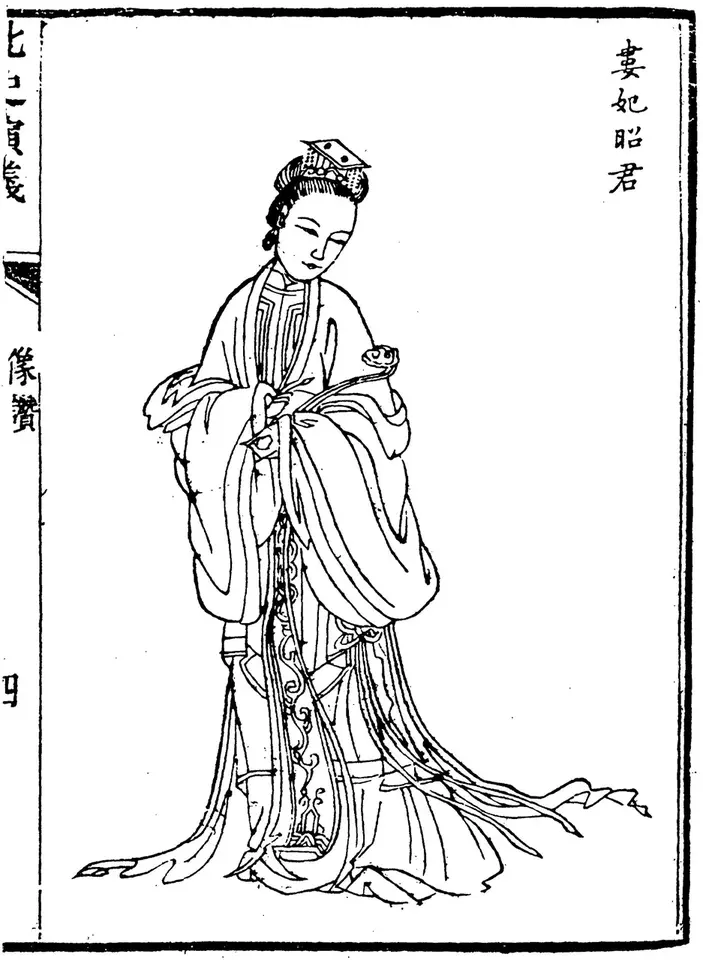
Biography
Aristocratic Lineage and Visionary Marriage
Lou Zhaojun was born into an eminent Xianbei aristocratic clan in Pingcheng, Dai Commandery. Her grandfather, Lou Ti, had rendered distinguished military service under Emperor Taiwu of Northern Wei and was enfeoffed as Marquis of Zhending, while her father, Lou Neigan, held the rank of Minister of Works. The Lou family amassed enormous wealth in northern Shanxi, commanding thousands of retainers and livestock that filled mountain valleys, and maintained a broad network of scholar-officials through regular philanthropy.
Endowed with exceptional intellect and poised judgment, Lou Zhaojun declined numerous marriage proposals from prominent noble houses during her youth, convinced that she should only wed an extraordinary individual. Around the Zhengguang era, Gao Huan, then an impoverished youth of Han-Xianbei cultural background, was assigned to sentry labor atop the city walls of Pingcheng. Observing him from an overlook, Lou Zhaojun noticed his dignified bearing and resolute demeanor despite his ragged clothing, exclaiming to her maid: "This man is destined to be my husband!"
Lou Zhaojun dispatched her maid to convey her interest and repeatedly provided private gold and silk to help Gao Huan assemble traditional betrothal gifts. Although her parents were initially dismayed by Gao Huan's humble standing, Lou Zhaojun remained adamant, compelling them to consent. Following their union, Lou Zhaojun placed her entire personal fortune at Gao Huan's disposal to purchase fine warhorses, armor, and provisions, enabling him to forge alliances with frontier elites across northern garrisons. In all of Gao Huan's strategic deliberations, Lou Zhaojun participated actively as a trusted counselor.
Domestic Governance and Statesmanship
In 531, Gao Huan launched an uprising from Xindu against the Erzhu warlords, successfully establishing Prince Yuan Gong as Emperor Jiemin of Northern Wei and receiving the title of Prince of Bohai. Lou Zhaojun was formally invested as Princess Consort of Bohai, assuming complete authority over clan governance and domestic administration.
Despite her elevated rank, Lou Zhaojun practiced rigorous personal frugality and wore modest garments. Whenever she traveled to inspect provincial estates, her escort never exceeded ten attendants, setting a powerful standard of moderation across the Gao household. She personally led female attendants in spinning and weaving coarse fabric, producing winter cloaks to reward courageous officers on the front lines. Furthermore, Lou Zhaojun treated Gao Huan's concubines with kindness and raised secondary offspring as her own children. Because she managed the domestic sphere with absolute fairness, Gao Huan was able to conduct distant military campaigns without concern for domestic intrigue.
During one major western offensive against Western Wei, Lou Zhaojun experienced protracted and excruciating childbirth labor in the middle of the night. Midwives urged dispatching emergency dispatch riders to inform Gao Huan. Lou Zhaojun adamantly forbade it, declaring: "The prince is leading imperial armies against powerful foes where victory hangs by a hair; how could domestic childbirth interrupt the supreme commander?" Hearing of this upon his triumphant return, Gao Huan was moved to tears of profound admiration.
In 532, Gao Huan enthroned Emperor Xiaowu, receiving appointment as Grand Chancellor and Grand General of the Celestial Column, and relocated the capital to Ye to found Eastern Wei. Lou Zhaojun frequently accompanied the military headquarters to Jinyang, providing strategic counsel on personnel appointments and political diplomacy.
Insight Regarding Hou Jing and Sacrifice for the Rouran Alliance
In 537, Gao Huan suffered a severe military reverse against Yuwen Tai at the Battle of Shayuan. In the aftermath of the defeat, the ambitious frontier commander Hou Jing repeatedly petitioned Gao Huan, requesting twenty thousand elite cavalry with a promise to storm Chang'an and capture Yuwen Tai.
Intrigued by the proposal, Gao Huan shared the plan with Lou Zhaojun. Lou Zhaojun immediately cautioned: "Hou Jing possesses boundless treacherous ambition and unpredictable deceit. If you grant him twenty thousand veteran cavalry into the western mountain passes, will he ever willingly return to your command? Even if he were to overcome Yuwen Tai, you would merely exchange one rival for an independent warlord. What benefit does that bring the state?" Convinced by her foresight, Gao Huan rejected Hou Jing's request, averting an immediate loss of core imperial reserves.
In 545, Western Wei concluded a secret pact with the Rouran Khaganate to coordinate a joint northern and western assault against Eastern Wei. Seeking to break this dangerous encirclement, Gao Huan sent Du Bi as an envoy to negotiate a marital alliance with Rouran Khagan Anagui, proposing to marry Princess Yujiulü to Gao Huan's eldest son, Gao Cheng. However, Anagui insisted that only Gao Huan himself was worthy of marrying his daughter.
Reluctant to compromise his lifelong bond with Lou Zhaojun, Gao Huan hesitated. Recognizing the existential threat to Eastern Wei, Lou Zhaojun took the initiative, counseling Gao Huan: "The survival of the realm takes precedence over all else. The Rouran are formidable; pray do not hesitate on my account!"
Lou Zhaojun voluntarily moved out of the principal palace residence into an outer auxiliary compound, ceding the primary consort status to Princess Yujiulü. Anagui was so impressed by Lou Zhaojun's dignity and selflessness that he pledged steadfast military cooperation with Eastern Wei. Later, when Gao Huan fell ill at Jinyang and Princess Yujiulü visited his bedside, Lou Zhaojun ordered her own carriage to pull aside and yield the roadway whenever their retinues met, prompting Gao Huan to weep with gratitude and remorse.
Founding of Northern Qi and Leadership of the Qianming Coup
In 547, Grand Chancellor Gao Huan passed away, and their eldest son Gao Cheng succeeded to authority as Prince of Bohai, with Lou Zhaojun elevated to Dowager Princess. In 550, her second son Gao Yang accepted the abdication of Eastern Wei to establish the Northern Qi dynasty as Emperor Wenxuan, investing Lou Zhaojun as Empress Dowager in Xuanxun Palace.
While Emperor Wenxuan initially displayed decisive administrative talent, his later years were marked by erratic alcoholism and arbitrary executions. Lou Zhaojun repeatedly rebuked his excesses; on one occasion when the emperor acted with drunken disrespect, she struck him with her staff, prompting the chastened ruler to prostrate himself in remorse. In 559, Emperor Wenxuan died, and his fifteen-year-old heir Gao Yin took the throne as Emperor Fei, honoring Lou Zhaojun as Grand Empress Dowager.
Emperor Fei was young, and regency powers were exercised by Senior Minister of Writing Yang Yin, Commander of the Army Yan Zixian, and Attendant Song Qindao. Fearing that the adult imperial uncles, Prince Gao Yan of Changshan and Prince Gao Zhan of Changguang, would usurp royal prerogatives, Yang Yin secretly petitioned to reassign both princes to distant frontier commands.
Grand Empress Dowager Lou Zhaojun discerned that purges against the imperial brothers would destabilize the royal house amidst hostile encirclement by Northern Zhou and the Chen dynasty. Summoning Gao Yan and Gao Zhan to Xuanxun Palace, she authorized a preemptive strike. On the twenty-third day of the second month of 560, the princes staged an ambush at the Taiji Hall, executing Yang Yin, Yan Zixian, and Song Qindao. Lou Zhaojun then issued a formal imperial edict deposing Gao Yin as Prince of Jinan and enthroning Gao Yan as Emperor Xiaozhao, resuming her rank as Empress Dowager.
Final Governance and Interrment at Yiping Mausoleum
Emperor Xiaozhao proved an industrious and frugal sovereign, but in the winter of 561, he suffered mortal injuries in a hunting accident near Jinyang. Recognizing that his infant son Gao Bainian could not survive dynastic turbulence, the dying emperor bequeathed the throne to his brother Gao Zhan.
Lou Zhaojun traveled day and night from Ye to Jinyang to maintain political stability. Following Gao Yan's death, she directed the enthronement of her ninth son Gao Zhan as Emperor Wucheng, continuing her stabilizing influence as Empress Dowager.
In the spring of 562, the sixty-two-year-old Empress Dowager fell gravely ill in Xuanxun Palace. When court attendants suggested summoning Buddhist monks to conduct elaborate public fasts and rituals to pray for her recovery, Lou Zhaojun dismissed them, stating: "Human lifespan is determined by natural destiny; how can Buddhist chanting extend life? It would merely waste treasury revenues and burden the people!" On the second day of the fourth month of 562 (May 20, 562), Lou Zhaojun passed away at the age of sixty-two. Emperor Wucheng honored her with the posthumous title Empress Wuming, and she was interred alongside Gao Huan in Yiping Mausoleum in the fifth month.