Settling in Taiwan
Active in Zheng Zhilong's maritime trade network before settling in southern Taiwan after the Dutch occupation of Tayouan (Tainan).
何斌
He Bin (何斌, birth and death dates unrecorded in historical sources), courtesy name Tingbin, was a native of Nan'an County in Quanzhou Prefecture, Fujian, a prominent interpreter in Taiwan during the late Ming and early Qing transition, and a pivotal figure in Zheng Chenggong's recovery of Taiwan. Having participated in maritime trade with Zheng Zhilong's organization in his youth, he settled in Chikan (modern Tainan, Taiwan),…
He Bin (何斌, birth and death dates unrecorded in historical sources), courtesy name Tingbin, was a native of Nan'an County in Quanzhou Prefecture, Fujian, a prominent interpreter in Taiwan during the late Ming and early Qing transition, and a pivotal figure in Zheng Chenggong's recovery of Taiwan. Having participated in maritime trade with Zheng Zhilong's organization in his youth, he settled in Chikan (modern Tainan, Taiwan), where his fluency in Dutch and Southern Min, combined with his commercial acumen, led to his appointment as Chief Interpreter (Da Tongshi) and Chinese Elder under the Dutch East India Company administration in Taiwan, overseeing Chinese land reclamation, commerce, and tax collection. Beginning in 1657, He Bin secretly established contact with Zheng Chenggong (Prince of Yanping) in Xiamen, covertly collecting maritime duties on Zheng's behalf in Taiwan while surveying Taiwan's coastal channels and Dutch fortifications. When Dutch Governor Frederick Coyett discovered the arrangement in 1659 and stripped him of his post with heavy fines, He Bin fled across the Taiwan Strait to Xiamen carrying detailed maps of the Lu'ermen channel and Dutch defenses. In Xiamen, he persuaded Zheng Chenggong to launch an eastern expedition to expel the Dutch colonists. In the third month of 1661, He Bin accompanied Zheng Chenggong's fleet across the strait, personally piloting the vanguard warships through the Lu'ermen channel at high tide and rallying local Han settlers and indigenous inhabitants to support the campaign until the Dutch surrendered in early 1662.
Active in Zheng Zhilong's maritime trade network before settling in southern Taiwan after the Dutch occupation of Tayouan (Tainan).
Appointed Chief Interpreter and Chinese Elder by the Dutch East India Company authorities in Taiwan, managing Chinese agricultural settlements and trade taxes.
Traveled to Xiamen to negotiate trade restoration with Zheng Chenggong and secretly agreed to survey Taiwan's waterways and Dutch defenses.
Exposed for collecting maritime duties on Zheng Chenggong's behalf and prosecuted by Governor Coyett, fled by sea to Xiamen with hydrological and military maps of Taiwan.
Presented Taiwan's strategic geography and tidal patterns at the Xiamen military council, convincing Zheng Chenggong to launch the campaign.
Piloted Zheng Chenggong's fleet through the Lu'ermen channel into the Taijiang inland sea in the fourth month, aiding the siege of Fort Zeelandia until the Dutch surrender.
He Bin was born in Nan'an County, Quanzhou Prefecture, Fujian, and participated in his youth in the maritime commercial and naval network led by Zheng Zhilong, acquiring deep familiarity with the sea routes of the Taiwan Strait. After Dutch colonists occupied Tayouan (modern Anping, Tainan) in 1624 and constructed Fort Zeelandia, large numbers of migrants from Zhangzhou and Quanzhou crossed the strait to cultivate land and trade in Taiwan, and He Bin established his residence in Chikan.
Resourceful, generous, and fluent in both Dutch and Southern Min, He Bin enjoyed high prestige among Chinese settlers in Taiwan. Consequently, the Dutch East India Company council appointed him Chief Interpreter (Da Tongshi) and head of the Chinese elders. In this capacity, He Bin managed tax-farming contracts over local settlements, supervised sugarcane and rice cultivation, and coordinated maritime trade between Taiwan and Xiamen, building a substantial fortune and frequently assisting impoverished immigrants from southern Fujian.
Between 1654 and 1657, outraged by Dutch seizures of Chinese merchant vessels and mistreatment of Chinese residents in Taiwan, Zheng Chenggong imposed a strict maritime embargo from Xiamen that crippled Dutch trade on the island. In 1657, Dutch Governor Frederick Coyett dispatched He Bin as an envoy to Xiamen with gifts to petition Zheng Chenggong for the resumption of trade.
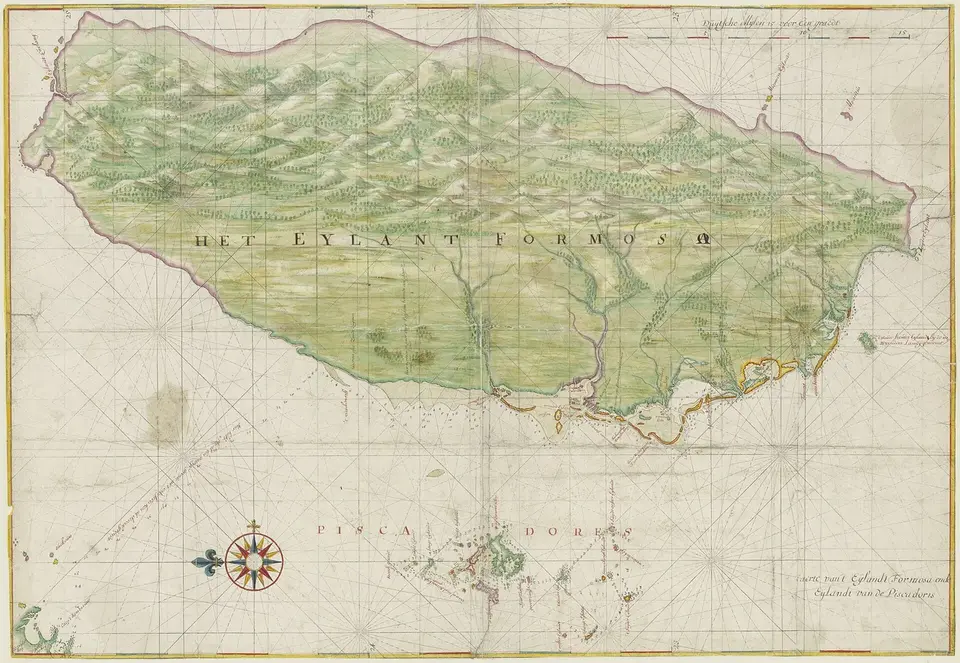
Upon meeting Zheng Chenggong in Xiamen, He Bin privately pledged his loyalty to the Ming cause and offered to assist in recovering Taiwan. Zheng Chenggong entrusted He Bin with covertly collecting customs duties from mainland merchant ships arriving in Taiwan and surveying the island's coastal channels and Dutch fortifications. Returning to Taiwan, He Bin used his position as Chief Interpreter to shield Zheng's intelligence agents while hiring skilled boatmen to sound the depths of Tayouan Harbor, Baxemboy, and the treacherous Lu'ermen channel by night, compiling a detailed military and hydrological map recording hidden reefs, tidal schedules, and the artillery deployments of Fort Zeelandia and Fort Provintia.
In 1659, after Zheng Chenggong's northern expedition against Nanjing ended in defeat and his forces retreated to Xiamen, Zheng urgently needed a secure strategic base. At that moment, a Chinese interpreter named Guo Ping betrayed He Bin to Governor Frederick Coyett, revealing that He Bin had been secretly collecting tens of thousands of taels in shipping duties for Zheng Chenggong. Coyett immediately dismissed He Bin from his office as Chief Interpreter, confiscated his account books, imposed heavy fines, and placed him under surveillance.
Recognizing the imminent danger, He Bin acted decisively in the winter of 1659. Under the pretext of celebrating the New Year lantern festival, he hosted a lavish banquet at his Chikan mansion for Dutch soldiers and officers; while the guards were intoxicated, He Bin and his trusted retainers boarded a fast vessel waiting off the Anping coast with his secretly drafted maps of Taiwan and sailed across the Taiwan Strait to Xiamen.
Arriving in Xiamen (Siming Subprefecture), He Bin presented his military and hydrological maps of Taiwan to Zheng Chenggong, declaring that Taiwan possessed a thousand li of fertile land, abundant sulfur and resources in Jilong and Tamsui, and strategic command over maritime trade routes—making it an ideal base from which to sustain an army and rebuild the Ming cause. When several of Zheng's generals objected out of fear of the perilous strait and Dutch cannon at Fort Zeelandia, He Bin pointed to his charts to explain that although the Lu'ermen channel was shallow and lined with reefs, spring tides raised the water level by several feet, allowing warships to bypass Fort Zeelandia's main batteries and sail directly into the broad Taijiang inland sea. Convinced by He Bin's precise intelligence, Zheng Chenggong resolved to march east.
In the third month of 1661, Zheng Chenggong personally led hundreds of warships and 25,000 troops eastward from Liaoluo Bay in Kinmen, with He Bin aboard the command flagship as Chief Navigator. At dawn on the first day of the fourth month (April 30, 1661), the fleet arrived off Lu'ermen. Relying on the shallow reefs of Lu'ermen, the Dutch garrison had sunk vessels only in the main southern channel and left Lu'ermen unguarded.
As the midday tide rose, He Bin stood at the bow of the lead pilot vessel, taking depth soundings and guiding Zheng Chenggong's main fleet safely through the Lu'ermen channel into the Taijiang inland sea to land at Heliaogang and Chikan. Going ashore immediately, He Bin rallied local Han settlers and indigenous villagers to supply ox-carts, grain, and fresh water to the landing troops, while turning over his own granaries and mansion in Chikan to serve as Zheng Chenggong's headquarters. With He Bin's assistance, Zheng's forces swiftly forced the surrender of Fort Provintia (Chikan Tower) and besieged the main Dutch garrison inside Fort Zeelandia. Early in 1662, Dutch Governor Frederick Coyett formally signed articles of surrender, ending thirty-eight years of Dutch colonial rule and restoring Taiwan to Chinese governance.
FIGURES ASSOCIATED WITH THIS DYNASTY