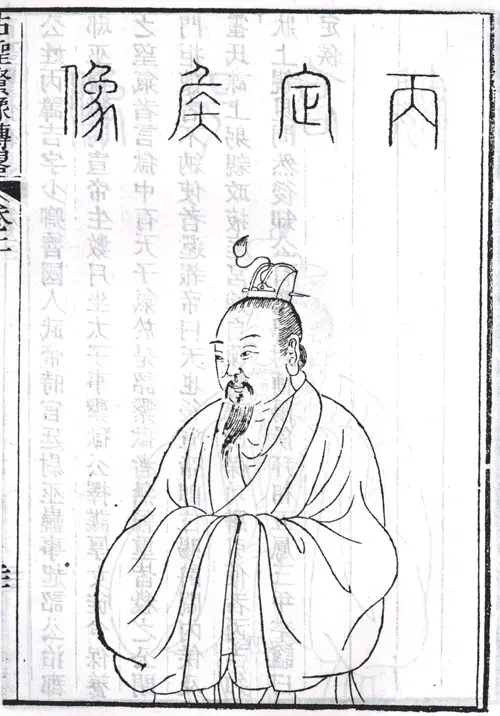
Biography
Legal Mastery and Early Administrative Career
Bing Ji was born in Qufu, the cultural capital of Lu, where Confucian scholarship and administrative rigor shaped his youth. He diligently studied imperial statutes, legal commentaries, and trial procedures, entering the civil service as a Prison Scribe within the Lu provincial government. Although charged with enforcing penal laws, Bing Ji was naturally humane and equitable, striving to establish objective truth and prevent judicial abuses rather than manufacturing harsh convictions to flatter superiors.
Due to his unblemished record and judicial precision, Bing Ji was recommended to the central government in Chang'an, where he was appointed Senior Supervisor in the Court of Judicial Review, assisting in adjudicating complex empire-wide capital trials. Although he was temporarily dismissed from office due to collateral involvement in an administrative trial, he accepted his dismissal with stoic equanimity, returning to Lu to serve quietly as an imperial provincial assistant.
The Witchcraft Catastrophe and Protecting the Imperial Great-Grandson
In 91 BC, the political tragedy known as the Witchcraft Disaster devastated the Western Han court. Corrupt officials Jiang Chong and Su Wen falsely accused Crown Prince Liu Ju of employing dark sorcery against Emperor Wu. Forced into open rebellion, the crown prince mobilized city garrisons before fleeing to Huxian, where he committed suicide. Empress Wei hanged herself, the crown prince's consorts and offspring were systematically executed, and tens of thousands of citizens perished in bloody recriminations.
Amidst this nationwide panic, the throne appointed Bing Ji as imperial judicial commissioner to preside over the overcrowded detention facilities in Chang'an, with the late crown prince's immediate household held within the Jun Di Prison. Among the prisoners was Liu Bingyi (the future Emperor Xuan), the son of Prince Liu Jin and grandson of Crown Prince Ju, who was barely several months old. With his parents executed, the helpless infant was confined to a squalid prison cell.
Inspecting the cells, Bing Ji was deeply moved by the innocent infant's plight. Convinced of the crown prince's innocence and horrified by the mistreatment of royal flesh and blood, Bing Ji resolved to protect the infant at all costs. He selected two convicted female prisoners of gentle temperament, Hu Zu and Guo Zhengqing, pardoning them from hard labor to nurse and care for the baby. To prevent the infant from succumbing to prison dampness, Bing Ji paid for clean swaddling clothes and medicine from his own salary, transferring the child to a dry, well-ventilated room and visiting him daily.
Defying the Death Decree and Preserving the Future Emperor
In early 87 BC, Emperor Wu fell critically ill at his country retreats in Changyang and Wuzuo. Astrologers informed the suspicious sovereign that an ominous "son-of-heaven aura" was emanating from the prisons of Chang'an, suggesting an impending imperial usurper. Terrified of losing power, Emperor Wu dispatched court attendant Guo Xiang with imperial credentials, ordering the immediate execution of all prisoners within the capital's detention centers without exception.
Panic-stricken prison wardens opened their gates to execute the inmates, but when Guo Xiang arrived before the Jun Di Prison, he found the iron gates locked and barred from within.
Standing atop the prison battlements in full armor, Bing Ji refused entry to the imperial envoy, declaring loudly: "The imperial great-grandson is within! Even ordinary innocent commoners cannot be executed without lawful trial, how much less the legitimate great-grandson of the reigning emperor!" Guo Xiang shouted and threatened violence while brandishing the imperial tally, but Bing Ji maintained his defensive cordon throughout the night. At dawn, Guo Xiang rode back to report Bing Ji's insubordination to Emperor Wu.
Hearing the phrase "imperial great-grandson," the dying emperor experienced an epiphany of conscience, observing that the infant's preservation was guided by Heaven. Instead of punishing Bing Ji, Emperor Wu issued a general amnesty across the empire, saving the lives of all prisoners in the Jun Di Prison. Following the amnesty, Bing Ji continued to finance the child's care until he was healthy, eventually tracking down the family of the child's maternal grandmother, Shi Liangdi. Bing Ji personally delivered the child to Shi Gong's residence, entrusting him to his great-grandmother Lady Zhen, thereby safeguarding the sole surviving branch of the direct imperial lineage.
Advising Huo Guang and the Dynastic Succession
Following the death of Emperor Wu, eight-year-old Emperor Zhao ascended the throne under the regency of Grand General Huo Guang. Recognizing Bing Ji's legal expertise and political discretion, Huo Guang appointed him director of the city market and soon elevated him to Chief of Staff within the Grand General's headquarters. Bing Ji provided counsel during the suppression of plots orchestrated by Shangguan Jie and Prince Liu Dan, earning Huo Guang's implicit trust before transferring to the senior advisory ranks of Grandee Remonstrant and Palace Attendant.
In 74 BC, Emperor Zhao died prematurely without an heir. Huo Guang and senior ministers enthroned Prince He of Changyi, only for the young prince to commit over one thousand documented administrative abuses and ceremonial violations within twenty-seven days. Huo Guang and General of Chariots and Cavalry Zhang Anshi determined to depose the ruler, but they were paralyzed regarding who should succeed to the imperial throne.
At this critical crossroads, Bing Ji held a confidential audience with Huo Guang. Bing Ji advised: "The Grand General acts with upright devotion, but the realm currently lacks a master. I have closely observed that the grandson of Crown Prince Ju, Liu Bingyi, is currently living among commoners in the city. He is educated in the classics, upright in conduct, and possesses broad practical wisdom. If the Grand General follows ancestral precedent and welcomes this legitimate great-grandson to ascend the throne, the empire and ancestral altars will be blessed with enduring stability."
Huo Guang enthusiastically embraced Bing Ji's proposal. Working alongside the imperial family, Huo Guang obtained authorization from Empress Dowager Shangguan to depose Prince He, dispatching Bing Ji and the Minister of the Imperial Clan to escort eighteen-year-old Liu Bingyi to Weiyang Palace to ascend the throne as Emperor Xuan.
Concealing Merit and Imperial Recognition
Following Emperor Xuan's accession, numerous ministers received aristocratic fiefs for their roles in the succession. However, Bing Ji maintained remarkable modesty. Throughout his daily duties in court, he never mentioned his life-saving deeds in the Jun Di Prison or his secret proposal to Huo Guang. Even the emperor remained entirely unaware that the dignified official before him was his childhood savior.
During the early reign, Bing Ji discharged his offices with quiet professionalism. In 67 BC, Emperor Xuan appointed him Grand Tutor to Crown Prince Liu Shi to oversee the heir's education; months later, he was promoted to Censor-in-Chief, working closely with Chancellor Wei Xiang to direct imperial policy.
In 63 BC, Guo Zhengqing, one of the former wet nurses who had fallen into poverty, petitioned the palace asking for recognition of her childhood care of the emperor. Astounded, Emperor Xuan ordered a thorough investigation. The superintendent of the inner palace confirmed the records, reporting: "When the late crown prince's family perished, the infant emperor was preserved entirely through the intervention of judicial commissioner Bing Ji, who assigned female prisoners to nurse you, paid for your medicine, and risked his life by barring the gates against the death decree."
Overwhelmed with emotion, Emperor Xuan wept openly, marveling that Bing Ji had concealed such monumental virtue for decades without seeking reward. Emperor Xuan summoned Bing Ji to Xuanrui Hall to express his gratitude, immediately creating him Marquis of Boyang with an estate of one thousand three hundred households and substantial gifts. Following the death of Wei Xiang, Emperor Xuan elevated Bing Ji to Chancellor, entrusting him with supreme executive authority.
Benevolent Chancellorship and Inquiring after the Ox
As Chancellor, Bing Ji harmonized Confucian ethical governance with legalist administrative precision. Although trained in criminal jurisprudence, he had studied the Book of Songs and the Book of Rites, believing that stable governance relied on moral education and social harmony. In administration, he championed leniency, courtesy, and respect for bureaucratic morale, avoiding petty surveillance and harsh persecutions. When subordinate officials committed minor infractions, he granted them extended leaves of absence to allow them to retire gracefully rather than publicly prosecuting them.
On an inspection tour outside the capital, Bing Ji's carriage encountered a violent public brawl where citizens had been killed and wounded, with casualties lying across the roadway. Bing Ji instructed his driver to navigate around the disturbance without halting to inquire. Shortly after, an elderly peasant was seen walking an ox that was panting heavily with its tongue protruding. Bing Ji immediately ordered his carriage halted and dispatched an attendant to ask the farmer: "How many li has that ox walked?"
His carriage driver was deeply perplexed, asking why the Chancellor had ignored dead citizens in the street while stopping to investigate a panting ox.
Bing Ji patiently explained: "Street brawls and homicides fall under the direct jurisdiction of the Mayor of the Capital and local magistrates, who are responsible for arresting criminals according to law; at the end of the year, the Chancellor assesses their administrative performance. It is inappropriate for the Chancellor to micromanage street policing. However, it is currently early spring, and the weather is not yet hot. If an ox pants heavily after walking a short distance, it indicates that the natural seasonal equilibrium has been disrupted, warning of potential unseasonable heat, droughts, or agricultural failures that could ruin crops across the empire. A Chancellor's foremost duty is to balance the macro-ecological energies of Heaven and Earth and protect the agrarian livelihood of the realm. Therefore, investigating the ox takes precedence." Hearing this explanation, the driver and attendants were awed by his high-level statesmanship.
In 55 BC, an aging Bing Ji fell gravely ill. Emperor Xuan visited his bedside in person, asking him to recommend future chancellors. Bing Ji nominated Censor-in-Chief Du Yannian, Judicial Commandant Yu Dingguo, and Grand Minister of Agriculture Chen Wannian as capable and upright statesmen. Shortly thereafter, Bing Ji passed away peacefully, receiving the posthumous title of Marquis Ding. Emperor Xuan followed his deathbed recommendations, ensuring that the Western Han maintained its golden age of peace and prosperity.
Major Achievements
Defying the Death Decree to Shield the Future Emperor
During the lethal political purge of the Witchcraft Disaster, Bing Ji displayed extraordinary moral fortitude and civic courage. In an era when courtiers prioritized personal survival, Bing Ji risked the extermination of his entire lineage to protect the orphaned infant Liu Bingyi within the Jun Di Prison.
His decision to bar the prison gates against imperial executioners armed with sovereign authority stands as one of the most heroic acts of principled resistance in ancient Chinese annals. By defying an unlawful decree and compelling an imperial reconsideration, Bing Ji preserved the life of the future Emperor Xuan, directly altering the dynastic fortunes of the Western Han.
Preserving Dynastic Stability through the Restoration of Emperor Xuan
During the constitutional crisis following the death of Emperor Zhao and the deposition of Prince He, the empire faced the threat of aristocratic fragmentation. Bing Ji demonstrated profound geopolitical insight by proposing the enthronement of the commoner prince Liu Bingyi.
His strategy restored the legitimate lineage of Emperor Wu while providing the empire with a sovereign who intimately understood agrarian poverty and social injustice. Bing Ji's decisive counsel to Huo Guang averted a prolonged succession struggle and established the ideological foundation for the benevolent policies of the Zhao-Xuan Restoration.
Practicing Unassuming Virtue and Administrative Leniency
Bing Ji's character was defined by an exceptional degree of modesty and ethical restraint. Despite having preserved the sovereign's life and engineered his ascension, he sought no recognition, refusing to exploit his past service for personal aggrandizement.
As Chancellor, he implemented a governance style based on Confucian magnanimity. By granting long leaves to errant subordinates rather than inflicting punitive humiliation, he preserved the dignity of the civil service and fostered high bureaucratic morale. His unassuming leadership provided an essential moderating balance to the centralized legal apparatus of the Han court.
Defining Chancellor Governance through Inquiring after the Ox
The philosophical lesson of "Bing Ji Inquiring after the Ox" represents an enduring contribution to Chinese political theory, establishing clear boundaries between macro-strategic leadership and micro-administrative execution.
By entrusting street violence to local magistrates while dedicating imperial attention to seasonal climate anomalies that impacted agricultural security, Bing Ji articulated the true responsibility of supreme ministerial power. His insistence that grand ministers must focus on systemic harmony, agrarian stability, and institutional oversight served as an enduring model for chancellors throughout imperial history.