Birth in Huai'an
Born into a merchant family in Hexia Town, Shanyang County; displayed precocious intellect and passion for supernatural lore.
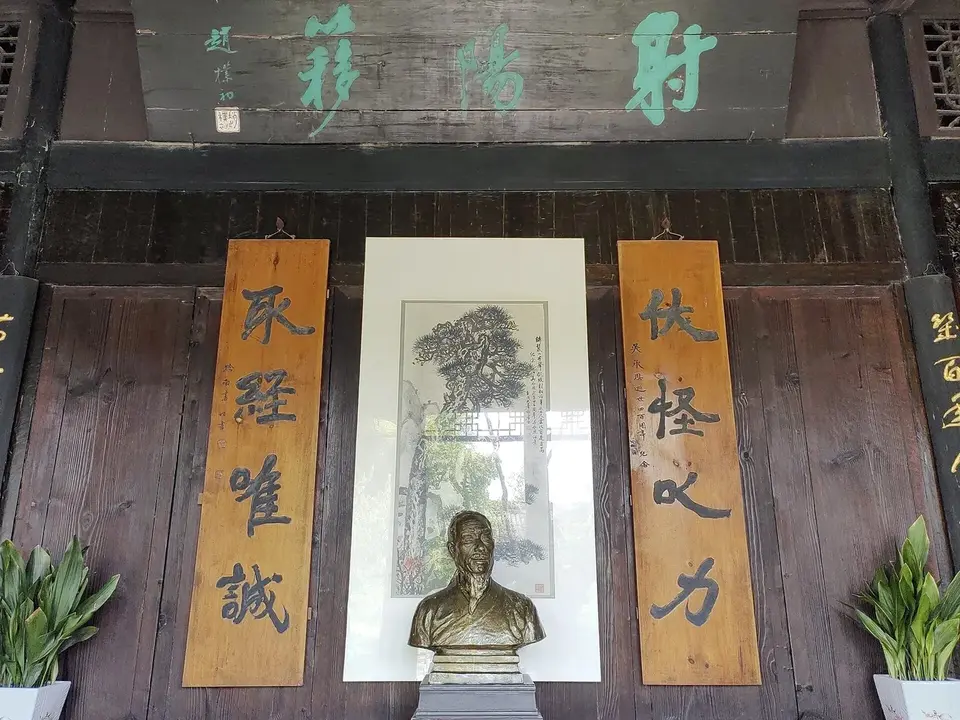
吴承恩
Wu Cheng'en (吴承恩, also known as Wu Chengen and Wu Ruzhong), courtesy name Ruzhong, art name Sheyangshanren, was a native of Shanyang County, Huai'an Prefecture. He was an eminent novelist and literatus of the middle and late Ming dynasty, celebrated as the compiler and author of Journey to the West (Xiyou Ji), one of the Four Great Classical Novels of Chinese literature, occupying a monumental place in world literature.…
Wu Cheng'en (吴承恩, also known as Wu Chengen and Wu Ruzhong), courtesy name Ruzhong, art name Sheyangshanren, was a native of Shanyang County, Huai'an Prefecture. He was an eminent novelist and literatus of the middle and late Ming dynasty, celebrated as the compiler and author of Journey to the West (Xiyou Ji), one of the Four Great Classical Novels of Chinese literature, occupying a monumental place in world literature. Endowed with extraordinary intellectual brilliance from youth, Wu read voraciously across classical canons, excelled in poetry, calligraphy, and weiqi, and exhibited an unquenchable passion for supernatural tales, folklore, and strange records. His father, Wu Rui, ran a small sundry shop in Hexia Town and earnestly hoped his son would pass the civil service examinations and bring honor to the lineage, naming him Cheng'en ("receiving imperial grace") and Ruzhong ("maintaining loyalty"). However, Wu encountered decades of heartbreak in the examination halls; despite gaining renown among regional scholars such as Zhu Yingdeng and Prefect Ge Mu, he repeatedly failed the Yingtian provincial examinations in Nanjing, languishing as a county student until he was finally selected as a tributary student (gongsheng) in 1544 in his forties. In his sixties, compelled by poverty and familial duty, Wu traveled to Beijing and was appointed Assistant Magistrate of Changxing County in Huzhou Prefecture, Zhejiang. In office, he proved incorruptible, fiercely defending local commoners against heavy exactions while refusing to flatter venal superiors. His unbending integrity provoked the malice of the county magistrate and entrenched gentry, who fabricated charges of corruption to remove him from office. Although exonerated through the intervention of literary friends like Xu Zhongxing and reappointed as Moral Mentor in the Jing Princely Establishment in Hubei, Wu had become thoroughly disgusted with the depravity of the imperial bureaucracy and promptly resigned to return home. In his final years, impoverished, solitary, and childless, Wu lived in seclusion in his ancestral town, styling himself Sheyangshanren. Channeling his lifelong observations of societal hypocrisy, indignation against bureaucratic venality, and romantic yearning for spiritual liberation into creative composition, he produced the immortal hundred-chapter masterpiece Journey to the West. Through sweeping imagination and acerbic wit, he crafted immortal archetypes including Sun Wukong, Zhu Bajie, and Tang Seng, ushering in the golden age of Chinese gods-and-demons fiction. His surviving writings are collected in Surviving Drafts of Master Sheyang, cementing his enduring legacy as a supreme cultural genius.
Born into a merchant family in Hexia Town, Shanyang County; displayed precocious intellect and passion for supernatural lore.
Married the great-granddaughter of Minister of Revenue Ye Qi; gained widespread literary fame in Huai'an.
Entered Longxi Academy founded by Prefect Ge Mu; amassed extensive collections of strange tales and legends.
Sat for the Yingtian provincial examination in Nanjing; despite his literary reputation, failed to secure degree.
Selected as a tributary student (suigong) after decades of trial, entering the Imperial Academy in Beijing.
Appointed Assistant Magistrate of Changxing County, Zhejiang; governed with integrity and empathy for local populace.
Framed and imprisoned by corrupt magistrate; cleared of charges and transferred to Jing Princely Establishment before resigning.
Returned to Hexia Town, styling himself Sheyangshanren, living in austere reclusion and drafting Journey to the West.
Finalized the hundred-chapter text of Journey to the West, synthesizing oral traditions into a coherent spiritual epic.
Passed away in poverty at his home in Huai'an; friends such as Chen Wenzhu later gathered and printed his collected writings.
Wu Cheng'en's family originated from Andong County (present-day Lianshui County, Jiangsu) and relocated to Hexia Town, Shanyang County, Huai'an Prefecture during the late Yuan and early Ming. By Wu's generation, the family had resided in this prosperous canal trading port for five generations. While his great-grandfather had served as an educational official, his father, Wu Rui (art name Juweng), abandoned scholarship for trade due to financial decline, operating a modest sundry merchant shop in Hexia. A gentle and cultured merchant who loved books and refined discourse, Wu Rui's deepest regret was his inability to attain bureaucratic honors.
Hoping his son would achieve the family's long-sought scholarly status, Wu Rui named him Cheng'en ("receiving imperial grace") with the courtesy name Ruzhong ("maintaining loyalty"). Young Wu exhibited astonishing precocity, possessing photographic memory and composing elegant poetic couplets at age eight. In addition to calligraphy, painting, and board games, he harbored a passionate fascination with supernatural stories, spending hours devouring classical compilations such as Youyang Zazu, Xuanguailu, and medieval monk legends.
Eminent scholar Zhu Yingdeng visited Huai'an and was awed by young Wu's poetic brilliance, predicting that he would read every book under heaven and gifting him half of his private library. In 1527, at twenty-eight, Wu married the great-granddaughter of Ming Minister of Revenue Ye Qi. In 1529, when Huai'an Prefect Ge Mu established the Longxi Academy, Wu was admitted as a premier scholar, earning Ge Mu's high patronage and spreading his literary fame across the Jianghuai region.
Despite his dazzling literary talent, Wu suffered repeated setbacks in the imperial examination system. Ming examination orthodoxy enforced rigid eight-legged essay formats, and Wu's expansive, unconstrained, and satirical style was often penalized by dogmatic examiners as eccentric. In 1531, in his early thirties, Wu traveled to Nanjing for the Yingtian provincial examination, only to meet with bitter failure.
Wu sat for successive provincial examinations in 1534 and 1537, failing on each attempt. During this period, his father died from overwork, the family business collapsed, and Wu was reduced to living on modest income from writing and occasional help from relatives. The grinding poverty and bureaucratic rejection failed to crush his spirit; instead, it deepened his cynical understanding of the feudal regime. He reflected bitterly in verse: "Within my breast, the evil-slaying sword is worn to dust; wishing to strike down the wicked, I grieve over bending the knee."
In 1544, having persevered for decades in the county school, forty-four-year-old Wu was finally selected as a tributary student (suigong). Grasping this final opportunity for official employment, he traveled north to Beijing to study at the Imperial Academy (Guozijian). In Beijing, he formed warm friendships with prominent scholars, including future Grand Secretary Li Chunfang. However, because tributary students ranked far below regular metropolitan examination graduates (jinshi), appointment to office required years of waiting, during which Wu endured over a decade of bureaucratic indifference and loneliness.
In the final year of the Jiajing reign, when Wu was nearly seventy, he was finally appointed Assistant Magistrate of Changxing County in Huzhou Prefecture, Zhejiang. Although ranked as an eighth-rank secondary magistrate assisting with fiscal records and judicial hearings, the post was subordinate to the autocratic authority of the county magistrate and entrenched local gentry.
Upon assuming office, Wu strove to alleviate tax burdens on the common people and maintain clean governance. However, the incumbent magistrate was avaricious and servile toward higher dignitaries. Possessing an unbending spirit, Wu openly resisted the magistrate's predatory taxation and illegal exactions. Enraged by his insubordination, the magistrate colluded with local elites to fabricate charges of financial mismanagement against Wu, resulting in his abrupt dismissal and temporary arrest.
This injustice incited outrage among southeastern literati. Celebrated figures like Xu Zhongxing and Chen Wenzhu intervened to clear Wu of all fabricated charges. The imperial court subsequently reassigned him to the sinecure post of Moral Mentor in the Jing Princely Establishment in Qichun, Hubei. Having experienced the moral bankruptcy of officialdom, Wu realized that upright integrity was incompatible with imperial administration. He promptly resigned his clerical post, declining to pursue further bureaucratic office.
Around 1570, seventy-year-old Wu returned to Hexia Town in Huai'an. His later years were marked by bereavement and poverty: his wife had passed away, his only son had died young, and he lived in solitary reclusion without an heir. Styling himself Sheyangshanren, he lived in a modest cottage, surviving on writing fees and assistance from loyal disciples, proclaiming that he took pride in dying in honest poverty rather than bowing to princes.
In this serene detachment, Wu unleashed his accumulated creative energy. Drawing upon oral storytelling prompt-books, Southern Song poetic tales, and Yang Jingxian's Yuan zaju, he spent over a decade writing and polishing the monumental hundred-chapter novel Journey to the West.
Around 1582, octogenarian Wu passed away quietly in his cottage in Huai'an. His close friend, former Huai'an Prefect Chen Wenzhu, provided funds for his burial in Erpu Village and gathered his surviving poems and essays, publishing them in 1589 as Surviving Drafts of Master Sheyang. In 1592, the Jinling Shidetang publishing house printed the earliest extant edition of the hundred-chapter Journey to the West, securing Wu's immortal stature in world literature.
Wu Cheng'en's supreme literary achievement was his epochal recreation of the historical journey of Xuanzang into the full-length hundred-chapter fantasy novel Journey to the West. Prior to Wu, the narrative existed as fragmented historical memoirs, crude medieval prompt-books, and regional dramatic scripts centered primarily on religious piety.
Wu synthesized these disparate traditions into an integrated, panoramic fantasy cosmos spanning Heaven, Earth, the Dragon Palaces, and the Netherworld. He transformed the historical expedition into an epic spiritual trial of self-cultivation and collective struggle, structured around the Great Havoc in Heaven, the Gathering of the Disciples, and the Eighty-One Tribulations. His hundred chapters exhibited exquisite narrative balance and psychological progression, establishing the canonical aesthetic paradigm for classical Chinese gods-and-demons fiction.
Wu's most radiant artistic triumph was the creation of Sun Wukong (the Monkey King), a universal symbol of human liberation and heroic defiance. Born from a magic stone on the Mountain of Flowers and Fruit, Sun Wukong mastered Daoist arts, acquired the As-You-Will Golden-Banded Staff from the Dragon Palace, and erased his name from the Register of Death in the Underworld, ultimately raising the banner of "Great Sage Equal to Heaven" to wage war against the celestial hierarchy.
In crafting Sun Wukong, Wu seamlessly fused bestial nature, divine power, and human emotion. During the Havoc in Heaven, Sun Wukong was a fearless iconoclast defying feudal authority, proclaiming that imperial sovereignty should rotate to the worthy. During the pilgrimage, he evolved into a courageous, razor-sharp defender of justice who penetrated monstrous disguises with his fiery golden eyes and smote evil without compromise. Sun Wukong remains the most beloved heroic embodiment of courage, wisdom, and freedom in Chinese civilization.
Beneath its buoyant fantasy and comic adventure, Journey to the West functions as a trenchant satirical critique of Ming imperial despotism and bureaucratic venality. As Lu Xun observed in A Brief History of Chinese Fiction, the novel is infused with subtle and sharp social mockery. Drawing from his own painful experiences of false imprisonment and the rampant corruption of Grand Secretary Yan Song's era, Wu allegorized the human bureaucracy through celestial regimes.
The Jade Emperor was portrayed as indecisive and complacent; the courts of the Underworld ran on bribery and favoritism; and the ferocious monsters terrorizing mortal realms were revealed to be the escaped divine mounts, pets, or attendants of Buddhist and Daoist deities. Whenever Sun Wukong prepared to strike down a demon, a divine master invariably intervened to rescue the culprit from mortal retribution, whereas beasts lacking celestial connections were slaughtered. This satirical contrast between connected privileged demons and common mortals laid bare the systemic injustice of the imperial order.
In literary language, Wu attained supreme mastery by fusing the vivid vernacular of the Jianghuai region with refined classical poetry. The dialogue sparkles with comic vitality, verbal irony, and streetwise humor.
Wu individualized characters through their distinct speech: Zhu Bajie's gluttony, worldly compromises, and naive excuses; Tang Seng's pious pedantry and timidity; and the playful banter among minor demons. Interspersed throughout every chapter are meticulously crafted parallel prose descriptions and metered verse depicting perilous mountain tracks, enchanted caverns, and magical weapon duels. This effortless integration of elite literary elegance and popular vernacular accessibility created an enduring model of classical Chinese fiction.
FIGURES ASSOCIATED WITH THIS DYNASTY