Accession to the Throne
Inherited the throne from his royal forebears, reigning over Wiman Joseon from Wangxian Fortress.
卫右渠
Wei Youqu (died 108 BCE), also known as King Ugeo, was the third and final monarch of Wiman Joseon (Wei-clan Joseon) during the Western Han period and the grandson of its founding sovereign, Wei Man (Wiman). Succeeding to the throne in Wangxian Fortress (modern Pyongyang), Wei Youqu leveraged the natural coastal and mountainous barriers of the Taedong River basin to develop agriculture, metallurgy, and border defense,…
Wei Youqu (died 108 BCE), also known as King Ugeo, was the third and final monarch of Wiman Joseon (Wei-clan Joseon) during the Western Han period and the grandson of its founding sovereign, Wei Man (Wiman). Succeeding to the throne in Wangxian Fortress (modern Pyongyang), Wei Youqu leveraged the natural coastal and mountainous barriers of the Taedong River basin to develop agriculture, metallurgy, and border defense, absorbing tens of thousands of Chinese migrants and refugees to expand dynastic power. During his reign, he grew increasingly defiant toward the Western Han court, refusing to render feudal tribute in Chang'an and severing diplomatic access for peripheral polities such as Jin and Zhenfan seeking audience with Emperor Wu. In 109 BCE, after an abrasive diplomatic encounter, Han ambassador She He murdered an escorting Joseon sub-prince; Wei Youqu launched a retaliatory border raid that killed She He. In response, Emperor Wu mobilized over fifty thousand land and naval troops under Generals Xun Zhi and Yang Pu in a dual-pronged campaign. Wei Youqu mounted a fierce defense of Wangxian Fortress, crushing Yang Pu's amphibious vanguard and containing Xun Zhi's cavalry at the Pei River for months. In the summer of 108 BCE, as the siege protracted and starvation mounted, court factions fractured. A pro-surrender clique led by Minister Sam dispatched an assassin to murder Wei Youqu within his palace. Following his assassination, Wangxian Fortress fell, terminating Wiman Joseon. Emperor Wu promptly annexed the territory, establishing the Four Commanderies of Han (Lelang, Xuantu, Zhenfan, and Lintun).
Inherited the throne from his royal forebears, reigning over Wiman Joseon from Wangxian Fortress.
Welcomed waves of refugees and displaced laborers fleeing Han corvee exactions, reinforcing defensive citadels.
Blockaded tributary roads, prohibiting neighboring polities like Jin and Zhenfan from communicating with the Han empire.
Rejected diplomatic ultimatums presented by Han envoy She He; She He assassinated an escorting prince on the border river.
Dispatched elite cavalry to ambush and kill She He, provoking Emperor Wu to order a massive joint military expedition.
Decimated Admiral Yang Pu's amphibious vanguard and resisted General Xun Zhi at the Pei River, forcing a prolonged siege.
With the fortress encircled and supplies exhausted, pro-peace minister Sam orchestrated his assassination before surrendering.
Wangxian Fortress capitulated, extinguishing Wiman Joseon; Emperor Wu reorganized the Korean peninsula into the Four Commanderies.
Wei Youqu was the grandson of Wei Man, an aristocratic general from the former State of Yan who crossed the Yalu River during the reign of Emperor Hui of Han to establish Wiman Joseon. By the era of Wei Youqu, the kingdom had enjoyed decades of peace, extensively absorbing advanced Han cast-iron metallurgy, hydraulic engineering, and agricultural implements. The realm constructed formidable stone bastions and maintained disciplined cavalry divisions. Ambitious and defiant, Wei Youqu perceived that the Western Han empire was preoccupied with subduing the Xiongnu nomads and pacifying southwestern tribes. Consequently, he pursued regional dominance, offering sanctuary to Chinese fugitives and tax resisters from Yan and Qi. Establishing his capital at Wangxian Fortress (modern Pyongyang) along the fertile Taedong River, Wei Youqu accumulated immense wealth by acting as an exclusive commercial conduit between the Chinese mainland and the Korean peninsula, progressively ignoring his tributary obligations to Chang'an.
During the early Yuanfeng era, neighboring states such as Zhenfan and Jin wished to dispatch diplomatic missions across Liaodong to present tributary memorials to Emperor Wu of Han. Wei Youqu closed all river crossings and mountain passes, enforcing a strict blockade to monopolize overseas trade. In 109 BCE, Emperor Wu dispatched envoy She He to Wangxian to rebuke the monarch and demand that he send royal hostages to Chang'an. Wei Youqu flatly refused. On his return journey, while crossing the border river, She He treacherously murdered the Joseon sub-prince commanding his protective escort, fabricating a fraudulent report to Emperor Wu that he had slain a prominent Joseon general. Appointed Eastern Military Commandant of Liaodong as reward, She He incurred the furious retaliation of Wei Youqu, who marshaled swift cavalry across the frontier, overwhelmed border outposts, and killed She He in battle.
She He's death triggered full-scale imperial retaliation. Emperor Wu commissioned Admiral Yang Pu with seven thousand naval infantry from Qi to sail across the Bohai Sea, while Left General Xun Zhi led fifty thousand cavalry and infantry through Liaodong. In the autumn of 109 BCE, Yang Pu's vanguard reached Wangxian prematurely. Detecting the vulnerable isolation of the naval force, Wei Youqu personally launched a fierce sally from the citadel, routing Yang Pu's army and driving the surviving troops into mountainous retreats. Concurrently, Xun Zhi's main army encountered desperate resistance along the Pei River, stalling all Han operations. Negotiations mediated by imperial commissioner Wei Shan collapsed when mutual suspicion prevented the peaceful surrender of weapons. Han land and naval armies joined forces to invest Wangxian Fortress, subjecting it to relentless bombardment for months without breakthrough. By the summer of 108 BCE, severe starvation engulfed the fortress, driving high ministers into panic. Senior councilors, including Chancellor Luren, Han Yin, and Minister Sam, concluded that continued resistance would invite complete destruction. In secret collusion with Han commanders, Minister Sam sent palace assassins to murder Wei Youqu within his royal quarters, opening the gates to surrender. A loyalist minister named Chengji staged a desperate final stand before being killed in action. Wangxian Fortress fell, and Wiman Joseon ceased to exist.
At the height of Emperor Wu's imperial expansion, Wei Youqu utilized the fortified citadels of Wangxian and the tactical obstacles of the Taedong River to resist over fifty thousand elite Han troops for nearly an entire year. His decisive tactical victory over Admiral Yang Pu's naval force and his stubborn defensive campaign at the Pei River illustrated formidable martial leadership, marking one of the most grueling frontier siege operations encountered by Western Han expeditionary forces.
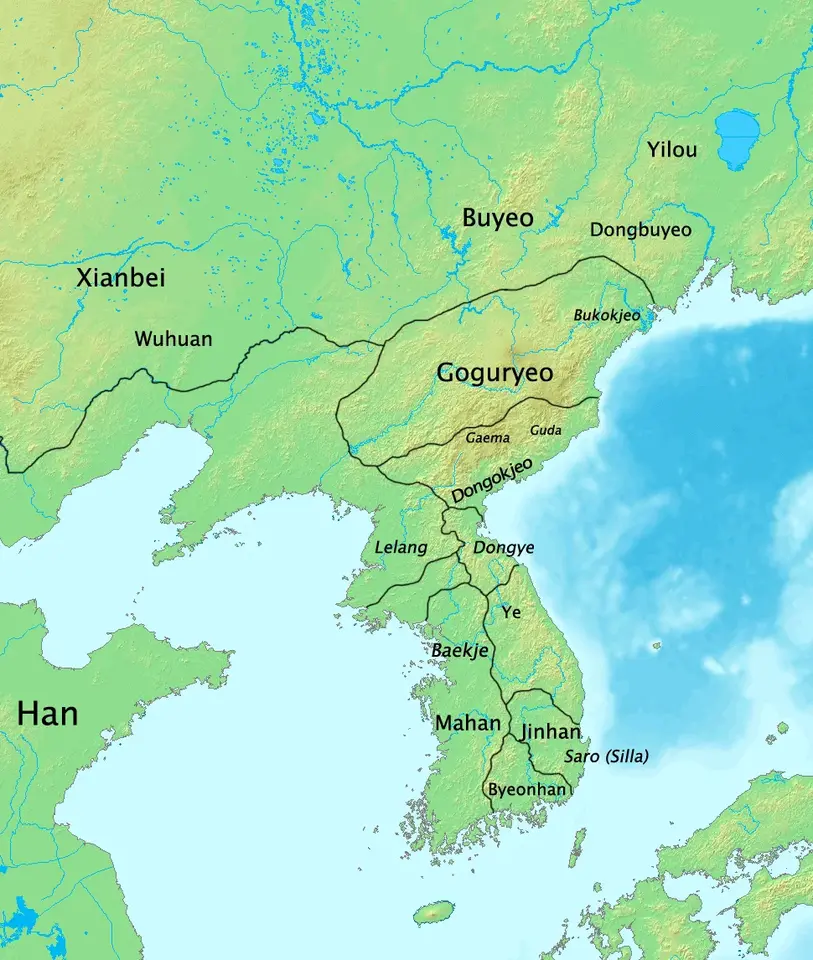
The downfall of Wei Youqu was a seminal geopolitical turning point in East Asian antiquity. Following the collapse of Wiman Joseon, Emperor Wu instituted the Four Commanderies of Han—Lelang, Xuantu, Zhenfan, and Lintun—bringing northern and central Korea under direct Chinese administrative governance. This structural transition catalyzed the dissemination of Confucian statecraft, legal institutions, Chinese writing systems, and iron technologies throughout the Korean peninsula and neighboring tribal confederations.
FIGURES ASSOCIATED WITH THIS DYNASTY