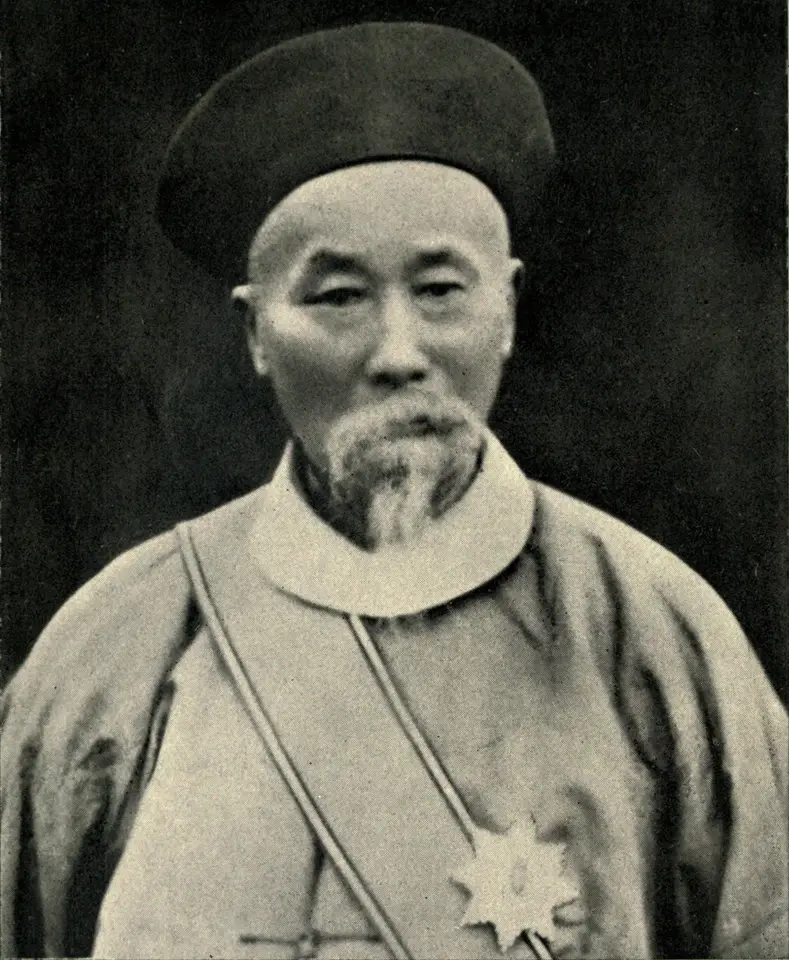
Life and Career
Early Career and Frontier Trials
Wenfu belonged to the prominent Feimo clan of the Manchu Plain Yellow Banner; his grandfather Wenda had served as Grand Secretary of the Wenhua Palace during the Kangxi reign. Proficient in archery, horsemanship, and fluent in Manchu, Chinese, and Mongolian, Wenfu entered the imperial service in 1728 after passing the imperial translation examinations, receiving appointment as a clerk in the Board of War. In 1731, during the northern campaigns against the Dzungar Khanate, the imperial court dispatched Prince Fupeng as Commander-in-Chief. Wenfu was attached to the northern headquarters, gaining critical operational experience in troop movement and border logistics across the Mongolian steppe until the army withdrew in 1734.
Under the Qianlong Emperor, Wenfu achieved rapid promotions, serving as secretary and department director in the Board of War. His sharp drafting ability and administrative diligence led to his selection into the Grand Council as a secretary in 1743. In late 1746, he was promoted to Financial Commissioner of Hunan, overseeing provincial taxation and granaries, before transferring to the same post in Guizhou in 1749. While in Guizhou, a major courtroom protest occurred in Pingyuan Subprefecture led by local litigant Chen Xinxu. Wenfu dismissed the case precipitously without conducting a thorough inquiry. In 1754, following an imperial censorate impeachment revealing administrative injustice, Emperor Qianlong dismissed Wenfu from all posts, sentencing him to penal exile at the Uliastai military post.
Western Expeditions and Ministerial Ascent
In 1758, the Afaqi Khoja brothers ignited an armed insurrection across southern Xinjiang. With military operations escalating in the Tarim Basin, the throne recalled Wenfu as an acting Reader of the Grand Secretariat and dispatched him to the frontline headquarters of General Settling the Frontiers Zhaohui. In the fierce clashes preceding the Siege of the Black Water, Wenfu fought in the vanguard outside Yarkand, where an enemy bullet struck and fractured his right cheekbone. Spattered with blood, Wenfu bandaged his wound and continued rallying his infantry, displaying notable physical courage.
Following the pacification of southern Xinjiang in 1759, Wenfu was awarded imperial commendations, granted nine official merit citations, and promoted to Sub-Chancellor of the Grand Secretariat. Returning to Beijing in 1760, he served as Banner Vice-Commander and Vice Minister of Granaries. In 1762, the throne granted him the hereditary rank of Yunqiwei.
In 1769, Wenfu was assigned as Governor of Fujian, where he overhauled coastal maritime patrols and local grain distribution. Recalled to the capital in 1770 as Vice Minister of Personnel, he re-entered the Grand Council as a councillor. In July of that year, he was appointed Minister of the Court of Colonial Affairs concurrently overseeing the Ministry of Works, and in August assumed command of the Mongol Plain Yellow Banner, standing as one of the monarch's most favored military ministers.
Conquest of Xiaojinchuan
In 1771, the Gyalrong Tibetan chieftains of Dajinchuan (Sonom) and Xiaojinchuan (Senggesang) launched combined rebellions against neighboring loyal native chieftains and slaughtered imperial detachments, triggering the Second Jinchuan War. Emperor Qianlong mobilized imperial banner forces, appointing Wenfu as Assistant General to lead the western army from Wenchuan, while Guilin led southern forces from Dajianlu (Kangding).
Adhering to imperial instructions to neutralize Xiaojinchuan first, Wenfu advanced across Balangla in mid-winter. Fighting through severe blizzards across 4,000-meter peaks, his forces engaged the insurgents for three consecutive days and nights before breaking the mountain redoubts. In late 1771, Qianlong elevated Wenfu to Grand Secretary of the Wuying Palace. In early 1772, Wenfu stormed Damuba-dzong, Zili, Dongma, and Luding-dzong, clearing fortified stone towers with artillery and mountain infantry. In December 1772, Wenfu was confirmed as supreme General Settling the Frontiers, with celebrated commanders A'gui and Fengshenge serving as his deputies. Advancing on the Xiaojinchuan stronghold of Meinuo, Wenfu captured chieftain Zewang, sending him in chains to Beijing for execution, while Senggesang fled into the rugged canyons of Dajinchuan.
Inflexibility and the Debacle at Mugoumu
Following the fall of Xiaojinchuan, Wenfu demanded that Sonom surrender Senggesang, which Sonom refused. Qianlong determined to crush Dajinchuan, and Wenfu devised an advance via the Kasa corridor, while A'gui and Fengshenge led flanking columns.
However, during this campaign, Wenfu displayed fatal arrogance and tactical rigidity. Rejecting the counsel of experienced frontier officers, he mechanically replicated the failed watchtower tactics of Zhang Guangsi from the First Jinchuan War, constructing thousands of small stone watchtowers and dispersing his twenty-thousand-man strike force into tiny, isolated detachments along alpine ridges. Meanwhile, Wenfu held lavish banquets inside his headquarters. When Assistant Councillor Wudai warned that such dispersion invited catastrophe, Wenfu retaliated by impeaching Wudai, orchestrating his banishment to Ili.
In the spring of 1773, encountering stubborn resistance at Gonggala, Wenfu established his main base at Mugoumu (in modern Kasa Township), ordering Provincial Commander Dong Tianbi to garrison the rear depot at Dimuda. Both Mugoumu and Dimuda were situated within recently conquered Xiaojinchuan territory. Operating covertly, Sonom sent agents to incite the local Tibetan population, who were infuriated by grain requisitions. In June 1773, the insurgents launched a synchronized counter-strike, storming Dimuda and killing Dong Tianbi before capturing the main supply depot and severing the water supply and courier routes to Mugoumu.
Wenfu had failed to fortify the high ridges behind his camp. Insurgent marksmen descended the precipitous cliffs into the encampment, seized the artillery batteries, and opened fire. As thousands of retreating baggage coolies and infantry crowded around the camp redoubt seeking entry, a panicked Wenfu ordered the gates shut and barred. Insurgent artillery battered the wooden gates until they collapsed, triggering uncontrollable panic. Rebel fighters poured through the breaches from four directions; Wenfu was shot dead outside his command tent. Assistant Councillor Hailancha fought a desperate rearguard action to extract surviving remnants, but the entirety of Xiaojinchuan fell back into rebel hands.
Initially informed that his general had died heroically, Emperor Qianlong posthumously ennobled Wenfu as a First Class Count, granted two thousand taels for burial expenses, and ordered his enshrinement in the Temple of Loyalty and Zeal. However, joint memorials submitted by Hailancha, Liu Bingtian, and Fulehun subsequently laid bare the full extent of Wenfu's arrogance, logistical neglect, and the disastrous decision to lock the camp gates. Incensed by the catastrophe, Emperor Qianlong rescinded the countship and reduced Wenfu's honors to a minor hereditary rank; in 1776, following the final pacification of Jinchuan, all remaining hereditary titles were completely stripped.
Major Achievements
Strategic Breakthrough and Suppression of Xiaojinchuan
During the opening phase of the Second Jinchuan War, Wenfu executed aggressive, highly effective mountain offensives. Confronting steep glacial terrain, fortified stone towers, and severe alpine weather, he personally directed the crossing of Balangla, overcoming days of brutal resistance.
By coordinating multi-column flanking movements to cut off enemy water sources, he captured more than twenty stone fortresses, including Damuba-dzong and Zili, culminating in the seizure of Meinuo and the capture of chieftain Zewang. His complete subjugation of Xiaojinchuan within one year opened the primary invasion corridor toward Dajinchuan, earning him appointment as supreme general and grand secretary.
Tactical Hubris and the Collapse of Mugoumu
The catastrophe at Mugoumu stands as one of the most severe military disasters of the mid-Qing Dynasty, resulting directly from Wenfu's tactical dogmatism and command failure. Rather than concentrating his forces for decisive maneuvers, he divided his twenty thousand soldiers among thousands of static watchtowers, creating an overextended, brittle defensive line.
His fatal failure to secure his rear communication lines, combined with his blind trust in newly surrendered native populations, allowed insurgent infiltrators to encircle his camp unchallenged. In the crisis of battle, his catastrophic decision to bar the camp gates against his own troops destroyed all discipline and morale. The resulting collapse caused the death of General Dong Tianbi and thousands of imperial soldiers, wiping out all previous gains in Xiaojinchuan and forcing A'gui to reconstruct the campaign from the beginning.