Ingratiation through Games
Following Emperor Jingzong's enthronement, gained rapid imperial favor through athletic agility and sportsmanship.
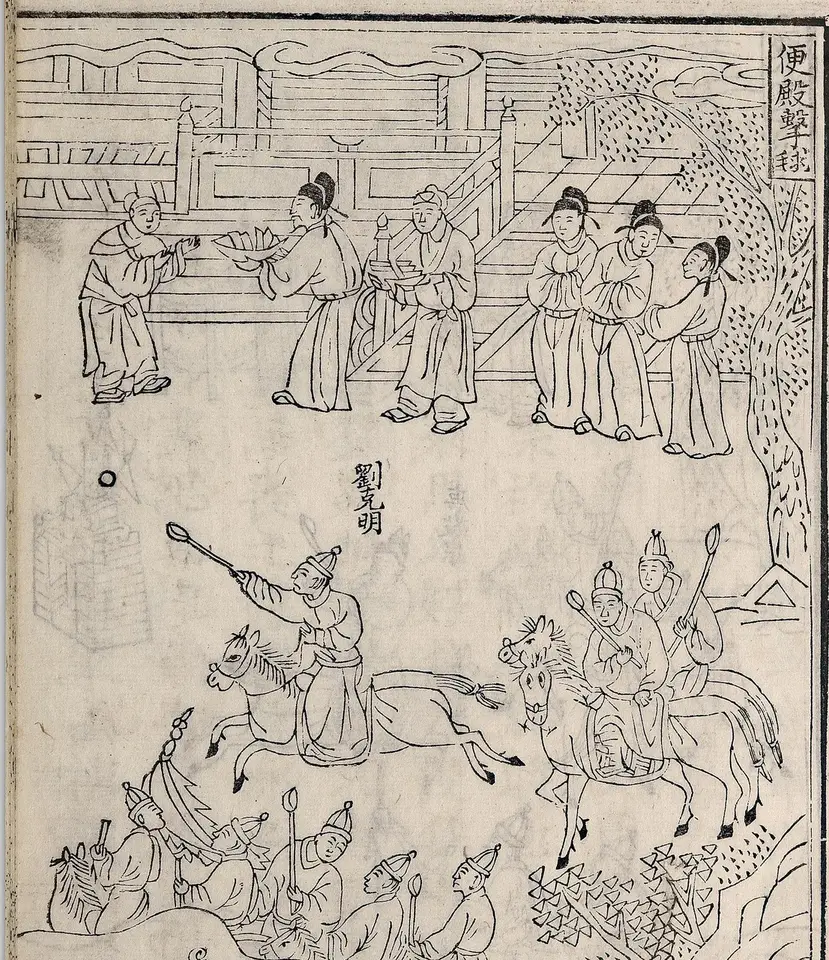
刘克明
Liu Keming (刘克明) (birth year unrecorded in historical records – January 9, 827) was an influential eunuch of the mid-Tang dynasty whose ancestral home and early background are unrecorded in official histories. Gaining extraordinary imperial favor under Emperor Jingzong (Li Zhan) by catering to the young monarch's passion for sports and nocturnal gaming, Liu entered the inner palace chambers and became an infamous archetype of…
Liu Keming (刘克明) (birth year unrecorded in historical records – January 9, 827) was an influential eunuch of the mid-Tang dynasty whose ancestral home and early background are unrecorded in official histories. Gaining extraordinary imperial favor under Emperor Jingzong (Li Zhan) by catering to the young monarch's passion for sports and nocturnal gaming, Liu entered the inner palace chambers and became an infamous archetype of late Tang eunuch factionalism and violent regicide. Ascending the throne as an adolescent, Emperor Jingzong was frivolous and volatile, avoiding state administrative affairs to devote himself to polo, unarmed combat wrestling, and midnight fox hunting. Liu Keming, alongside Chang'an street ruffians and Shence Army soldiers, was assigned to the Xuanhui Academy and the Imperial Music Academy to entertain the emperor day and night. However, Jingzong was unpredictable and tyrannical, frequently subjecting his personal attendants to severe floggings and verbal humiliation over trivial lapses, breeding deep underground terror and resentment among his inner circle. On the night of January 8, 827, after returning from a midnight hunt, Emperor Jingzong engaged in heavy drinking with Liu Keming, Su Zuoming, and twenty-eight attendants. When the emperor retired to the dressing chamber, the candles were suddenly extinguished, and Liu Keming joined Su Zuoming and Shi Dingkuan in brutally assassinating the eighteen-year-old monarch in the dark. Liu forged an imperial decree commanding Hanlin Academician Lu Sui to draft an edict installing Li Wu, Prince of Jiang, as regent to seize supreme military control of the Shence Army. However, Privy Councilor Wang Shoucheng, Shence Commandant Liang Shouqian, and Chancellor Pei Du executed a swift counter-coup, mobilizing palace cavalry to storm the inner palace and enthroning Li Ang (Emperor Wenzong). Realizing his defeat, Liu committed suicide by leaping into a palace well; his corpse was extracted, beheaded, and publicly mutilated, while his conspiratorial faction was thoroughly liquidated.
Following Emperor Jingzong's enthronement, gained rapid imperial favor through athletic agility and sportsmanship.
Accompanied the emperor in polo tournaments, wrestling bouts, and nocturnal hunts, serving in the Xuanhui Academy.
Subjected to capricious punishments and verbal abuse by the emperor, secretly conspired with Su Zuoming to stage a coup.
On the night of December 8, extinguished the candles in the palace dressing chamber and assassinated Emperor Jingzong.
Coerced Academician Lu Sui to draft a succession edict proclaiming Prince of Jiang Li Wu as regent to control the palace guard.
On December 9, defeated by Wang Shoucheng and Pei Du's loyalist assault, drowned himself in a well; his corpse was subsequently dismembered.
Liu Keming's early origins remain absent from historical documentation. He entered the imperial palace service as a young eunuch. In 824, following the death of Emperor Muzong, fifteen-year-old Emperor Jingzong (Li Zhan) ascended the throne. Immature and restless, the young sovereign found administrative governance tedious, preferring equestrian polo, wrestling, tug-of-war, and competitive athletic spectacles. Perceiving an opportunity for advancement, Liu Keming ingratiated himself by showcasing his agility and sports acumen, alongside a circle of street youths and Shence Army roughnecks including Tao Yuanhao, Jin Suiliang, Zhao Shize, Li Gongding, and Shi Dingkuan.
Emperor Jingzong grew exceptionally intimate with this circle, incorporating them into the Xuanhui Academy and the Imperial Music Academy. He spent entire days and nights gambling and carousing with them in the informal palace pavilions. On one occasion, the emperor observed gladiatorial wrestling where contestants suffered fractured skulls and severed limbs, with blood soaking the courtyard stones. Rather than expressing horror, Jingzong applauded with delight, distributing immense rewards of silk and gold past midnight. Furthermore, the emperor frequently mobilized eunuch squads into the palace game reserves to hunt wild foxes at midnight, an obsession termed hunting night foxes. Any attendant who lagged behind or arrived late was summarily demoted and expelled.
Despite enjoying continuous material rewards, Liu Keming and his associates existed in perpetual terror. Emperor Jingzong possessed a volatile temper and took sadistic pleasure in punishing his personal staff for the slightest misstep. Attendants Xu Suizhen, Li Shaoduan, and Yu Zhihong were stripped of office and exiled merely for arriving minutes late to an imperial hunt.
The retainers surrounding Jingzong were hardened opportunists and desperate soldiers. Suffering frequent floggings, public humiliation, and unpredictable rages from their teenage master, these attendants realized that imperial favor offered no shield against arbitrary execution. Liu Keming, who managed the emperor's intimate bedchambers and daily apparel, observed numerous peers fall victim to imperial wrath. Convinced that his own destruction was only a matter of time, he formed a secret conspiracy with fellow attendants Su Zuoming, Shi Dingkuan, Tian Wucheng, and Xu Wenduan to eliminate the emperor.
On the night of January 8, 827, Emperor Jingzong returned to the Qingsi Hall following an exhausting midnight fox hunt. Highly energized, the monarch summoned twenty-eight palace attendants, including Liu Keming, Su Zuoming, Tian Wucheng, Xu Wenduan, Shi Dingkuan, Wang Jiaxian, and Yan Weizhi, to join him in a prolonged drinking banquet. The monarch indulged heavily, consuming vast quantities of wine until he was severely intoxicated.
Around midnight, Emperor Jingzong rose from his couch and proceeded to an adjoining chamber to relieve himself and change his garments. Liu Keming exchanged signals with his co-conspirators, and an attendant promptly extinguished all candles inside the dressing room. In total blackness, Liu Keming, Su Zuoming, and Shi Dingkuan lunged forward with concealed daggers, striking down the helpless sovereign. Emperor Jingzong was stabbed repeatedly in the dark, dying instantly on the floor at the age of eighteen.
Immediately following the assassination, Liu Keming secured the palace portals and concealed the emperor's death. At dawn, he produced a forged imperial directive summoning Hanlin Academician Lu Sui, demanding that he draft an emergency succession edict. Liu falsely announced that the emperor had succumbed to sudden illness and proclaimed Li Wu, Prince of Jiang (the sixth son of Emperor Xianzong), as imperial regent. Through this puppet installation, Liu intended to purge the existing military commanders and place his conspirators in charge of the Shence Army.
However, senior palace leaders swiftly intervened. Privy Councilors Wang Shoucheng and Yang Chenghe, alongside Shence Army Commandants Liang Shouqian and Wei Congjian, detected the fraudulent nature of the proclamation. Coordinating with Chancellor Pei Du, they resolved to mount an immediate loyalist offensive. Moving with decisive speed, Wang Shoucheng welcomed Prince of Jiang Li Ang (Emperor Xianzong's second son) through the Xuanwu Gate while deploying thousands of elite Shence cavalry and imperial Feilong troopers to storm the inner palace complexes.
On January 9, 827, loyalist iron cavalry breached the palace gates, shouting for the execution of the regicides. Realizing that the coup had collapsed and that capture meant torturous execution, Liu Keming fled through the palace grounds and cast himself into a deep well, drowning beneath the water. Shence soldiers located the well, hauled Liu's corpse to the surface with grappling hooks, and decapitated and disemboweled his body in the main courtyard. His accomplices Tian Wucheng and Su Zuoming were executed by public dismemberment, their assets confiscated, and the puppet prince Li Wu was strangled.
Prior to the rebellion, Liu Keming's mother had wept bitterly, pleading with her son to abandon his treacherous ambitions, but Liu had ignored her counsel. Following his enthronement as Emperor Wenzong, the new sovereign commended her maternal rectitude, issuing an imperial decree exempting her from execution and granting her one thousand strings of cash, five hundred bolts of silk, and two palace maidservants to sustain her remaining years.
During the Baoli era, Liu Keming capitalized on Emperor Jingzong's youthful irresponsibility by introducing violent street fighters and undisciplined soldiers into the Xuanhui Academy. This infiltration dismantled traditional palace security protocols, transforming the sovereign's private quarters into an arena of unmonitored revelry and creating the structural vulnerability that enabled intimate regicide in the late Tang inner court.
The assassination of Emperor Jingzong on January 8, 827, stands as one of the few instances of direct, physical regicide carried out by intimate eunuchs in imperial Chinese history. Exploiting routine dressing rituals and plunging the chamber into darkness, Liu Keming successfully eliminated the reigning monarch and temporarily installed a puppet regime. Although his political inexperience and lack of command over the primary Shence Army cantonments caused his rapid downfall, his brazen treason exposed the profound volatility of the late Tang palace guard system.
FIGURES ASSOCIATED WITH THIS DYNASTY