Shenlong Coup
On February 20, Chancellor Zhang Jianzhi leads the Imperial Guard into the palace, executing the Zhang brothers and restoring Emperor Zhongzong.
Wu Zhou Dynasty (武周) · HISTORICAL EVENT
中宗
The Restoration of Emperor Zhongzong and Turmoil of Empress Wei (中宗) denotes the tumultuous political cycle spanning from 705 to 710 in the Tang dynasty, encompassing the restoration of Emperor Zhongzong (Li Xian) and the subsequent violent usurpation orchestrated by his consort, Empress Wei. In the spring of 705, octogenarian Empress Wu Zetian fell gravely ill in Luoyang while her courtiers Zhang Yizhi and Zhang Changzong abused imperial authority.…
The Restoration of Emperor Zhongzong and Turmoil of Empress Wei (中宗) denotes the tumultuous political cycle spanning from 705 to 710 in the Tang dynasty, encompassing the restoration of Emperor Zhongzong (Li Xian) and the subsequent violent usurpation orchestrated by his consort, Empress Wei. In the spring of 705, octogenarian Empress Wu Zetian fell gravely ill in Luoyang while her courtiers Zhang Yizhi and Zhang Changzong abused imperial authority. Chancellor Zhang Jianzhi led the Shenlong Coup, slaying the favorites and forcing the transfer of the throne to Crown Prince Li Xian, formally restoring the Tang dynastic title. However, bound by emotional promises made during fourteen years of exile in Fangling, Zhongzong yielded full executive leeway to Empress Wei. Wei formed a venal alliance with Prince Wu Sansi, banishing and executing the Five loyalist Kings while marketing thousands of irregular "oblique-sealed appointments" (xiefeng guan) alongside Princess Anle. Following Zhongzong's sudden death in 710—widely attributed to poison administered by Empress Wei—Prince of Linzi Li Longji and Princess Taiping staged the preemptive Tanglong Coup, breaching the imperial palaces to execute Empress Wei, Princess Anle, and Shangguan Wan'er, enthroning Emperor Ruizong and concluding the era of consort domination.
On February 20, Chancellor Zhang Jianzhi leads the Imperial Guard into the palace, executing the Zhang brothers and restoring Emperor Zhongzong.
Empress Wei allies with Wu Sansi, neutralizing Zhang Jianzhi and the Five Kings before dispatching assassins to murder them in exile.
Empress Wei and Princess Anle institutionalize the sale of imperial offices via "oblique-sealed decrees", debasing state governance.
Crown Prince Li Chongjun launches a desperate mutiny, executing Wu Sansi before being routed and killed at the palace gates.
On July 3, Emperor Zhongzong dies suddenly from poison; Empress Wei conceals the demise, enthrones puppet Li Chongmao, and assumes the regency.
On July 21, Prince Li Longji and Princess Taiping lead the Imperial Guard to storm the palace, executing Empress Wei and enthroning Emperor Ruizong.
In late 704, Wu Zetian, the sole reigning female sovereign in Chinese history, was confined by infirmity to the Yingxian Palace in Luoyang. Her male favorites, the brothers Zhang Yizhi and Zhang Changzong, exploited the empress's seclusion to monopolize state decrees, slander upright officials, and execute imperial clansmen. Public revulsion against their arbitrary tyranny triggered intense clandestine agitation for the restoration of the ancestral Li Tang house. Supported by the dying counsels of statesman Di Renjie, veteran ministers Zhang Jianzhi, Cui Xuanwei, Jing Hui, Huan Yanfan, and Yuan Shuji forged a secret covenant with palace guard commanders, preparing an armed transition.
Li Xian had previously reigned for fifty-five days in 684 before being unceremoniously deposed and banished to remote Fangzhou by his mother Wu Zetian. During fourteen grueling years of house arrest, Li Xian was consumed by suicidal terror whenever imperial messengers arrived; Empress Wei consistently comforted him, prompting Li Xian to swear an emotional oath: "If I ever see the light of day again, you shall do whatever you desire without restriction." Restored as Crown Prince in 698, Li Xian remained timid and indecisive, whereas Empress Wei emerged from exile possessed by an insatiable appetite for supreme political supremacy modeled upon Wu Zetian.
On the night of February 20, 705 (the twenty-second day of the first month of Shenlong), Chancellor Zhang Jianzhi, Cui Xuanwei, and General Li Duozuo mobilized five hundred armored guards at the Xuanwu Gate of Luoyang. Escorting Crown Prince Li Xian into the inner palaces, the conspirators severed the gates of the Jixian Hall and executed Zhang Yizhi and Zhang Changzong on the spot.
Surrounding the bed of the ailing Wu Zetian, Zhang Jianzhi firmly presented an ultimatum requesting the immediate transfer of state authority to the prince. The helpless empress acquiesced, issuing an edict commanding Li Xian to supervise state affairs. On February 23, Li Xian was formally enthroned at Tongtian Palace as Emperor Zhongzong. On March 3, an imperial edict restored the "Great Tang" dynastic name, revived ancestral calendar systems, and abolished the administrative nomenclature of Wu Zhou, restoring the Tang dynasty to its ancestral sovereignty.
Following his restoration, Emperor Zhongzong failed to honor the Five Kings who had orchestrated his accession, choosing instead to fulfill his Fangling oath by granting Empress Wei complete mastery over palace affairs. Empress Wei immediately allied with Wu Sansi (nephew of Wu Zetian), while elevating literary talent Shangguan Wan'er to draft imperial rescripts. Wu Sansi seduced Empress Wei and infiltrated the inner cabinet, forming the dominant "Wei-Wu Coalition." Resenting Zhang Jianzhi's moral authority, Wu Sansi repeatedly whispered to Zhongzong that the Five Kings possessed dangerous prestige and plotted to usurp the dynasty.
In May 705, Zhongzong stripped the Five Kings of executive chancellorships, kicking them upstairs with ceremonial princely titles. Within months, Wu Sansi orchestrated fabricated treason indictments against them, dispatching imperial executioners to murder them in distant southern exile. Jing Hui was dismembered alive, Huan Yanfan was dragged across bamboo slats until his flesh was stripped, and Zhang Jianzhi died of sorrow in Lingnan. The loyalist leadership that had restored the Tang dynasty was annihilated, abandoning the imperial administration to the unfettered corruption of the Wei-Wu clique.
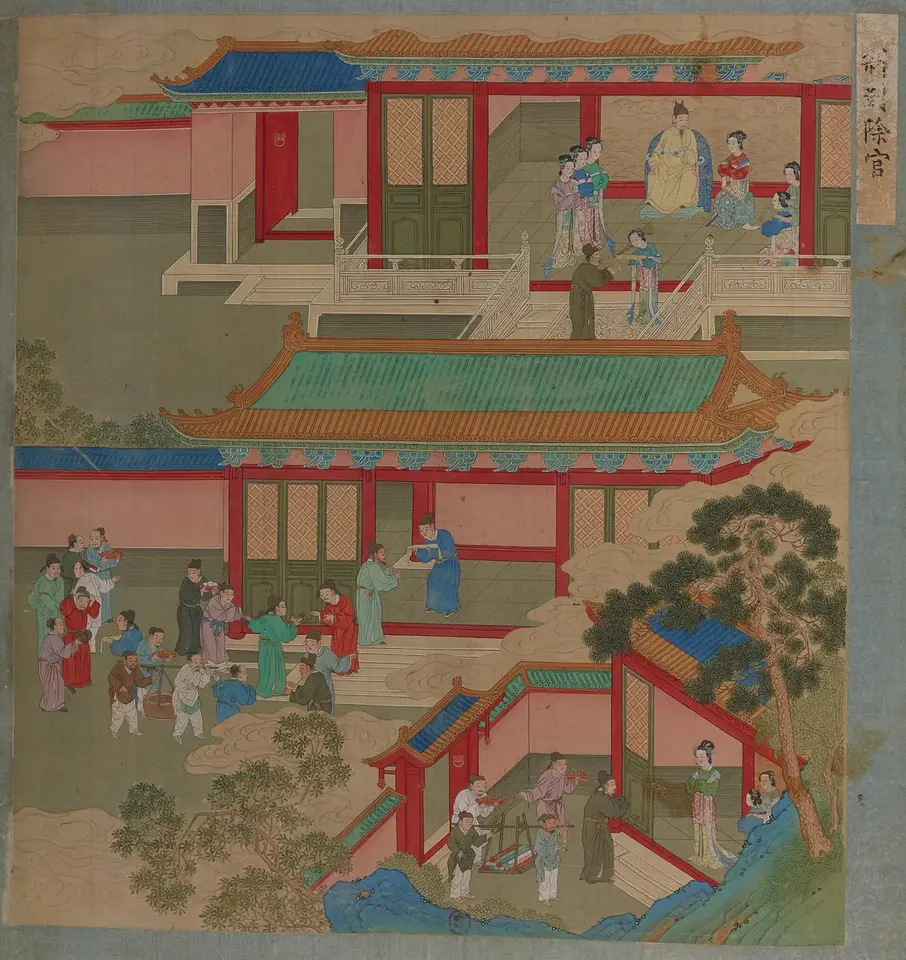
Unchallenged in power, Empress Wei and her youngest daughter Princess Anle engaged in predatory commercialization of the state apparatus. Princess Anle drafted imperial decrees herself, covering the text with her sleeve and forcing her indulgent father to sign without reading. Bypassing the Ministry of Personnel and the Chancellery, she sold official credentials sealed askew with black ink, termed "oblique-sealed offices" (xiefeng guan). Thousands of wealthy butchers, brewers, and criminals purchased titles of vice-minister or imperial censor for three hundred thousand cash, filling the bureaucracy with venality. Concurrently, Princess Anle aggressively lobbied Zhongzong to proclaim her "Crown Princess Imperial" (Huang Tai Nü), plotting to replicate Wu Zetian's female emperorship.
Pushed to desperation, Crown Prince Li Chongjun (who was not Empress Wei's biological son) launched a palace uprising in July 707. Joining with Guard General Li Duozuo and three hundred cavalry, Chongjun stormed Wu Sansi's mansion, slaying Wu Sansi and his son Wu Chongxun before marching on the palace to apprehend Empress Wei. However, when Emperor Zhongzong personally appeared atop the palace ramparts and appealed to the mutineers, the guard troops wavered and turned their blades against Li Duozuo. Li Chongjun fled into the mountains and was murdered by his own retainers, eliminating the last internal check on Empress Wei's dictatorial ambitions.
On July 3, 710 (the second day of the sixth month of Jinglong), Emperor Zhongzong died abruptly in the Shenlong Hall at the age of fifty-five. Contemporary chronicles Old Book of Tang and Comprehensive Mirror affirm that Empress Wei, terrified that Zhongzong had discovered her treasonous adultery, joined with Princess Anle to poison an imperial pastry, causing the emperor's instant demise. Concealing the death, Wei enthroned sixteen-year-old Prince of Wen Li Chongmao as a puppet child-monarch, while assuming the regency herself and placing her kinsmen in command of the Imperial Guard, plotting an outright dynastic coup.
Confronting the imminent extinction of the dynasty, Prince of Linzi Li Longji (the third son of Prince of Xiang Li Dan) conspired with his aunt Princess Taiping to strike first. On the night of July 21, Li Longji coordinated with palace guard commanders Ge Fushun and Chen Xuanli, storming the Xuanwu Gate of Chang'an under the cover of darkness. The loyalist cavalry overwhelmed the palace garrisons, cutting down Wei generals and sweeping through the halls. Empress Wei fled toward the flying cavalry camp where she was butchered by rebelling soldiers; Princess Anle was beheaded at her dressing mirror; while Shangguan Wan'er was executed despite presenting Zhongzong's will. Li Longji and Princess Taiping enthroned Li Dan as Emperor Ruizong, crushing the Wei-Wu faction.
During the years of the Wei-Wu supremacy, the imperial court at Chang'an exhibited a decadent political culture. Emperor Zhongzong established the Xiuwen Hall to gather courtier-poets such as Shen Quanqi and Song Zhiwen, staging lavish "Jinglong Literary Gatherings" filled with banquets, boating on Kunming Lake, and verse competitions. Beneath this facade of literary patronage, imperial authority was completely privatized by consort clans. Empress Wei gambled openly with Wu Sansi inside the private imperial chambers while the compliant emperor kept score, entirely debasing monarchical dignity.
Serving as the chief drafter of imperial rescripts, Shangguan Wan'er exploited her literary brilliance to mediate between high officials and inner palace cabals. Academicians seeking bureaucratic promotion offered flattery and panegyrics to the Princesses and Empress Wei rather than performing administrative duties. The normal deliberative functions of the central secretariats were hollowed out by private transactions, ensuring that internal governance could only be corrected through violent political slaughter.
Zhongzong's pathological indulgence toward Empress Wei was rooted in severe psychological trauma suffered during his early reign. Enthroned briefly in 684, he was deposed by Wu Zetian after just fifty-five days for attempting to grant high office to his father-in-law Wei Xuanzhen, and banished to the remote mountains of Fangzhou. Confined for fourteen years under armed surveillance, Li Xian and Lady Wei endured privation and the constant terror of summary execution by royal inquisitors.
This prolonged captivity shattered Li Xian's self-confidence. Whenever imperial envoys approached the compound, he fell into hysterical panic and attempted suicide, preserved only by Lady Wei's resolute intervention. The solemn vow he swore to her in exile—promising unfettered freedom of action should he ever regain the throne—became an unbreakable psychological shackle. When he returned to the throne, his profound survivor's guilt blinded him to Empress Wei's flagrant usurpations and court corruption, ultimately paving the path to his own destruction.
With the blessing of Empress Wei and Wu Sansi, Princess Anle indulged in unrestrained opulence, seizing private farmlands and imperial waterways to construct sprawling aristocratic estates. Competing with her aunt Princess Taiping in displays of wealth, she commandeered peasant properties to excavate an artificial pleasure lake spanning dozens of li, deliberately naming it "Dingkun Lake" to signify that it eclipsed Emperor Wu of Han's legendary Kunming Lake.
Princess Anle also commissioned imperial artisans to gather plumage from rare avian species across southern China, weaving the legendary "feather dresses of one hundred birds." Valued at hundreds of thousands of gold pieces, these garments shimmered in varied hues depending on viewing angles, sparking a fashion frenzy that led to the near-extinction of rare birds in Jiangnan. This rapacious consumption alienated commoners and garrison soldiers alike, completely eroding the political legitimacy of Zhongzong's restoration and isolating the Wei-Wu clique from all sectors of society.
The Tanglong Coup permanently dismantled the entrenched consort networks that had dominated Chinese politics for fifty years following Wu Zetian's rise. Empress Wei, Princess Anle, and dozens of high-ranking kinsmen were executed, their wealth expropriated, and the collateral lineages of the Wu clan stripped of administrative authority. The decisive victory extinguished the historical precedent of female imperial enthronement, reasserting traditional patriarchal succession within the Li Tang dynasty.
Following the accession of Emperor Ruizong, the imperial administration immediately enacted systematic bureaucratic reforms. Thousands of illegitimate "oblique-sealed appointments" purchased during Empress Wei's regency were annulled, and unqualified officeholders were dismissed from metropolitan boards. The Ministry of Personnel reinstated standardized civil service examinations and regulatory audits, purifying the imperial bureaucracy and restoring public faith in the fairness of Confucian administration.
The tumultuous five-year interregnum of Emperor Zhongzong's restoration and Empress Wei's tyranny served as the crucible that forged the political talents of young Li Longji. Exhibiting extraordinary personal courage, tactical decisiveness, and military charisma during the Tanglong Coup, Li Longji was named Crown Prince. In 713, he launched the Xiantian Coup to eliminate the lingering faction of Princess Taiping, securing absolute monarchical authority and inaugurating the celebrated Kaiyuan Era (713-741), the cultural and demographic pinnacle of the Tang Empire.
In the Old Book of Tang (Jiu Tangshu), imperial chroniclers remarked: "Empress Wei exploited the Oath of Fangling to monopolize executive authority. Allying with the Wu clan and murdering her own kin, she poisoned the Son of Heaven to seize the throne. Never in history was a consort crisis more dreadful! The realm was preserved solely because Xuanzong arose with transcendent martial virtue, exterminating the traitors and restoring the imperial house."
The Northern Song historian Sima Guang wrote in Comprehensive Mirror in Aid of Governance (Zizhi Tongjian): "Emperor Zhongzong was subjugated by a tyrannical wife and deceived by a spoiled daughter, fraternizing with the hated Wu family while murdering his benefactor Zhang Jianzhi. Destruction was conceived in this weakness, until he perished by the hand of a treacherous woman. Although titled Zhongzong (the Restorer), where was any restoration?"
The late Ming philosopher Wang Fuzhi noted in On the Comprehensive Mirror: "During the Tanglong crisis, the Prince of Linzi rendered supreme service to the ancestral altars. Empress Wei and Princess Anle were more wicked than Wu Zetian, yet lacked her administrative genius. Had Longji not mobilized the Imperial Guard, the shrines of Tang would have become the private estate of the Wei clan."