Mutiny of Conscripted Qiang
Conscripted Qiang cavalrymen mutiny at Jiuquan; chieftain Dian Ling declares himself emperor, inaugurating the Great Yongchu Rebellion.
Eastern Han Dynasty (东汉) · HISTORICAL EVENT
东汉汉羌战争
The Eastern Han-Qiang Wars (东汉汉羌战争) constituted a protracted, six-decade sequence of massive ethnic uprisings and brutal imperial counter-insurgency campaigns along the northwestern frontier of the Eastern Han dynasty. Ignited in 107 when Empress Dowager Deng Sui enforced the compulsory conscription of Qiang cavalry to wage war in the Western Regions, the conflict witnessed widespread uprisings among the Xianling and Shaodang Qiang tribes who crowned Dian…
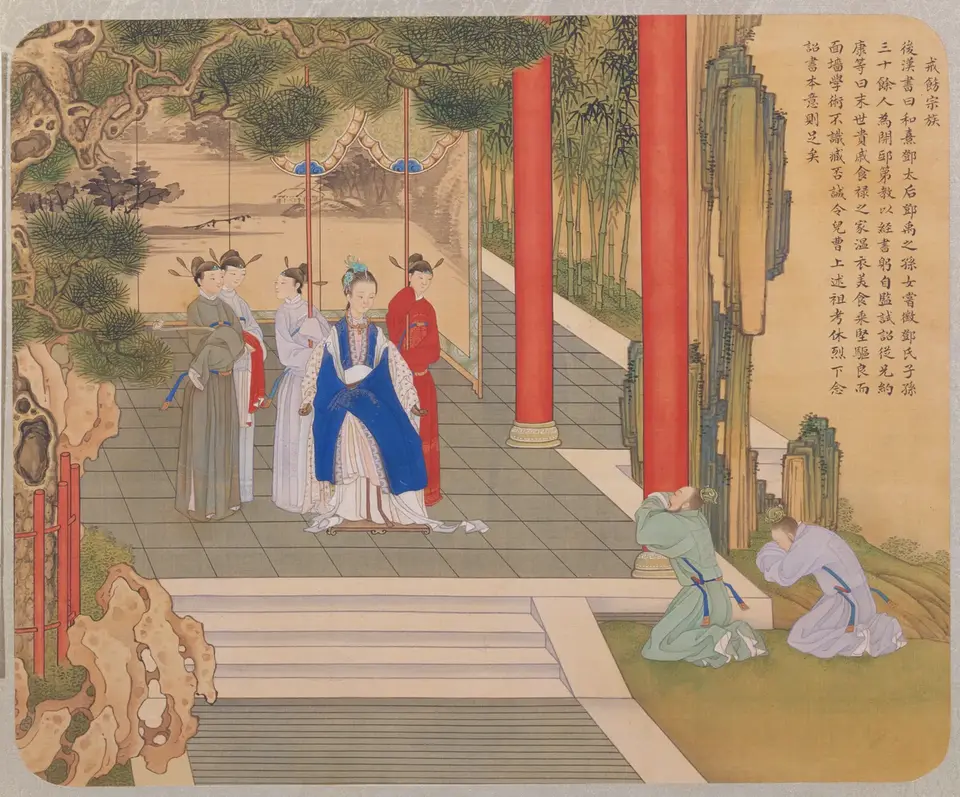
The Eastern Han-Qiang Wars (东汉汉羌战争) constituted a protracted, six-decade sequence of massive ethnic uprisings and brutal imperial counter-insurgency campaigns along the northwestern frontier of the Eastern Han dynasty. Ignited in 107 when Empress Dowager Deng Sui enforced the compulsory conscription of Qiang cavalry to wage war in the Western Regions, the conflict witnessed widespread uprisings among the Xianling and Shaodang Qiang tribes who crowned Dian Ling as emperor and repeatedly raided Guanzhong, threatening the imperial capital of Luoyang and despoiling the Han ancestral tombs. Confronting catastrophic financial and territorial strain, the Han dynasty mobilized millions of soldiers under commanders including Ren Shang, Ma Xian, and the celebrated "Three Luminaries of Liangzhou" (Huangfu Gui, Zhang Huan, and Duan Jiong). The warfare concluded only in 169 when Duan Jiong executed an uncompromising campaign of extermination across the frontier valleys. The conflict drained national treasuries, left the northwestern borderlands in ruins, and fostered the militarization of private frontier armies that culminated in Dong Zhuo's catastrophic coup.
Conscripted Qiang cavalrymen mutiny at Jiuquan; chieftain Dian Ling declares himself emperor, inaugurating the Great Yongchu Rebellion.
Dian Ling's confederation sweeps through Liangzhou, penetrates Guanzhong, and desecrates the Western Han imperial tombs.
Yu Xu blocks court proposals to abandon Liangzhou, defeating Qiang ambushes at Chiting through deceptive tactical hearths.
General Ren Shang utilizes bribery and coordinated encirclement to eliminate tribal leaders Ling Chang and Langmo, temporarily subduing the rebellion.
Shaodang and Xianling confederations launch renewed uprisings; Emperor Shun dispatches General Ma Xian with one hundred thousand troops.
General Ma Xian and his sons are encircled and killed in battle at Mount Shegu, triggering widespread panic along the frontier.
Huangfu Gui serves as Governor of Liangzhou, pacifying over one hundred thousand tribal combatants through personal diplomacy and military deterrence.
Duan Jiong crushes the Eastern Qiang main host at Mount Fengyi, initiating an unrelenting offensive across the northern valleys.
Duan Jiong completely destroys the final Eastern Qiang forces at Mount Fanting, bringing the sixty-year war to a close.
Since the reigns of Emperor Xuan and Emperor Yuan of Western Han, inward-migrating Qiang tribes had been settled across Longxi, Anding, and Jincheng Commanderies, living alongside Han agricultural settlers. Under the Eastern Han, the imperial court created the Colonel-Protector of the Qiang (Huqiang Xiaowei) to superintend tribal affairs. However, local landed magnates and regional administrators systematically subjected the Qiang to arbitrary taxation, corvee extortion, and forced enslavement. Deep-seated resentment festered across tribal lineages, creating a combustible environment awaiting a spark.
In 107 (the first year of Yongchu), following rebellions in the Western Regions, the Eastern Han court commanded regional governors to forcibly recruit several thousand Qiang cavalrymen from Jincheng and Longxi for an expeditionary march to Central Asia. Deeply attached to their ancestral grasslands and fearing perilous overseas deployment, the conscripted cavalrymen mutinied and deserted upon reaching Jiuquan. When frontier magistrates brutally torched deserting tribal camps and executed clan members, the Xianling Qiang chieftain Dian Ling united regional tribes, proclaimed himself Son of Heaven, and unleashed a ferocious armed uprising across the northwest.
In the winter of 107, Dian Ling formed a broad confederation with the Shaodang and Anding tribes, mobilizing tens of thousands of horsemen across Liangzhou. Sweeping past imperial frontier garrisons, Qiang cavalry overwhelmed Han administrative seats, killed the Governor of Hanyang, and breached the strategic passes guarding Guanzhong. The raiders ravaged the outskirts of Chang'an and pillaged the Western Han imperial mausoleums. Panic enveloped the court in Luoyang, prompting Grand General Deng Zhi to mobilize the crack Five Northern Armies under General Ren Shang, though divided command led to catastrophic defeats at Pingxiang and Jixian.
Confronting repeated military failures, faint-hearted ministers proposed abandoning Liangzhou entirely to fortify the Hangu Pass. This defeatist policy was decisively thwarted by the strategist Yu Xu, who presented a memorial to Empress Dowager Deng arguing that Liangzhou was the protective bulwark of the empire and the traditional nursery of brave generals. Appointed Governor of Wudu, Yu Xu utilized ingenious tactical deception—such as increasing cooking hearths to simulate continuous reinforcements—to smash Qiang ambushes at Chiting, effectively safeguarding the southwestern flank of Guanzhong.
During the Yonghe era of Emperor Shun, decades of uneasy truce shattered when the Shaodang chieftain Nali joined surviving Xianling clans in a second massive revolt. The rebels overran imperial outposts, killed imperial delegates, and advanced toward Fufeng. Emperor Shun commissioned veteran cavalry general Ma Xian as General Who Conquers the West, entrusting him with an army of one hundred thousand infantry and cavalry. Though Ma Xian achieved initial successes, his growing arrogance led to catastrophe in 141, when his vanguard was encircled in the crags of Mount Shegu; Ma Xian and his two sons fought to the death as the Han field army collapsed.
The disaster severed communication along the Hexi corridor and isolated the Western Regions. In response, the court deployed seasoned scholar-generals Huangfu Gui and Zhang Huan to stabilize Longdong. Huangfu Gui rode unarmed into tribal camps, using moral prestige to induce tens of thousands of rebel warriors to surrender. Zhang Huan disciplined the frontier regiments and checked rebel momentum through tactical maneuver, preventing the insurgency from penetrating into the Central Plains.
During the Yanxi reign of Emperor Huan, the conflict entered its final, bloodiest phase under the command of General Duan Jiong. Holding the post of Colonel-Protector of the Qiang, Duan Jiong rejected conciliation, advocating the systematic armed destruction of all hostile tribes. Maintaining rigorous discipline and sharing rations with common foot soldiers, Duan Jiong led high-speed cavalry columns deep into mountain strongholds. At Mount Fengyi, he engaged the Xianling main body in day-long close-quarters combat, slaughtering thousands of hostile warriors.
Over subsequent years, Duan Jiong fought 180 engagements across treacherous mountain ravines, severing over forty thousand enemy heads. In 169 (the second year of Jianning), Duan Jiong ambushed the final confederation of the Eastern Qiang at Mount Fanting, exterminating their surviving leadership and forcibly relocating non-combatant survivors into interior counties. After more than six decades of unrelenting bloodshed, the Eastern Han-Qiang Wars came to an end.
The Eastern Han dynasty ultimately achieved military victory over the Qiang confederation through Duan Jiong's uncompromising scorched-earth campaign. However, this triumph came at an appalling humanitarian and demographic cost. Urban centers across Liangzhou and Bingzhou were completely destroyed, while millions of Han and Qiang civilians perished from continuous warfare and famine. The imperial court was repeatedly compelled to relocate administrative commanderies eastward, reducing the once-prosperous Guanzhong and Longyou corridors into depopulated wastelands.
The prolonged conflict operated as an inescapable fiscal drain on the Eastern Han state. Dynastic records indicate that military expenditures exceeded 24 billion cash during the Yongchu era and another 20 billion during the reigns of Shun and Huan, totaling over 44 billion cash. To finance these staggering costs, the court slashed bureaucratic stipends, institutionalized the public sale of aristocratic offices, and levied burdensome land surtaxes, aggravating social instability and setting the stage for the Yellow Turban Rebellion.
Six decades of frontier warfare fundamentally altered the distribution of military power in China. Because metropolitan armies from the Central Plains proved ineffective in rugged mountain combat, the court relied on hardened provincial cavalry forces raised from Liangzhou. Commanders such as Dong Zhuo accumulated personal military followings during these campaigns. Following the death of Emperor Ling, Dong Zhuo led his seasoned frontier legion into the imperial capital, deposing the emperor and extinguishing the political authority of the Han dynasty.
In the Book of the Later Han (Hou Hanshu), Fan Ye analyzed the catastrophe: "The governance of the Eastern Han was marred by rapacity and cruelty. From the Yongchu era onward, the Qiang turmoil raged continuously, crossing Mount Long, ravaging the Sanfu region, and pillaging imperial mausoleums. The empire was exhausted, national treasuries emptied, and half the population displaced. When Duan Jiong applied extreme severity to exterminate the tribes, frontier commanders seized military authority, bringing ultimate ruin to the Han house."
The Northern Song historian Sima Guang remarked in Comprehensive Mirror in Aid of Governance (Zizhi Tongjian): "The decline of the Eastern Han began not with Emperors Huan and Ling, but with the Qiang uprisings of Emperor An's Yongchu era. The wealth of the nation was exhausted in Longyou, and commoners were crushed by military levies. Internal collapse was already sealed."
The late Ming scholar Wang Fuzhi wrote in On the Comprehensive Mirror: "Han governance failed in Longxi, where magistrates were more savage than wolves. While Duan Jiong established renown through slaughter, he nurtured the very forces that destroyed the empire."