Kurultai Approves Western Invasion
Ogedei Khan convenes the council at the Onon River, ordering the eldest sons of all imperial lineages to join the western expedition.
Mongol Empire, Ogedei Khan Reign (1235–1242 CE) · HISTORICAL EVENT
拔都西征
Batu's Western Campaign (拔都西征, also known as the Campaign of the Elder Princes) was an unprecedented trans-continental invasion launched from 1235 to 1242 CE by the Mongol Empire under second Khagan Ogedei, led by the eldest sons of all imperial lineages. Because the expeditionary leadership comprised the primary heirs of Genghis Khan's sons (Jochi's second son Batu as supreme commander, Ogedei's eldest son Guyuk, Tolui's eldest son Mongke, and Chagatai's…
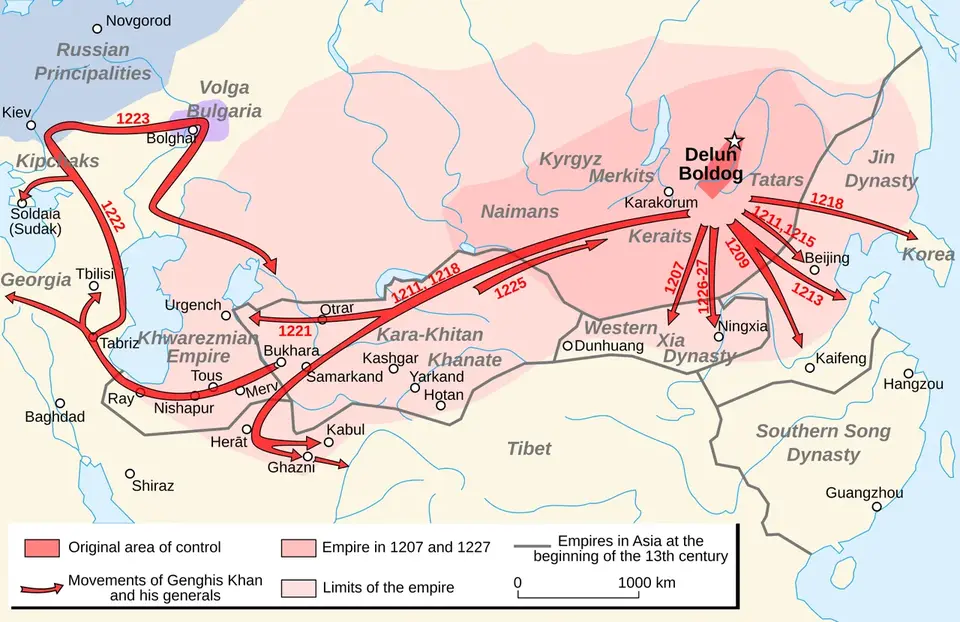
Batu's Western Campaign (拔都西征, also known as the Campaign of the Elder Princes) was an unprecedented trans-continental invasion launched from 1235 to 1242 CE by the Mongol Empire under second Khagan Ogedei, led by the eldest sons of all imperial lineages. Because the expeditionary leadership comprised the primary heirs of Genghis Khan's sons (Jochi's second son Batu as supreme commander, Ogedei's eldest son Guyuk, Tolui's eldest son Mongke, and Chagatai's grandson Buri), contemporary chronicles termed it the "Campaign of the Elder Princes." Veteran commander Subutai oversaw operational theater strategy. Mobilizing a disciplined cavalry force of 150,000 warriors, the expedition crossed the Ural River in 1236, conquering the Volga Bulgars and subjugating the Kipchak steppes while executing chieftain Bachman. Exploiting frozen winter rivers, the armies swept across the Rus' principalities, sacking Ryazan, Moscow, and Vladimir, and slaying Grand Duke Yuri II at the Battle of the Sit River. After laying waste to Kyiv in 1240, the Mongol forces executed a dual advance into Central Europe: the northern wing decimated Polish and German crusader knights at Legnica, while the southern wing shattered the Hungarian royal army at the Battle of Mohi on the Sajo River. Reaching the Adriatic coast, the armies halted in 1242 upon receiving news of Ogedei Khan's death, prompting Batu to establish the capital of Sarai along the lower Volga and lay the foundations of the Golden Horde.
Ogedei Khan convenes the council at the Onon River, ordering the eldest sons of all imperial lineages to join the western expedition.
The western army crosses the Ural River and sacks the capital city of Bulgar, establishing a forward logistics base.
Mongke and Subutai conduct an amphibious sweep through the Volga marshes, capturing and executing Kipchak chieftain Bachman.
Exploiting frozen riverways, Mongol cavalry bombard and destroy Ryazan and Moscow with counterweight trebuchets.
Subutai encircles and slays Grand Duke Yuri II of Vladimir at the Sit River, eliminating organized resistance in northeastern Rus'.
Batu's siege artillery batters down the Polish Gate; Kyiv is sacked and burned, bringing the Kievan Rus' era to an end.
Baidar's northern division uses feigned retreats to encircle and destroy the allied Polish and Teutonic knights, killing Henry II.
Subutai executes a nocturnal river crossing to outflank the Hungarian army at Mohi, killing over seventy thousand royal soldiers.
Reaching the Adriatic coast, the armies halt upon receiving news of Ogedei Khan's death and withdraw eastward.
Batu establishes his imperial capital at Sarai along the lower Volga, inaugurating two and a half centuries of the Golden Horde.
In 1234, allied Mongol and Southern Song armies breached the walls of Caizhou, driving the last Jin emperor to commit suicide and extinguishing the Jurchen Jin Dynasty after 120 years of rule. Having consolidated authority over northern China, the Mongol Empire reached the height of its administrative and military organization under its second supreme ruler, Ogedei Khan, who instituted central taxation and established the imperial courier network (Yam).
Under the patrimonial division enacted by Genghis Khan, his eldest son Jochi was granted the westernmost territories "as far as Mongol horses could tread." However, following the deaths of Jochi and Genghis Khan, the actual territory under Jochid control remained confined to the Irtysh and Aral basins, while the vast Kipchak steppes and Rus' principalities to the west remained unsubdued.
In the spring of 1235 (the 7th year of Ogedei Khan), Ogedei convened a general imperial council (Kurultai) at the Onon River. The council finalized a grand strategy targeting both the Southern Song borderlands and eastern Europe. To guarantee maximum military efficacy and imperial solidarity, Ogedei enacted the "Conscription of the Eldest Sons": decreeing that the eldest sons of all princely houses, along with the firstborn sons of all commanders of ten thousand and one thousand, must personally join the campaign. Batu was designated supreme commander, while Genghis Khan's veteran general Subutai was appointed operational field commander, commanding 150,000 Mongol, Turkic, and auxiliary troops.
The primary strategic obstacle confronting the expedition was the sprawling Kipchak Steppe north of the Caspian and Black seas, occupied by independent nomadic Turkic clans. These tribes lacked centralized governance and engaged in constant internecine warfare, led by the prominent chieftain Bachman.
West of the steppes lay the fragmented principalities of Kievan Rus'. Since the 12th century, central authority had disintegrated into competing regional principalities, including Ryazan, Vladimir-Suzdal, Novgorod, Smolensk, Chernigov, and Halych. These principalities feuded continuously over thrones and trade routes. Despite having suffered a devastating defeat against Subutai and Jebe at the Battle of the Kalka River in 1223, the Rus' princes failed to form a unified defensive confederation or upgrade their defensive architecture, leaving them profoundly vulnerable to concentrated cavalry attacks.
In the autumn of 1236, the western expeditionary army crossed the Ural River and advanced toward the ancient agrarian state of Volga Bulgaria along the middle Volga. Subutai laid siege to the capital city of Bulgar with counterweight trebuchets, storming the fortifications within days. The realm was annexed, securing a forward operational supply depot.
Subsequently, the armies combed the lower Volga and Caspian steppes to neutralize Kipchak resistance. Chieftain Bachman utilized his familiarity with the labyrinthine marshlands and reeds of the Volga delta to mount persistent guerrilla raids against Mongol outposts. In the summer of 1237, Prince Mongke and Subutai organized a riverine search operation. Discovering that Bachman had taken refuge on an isolated island, Mongke capitalized on a sudden offshore gale that blew back the river waters, leading mounted warriors across the shallows to capture Bachman. When Bachman refused to kneel, he was executed. Surviving Kipchak refugees fled westward into Hungary, leaving the vast steppes in Mongol hands.
With the steppes subdued, Batu and Subutai launched a winter blitzkrieg against the Rus' principalities. Understanding that freezing temperatures turned marshy forests and river corridors into solid highways for mounted cavalry, the command commenced operations in December 1237.
Mongol divisions crossed the frozen Oka River and besieged Ryazan. After Grand Duke Yuri's appeals for aid were rejected by neighboring Vladimir, the defenders resisted alone. Mongol siege engineers deployed heavy stone-throwers and flaming incendiaries, breaching the stone ramparts after six days of bombardment. The city was completely incinerated, and its garrison was eliminated.
The armies pressed across northeastern Rus', taking Kolomna and Moscow. In February 1238, the central column invested Vladimir, the political capital of northeastern Rus'. Grand Duke Yuri II fled north to gather field forces, leaving the garrison to make a final stand in the Cathedral of the Dormition, which was burned. On March 4, 1238, Subutai intercepted Yuri II's army at the Sit River. Encircled in heavy snowdrifts, the Rus' field army was annihilated and Yuri II was killed in combat. Mongol cavalry advanced within sixty miles of the mercantile metropolis of Novgorod before spring thaws turned the landscape into impassable mud, prompting a withdrawal to southern pastures.
Following campaigns through the Crimea and the northern Caucasus in 1238 and 1239 to protect their flanks, the Mongol high command concentrated against southern Rus' in the autumn of 1240, targeting the historic capital of Kyiv.
Kyiv boasted massive stone battlements and the formidable Golden Gate. Grand Duke Mikhail fled to Poland, leaving garrison commander Voivode Dmytro to conduct the defense. In November 1240, Batu and Mongke deployed massive armies along the Dnieper River. Siege engineers constructed elevated platforms opposite the Polish Gate, firing heavy boulders day and night until the masonry collapsed.
On December 6, 1240, Mongol armored cavalry poured through the breaches. Surviving citizens made a desperate final stand atop the roof of the Church of the Tithes, which collapsed under the excessive weight of the refugees. Kyiv was sacked and burned to the ground, with historic cathedrals and palaces leveled. The fall of Kyiv marked the end of the Kievan Rus' golden age. Mongol columns then swept westward across Halych and Volhynia, reaching the foothills of the Carpathian Mountains.
Having subdued the Rus' lands, Batu prepared to invade Central Europe to pursue Kipchak refugees who had found sanctuary in Hungary. To prevent northern European powers—Poland, Bohemia, and the Holy Roman Empire—from coming to Hungary's defense, Batu divided his command into northern and southern wings.
The northern wing, comprising thirty thousand cavalry under princes Baidar and Kadan, invaded Poland. High Duke Henry II the Pious of Silesia gathered a joint army of thirty thousand knights, incorporating Polish feudal barons, Moravian levies, and elite contingents from the Knights Templar, Knights Hospitaller, and Teutonic Order.
On April 9, 1241, the armies met outside Legnica. Henry II launched a heavy cavalry charge against the Mongol center. Baidar utilized nomadic feigned-retreat tactics, drawing the armored European knights into an open killing zone. As the knightly ranks became strung out, Mongol horse archers executed a sweeping counter-flank movement, showering the disorganized knights with armor-piercing arrows before surrounding them in close-quarters combat. Henry II was beheaded, and thousands of crusader knights were annihilated, plunging Poland into panic.
Concurrently, Batu and Subutai led the southern strike force of one hundred thousand cavalry across the Carpathian passes into Hungary. King Bela IV assembled an army of one hundred thousand troops, entrenching his forces within an extensive fortified wagon camp on the plains of Mohi along the Sajo River.
On April 11, 1241, the Battle of the Sajo River commenced. While Batu launched a frontal assault against the fortified river bridge, Subutai led thirty thousand cavalry on a midnight crossing through deep waters downstream, flanking the Hungarian camp from the rear. At dawn, Mongol siege engines bombarded the wagon enclosure with incendiary pots, while Subutai's cavalry charged from the rear.
Seeing the defense break, Batu deliberately left a gap in the encirclement to the west. As Hungarian troops broke ranks and fled along this corridor, Mongol cavalry executed a rolling ambush across dozens of miles. Over seventy thousand Hungarian soldiers were killed, and King Bela IV escaped to an offshore Adriatic island.
Mongol divisions pursued the fugitive king to the Adriatic coast, with vanguard units advancing within sight of Vienna. In the spring of 1242, dispatch riders arrived from Karakorum bearing urgent imperial intelligence: Khagan Ogedei had died of illness in November 1241, and Empress Toregene had declared an imperial regency, ordering all imperial princes to return for the succession Kurultai.
Batu and Subutai immediately suspended the invasion. The armies retired across Bulgaria and the northern Black Sea coast toward the Volga River. Aware of his bitter political rivalry with Ogedei's heir Guyuk, Batu chose not to return to Mongolia. Instead, he halted along the lower Volga, founding his capital at Sarai (near modern Astrakhan) and establishing the Golden Horde, concluding one of the most destructive military expeditions in Eurasian history.
Batu's Western Campaign concluded in an unprecedented trans-continental victory for the Mongol Empire. Over nearly eight years of continuous campaigning across thousands of miles, the Mongol armies eliminated Volga Bulgaria and the Kipchak confederation, subjugated over a dozen Rus' principalities, and routed the feudal field armies of Poland and Hungary. Tens of thousands of fortified citadels, including Ryazan, Vladimir, and Kyiv, were leveled. With the unexpected death of Ogedei Khan, the Mongol forces suspended their planned assault into western Europe, enabling Batu to consolidate his territorial conquests into the Golden Horde along the lower Volga.
The campaign fundamentally altered Eurasian geopolitical development across centuries. First, it imposed the two-and-a-half-century "Tatar Yoke" (1240–1480 CE) over the Russian lands. The destruction of Kyiv dismantled the old decentralized Rus' system; under Mongol suzerainty, the previously peripheral Grand Duchy of Moscow served as imperial tax collectors, steadily absorbing rival principalities and ultimately forging the unified Russian tsardom. Second, the near-total destruction of Central European armies shocked Catholic Christendom, prompting Popes and monarchs to dispatch Franciscan diplomats such as Giovanni da Pian del Carpine and William of Rubruck to Karakorum, inaugurating direct European engagement with East Asia. Third, the pacification of the vast Eurasian steppe unified maritime and overland transit under the Pax Mongolica, dramatically expanding trans-continental commercial networks along the Silk Road and accelerating the diffusion of Chinese gunpowder, the magnetic compass, and printing technologies to the West, which stimulated the European Renaissance and the Age of Discovery.