Yancheng Victory and Twelve Gold Plaques
Yue Fei routs the Jin heavy cavalry and advances to Zhuxian Town; Gaozong issues twelve gold plaques ordering an immediate retreat.
Southern Song Dynasty (南宋) · HISTORICAL EVENT
岳飞之死
The Death of Yue Fei was an infamous political persecution and miscarriage of justice that culminated on New Year's Eve of the eleventh year of Shaoxing (January 27, 1142) inside the Dali Temple prison of Lin'an (modern Hangzhou). In 1140, Wanyan Zongbi, commander-in-chief of the Jurchen Jin dynasty, broke earlier accords and launched a massive invasion of the south. Junior Guardian and Assistant Commissioner of Military Affairs Yue Fei counter-attacked…
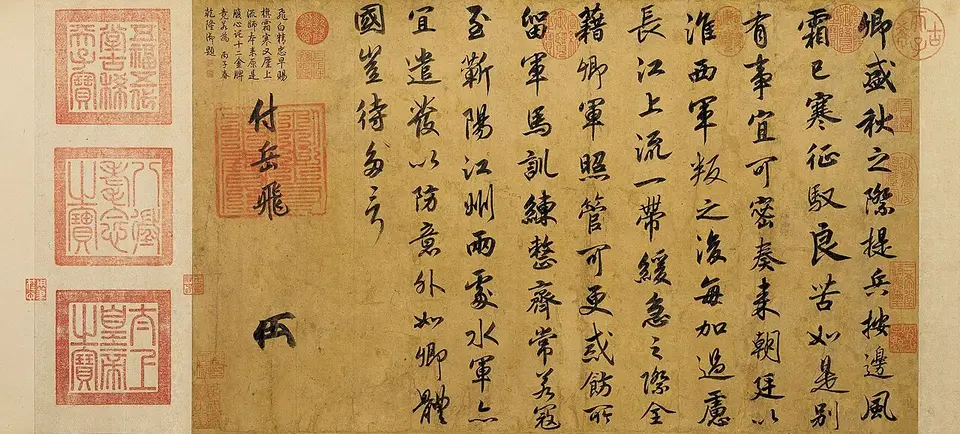
The Death of Yue Fei was an infamous political persecution and miscarriage of justice that culminated on New Year's Eve of the eleventh year of Shaoxing (January 27, 1142) inside the Dali Temple prison of Lin'an (modern Hangzhou). In 1140, Wanyan Zongbi, commander-in-chief of the Jurchen Jin dynasty, broke earlier accords and launched a massive invasion of the south. Junior Guardian and Assistant Commissioner of Military Affairs Yue Fei counter-attacked at the head of the elite Yue Family Army, defeating the Jin heavy cavalry iron pagodas and flank horsemen at Yancheng and Yingchang. As Yue Fei reached Zhuxian Town poised to liberate the Northern Song capital of Kaifeng, Emperor Gaozong and Chancellor Qin Hui issued twelve golden plaques in a single day, ordering an immediate retreat to facilitate peace negotiations. In early 1141, Gaozong stripped Yue Fei, Han Shizhong, and Zhang Jun of their troop commands. When Wanyan Zongbi insisted that Yue Fei must be killed before a peace treaty could be finalized, Qin Hui and General Zhang Jun bribed subordinate officers to fabricate treason allegations against Yue Fei's top lieutenant Zhang Xian and his son Yue Yun. Subjected to brutal interrogation, Yue Fei revealed the four characters "Serve the Country with Utmost Loyalty" tattooed across his back. When Han Shizhong demanded evidence, Qin Hui infamously replied "perhaps there was." Gaozong ordered Yue Fei's execution by poison at Fengbo Pavilion, while Yue Yun and Zhang Xian were beheaded, permanently extinguishing Song hopes of reclaiming the northern plains.
Yue Fei routs the Jin heavy cavalry and advances to Zhuxian Town; Gaozong issues twelve gold plaques ordering an immediate retreat.
Gaozong summons Yue Fei, Han Shizhong, and Zhang Jun to court, appointing them to the Bureau of Military Affairs and stripping them of their armies.
Qin Hui schemes to purge Han Shizhong; Yue Fei secretly warns Han, earning Qin Hui's hatred.
Wanyan Zongbi demands Yue Fei's death; Qin Hui bribes Wang Jun to accuse Zhang Xian and Yue Yun of plotting mutiny.
Yue Fei is arrested; Censor He Zhu observes the tattoo on Yue's back, finds no treason, and is dismissed by Qin Hui.
Moqi Xie subjects Yue Fei to interrogation; Yue Fei goes on hunger strike and writes "The bright sun above shines clear!"
Han Shizhong confronts Qin Hui over the lack of evidence; Qin Hui gives the "perhaps there was" response.
Gaozong issues a secret rescript executing Yue Fei at Fengbo Pavilion; Yue Yun and Zhang Xian are beheaded at Zhongan Bridge.
Gaozong signs the Treaty of Shaoxing, ceding northern lands, paying annual tribute, and declaring vassalage to the Jin.
Emperor Xiaozong rehabilitates Yue Fei, interring his remains at West Lake and conferring the posthumous titles of Wumu and Prince of E.
In the fifth lunar month of 1140, Jin general Wanyan Zongbi abrogated the initial peace treaty and launched a full-scale assault across the Central Plains. Charged with defending the central front, Yue Fei advanced from Xiangyang, enforcing iron discipline with the famous motto: "Freeze to death rather than tear down a house; starve to death rather than plunder." Operating in tandem with regional loyalist militias, the Yue Family Army swept through Henan, recapturing Zhengzhou, Luoyang, and Chenzhou.
During the climactic engagements at Yancheng and Yingchang, Yue Fei deployed his elite shock cavalry, the Beiguan horsemen, wielding curved glaives and heavy war-axes to bring down Jin ironclad cavalry formations. Slashing through the armored "iron pagodas" and routing the "flank horses," Song troops shattered the core of the Jurchen royal army, forcing Wanyan Zongbi to withdraw toward Kaifeng. Yet at Lin'an, Emperor Gaozong and Chancellor Qin Hui harbored deep dread of victorious generals and feared that a total triumph might lead to the repatriation of former emperors Huizong and Qinzong, endangering Gaozong's throne. In a single day, Gaozong dispatched twelve imperial gold-inscribed couriers demanding an immediate halt and general withdrawal. Weeping with indignation, Yue Fei lamented that ten years of martial sacrifice had been discarded in a single morning, reluctantly withdrawing his divisions southward amidst the tears of abandoned northern civilians.
Following the withdrawal, Gaozong and Qin Hui accelerated efforts to neutralize military commanders. In the fourth lunar month of 1141, Gaozong summoned the three foremost restoration commanders—Han Shizhong, Zhang Jun, and Yue Fei—to Lin'an. Under the guise of rewarding battlefield merit, Gaozong appointed Han Shizhong and Zhang Jun as Commissioners of Military Affairs, and named Yue Fei Assistant Commissioner, simultaneously abolishing regional pacification commission bureaus and transferring all active command authority directly to the throne.
While General Zhang Jun cravenly allied with Qin Hui, Han Shizhong and Yue Fei remained dedicated to northern recovery. Qin Hui and Zhang Jun initially attempted to frame Han Shizhong, but Yue Fei dispatched an express warning, enabling Han to plead his case before Gaozong and avoid imprisonment. Qin Hui was infuriated by Yue's intervention. At that juncture, Wanyan Zongbi addressed a confidential dispatch to Qin Hui from the Huai River front, laying down an ultimatum: "You ceaselessly petition for peace, yet Yue Fei plots to retake Hebei. You must kill Yue Fei; only then can peace be concluded." Determined to achieve a peace treaty at any moral cost, Gaozong and Qin Hui resolved to destroy Yue Fei.
In the eighth lunar month of 1141, acting under secret instructions from Qin Hui and Zhang Jun, Wang Jun, deputy commander of the forward division of the Yue Family Army, submitted a fabricated denunciation. Wang falsely claimed that Zhang Xian, Yue Fei's chief of staff and military governor of Ezhou, was plotting a mutiny alongside Yue Fei's eldest son Yue Yun, seeking to seize the garrisons of Ezhou and Xiangyang to coerce the imperial court into restoring Yue Fei to supreme command.
Zhang Jun hurried to Ezhou under imperial orders, arrested Zhang Xian, and subjected him to torture, attempting to extract a confession incriminating Yue Fei. Zhang Xian was beaten until his skin was shredded, but he steadfastly refused to validate the falsehood. In the ninth month, on the pretext of treason, Qin Hui ordered the Censorate to arrest Yue Fei at his retirement retreat on Mount Lu and escort him alongside Yue Yun to the Dali Temple prison in Lin'an.
Initially, Gaozong appointed Censor-in-Chief He Zhu to preside over the interrogation. When He Zhu interrogated Yue Fei, the general tore open his prison garments, exposing the four deep characters "Serve the Country with Utmost Loyalty" tattooed upon his flesh by his mother. Deeply moved and finding no evidence of sedition, He Zhu reported to Qin Hui that Yue Fei was innocent, warning that executing a peerless loyal general would alienate the hearts of all subjects.
Furious at He Zhu's refusal to comply, Qin Hui dismissed him from office, replacing him with Moqi Xie, a brutal judicial henchman, assisted by Luo Ruji. Moqi Xie subjected Yue Fei to torture, using red-hot branding irons, heavy manacles, and constant physical beatings to force a written confession. Despite broken ribs and agonizing burns, Yue Fei remained resolute, initiating a hunger strike. Handed a written confession form, Yue Fei picked up a brush and penned an eight-character epitaph: "The bright sun above shines clear! The bright sun above shines clear!"
Moqi Xie searched military correspondences for months without discovering a single scrap of seditious writing. Senior Commissioner Han Shizhong confronted Qin Hui directly, demanding to know what evidence justified Yue Fei's imprisonment. Blushing with shame and unable to present legal proof, Qin Hui stammered that while the letters between Yue Yun and Zhang Xian were ambiguous, the matter was "perhaps there was." Overcome with rage, Han Shizhong shouted: "How can the three words 'perhaps there was' convince all under Heaven?"
On New Year's Eve of the eleventh year of Shaoxing (January 27, 1142), as families celebrated across the empire, negotiations with the Jin dynasty reached their final stage. To satisfy the Jurchen demands, Emperor Gaozong issued an imperial rescript ordering Yue Fei's immediate execution inside the Dali Temple.
Executioners carried poisoned wine and strangulation ropes into Fengbo Pavilion within the prison grounds. Yue Fei was executed in cold blood at the age of thirty-nine. Simultaneously, his twenty-three-year-old son Yue Yun and lieutenant Zhang Xian were dragged in chains to the Zhongan Bridge marketplace and publicly beheaded. Snow blanketed the capital as commoners wept openly in the streets. A courageous prison clerk named Kui Shun risked his life to carry Yue Fei's body over the city walls under cover of darkness, burying the general at the foot of Qixia Ridge by the West Lake. Shortly after the executions, Gaozong concluded the humiliating Treaty of Shaoxing with the Jin dynasty.
The execution of Yue Fei dismantled the military instrument capable of challenging Jurchen hegemony. Following the purge of the Yue Family Army, Wanyan Zongbi reportedly celebrated in the Jin capital, declaring that the Southern Dynasty had destroyed its own shield. In the second month of 1142, Emperor Gaozong concluded the humiliating Treaty of Shaoxing: the Southern Song ceded all territories north of the Huai River and the Dabie Mountains, agreed to pay an annual tribute of 250,000 ounces of silver and 250,000 bolts of silk, and formally declared vassalage to the Jin emperor. This geopolitical surrender locked the Southern Song into a permanent regional enclave south of the Yangtze.
Yue Fei's wrongful death provoked deep popular outrage. In 1162, upon ascending the throne, Emperor Xiaozong of Song formally overturned the verdict, restoring Yue Fei's titles and reinterring his remains with full honors at Qixia Ridge by Hangzhou's West Lake, later conferring the posthumous titles Wumu, Zhongwu, and King of E. Iron statues of Qin Hui, Moqi Xie, Zhang Jun, and Qin Hui's wife were cast to kneel perpetually in disgrace before Yue Fei's tomb. Yue Fei's dedication to his country and his tragic fate cemented his stature as China's foremost paragon of military virtue, loyalty, and resistance against foreign aggression.