The Inception of Northern Drama
The Mongol conquest of Jin drives literati into the marketplace, beginning the synthesis of Zaju.
Yuan Dynasty (元朝) · HISTORICAL EVENT
元曲兴起
The Rise of Yuan Qu refers to the monumental artistic and literary movement between the mid-thirteenth and fourteenth centuries (from the Mongol conquest of the Jin dynasty through the late Yuan dynasty) that witnessed the flowering of Yuan Zaju drama and Sanqu poetry, establishing traditional Chinese theatrical art in its mature classical form. Following the Mongol destruction of the Jurchen Jin dynasty, severe ethnic stratification and the decades-long…
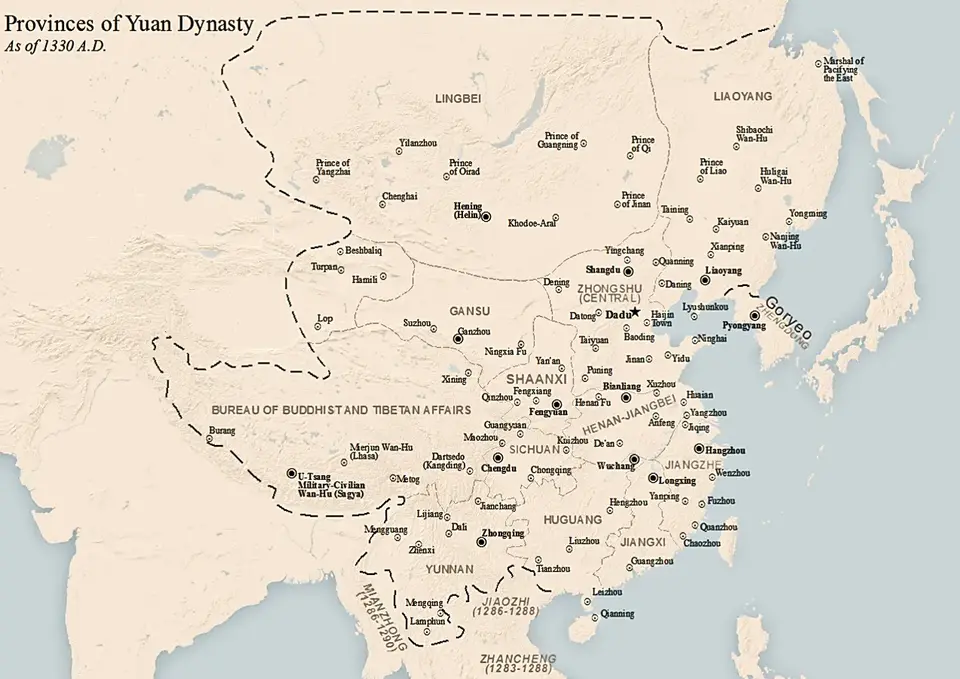
The Rise of Yuan Qu refers to the monumental artistic and literary movement between the mid-thirteenth and fourteenth centuries (from the Mongol conquest of the Jin dynasty through the late Yuan dynasty) that witnessed the flowering of Yuan Zaju drama and Sanqu poetry, establishing traditional Chinese theatrical art in its mature classical form. Following the Mongol destruction of the Jurchen Jin dynasty, severe ethnic stratification and the decades-long suspension of imperial examinations stripped Han literati of administrative careers, plunging them into the lower social strata. Disillusioned scholars coalesced in urban centers, forming professional literary guilds known as Shuhui alongside popular actors and musicians. Synthesizing the comedic conventions of Jin dynasty Yuanben with the modal music of Zhugongdiao ballads, these playwrights established a sophisticated four-act dramatic structure integrating northern qu-suites, colloquial spoken dialogue, and formalized physical pantomime. Celebrated masters—including Guan Hanqing, Bai Pu, Ma Zhiyuan, Zheng Guangzu, and Wang Shifu—penned immortal masterpieces such as Injustice to Dou E, Rain on the Wutong Tree, Autumn in the Han Palace, and Story of the Western Wing. Performing across metropolitan pleasure districts and rural temple stages, Yuan Qu dismantled the monopoly of elite poetry, marking the zenith of Chinese vernacular narrative literature.
The Mongol conquest of Jin drives literati into the marketplace, beginning the synthesis of Zaju.
Kublai Khan establishes Dadu; urban commercial revitalization triggers an unprecedented boom in Goulan theater.
Guan Hanqing composes Dou E Yuan at the Yujing Shuhui in Dadu, defining classical tragedy.
The fall of the Southern Song eliminates borders, prompting northern playwrights to migrate to Hangzhou.
Wang Shifu composes the twenty-one-act romantic epic Story of the Western Wing, elevating Zaju verse to its peak.
The restoration of examinations stimulates literary verse; masters Zhang Yanghao and Qiao Ji establish Sanqu poetry.
The performance troupe mural of Zhong Duxiu is painted in Hongtong, documenting rural temple performances.
The rise of the Ming dynasty establishes the transition from Zaju to Ming-Qing Chuanqi and Kunqu opera.
In the early thirteenth century, the expanding Mongol cavalry swept across northern China, conquering Western Xia and the Jurchen Jin dynasty, subjecting the Central Plains to decades of warfare and administrative disruption. In the wake of mass migrations and military subjugation, Jurchens, Khitans, Han Chinese, and diverse Central Asian populations were forced into close communal interaction across northern towns. The violent collapse of traditional bureaucratic institutions loosened classical Confucian orthodoxies, creating an urgent popular demand for vigorous, emotionally resonant vernacular artistic mediums capable of giving voice to grievances against ethnic subjugation, judicial corruption, and social injustice.
Following the initial devastation of conquest, northern urban centers such as Dadu, Zhending, and Pingyang regained commercial vigor under pax Mongolica. Commercial handicraft production and long-distance transport fostered a burgeoning mercantile and artisanal populace within walled metropolitan centers. Unlike imperial courtiers, this urban plebeian class favored entertaining, plot-driven, and emotionally evocative theatrical performances over classical elite verse. Commercial entertainment complexes known as Washe Goulan proliferated rapidly, transforming staged theatrical performances into an indispensable feature of urban daily life.
The Jin-Yuan interregnum unleashed catastrophic social fractures across northern China. The Mongol authorities imposed rigid ethnic hierarchies and draconian martial surveillance over the conquered sedentary population. In this oppressive social climate, classical court poetry and archaic prose grew divorced from popular life, while grassroots vernacular forms—including oral storytelling, street skits, and folk ditties—thrived among ordinary city dwellers.
Commoners enduring wartime dislocations and bureaucratic predation channeled their hopes into oral storytelling and musical performance. The comedic farces of the Jin dynasty and narrative ballads such as Master Dong's Western Wing Romance provided rich storehouses of northern melodies and dramatic plots. The convergence of popular dissatisfaction and mature vernacular forms provided the foundational soil from which Yuan Zaju drama would blossom.
The crucial catalyst that transformed popular entertainment into high theatrical art was the abrupt disinheritance of the northern scholar-official class. Following the fall of the Jin, the Mongol court suspended the imperial civil service examinations for nearly eight decades. Deprived of bureaucratic careers, scholars who had spent decades mastering classical texts were relegated to the lower tiers of society, classified in popular parlance as the ninth rank of Confucian scholars, barely above beggars.
Confronting destitution, educated scholars abandoned their traditional elitism and entered the bustling world of urban entertainment. Talented writers brought their mastery of poetic prosody, dramatic pacing, and philosophical introspection into the theatrical troupes of the marketplace. This infusion of literary craftsmanship elevated crude street skits into works of dramatic genius, propelling the rapid maturation of Yuan Zaju.
As literati settled into the urban marketplace, they formed collaborative creative guilds known as Shuhui alongside professional actors and book printers. Celebrated organizations like the Yujing Shuhui in Dadu and the Wulin Shuhui in Hangzhou operated as collaborative dramatic workshops. Playwrights proudly adopted the professional title of Shuhui talent, with masters such as Guan Hanqing, Bai Pu, and Ma Zhiyuan maintaining intimate professional ties with these guilds.
The Shuhui facilitated an organic partnership between scholarly playwrights and performing actors. Writers studied northern musical modes, stage choreography, and the vocal strengths of celebrated divas, tailoring dynamic scripts for specific performers. Actors gained refined, poetic scripts that drew wealthy audiences, while scholars saw their social critiques voiced across metropolitan stages. This mutual dependence commercialized and standardized theatrical production.
Urban theatrical life was centered upon commercial pleasure quarters known as Washe, within which operated enclosed performance spaces termed Goulan. In metropolitan hubs like Dadu, Zhending, Pingyang, Kaifeng, and Hangzhou, dozens of pleasure quarters operated simultaneously, with large Goulan theaters accommodating thousands of paying spectators. These permanent wooden structures featured elevated stages, surrounding covered gallery seating, and curtained backstage dressing areas.
Performances within the Goulan adhered to market dynamics. Theatrical troupes sold admissions, advertised star actors with painted placards, and competed fiercely for ticket revenues. To survive commercial competition, dramatists and actors refined their plots, incorporating dramatic cliffhangers, lively comic timing, and evocative dialogue. Theater-going evolved from an occasional aristocratic luxury into an everyday leisure habit of the urban middle class.
Structurally and musically, Yuan Zaju drama synthesized the traditions of Song-Jin theatrical skits and the narrative ballads known as Zhugongdiao. The comedic farces of the Jin dynasty, termed Yuanben, featured stock archetypes performing satirical dialogue and slapstick tumbling, but lacked sustained dramatic plots. Conversely, the Zhugongdiao tradition combined diverse musical modes to narrate extended epics through a single singer.
Yuan Zaju dramatists combined the physical stagecraft and character specialization of Jin Yuanben with the complex modal suites and extended narrative capacities of the Zhugongdiao. By transforming third-person recitation into first-person dramatic character embodiment, playwrights unified singing, spoken dialogue, dance movements, and dramatic action into a coherent theatrical medium, achieving the definitive transition from narrative song-recital to fully realized stage drama.
Through decades of creative staging, Yuan Zaju developed an architectural script template known as the four-act and wedge structure. Each zhe, corresponding to an act in Western theater, functioned as a self-contained narrative unit representing the traditional progression of dramatic action: exposition, rising action, climax, and resolution.
To bridge temporal gaps or introduce complex character backstories, dramatists inserted one or two brief scenes known as xiezi, or wedges. Comprising only one or two short musical arias, the wedge was deployed either at the opening of the play as a prologue or between major acts as a transitional scene. This formal architecture allowed dramatists to balance narrative tension while conforming to the temporal constraints of commercial stage scheduling.
Musically, Yuan Zaju operated under strict structural regulations. In each act, all arias belonged to a single musical mode, strung together into an extended suite of eight to twenty tunes adhering to a strict rhyme scheme that could not be modulated midway through the scene. Across the four acts, the musical suites utilized distinct modes—such as Xianlyugong, Zhengong, Zhonglyugong, and Nanlyugong—to mirror the psychological and dramatic arc of the story.
A distinctive feature of Zaju was its solo singing convention. In each production, all arias throughout the entire four acts were performed exclusively by a single lead character: either the male lead, in which case the play was classified as a zhengmo text, or the female lead, classified as a zhengdan text. Secondary roles spoke, pantomimed, and bantered, but never sang. This solo singing convention concentrated musical and emotional intensity within the primary protagonist, producing an impassioned vocal delivery.
Yuan Zaju achieved aesthetic sophistication through its triadic performance system of chang (singing), bai (dialogue), and ke (physical movement). The singing delivered the musical arias, expressing the deepest psychological motives of the lead character and establishing atmospheric mood. The dialogue, designated binbai, was spoken in vivid, idiomatic northern vernacular, incorporating colloquial street slang, Mongolian loanwords, and satirical humor that enlivened the dramatic narrative.
The term ke referred to formalized stage directions indicating physical actions, facial expressions, acrobatic stunts, and prop manipulations. These directions encompassed detailed movements such as stylized weeping or laughing, tumbling, spear combat, and folk choreographies like the village festival dance or hobbyhorse routines. The seamless fusion of vocal song, rhythmic dialogue, and stylized pantomime realized the traditional aesthetic canon of Chinese theater: no sound without music, no movement without dance.
As theater professionalized, character classification solidified into an articulated role-type hierarchy comprising mo, dan, jing, and za. The mo category encompassed adult male personas, dominated by the singing lead zhengmo, alongside secondary male archetypes such as young scholars, elderly patriarchs, and military officers. The dan category encompassed all female roles, anchored by the singing lead zhengdan, supported by coquettish courtesans, virtuous maidens, comic hags, and matrons.
The jing category, commonly known as painted-face characters, portrayed rough-hewn, villainous, or outrageously comic personalities, including tyrants, boisterous warriors, and corrupt magistrates. The za category accommodated auxiliary functional characters, including imperial officials, innkeepers, constables, and servants. This systemic categorization facilitated casting across varied repertories while providing dramatists with standardized archetypes for character development.
At the summit of the Dadu literary world stood Guan Hanqing, revered as the Crown of Yuan Drama. Styling himself the Patriarch of Playwrights, Guan immersed himself in the pleasure quarters and theatrical troupes of Dadu, composing over sixty plays, eighteen of which survive. His diverse oeuvre encompassed historical epics, courtroom investigations, domestic satires, and romantic comedies, consistently displaying solidarity with downtrodden social classes and victimized women.
His tragic masterpiece, The Injustice to Dou E (Dou E Yuan), represents the highest peak of classical Chinese realistic tragedy. The drama follows the innocent young widow Dou E, falsely framed for murder by the rogue Zhang Lyu'er and condemned to death by the venal magistrate Tao Wu. Facing execution, Dou E proclaims three supernatural oaths: that her warm blood shall splash upon the white banner without spilling on the ground, that snow shall fall in midsummer, and that three years of drought shall plague the district. In the climactic fourth act, her ghost sings searing arias indicting heaven and earth for failing to distinguish good from evil, creating an enduring anthem of social defiance.
Ranking alongside Guan Hanqing was Bai Pu, an eminent literatus who experienced the trauma of the Mongol conquest of Kaifeng during his childhood. Preserving his dignity as an uncompromised Jin loyalist, Bai Pu secluded himself from political office, pouring his talents into lyrical verse and dramatic composition. Among his sixteen dramas, Rain on the Wutong Tree (Wutong Yu) and Over the Wall and on the Horse (Qiangtou Mashang) achieved enduring fame.
Adapted from Bai Juyi's celebrated Song of Everlasting Sorrow, Rain on the Wutong Tree uses the drizzling autumn rain upon the wutong leaves as a haunting auditory motif, evoking the profound isolation and remorse of Emperor Xuanzong of Tang following the death of Consort Yang Guifei at Mawei. The concluding acts weave evocative scenery with grief, transforming dynastic catastrophe and personal loss into a poetic lamentation that defined the lyrical elegance of northern arias.
Celebrated as the Number One Lyricist, Ma Zhiyuan was a native of Dadu whose early bureaucratic ambitions were thwarted by the Mongol regime, leading him to withdraw into rural seclusion. He excelled in composing philosophical Daoist deliverance plays and patriotic historical tragedies, authoring fifteen dramas including Autumn in the Han Palace (Han Gong Qiu), while his twenty-eight-character qu-poem Autumn Thoughts was lauded as the crowning lyric of Chinese literature.
Autumn in the Han Palace reimagines the historical marriage of palace lady Wang Zhaojun to the Xiongnu chanyu. Ma Zhiyuan restructured the traditional narrative into a tragic indictment of imperial cowardice, portraying the Han court as paralyzed by barbarian threats and forcing the sovereign to surrender his beloved consort to prevent invasion. As Zhaojun casts herself into the northern river to preserve her honor and wild geese cry across the autumnal sky, the drama voices the grief of northern Chinese scholars subjugated under alien rule.
Representing the later flourishing of Zaju in southern China was Zheng Guangzu of Shanxi. An upright scholar who served as a petty clerk in Hangzhou, Zheng won the adoration of southern actors and literati, joining Guan Hanqing, Bai Pu, and Ma Zhiyuan as one of the Four Great Yuan Playwrights. He specialized in depicting the delicate psychology and romantic yearnings of young lovers, authoring eighteen plays anchored by The Ghostly Soul Leaves the Body (Qiannü Lihun).
Adapted from a Tang dynasty novella, the play depicts the maiden Zhang Qiannü, who falls desperately ill with lovesickness when her parents forbid her marriage to the traveling scholar Wang Wenju. In a flight of romantic imagination, her passionate soul detaches from her bedridden body and journeys across rivers and mountains to accompany her lover to the imperial examinations. This supernatural motif affirmed the supremacy of true romantic affection over repressive Confucian orthodoxy.
Among the dramatists of Dadu, Wang Shifu stood as a master of theatrical poetics. Dedicating his life to dramatic composition, Wang authored fourteen plays, dominated by his monumental masterpiece, the twenty-one-act five-volume romantic epic Story of the Western Wing (Xixiang Ji). The work broke through the traditional four-act format, achieving the supreme pinnacle of classical Chinese theatrical verse.
Story of the Western Wing chronicles the passionate romance between scholar Zhang Sheng and maiden Cui Yingying, facilitated by the maid Hongniang, mounting an assault on feudal arranged marriages and aristocratic class hierarchies. The drama is celebrated for its dazzling poetic texture and refined musical lyricism, producing immortal lines that depict autumn landscapes reflecting the sorrows of parted lovers. Its climactic affirmation—May all lovers under heaven be united in marriage—remains an enduring declaration of romantic freedom.
Dadu dramatist Ji Junxiang authored the monumental tragedy The Orphan of Zhao, a work of heroic sacrifice and generational vengeance. Drawing upon the Spring and Autumn annals and Sima Qian's Historical Records, the play dramatizes the slaughter of the Zhao clan by the villainous general Tu'an Gu and the selfless sacrifices of upright retainers Cheng Ying, Gongsun Chujiu, and Han Jue to preserve the infant orphan.
The dramatic tension builds inexorably through moral sacrifice: Gongsun Chujiu yields his life to protect the infant, while Cheng Ying endures decades of public infamy to raise the child to exact retribution. The work radiates heroic grandeur, demonstrating that classical Chinese drama possessed tragic depth. In the eighteenth century, the drama was translated into French by the philosopher Voltaire and adapted as The Chinese Orphan, winning acclaim across Enlightenment Europe.
Among the diverse thematic genres of Yuan Zaju, courtroom dramas occupied a prominent place. Under Mongol governance, the Chinese populace suffered under judicial corruption, discriminatory laws, and venal magistrates, leaving commoners without legal redress. Despairing of institutional justice, audiences sought catharsis in the fictional exploits of righteous, incorruptible magistrates who championed the vulnerable and punished villains.
In plays by Guan Hanqing such as The Butterfly Dream and The Rescuer of Lu Zhailang, the Northern Song historical official Bao Zheng was transformed into the legendary Judge Bao. As portrayed on the Zaju stage, Judge Bao was an unyielding hero who feared neither imperial princes nor corrupt officials, solving mysterious crimes and defending the defenseless. Courtroom dramas served as an emotional outlet for a subjugated people yearning for social equity and the rule of law.
Romantic comedies and domestic dramas formed an inspiring and progressive current within the Yuan Zaju repertoire. Challenging traditional arranged marriages and the subjugation of women, playwrights celebrated emotional autonomy and romantic fidelity. Beyond Western Wing, Guan Hanqing's Rescued by a Courtesan (Jiu Fengchen) introduced the quick-witted, valiant courtesan Zhao Pan'er, who uses her cunning to deceive an abusive rake and liberate her friend Song Yinzhang.
These dramas discarded traditional scholarly condescension toward courtesans and entertainers, portraying plebeian women as resourceful, courageous, and morally superior to the corrupt gentry. Confronting aristocratic abuse, these female protagonists seized control of their destinies through wit and solidarity, heralding an early dawn of humanist consciousness in Chinese popular literature.
Historical dramas drew heavily upon the heroic epics of the Three Kingdoms and the founding of the Tang dynasty. Living under alien domination, southern playwrights used the heroic past to voice contemporary patriotic anguish. Guan Hanqing's Going to the Feast with a Single Saber (Dan Dao Hui) stands as the supreme example, where the general Guan Yu sails across the turbulent Yangtze, singing of rushing waves carrying twenty years of heroic blood.
These historical dramas evoked the martial valor and moral integrity of ancient champions, offering an emotional outlet for Chinese subjects mourning the loss of national sovereignty. The widespread popularity of Three Kingdoms dramas on the Zaju stage provided the direct characterizations, battle choreography, and dramatic plots that novelist Luo Guanzhong would later synthesize into the foundational epic Romance of the Three Kingdoms.
During the early and middle Yuan period, Zaju drama flourished across three regional powerhouses: Pingyang, Zhending, and Dadu. Pingyang in southern Shanxi served as the earliest cradle of northern drama, where a vibrant printing industry and thriving theater guilds nurtured early playwrights such as Shi Junbao. Zhending in modern Hebei was a cultural metropolis where master Bai Pu composed his dramas alongside elite acting troupes.
Dadu, the imperial capital, functioned as the supreme nexus of theater culture. As the administrative, economic, and demographic center of the empire, the capital housed vast networks of commercial pleasure quarters that attracted playwrights and performing troupes from across China. Master dramatists Guan Hanqing, Wang Shifu, and Ma Zhiyuan converged in Dadu, transforming the metropolis into the vibrant creative laboratory of the theatrical golden age.
Yuan Zaju extended beyond urban commercial pleasure quarters into the rural agrarian countryside. In the Jinnan basin of southern Shanxi, eight authentic Yuan dynasty temple stages survive intact, including the Niuwang Temple Stage in Linfen and the Dongyue Temple Stage in Yicheng. These timber pavilions feature open-sided stages with hip-and-gable tile roofs, demonstrating sophisticated acoustical and structural engineering.
Within the Water God Hall of the Guangsheng Monastery in Hongtong, Shanxi, survives a magnificent full-color theatrical mural painted in 1324. Bearing the inscription "The Grand Traveling Troupe of Zhong Duxiu Performs Here," the mural depicts an eleven-member company of actors in makeup, robes, and headdresses, accompanied by drummers and flutists. During festivals and seasonal fairs, itinerant troupes toured rural temples, entertaining tens of thousands of farming households and proving that Zaju possessed deep roots in traditional community life.
In 1276, the Mongol armies conquered Lin'an, bringing an end to the Southern Song dynasty and reunifying the realm under the Yuan. The elimination of military frontiers enabled northern playwrights and actors to travel down the Grand Canal to the opulent cities of Jiangnan. Following the deaths of Guan Hanqing and Bai Pu, second-generation dramatists including Zheng Guangzu and Qiao Ji established themselves in Hangzhou, shifting the creative heart of Zaju from the Yellow River basin to the lower Yangtze.
Hangzhou offered a milder climate, denser urban populations, and a wealthy mercantile elite. In this southern milieu, northern arias softened, adopting lyrical polish and intricate musical ornamentation. Thematic concerns shifted toward domestic romances, scholar-beauty narratives, and elegant melancholy, inaugurating the transitional late phase of Zaju drama.
The southern migration of Zaju brought northern drama into creative contact with the indigenous dramatic tradition of the south, known as Nanxi, or southern drama. Originating in Wenzhou, Nanxi utilized pentatonic southern scales, featured alternate singing between characters, and operated without the rigid four-act constraints of Zaju. Stimulated by the sophisticated scripts and character specializations of Zaju, southern dramatists elevated Nanxi into an accomplished art form.
Gao Ming's late Yuan masterpiece, Tale of the Pipa (Pipa Ji), demonstrated that southern drama had equaled Zaju in psychological depth and literary majesty. The integration of northern and southern musical suites gave birth to the Chuanqi dramatic structure of the Ming dynasty, breaking the solo singing monopoly of Zaju and paving the way for the masterpieces of Tang Xianzu, Hong Sheng, and Kong Shangren.
Concurrent with the development of theater, the musical arias of Zaju generated an autonomous poetic genre known as Sanqu, or liberated verse. Unaccompanied by stage acting or spoken dialogue, Sanqu consisted of independent single stanzas called xiaoling and extended thematic suites called taoshu. Discarding the rigid tonal meters of Song lyrics, Sanqu welcomed colloquial idioms and padding syllables, producing verse characterized by playful candor, satire, and emotional vitality.
Brilliant masters shaped this genre: Guan Hanqing celebrated his indomitable spirit as an uncrushable bronze bean; Ma Zhiyuan evoked melancholy autumn scenes; and Zhang Yanghao composed the celebrated meditation on Tongguan Pass, mourning that whether dynasties rise or fall, the common people suffer. Sanqu joined Tang poetry, Song lyrics, and Yuan theater as a radiant peak in Chinese verse.
The theatrical and musical flourishing of the Yuan era was rooted in a multi-secular tradition of religious and ritual dance originating in the Han, Wei, and Tang dynasties. From Emperor Huan's Buddhist chants in the Eastern Han and sacred dances at Jingle Temple in Northern Wei, to the Xiliang and Khotan melodies of the Tang court, ritual dance had interacted with popular performing arts. Under the Yuan, imperial patronage of Tibetan Buddhism and shamanism stimulated the formalization of religious court pageantry.
The imperial protocol of the Yuan dynasty codified four ceremonial dance formations: the Music King Troupe for New Year audiences, the Longevity Star Troupe for imperial birthdays, the Ritual Music Troupe for state assemblies, and the Exposition of Dharma Troupe for Buddhist ceremonies. Each formation comprised ten sub-units integrating instrumentalists, ribbon dances, and floral drum routines, featuring performers arrayed as deities and guardian kings. The scale and stylized gestures of these court pageants directly enriched the physical vocabulary of theatrical stagecraft.
During the late Yuan, musical theater and palace choreography culminated inside the court of Emperor Huizong, Toghon Temür. Endowed with acoustic sensitivity and mechanical ingenuity, the emperor designed theatrical machinery and staged elaborate palace pageants. During the Zhizheng era, influenced by esoteric Buddhist rituals, he choreographed the celebrated Dance of the Sixteen Heavenly Demons.
The performance featured sixteen palace dancers wearing ivory tiaras, peacock-patterned brocades, and pearl necklaces, performing complex rhythmic steps while holding ritual instruments to the accompaniment of Tibetan horns and northern flutes. While court critics condemned the performance as decadence, the production exemplified the synthesis of multiethnic acoustic and choreographic traditions under the late Mongol court.
Across a century and a half of creative flourishing, Yuan Zaju and Sanqu were preserved in classical anthologies such as Selected Yuan Plays and The Supreme Sounds of Great Harmony. Ming and Qing scholars celebrated Yuan Qu alongside Han rhapsodies, Tang poetry, and Song lyrics, canonizing it as one of the four supreme achievements of classical Chinese literature. It permanently codified the traditional Chinese operatic paradigm of employing song and dance to enact a dramatic story within a stylized, symbolic stage environment.
The historical significance of Yuan Qu transcends literature. For the first time in Chinese civilization, it placed the voices, values, and democratic aspirations of ordinary citizens at the center of the cultural world. It shaped the ethical personality of the Chinese people, celebrating the triumph of justice, moral rectitude, and the defense of the vulnerable. Its dramatic architecture and vocal techniques nourished hundreds of regional operatic genres, serving as the living wellspring of China's classical theatrical heritage.
The Rise of Yuan Qu transformed the landscape of Chinese literature. It terminated the monopoly of courtly verse, elevating vernacular drama to the highest literary status. Over one hundred and sixty complete Zaju playscripts, thousands of Sanqu lyrics, and hundreds of extended musical suites survive to this day. It established the professional role-type system of mo, dan, jing, and za, formalizing the triadic stagecraft of singing, speech, and stylized movement across an extensive network of metropolitan theaters and rural temple pavilions.
Yuan Qu represents the definitive milestone marking the full maturity of classical Chinese theater and the flowering of multiethnic cultural synthesis. Aesthetically, it established the operatic canon of symbolic stage space and stylized character embodiment. Ethically, it infused Chinese theater with realistic social critique, championing justice, integrity, and individual romantic freedom. Institutionally, the conventions developed in Zaju provided the foundation from which Ming-Qing Chuanqi, Kunqu opera, and modern Peking Opera evolved, remaining an enduring monument of world theatrical art.