Liu Yuan's Uprising in Bingzhou
Liu Yuan rallies the five Xiongnu divisions at Lishi to establish the Han state, appointing Liu Yao as General of Establishing Martial Prowess.
Western Jin Dynasty (西晋) · HISTORICAL EVENT
刘曜灭西晋
Liu Yao's Destruction of the Western Jin (刘曜灭西晋) was a catastrophic dynastic transition war between 304 and 316 CE, in which the Han Zhao regime led by the Xiongnu aristocracy overthrew and completely annihilated the Western Jin dynasty. Following the disastrous sixteen-year War of the Eight Princes, the Western Jin imperial armed forces were decimated, the economy was ruined, and deep ethnic and social fractures erupted across the northern plains. The…
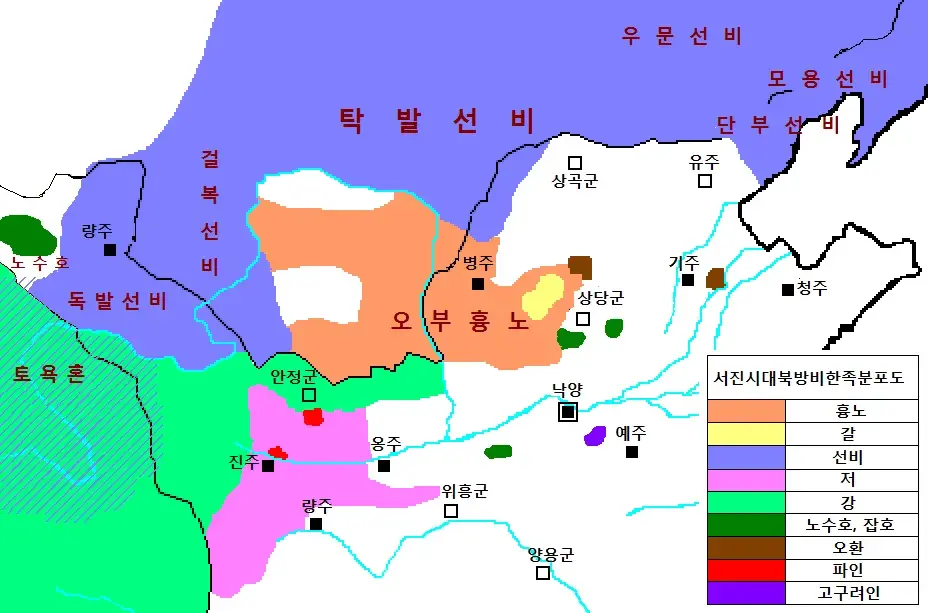
Liu Yao's Destruction of the Western Jin (刘曜灭西晋) was a catastrophic dynastic transition war between 304 and 316 CE, in which the Han Zhao regime led by the Xiongnu aristocracy overthrew and completely annihilated the Western Jin dynasty. Following the disastrous sixteen-year War of the Eight Princes, the Western Jin imperial armed forces were decimated, the economy was ruined, and deep ethnic and social fractures erupted across the northern plains. The Xiongnu leader Liu Yuan established the Han dynasty, whose armies campaigned relentlessly southward under commanders such as Liu Yao, Shi Le, and Wang Mi. In 311 CE, Shi Le annihilated the Western Jin court's last field army at Ningping City, after which Liu Yao and Huyan Yan captured the imperial capital of Luoyang and took Emperor Huai captive, an event known as the Disaster of Yongjia. In 316 CE, Liu Yao marched into Guanzhong and laid siege to Chang'an, where the youthful Emperor Min had maintained a desperate remnant court. Starved into submission, Emperor Min surrendered in humiliation, marking the formal collapse of the Western Jin. The catastrophe prompted the southward migration of the Chinese elite to establish the Eastern Jin in Jiangnan, while northern China entered more than a century of violent division during the Sixteen Kingdoms era.
Liu Yuan rallies the five Xiongnu divisions at Lishi to establish the Han state, appointing Liu Yao as General of Establishing Martial Prowess.
Liu Yuan assumes the imperial title and establishes his capital at Pingyang, while Liu Yao captures Huguan and pushes toward the Yellow River.
Liu Cong, Liu Yao, and Wang Mi lead fifty thousand cavalry to besiege Luoyang, but are forced to withdraw after rearguard engagements.
Following Liu Yuan's death, Liu Cong seizes power and appoints Liu Yao as General of Chariots and Cavalry and Shepherd of Yongzhou.
Shi Le destroys the main Jin field army at Ningping City; Liu Yao and Huyan Yan capture Luoyang and take Emperor Huai captive in the Disaster of Yongjia.
Emperor Huai is murdered in Pingyang; Sima Ye ascends the throne as Emperor Min in Chang'an, supported by Qu Yun and Suo Chen.
Liu Cong designates Liu Yao as Commander-in-Chief over the western provinces; Liu Yao crosses the Yellow River and reduces peripheral Jin garrisons.
Liu Yao captures Beidi and crushes the army of Qu Yun and Suo Chen at Quwo, laying direct siege to Chang'an.
Starved into submission after three months of siege, Emperor Min surrenders bare-chested to Liu Yao on December 17, ending the Western Jin.
Emperor Min is poisoned at Pingyang by Liu Cong; Sima Rui establishes the Eastern Jin at Jiankang, cementing the north-south division.
Following Emperor Wu's unification of the Three Kingdoms, the Western Jin abolished local commandery military garrisons to curb autonomous warlordism while enfeoffing imperial princes across the empire as a protective barrier for the throne. However, structural flaws in this feudal design combined with the mental incapacity of Emperor Hui enabled Empress Jia's usurpation, which ignited the devastating sixteen-year War of the Eight Princes. The conflict ravaged the central plains from Luoyang and Ye to Chang'an, leaving hundreds of thousands dead and major cities in ruins.
Prolonged civil war not only wiped out the accumulated wealth of previous decades but also depleted the central imperial guards and elite regional garrisons. Local governors and magistrates found themselves without troops or financial resources, rendering the central state apparatus entirely incapable of mounting an effective defense against rising external threats.
The Western Jin dynasty rested on a fragile coalition of powerful aristocratic families. After the Taikang reign, the ruling elite embraced extreme luxury and intellectual indulgence in Xuanxue pure talk (qingtan), neglecting governance and practical military administration. Prime ministers and grandees such as Wang Yan and Wang Rong occupied high offices while disdaining state affairs, paralyzing the government's capacity to address mounting economic distress and frontier instability.
Concurrently, large populations of Xiongnu, Jie, Di, and Qiang tribes who had settled in Guanzhong and Bingzhou were subjected to harsh exploitation and forced servitude by Jin officials. While scholars like Jiang Tong submitted memorials urging the relocation of non-Han tribes back to their ancestral homelands, the paralyzed Jin court failed to implement preventive measures, leaving ethnic tensions to escalate into open rebellion.
In 304 CE, during the climax of the War of the Eight Princes, Liu Yuan, the Senior Worthy Prince of the Left of the Southern Xiongnu, exploited the clashes between Prince Sima Ying and Sima Teng. Gathering the five divisions of the Xiongnu at Lishi, Liu Yuan claimed the title of King of Han and founded the Han Zhao dynasty. By claiming legitimate descent from the Han imperial line and honoring Liu Shan of Shu Han, he rallied diverse non-Han warriors and displaced Chinese refugees under a unified banner.
Among the prominent leaders of the rising state was Liu Yuan's clan nephew Liu Yao, known for his martial valor and classical erudition. Appointed General of Establishing Martial Prowess, Liu Yao became one of the core field commanders of Han Zhao. Alongside Jie chieftain Shi Le and Chinese refugee leader Wang Mi, the Han Zhao forces expanded rapidly across the Yellow River basin, pointing their spears directly at the Western Jin capital of Luoyang.
In the winter of 304 CE, Liu Yuan erected an altar south of Lishi to assume the royal mantle, proclaiming himself King of Han and adopting the reign era Yuanxi. Liu Yuan paid ritual homage to the imperial founders of the Han dynasty, aiming to secure ideological legitimacy among the Chinese populace. He distributed official appointments and designated Liu Yao as General of Establishing Martial Prowess to command frontline vanguard forces.
Sima Teng, the Western Jin Inspector of Bingzhou, gathered regional forces and fort militias to suppress the uprising. Liu Yao accompanied Liu Yuan in confronting the Jin armies at the Western River, crushing Sima Teng through ambush tactics. As Sima Teng retreated to Jinyang, Liu Yao swept through the Fen River valley, neutralizing Jin strongholds across the heartland of Bingzhou.
Sima Teng subsequently appealed to the Tuoba Xianbei chieftains Tuoba Yiduo and Tuoba Yilu for assistance. A massive force of Tuoba cavalry marched southward, inflicting a tactical setback on the Han forces at Xibi. Demonstrating coolness under pressure, Liu Yao personally commanded elite cavalry to fight a stubborn rearguard action in the narrow mountain passes, enabling Liu Yuan's main body to withdraw safely to Zuoguocheng.
Following the departure of the Xianbei cavalry, Liu Yuan adjusted his operational focus toward the middle and lower reaches of the Fen River. In 307 CE, Liu Yuan ordered Liu Yao and Liu Cong to spearhead a southward advance, capturing critical strategic hubs such as Fenyin and Puban, thereby expanding Han Zhao authority across southern Shanxi.
During these operations, Liu Yao enforced strict military discipline, prohibiting indiscriminate plundering and extending protection to displaced civilian populations. He recruited educated scholars into his staff and integrated fort chieftains who submitted peacefully. These policies secured the compliance of local magnates, consolidating Han Zhao control over the Hedong salient.
In 308 CE, Liu Yuan transferred his capital to Puzi and subsequently to Pingyang (modern Linfen, Shanxi). At Pingyang, Liu Yuan formally declared himself Emperor, inaugurating the Yongfeng era. Liu Yao was promoted to General Guarding the East for his distinguished service and tasked with preparing the general offensive against the Western Jin metropolitan district.
To open a clear corridor for the conquest of Luoyang, Liu Yuan dispatched Wang Mi as commander and Liu Yao as vice commander in the autumn of 308 CE to seize Huguan, the critical gateway at the southern extremity of the Taihang Mountains. Aware of Huguan's decisive terrain, the Jin court sent General Pacifying the North Wang Kan with several tens of thousands of imperial guards to relieve the garrison.
Liu Yao employed flanking mountain maneuvers, directing Wang Mi to fix the defenders in front while he led an elite detachment across steep mountain paths to strike the Jin rear. Caught in a coordinated vice, Wang Kan's army disintegrated, and the Han Zhao forces took the fortress by storm, slaying Jin commander Pang Chun and securing the Taihang approaches.
The fall of Huguan caused the entire eastern defense line to buckle. Administrative officials across Shangdang abandoned their posts, allowing Liu Yao to overrun Changzi and Tunliu before advancing to the north bank of the Yellow River. The Jin court was thrown into total panic, and Emperor Huai issued frantic decrees summoning provincial garrisons to march to the aid of the throne.
In the autumn of 309 CE, Liu Yuan resolved to mount a decisive thrust against the imperial capital. He appointed Liu Cong as supreme commander, Wang Mi as vanguard, and Liu Yao as commander of the rear echelons, mobilizing an elite force of fifty thousand cavalry and infantry across the Yellow River toward Luoyang.
The Han Zhao army overwhelmed peripheral Jin outposts, crossed the Dagu Pass, and deployed directly beneath the Xuan Yang Gate of Luoyang. Prince Sima Yue ordered the city gates shut and mounted an obstinate defense. Liu Cong and Liu Yao established fortified camps along the Luo River, deploying light cavalry to ravage the surrounding countryside and driving grain prices within the capital to catastrophic levels.
However, Han Zhao vanguard officer Huyan Hao overextended his lines during an engagement and was killed in an ambush by Jin general Pei Miao. Taking advantage of the shock, Jin troops launched a nighttime sortie against the Han camp, causing temporary confusion. Liu Yao restored order among the rearguard and checked the enemy's pursuit, allowing the Han forces to conduct an orderly withdrawal across the river.
Only two months after the retreat, Liu Cong and Liu Yao urged Liu Yuan to renew the offensive, arguing that Luoyang was isolated and near starvation. In the winter of 309 CE, Liu Yuan again dispatched Liu Cong, Liu Yao, and Wang Mi with tens of thousands of cavalry to assault the western approaches of Luoyang, breaking Jin resistance at Yiyang and advancing directly to the Ximing Gate.
The Jin court gathered its remaining palace guards under Wang Yan and Wang Kan to defend the walls. Jin officer Gao Bao led several hundred volunteers in a nocturnal counterattack against the siege lines. Recognizing that the garrison was fighting with desperation and that winter snows impeded logistic support, Liu Yao concurred with Liu Cong to suspend the assault and preserve their forces for a future campaign.
While these two preliminary sieges failed to capture the capital immediately, they stripped Luoyang of its outer garrisons and exhausted the empire's remaining emergency food stores. Internal discord within the Jin leadership reached a boiling point as Sima Yue grew increasingly paranoid of Emperor Huai, setting the stage for total systemic collapse.
In the autumn of 310 CE, the founder Liu Yuan fell gravely ill at Pingyang. On his deathbed, he entrusted state affairs to Liu Cong and Liu Yao while naming his eldest son Liu He as successor. However, Liu He instigated a violent palace purge against his brothers, executing Liu Yu and besieging Liu Cong's garrison, plunging Pingyang into civil warfare.
Liu Cong responded swiftly, and Liu Yao led his personal veterans into the capital to crush the conspirators, executing Liu He and Liu Rui. The ministers acclaimed Liu Cong as the new Emperor. Recognizing Liu Yao's decisive role, Liu Cong elevated him to General of Chariots and Cavalry, Specially Advanced with Equal Prestige to the Three Excellencies, and Shepherd of Yongzhou, enfeoffing him as Prince of Zhongshan.
With his appointment as Shepherd of Yongzhou, Liu Yao was entrusted with supreme military direction over the Western Jin campaign. Moving his forces west of the Yellow River, Liu Yao swept through Jin positions along the riverbank, crushing Jin general Song Chou at Xiangling and severing communication between Luoyang and the western garrisons of Guanzhong.
By late 310 CE, the rift between Emperor Huai and Prince Sima Yue became irreparable. Fearing that the Emperor intended to have him eliminated, Sima Yue evacuated the entire elite palace garrison from Luoyang under the pretext of campaigning against Shi Le, concentrating his forces at Xiangxian. Luoyang was left virtually undefended, guarded only by a handful of aged palace retainers.
In March 311 CE, Sima Yue succumbed to illness and stress at Xiangxian. Grand Commander Wang Yan concealed the prince's death and attempted to lead the massive assembly of over two hundred thousand soldiers and aristocrats eastward toward the Prince of Donghai's fief. The retreating column was encumbered by baggage trains and completely lacked tactical cohesion.
In April, Han Zhao general Shi Le pursued the retreating host with elite cavalry, surrounding them at Ningping City in Ku County (modern Luyi, Henan). Shi Le ordered his archers to envelop the massed Jin troops and unleash continuous volleys. Trapped and disoriented, the Jin troops trampled one another in utter panic, resulting in the annihilation of the entire army. Wang Yan and dozens of princes and grandees were captured and executed, destroying the last mobile field army of the Western Jin.
News of the massacre at Ningping sent shockwaves through Luoyang. In May 311 CE, Han Zhao vanguard general Huyan Yan breached twelve protective stockades outside the capital and burned the Xuan Yang Gate. In June, the main armies under Liu Yao and Wang Mi converged outside the city walls, launching an all-out assault with scaling ladders.
The Han Zhao troops breached the defenses and poured through the Xuan Yang and Ximing Gates. Emperor Huai attempted to escape in disguise through the Hualin Garden toward Chang'an but was captured by Han Zhao scouts. Liu Yao established his headquarters in the Southern Palace and ordered the systematic firing of imperial shrines, ancestral halls, and palaces, while ransacking the imperial mausoleums for treasure.
Crown Prince Sima Quan, Prince Sima Yan, and more than thirty thousand court officials and residents were massacred in the streets. The cultural and political capital of the Western Jin was reduced to ashes, and the imperial administration across the Yellow River basin ceased to exist, an event recorded in history as the Disaster of Yongjia.
Following the sacking of Luoyang, Liu Yao escorted Emperor Huai and the captured imperial regalia to Pingyang. To flaunt his triumph, Liu Cong nominally granted Sima Chi the title of Duke of Kuaiji while subjecting him to public mockery and ritual degradation to extinguish the symbolic authority of the Jin dynasty.
On New Year's Day in 313 CE, Liu Cong hosted an imperial banquet for his nobility and ordered the former Jin Emperor to dress in coarse servant attire and serve wine to the assembled Xiongnu lords. Watching their sovereign endure such humiliation, former Jin officials Yu Min and Wang Juan broke into loud weeping. Enraged by this display of continued loyalty, Liu Cong ordered the execution of Yu Min and dozens of former Jin ministers.
Shortly thereafter, in February 313 CE, Liu Cong secretly poisoned Emperor Huai in his quarters at the age of thirty, along with Empress Liang. With Emperor Huai's demise, the primary lineage of the Western Jin imperial house was extinguished in northern China.
Following the fall of Luoyang, loyalist officials Yan Ding and Jia Pi escorted Prince Sima Ye across the western passes to Chang'an. In 313 CE, upon confirmation of Emperor Huai's death, the thirteen-year-old Sima Ye ascended the throne as Emperor Min, changing the reign era to Jianxing. He appointed Qu Yun as Left Vice Director of the Imperial Secretariat and Suo Chen as General of the Guards to manage the precarious remnant state.
However, the Guanzhong region had been devastated by repeated famines, droughts, and military incursions. Chang'an was reduced to a ghost city with fewer than a hundred surviving households. Officials attending court wore rough garments woven from rushes instead of formal ceremonial robes, and the imperial treasury possessed neither grain nor textiles.
The young Emperor subsisted on fermented mash and dregs. Local fortress commanders in the surrounding hills preserved their own resources and ignored imperial levies. Meanwhile, regional grandees such as Sima Rui in Jiangnan and Wang Jun in Youzhou prioritized their own spheres of influence, leaving Chang'an an isolated, defenseless island.
Having secured the central plains, the Han Zhao leadership directed its military forces toward eliminating the remnant court in Chang'an. In 314 CE, Liu Cong appointed Liu Yao as Commander-in-Chief over the Military Affairs of Yong, Liang, Yi, and Liang Provinces, placing a massive army under his command to subjugate Guanzhong.
Liu Yao crossed the Yellow River at Puban and advanced into Fengyi and Fufeng. Jin chancellor Qu Yun assembled the remaining ten thousand troops in Chang'an to intercept him at Qingping and Lingwu. Employing superior tactical maneuvering, Liu Yao shattered Qu Yun's lines, forcing him to fall back on Beidi.
Subsequently, Liu Yao laid siege to Qiancheng, defended by Jin general Qu Chang. By defeating relief forces in the open field, Liu Yao captured the fortress and severed Chang'an's vital communication lines with Hanzhong, Sichuan, and Liangzhou, stripping the remnant imperial regime of all strategic depth.
Rather than undertaking an immediate frontal assault on the massive walls of Chang'an, Liu Yao implemented a policy of systematically reducing outlying fortifications and winning over the non-Han tribes of northern Guanzhong. In early 315 CE, he campaigned across Shangjun and Anding, targeting anti-Han resistance forces.
The Di and Qiang tribes of the region, long alienated by Jin misrule, responded readily to Liu Yao's overtures. Liu Yao granted them fiscal remissions, recognized their tribal leadership, and took hostaged sons into his retinue. Within months, tens of thousands of tribal families submitted to his authority.
Liu Yao incorporated these experienced tribal horsemen into his frontline cavalry regiments, augmenting his offensive power. As a result, the northern and western flanks of Guanzhong were firmly integrated into Han Zhao territory, compressing the effective territory of the Jin court to the immediate environs of Chang'an.
In the autumn of 316 CE, Liu Yao launched his final offensive against Chang'an. He led his elite corps to surround Beidi, the most critical defensive bulwark protecting the capital from the north. Beidi administrator Qu Chang dispatched urgent couriers to Chang'an begging for relief. In deep distress, Emperor Min ordered Qu Yun to lead every available soldier north to break the siege.
However, the relief force possessed virtually no provisions, and soldiers were reduced to foraging for weeds and tree bark on the march. Informed of Qu Yun's advance, Liu Yao deployed light cavalry to sever the Jin army's supply lines and laid ambushes along the valley defiles.
Upon reaching the outskirts of Beidi, rumors that their rear was cut off spread panic through the starving Jin ranks. Qu Yun's army disintegrated without an engagement, and Qu Chang fled on horseback back to the capital. The fall of Beidi eradicated the Western Jin's final northern defense line.
Capitalizing on his triumph, Liu Yao pressed forward to Quwo, situated only a hundred li northwest of Chang'an. Realizing that the end was near, General Suo Chen rallied several thousand remaining palace defenders at Quwo to make a desperate stand along fortified trenches.
In September 316 CE, the Battle of Quwo commenced. Liu Yao personally beat the war drums on the frontline and ordered his armored cavalry to charge the Jin flanks. During the ferocious melee, Liu Yao's men killed Jin general Liang Su, causing the entire Jin line to collapse. Suo Chen barely escaped with his life back into Chang'an.
With the victory at Quwo, all resistance in Guanzhong collapsed. Liu Yao marched his army to the outskirts of Chang'an, encamping at Panxi. Dozens of surrounding fort commanders surrendered without a fight, presenting cattle and grain. Liu Yao's forces quickly established an impenetrable ring of circumvallation around the walls of Chang'an.
From August to November 316 CE, Chang'an remained under complete blockade by Liu Yao's forces for three grueling months. What little grain remained inside the city was exhausted in days, and an extraordinarily bitter winter descended upon the Guanzhong plain. Not a single cart of food or relief soldier could enter the city.
Horrific famine engulfed the besieged population. In their desperation to survive, soldiers and civilians dug for roots, hunted rats, and boiled leather saddles, bowstrings, and armor before resorting to cannibalism. Over half of the city's inhabitants died of starvation, their corpses littering the thoroughfares, while the survivors were too weak to bear arms.
Although Qu Yun and Suo Chen continued to inspect the battlements, the defenders were entirely incapable of mounting a counterattack. The collapse of the city was imminent, and the Western Jin court had reached the end of its historical journey.
On December 11, 316 CE (the eleventh day of the eleventh month in the fourth year of Jianxing), the sixteen-year-old Emperor Min wept openly before his courtiers, declaring that he could not allow the entire populace to perish as bleached bones on his account. He resolved to surrender and sent Attendant Gentleman Zong Chang to deliver his formal capitulation to Liu Yao's camp.
On December 17, the gates of Chang'an were thrown open. Emperor Min rode out in a modest sheep-drawn cart, bare-chested with a jade bi disc held in his mouth, followed by attendants bearing an empty coffin to symbolize absolute submission. He knelt before Liu Yao's headquarters to surrender the state.
Liu Yao received the jade disc, burned the coffin, and untied the sovereign, treating Emperor Min with diplomatic courtesy. Han Zhao forces entered Chang'an, confiscating the imperial seals, ceremonial regalia, and dynastic archives. Fifty-two years after its founding by Sima Yan in 265 CE, the Western Jin dynasty ceased to exist.
After securing Chang'an, Liu Yao took custody of Emperor Min, Qu Yun, Suo Chen, and other ministers to send them under guard to Pingyang. On the journey north, the officials met contrasting fates that mirrored their conduct during the siege.
Prior to the capitulation, Suo Chen had secretly sent his son to Liu Yao offering to betray the city in exchange for a promise of high office. Despising such disloyalty, Liu Yao publicly denounced Suo Chen upon entering Chang'an and had him executed as a traitor in Pingyang.
Qu Yun was brought before Liu Cong at Pingyang. Overcome by grief at the ruin of his state and the humiliation of his sovereign, Qu Yun threw himself onto the ground and wept bitterly before hanging himself in detention that night. Moved by his steadfast loyalty, Liu Cong ordered him buried with full ministerial honors.
At Pingyang, Liu Cong reduced Emperor Min to the rank of Grand Master for Splendid Happiness and Marquis of Huai'an. For over a year, the young Sima Ye was subjected to the same systematic degradation that his uncle Emperor Huai had endured.
Whenever Liu Cong went hunting, he forced Sima Ye to dress in soldier's armor and run ahead of his chariot as a herald. During imperial banquets, Sima Ye was ordered to wash drinking cups and pour wine for Xiongnu nobles, and even to hold an umbrella over Liu Cong when he visited the latrine. Observing this tragedy, former Jin official Xin Bin wept aloud while embracing the former Emperor, whereupon Liu Cong had Xin Bin executed on the spot.
In January 318 CE (the twelfth month of the fifth year of Jianxing), rumors of rescue attempts by Jin loyalists spread through Pingyang. Deeming Sima Ye too dangerous to keep alive, Liu Cong dispatched an assassin with poisoned wine to execute the eighteen-year-old sovereign. With his murder, the male imperial lineage of the Western Jin was entirely wiped out in the north.
Liu Yao's conquest of Chang'an elevated the Han Zhao dynasty to its zenith of territorial extent. In 318 CE, following Liu Cong's death and the Jin Zhun rebellion in Pingyang, Liu Yao advanced from Chang'an to put down the rebellion, ascending the imperial throne at Chibi, renaming the state Zhao, and establishing Chang'an as his imperial capital (known historically as Former Zhao).
However, the unified northern realm created by Liu Yao's conquest did not endure. Shi Le proclaimed his independence at Xiangguo, founding the Later Zhao dynasty and initiating a protracted struggle between east and west. In 328 CE, Liu Yao was defeated, captured, and executed by Shi Le at Luoyang, and the Former Zhao was absorbed by Later Zhao, plunging northern China into even deeper cycles of conflict among the Sixteen Kingdoms.
Liu Yao's destruction of the Western Jin terminated Sima rule across northern China. Between Sima Yan's founding in 265 CE and Emperor Min's surrender in 316 CE, the Western Jin lasted fifty-two years, enjoying unified rule for barely a decade. The fall of Luoyang and Chang'an obliterated the classical political and cultural institutions of the central plains, reducing the Yellow River basin to prolonged chaos and social retrogression.
The catastrophe triggered the mass southward exodus of northern aristocratic families and commoners across the Yangtze River, known historically as the Crossing of the Clothes and Caps. Prince Sima Rui, supported by southern and northern émigré clans led by Wang Dao and Wang Dun, reestablished the Jin dynasty at Jiankang (modern Nanjing) as the Eastern Jin. This transfer introduced northern agricultural techniques, labor, and administrative traditions to the south, accelerating the economic development of Jiangnan and establishing a unique balance of power between the throne and aristocratic lineages.
The elimination of the Western Jin removed the central geopolitical anchor in the north. Although Han Zhao triumphed, internal ethnic rivalries and military competition led to Shi Le's establishment of Later Zhao, which eventually destroyed Han Zhao. Diverse non-Han tribal leaders established competing regional states across the Yellow River basin, inaugurating the tumultuous Sixteen Kingdoms era. Over the course of more than a century of conflict and coexistence, intense spatial restructuring and cultural assimilation laid the demographic and institutional foundations for the eventual reunification of China under the Northern Wei, Sui, and Tang dynasties.