Loss of Jingzhou and Death of Guan Yu
Sun Quan seizes Jingzhou through Lu Meng's surprise raid; Guan Yu is executed at Maicheng.
Cao Wei (曹魏) · HISTORICAL EVENT
夷陵之战
The Battle of Yiling was a momentous strategic confrontation fought between 221 and 222 between the newly established state of Shu Han and the regime of Eastern Wu during the Three Kingdoms Period. Triggered by Sun Quan's stealth invasion of Jingzhou and the death of Guan Yu in 219, Emperor Liu Bei of Shu Han rejected diplomatic counsel and mobilized his national forces to wage an eastern punitive expedition. Eastern Wu general Lu Xun was appointed Grand…
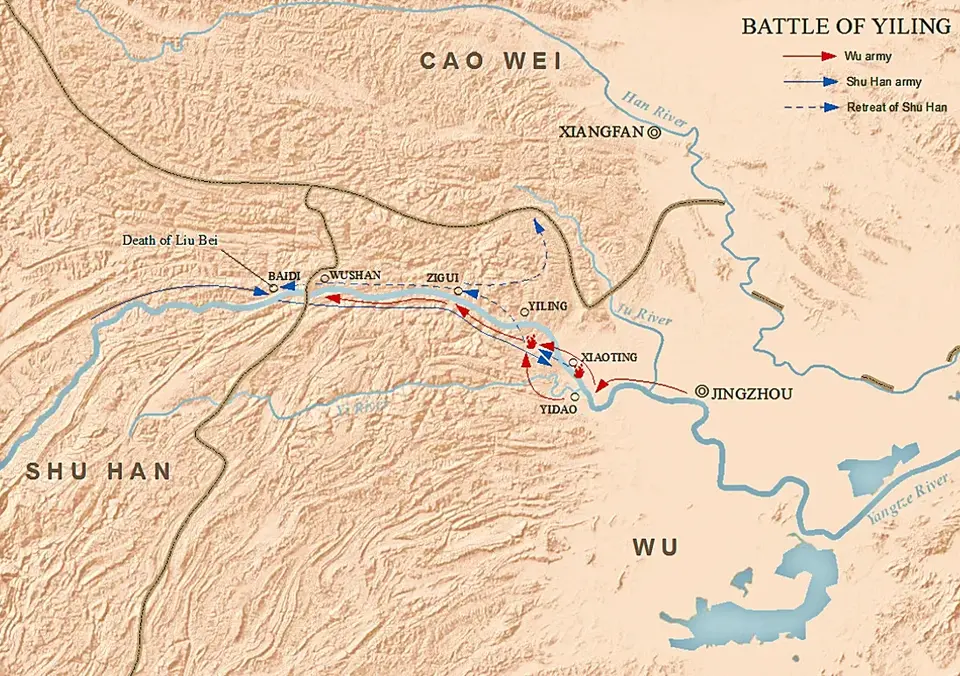
The Battle of Yiling was a momentous strategic confrontation fought between 221 and 222 between the newly established state of Shu Han and the regime of Eastern Wu during the Three Kingdoms Period. Triggered by Sun Quan's stealth invasion of Jingzhou and the death of Guan Yu in 219, Emperor Liu Bei of Shu Han rejected diplomatic counsel and mobilized his national forces to wage an eastern punitive expedition. Eastern Wu general Lu Xun was appointed Grand Commander to resist the invasion. Adopting an asymmetric defensive doctrine, Lu Xun retreated into the Yangtze gorge defiles, refusing battle for months until summer heat exhausted the invaders. Observing that Liu Bei had dispersed his encampments along seven hundred li of dense woodlands, Lu Xun launched a coordinated fire counteroffensive in July 222 that incinerated the Shu camps and destroyed their army. The catastrophic defeat crippled Shu Han's geopolitical power, forcing a diplomatic reconciliation with Wu and definitively solidifying the Three Kingdoms stalemate.
Sun Quan seizes Jingzhou through Lu Meng's surprise raid; Guan Yu is executed at Maicheng.
Liu Bei crowns himself emperor in Chengdu and decrees a total invasion of Eastern Wu despite internal objections.
Zhang Fei is assassinated; Liu Bei captures Zigui and enlists Wuling indigenous auxiliaries under Shamoke.
Sun Quan appoints Lu Xun as Grand Commander of fifty thousand troops to direct the defensive campaign.
Liu Bei attempts to bait Wu forces into ambushes; Lu Xun maintains defensive positions behind fortifications.
Lu Xun executes a devastating fire attack against Shu's connected camps, crushing the invasion and driving Liu Bei into Baidicheng.
Following the Battle of Red Cliffs in 208, Liu Bei secured southern Jingzhou, conquered the fertile Sichuan basin in 214, and captured Hanzhong in 219. This strategic expansion realized the initial phase of Zhuge Liang's Longzhong Plan, which envisioned launching a coordinated pincer offensive against Cao Wei simultaneously from northern Sichuan and eastern Jingzhou. However, Jingzhou commanded the middle reaches of the Yangtze River, controlling the vital gateway to Eastern Wu. Sun Quan viewed Shu's presence in Jingzhou as an unacceptable security threat to his dynastic survival.
In 219, Guan Yu launched the Battle of Fancheng, routing Cao Cao's northern armies and threatening the central plains. Exploiting Guan Yu's distant commitment, Sun Quan dispatched Lu Meng to execute a surprise crossing of the Yangtze disguised as civilian merchant convoys. The Wu forces captured the provincial base of Jiangling, cutting Guan Yu's supply lines. Encircled at Maicheng, Guan Yu was captured and executed, transferring total control of Jingzhou to Eastern Wu.
Guan Yu's loss devastated Shu Han, depriving the regime of its foremost general and severing the eastern axis of Zhuge Liang's grand strategy. Following Cao Pi's usurpation of the Han throne in 220, Liu Bei ascended the imperial throne in Chengdu in 221, proclaiming the restoration of the Han Dynasty. Despite passionate memorials from senior commanders Zhao Yun and Zhuge Liang urging that northern Cao Wei was the true imperial enemy, Liu Bei remained determined to reclaim Jingzhou and avenge his sworn brother. Before the campaign commenced, general Zhang Fei was assassinated in Langzhong by mutinous subordinates who defected to Wu, compounding Shu's strategic vulnerabilities before the expedition reached the gorges.
Seeking to avoid a perilous two-front conflict against both Shu and Wei, Sun Quan adopted a pragmatic diplomatic approach. He sent formal embassies to Cao Wei offering formal vassalage and accepting the title of King of Wu, while dispatching diplomatic envoys to negotiate a peace settlement with Liu Bei. When Liu Bei furiously rejected all diplomatic overtures, Sun Quan committed his full western army to total defense.
In July 221, Liu Bei led an expeditionary force of over forty thousand veteran troops down the Yangtze River, placing commanders Wu Ban, Feng Xi, and Zhang Nan at the vanguard. The Shu forces broke through the Wu frontier defenses along the Wu Mountain defiles, capturing Zigui and driving Wu border garrisons back toward Yiling. Concurrently, Liu Bei dispatched diplomat Ma Liang to forge a tribal alliance in the Wuling mountains, enlisting King Shamoke and ten thousand fierce indigenous auxiliary warriors.
To counter the offensive, Sun Quan appointed thirty-nine-year-old general Lu Xun as Grand Commander, granting him imperial authority over veteran generals including Zhu Ran, Pan Zhang, Han Dang, and Xu Sheng. The veteran commanders initially resented being subordinated to a younger scholar-general. Lu Xun asserted his authority through strict military discipline, warning that imperial survival depended entirely upon unified execution of command.
In February 222, Liu Bei advanced his main headquarters to Xiaoting, situated at the eastern mouth of the Yangtze gorges. Attempting to draw the Wu defenders into an immediate set-piece battle, Liu Bei deployed several thousand infantry in open lowlands while concealing eight thousand elite troops in nearby mountain ravines. Lu Xun recognized the ambush and strictly forbade his forces from taking the bait, ordering his army to remain behind fortified positions. Observing that the Shu army was fighting downhill with high initial momentum, Lu Xun resolved to trade space for time, ceding hundreds of li of rugged mountain terrain to lure Liu Bei deep into an extended logistical funnel.
The opposing armies remained locked in a tense standoff at Xiaoting through spring and into early summer. As months passed without battle, the Shu forces grew demoralized and exhausted by the oppressive climate within the enclosed gorges. By June 222, scorching summer heat swept through the river valleys. Unable to endure the sweltering heat aboard river transports, Liu Bei ordered his naval forces ashore, abandoning his river fleet and dispersing over forty separate encampments along seven hundred li of shaded forest canopy and ravine streams.
In Luoyang, Emperor Cao Pi of Wei observed Liu Bei's deployment and predicted immediate disaster, remarking that stringing out military encampments across hundreds of li through dense woodland violated elementary military doctrine. In the front lines at Xiaoting, Lu Xun recognized that his opportunity had arrived. The dispersed Shu camps were mutually isolated by rugged terrain, rendered immobile by seasonal exhaustion, and constructed primarily of dry timber.
In late June, Lu Xun conducted an exploratory assault on a single Shu outpost to confirm enemy tactical dispositions. Confident in his assessment, Lu Xun ordered a coordinated fire offensive. On a dry, windy night, Wu soldiers carrying bundles of resin-soaked reeds infiltrated the perimeter of the Shu camps, setting fire to the outer palisades from multiple directions simultaneously.
Driven by strong valley winds, walls of fire swept through the Shu encampments. The forested slopes transformed into an inferno. Trapped in dense smoke and blinding flames, the Shu troops descended into catastrophic panic. Lu Xun unleashed his general counteroffensive: Zhu Ran severed the Shu retreat from the north bank, Han Dang and Xu Sheng attacked the frontal defenses, and Pan Zhang ambushed fleeing remnants along the river. The Shu defense line disintegrated entirely.
Shu vanguard commanders Feng Xi and Zhang Nan were killed in fierce close combat, while tribal king Shamoke was slain in the rout. Over forty camps were reduced to ash, and tens of thousands of Shu soldiers were slaughtered or drowned in the Yangtze. Liu Bei rallied remnant detachments atop Mount Ma'an, where Lu Xun directed a fierce four-sided assault that shattered the last defensive perimeter. In a desperate rear-guard action, loyal officer Fu Rong refused all surrender demands and fought to the death. Liu Bei escaped under cover of darkness, ordering his men to burn military wagons and discard armor along narrow mountain trails to block pursuing Wu cavalry. Escorted by general Zhao Yun's relief force from Jiangzhou, Liu Bei took refuge inside Baidicheng. On the northern bank, general Huang Quan found his retreat blocked by Wu forces and surrendered to Cao Wei, concluding the total destruction of Shu's field army.
The Battle of Yiling fundamentally altered the political and military landscape of the Three Kingdoms era. Shu Han suffered a catastrophic blow from which it never fully recovered. Tens of thousands of veteran soldiers and virtually the entire mid-generation officer corps perished, while immense reserves of military equipment and logistical stores were lost. The defeat permanently extinguished Shu Han's ability to contest Jingzhou, permanently invalidating the two-pronged invasion envisioned in the Longzhong Plan and trapping the dynasty behind the mountainous perimeter of Sichuan.
Deeply humiliated and heartbroken, Liu Bei remained at Baidicheng where he fell gravely ill. In April 223, on his deathbed at the Palace of Everlasting Peace, Liu Bei entrusted the care of his state and young heir Liu Shan to Chancellor Zhuge Liang. Recognizing that Cao Wei remained the primary existential adversary, Zhuge Liang dispatched diplomat Deng Zhi to re-establish the historic Shu-Wu alliance. Facing impending invasions from Cao Pi, Sun Quan accepted the alliance, inaugurating decades of mutual diplomatic and military cooperation.
Geopolitically, the Battle of Yiling marked the conclusion of the early Three Kingdoms wars of rapid conquest. Along with the Battle of Guandu and the Battle of Red Cliffs, Yiling established an enduring territorial equilibrium. With the strategic boundaries between Wei, Shu, and Wu permanently drawn along natural barriers, the tripartite division of China was locked into an unalterable geopolitical reality lasting for generations.
Traditional historians and military strategists have universally celebrated the Battle of Yiling as an exemplary masterpiece of strategic patience and battlefield deception. Chen Shou in the Records of the Three Kingdoms lauded Lu Xun for adapting fluidly to changing circumstances, equating his strategic insight to that of Sun Tzu.
In the Comprehensive Mirror for Aid in Governance, Sima Guang commended Lu Xun for withstanding internal factional pressure and striking only when the enemy's logistical and physical vulnerabilities were totally exposed. Philosopher Wang Fuzhi noted that Liu Bei allowed personal grief to blind his strategic judgment, resulting in the comprehensive destruction of the Han restoration cause.
Modern military historians analyze Yiling as an archetypal model of operational transition from defensive absorption to offensive annihilation. Lu Xun's operational foresight, exploitation of seasonal climate, and decisive use of incendiary weapons firmly established his reputation as one of the preeminent military strategists in ancient Chinese history.