Uprising of Zhao Sanduo at Jiangjiazhuang
Plum Blossom Boxing master Zhao Sanduo adopted the name Yihe Boxers and raised the banner of "Aid the Qing and Destroy the Foreigners" in Guan County, inaugurating the Boxer movement.
Qing Dynasty (清朝) · HISTORICAL EVENT
义和团运动
The Boxer Rebellion (义和团运动) was a massive anti-imperialist and patriotic peasant movement that erupted across northern China between 1898 (twenty-fourth year of Guangxu) and 1901 (twenty-seventh year of Guangxu). Following China's catastrophic defeat in the First Sino-Japanese War, Western imperialist powers triggered a frenzy to carve out spheres of influence. Foreign Christian missionary organizations abused extraterritorial privileges to shield…
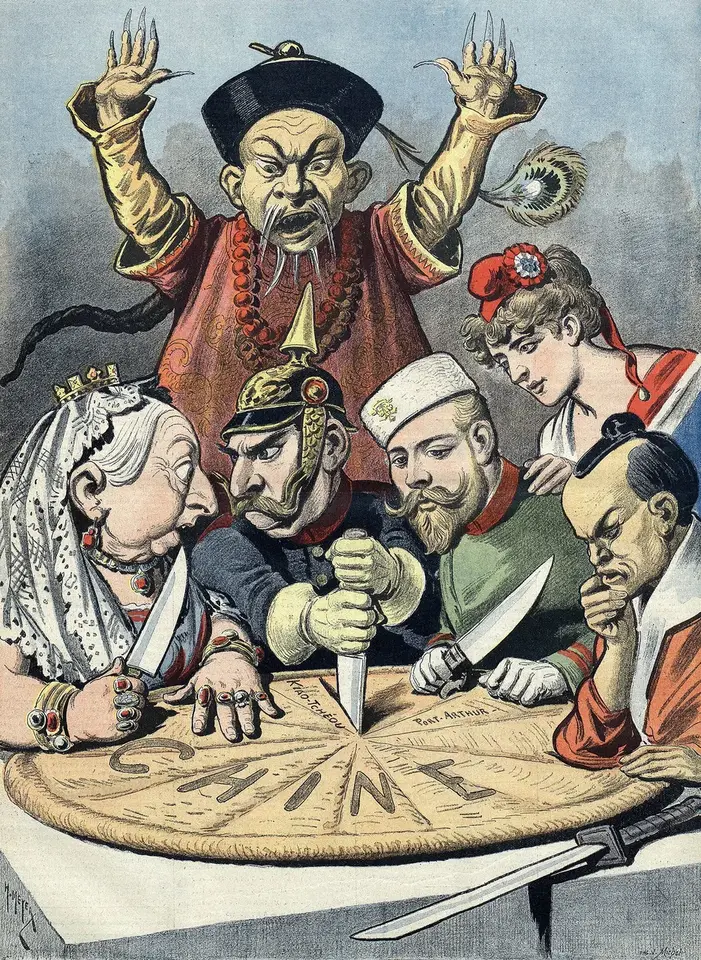
The Boxer Rebellion (义和团运动) was a massive anti-imperialist and patriotic peasant movement that erupted across northern China between 1898 (twenty-fourth year of Guangxu) and 1901 (twenty-seventh year of Guangxu). Following China's catastrophic defeat in the First Sino-Japanese War, Western imperialist powers triggered a frenzy to carve out spheres of influence. Foreign Christian missionary organizations abused extraterritorial privileges to shield delinquent converts and meddle in provincial litigation, severely aggravating civil-religious tensions. Simultaneously, catastrophic consecutive droughts devastated northern agricultural communities, driving millions of bankrupt peasants and urban laborers toward armed insurrection. The movement originated in western Shandong under leaders such as Zhao Sanduo and Zhu Hongdeng, adopting the rallying banner of "Support the Qing and Destroy the Foreigners." It rapidly spread across Zhili, Beijing, Tianjin, and parts of Manchuria. Facing domestic and external crises, the Qing court vacillated between suppression and appeasement, before Empress Dowager Cixi resolved to harness the Boxers to confront the foreign powers, formally declaring war against eleven foreign nations. Boxer fighters and patriotic Qing forces fought tenaciously in the Langfang Victory and the Defense of Tianjin, inflicting heavy casualties on the invading Eight-Nation Alliance. However, the Qing court betrayed the movement under joint domestic and foreign pressure, leading to the fall of Beijing, the flight of the imperial court, and the signing of the humiliating Boxer Protocol. Despite its ultimate defeat, the rebellion shattered imperialist designs to partition China and accelerated the collapse of the Qing dynasty.
Plum Blossom Boxing master Zhao Sanduo adopted the name Yihe Boxers and raised the banner of "Aid the Qing and Destroy the Foreigners" in Guan County, inaugurating the Boxer movement.
Zhu Hongdeng defeated Qing forces at Pingyuan Mound, prompting Governor Yu Xian to officially recognize the Boxers as legitimate local militias.
Yuan Shikai deployed modernized troops to suppress Shandong Boxers, executing Zhu Hongdeng and forcing Boxer militias to migrate northward into Zhili.
Boxer shrines proliferated across Zhili and entered Beijing, with Prince Duan promoting their utilization to resist foreign aggression.
Empress Dowager Cixi convened palace conferences and issued an imperial decree declaring war against eleven foreign powers, directing forces to besiege the legations.
Boxers and General Nie Shicheng's forces ambushed Seymour's relief expedition near Langfang, forcing allied troops to retreat toward Tianjin.
Allied fleets seized Dagu Forts as Commander Luo Rongguang died in combat; Boxers and Nie Shicheng fought allied forces at Balitai, where Nie fell in battle.
Tianjin fell under allied occupation; over twenty thousand allied troops marched up the Grand Canal to breach the gates of Beijing, occupying the capital.
Empress Dowager Cixi and the Guangxu Emperor fled to Xi'an, issuing edicts ordering imperial armies to ruthlessly eradicate Boxer militias.
Allied forces established partition zones across Beijing, carrying out widespread executions and looting imperial palaces and treasuries.
Prince Qing and Li Hongzhang signed the Boxer Protocol with eleven foreign powers, agreeing to 450 million taels of indemnity and allied stationing rights.
Jing Tingbin raised the banner of "Sweep Away the Qing and Destroy the Foreigners" in Guangzong, but was defeated and executed, concluding the Boxer era.
Following China's disastrous defeat in the First Sino-Japanese War in 1895, the Qing government signed the humiliating Treaty of Shimonoseki, ceding Taiwan, the Penghu Islands, and the Liaodong Peninsula while paying an exorbitant indemnity of 230 million taels of silver. This unprecedented geopolitical collapse stimulated the aggressive expansionism of Western imperialist powers. Foreign nations aggressively established spheres of influence and leased naval territories across China: Germany seized Jiaozhou Bay, Russia leased Port Arthur, Britain occupied Weihaiwei and the Kowloon Peninsula, and France claimed Guangzhou Bay. The imminent danger of national dismemberment fostered an intense sense of existential crisis among both the gentry and common people.
Empowered by an array of unequal treaties, foreign Catholic and Protestant missionary enterprises established networks deep into rural northern China. Certain foreign missionaries collaborated with colonial consuls, shielding converted Chinese converts in judicial proceedings and intimidating magistrates. Common villagers found themselves powerless against abusive church members who expropriated family lands, irrigation canals, and ancestral temples. In provinces like Shandong and Zhili, long-simmering resentment erupted into persistent and violent confrontations between indigenous villagers and foreign-backed Christian enclaves.
Between 1897 and 1899, northern China suffered severe and continuous drought conditions, causing catastrophic crop failures across Shandong and Zhili. Famine, typhus, and rural ruin drove millions of desperate peasants from their land. Traditional secret martial societies, such as the Big Sword Society and Plum Blossom Boxing, possessed long traditions of martial arts training, community defense, and shamanistic incantations. Confronting starvation and economic collapse, distressed peasants attributed the catastrophic environmental conditions to foreign interference, believing telegraph wires and railways angered the ancestral deities. Destitute peasants, boatmen displaced by steamships, and urban laborers coalesced into widespread resistance militias.
The organizational roots of the Boxer movement derived from traditional martial arts academies and secret societies across the North China Plain. During the Xianfeng and Tongzhi eras, martial brotherhoods such as the Big Sword Society, Plum Blossom Boxers, and Yihe Boxers operated extensively along the borderlands of Shandong and Henan. Initially formed to protect farming communities against roving bandits and extortion, these clubs enrolled impoverished farmers, artisans, and demobilized soldiers, fostering strong clan solidarity.
Over decades of localized struggle, these organizations incorporated syncretic Daoist and folk religious practices. Practicing Boxers established training grounds where they burned incense, recited defensive charms, and performed spirit-possession rituals, asserting that divine patronage granted them supernatural invulnerability to bladed weapons and firearm projectiles. This mystical framework provided powerful psychological comfort to impoverished commoners and generated reckless battlefield courage against modern weaponry.
In November 1897 (twenty-third year of Guangxu), the Juye Incident erupted at Zhangzhuang in Caozhou Prefecture, Shandong. Infuriated by years of church bullying, dozens of armed Big Sword Society members raided a mission station established by German Society of the Divine Word missionaries, slaying two German priests. German Emperor Wilhelm II capitalized on the incident as a pretext for immediate territorial aggression, ordering his East Asia Squadron to seize the strategic port of Qingdao at Jiaozhou Bay.
Intimidated by German naval bombardment threats, the Qing government conceded, signing the Sino-German Treaty of Beijing in March 1898, which leased Jiaozhou Bay to Germany for ninety-nine years and granted exclusive rights to construct the Qingdao-Jinan Railway and exploit adjacent mineral deposits. The seizure of Jiaozhou Bay transformed Shandong into a de facto German protectorate. German land requisition for railways and punitive expeditions infuriated local inhabitants, transforming regional anti-missionary grievances into direct resistance against foreign colonial domination.
The long-standing dispute in Liyuantun, Guan County, Shandong, over the ownership of the Jade Emperor Pavilion and a Catholic chapel served as the immediate catalyst for the armed Boxer movement. Supported by local magistrates, foreign priests seized and demolished the ancient village temple to construct a Catholic church, provoking years of intense community outrage. In the spring of 1898, renowned Plum Blossom Boxing master Zhao Sanduo responded to local invitations, uniting with martial instructors such as Yan Shuqin to assemble hundreds of fighters at Liyuantun.
Recognizing that traditional anti-dynastic rhetoric obstructed rural solidarity against foreign encroachment, Zhao Sanduo renamed his martial following "Yihe Boxers" (Righteous and Harmonious Boxers) and introduced the slogan "Aid the Qing and Destroy the Foreigners." In October 1898, Zhao and Yan formally raised their insurrectionary banner at Jiangjiazhuang, marshaling three thousand fighters to assault missionary outposts. Although provincial troops suppressed the initial uprising, Zhao's strategic vision spread resistance across the borderlands of Shandong and Zhili.
In the spring of 1899, another influential Boxer leader, Zhu Hongdeng, emerged across Chiping and Pingyuan in northwestern Shandong. Claiming descent from the Ming imperial line and possessing considerable medical and martial skill, Zhu established training grounds, treated impoverished villagers, and recruited disciples. Partnering with charismatic figures such as Monks Benming and Xincheng, Zhu consolidated disparate bands into a disciplined force under the unified doctrine of "Support the Qing and Exterminate the Foreigners."
In October 1899, Pingyuan Magistrate Jiang Kai deployed imperial troops and church-aligned auxiliaries to eradicate the Boxers. Zhu Hongdeng concentrated a thousand Boxers armed with polearms and broadswords at Pingyuan Mound, ambushing and routing the government forces, killing several military officers. The victory at Pingyuan Mound shattered the myth of government invincibility, transforming the Boxer movement from isolated village scuffles into an organized military force capable of confronting imperial regular units.
Following the battle at Pingyuan, provincial authorities were gripped by panic. However, Acting Governor of Shandong Yu Xian recognized that aggressive missionary abuses had incited immense popular indignation and concluded that exterminating hundreds of thousands of militant villagers was impossible. In memorials to Beijing, Yu Xian argued that the popular martial spirit could be harnessed, advocating appeasement over eradication. He officially recognized the scattered Boxers, rechristening them "Yihetuan" (Righteous and Harmonious Militia) as recognized community defense units.
Under Yu Xian's tolerance, Boxer training grounds proliferated across Shandong, dealing severe blows to foreign missionary impunity. However, Yu Xian's policies sparked intense diplomatic outrage from Britain, France, Germany, and the United States, whose ministers dispatched naval vessels to Dagu to threaten the imperial court. The weak Qing government bowed to foreign intimidation, dismissing Yu Xian in late 1899 and appointing Yuan Shikai, commander of the modernized Right Division of the Guards, as Governor of Shandong.
In December 1899, Yuan Shikai arrived in Jinan commanding seven thousand modernized troops equipped with German Krupp artillery and Maxim machine guns. An astute careerist determined to win foreign favor, Yuan immediately reversed Yu Xian's lenient policies, issuing draconian decrees against the Boxers. Yuan executed prominent leaders, including Zhu Hongdeng and Monk Xincheng, and deployed mobile battalions to systematically destroy Boxer shrines across Shandong, executing suspected members on sight.
Confronting relentless firepower, the Boxers adopted an evasive strategy. Guided by senior masters like Zhao Sanduo, the Shandong Boxers concluded that remaining in Shandong was unsustainable and directed their followers northward across the Grand Canal into Zhili. Beginning in early 1900, thousands of red-sashed Boxers entered the metropolitan province, combining with local rural secret societies and shifting the epicenter of the movement directly toward the political core of the Qing dynasty.
During the spring of 1900, Zhili province endured severe drought conditions that left millions on the brink of starvation. Arriving Boxers allied with indigenous Bagua and White Lotus networks, establishing an organizational structure based on the Daoist Eight Trigrams, including Qian, Kan, and Zhen units. From Baoding and Hejian to Tianjin and Beijing, virtually every village established altars where youths gathered to burn incense, recite chants, and drill with swords.
Amidst extreme environmental distress, Boxers distributed printed placards blaming foreign infrastructure for obstructing rain gods: "No rain falls from heaven, the earth dries out, all because foreign demons disrupt the Central Plains; tear up the railways, pull down telegraph poles, destroy the steamships." Millions of destitute peasants directed their frustrations into the widespread destruction of Western-built rail lines and telegraph communications, severing the Qing court's electronic connections to the coast.
At the height of the Boxer movement, a unique all-female armed organization known as the Red Lanterns (Hongdengzhao) emerged across Tianjin and urban Zhili. Founded and led by Lin Hei'er, a boatman's daughter revered as the "Holy Mother of the Yellow Lotus," the Red Lanterns recruited thousands of unmarried working-class women aged twelve to eighteen. Dressed in striking crimson garments with matching sashes and carrying red lanterns and paper fans, they established autonomous shrines that barred male presence.
Complementing the Red Lanterns were the Blue Lanterns for married women, the Black Lanterns for widows, and the Cooking Pot Lanterns for elderly matriarchs. In Tianjin, Lin Hei'er distributed herbal medicines, offered spiritual counsel, and drilled her followers in martial defense. During subsequent foreign attacks on Tianjin and Beijing, the Red Lanterns provided emergency medical aid, conveyed military supplies, and fought directly on city battlements against Allied troops.
The influx of Boxers into the capital intensified factional struggles inside the Forbidden City. Following the abortive Hundred Days of Reform in 1898, Empress Dowager Cixi deeply distrusted the reform-minded Guangxu Emperor and conspired to dethrone him in favor of Pujun, the son of Prince Duan (Zaiyi). However, Western diplomatic ministers refused to recognize the proposed succession, provoking deep anti-foreign resentment among Cixi and Manchu conservative nobles.
Prince Duan, Prince Zhuang, and Grand Secretaries Gangyi and Xu Tong exploited Cixi's fury, championing the Boxers as loyal subjects whose supernatural powers could expel the foreigners. Gangyi traveled to Zhuozhou to inspect the Boxers, reporting enthusiastically to Cixi that they were devoted patriots. Prince Duan forged a diplomatic ultimatum demanding Cixi return governance to Guangxu, crossing her absolute political line. Under conservative pressure, Cixi opened the gates of Beijing, permitting thousands of Boxers to establish shrines inside the city.
In mid-June 1900, with foreign warships assembling off Dagu, Empress Dowager Cixi convened four consecutive emergency imperial conferences at the Hall of Ceremonial Phoenixes. The Guangxu Emperor wept and pleaded against war, while moderate officials such as Yuan Chang and Xu Jingcheng warned that foreign firearms were formidable and Boxer magic was illusory. However, Prince Duan and Gangyi vehemently demanded total war, threatening dissenting ministers.
Driven by paranoid determination to safeguard her supreme power, Cixi silenced the moderates. On June 21, 1900 (twenty-fifth day of the fifth month), the Qing court issued an imperial edict declaring war simultaneously against eleven foreign powers, including Britain, the United States, France, Germany, Russia, Japan, Italy, and Austria-Hungary. The court called on provincial forces to defend the capital, disbursed one hundred thousand taels of silver to reward the Boxers, and offered bounties for the capture of foreigners.
Following the declaration of war, violent anti-foreign sentiment exploded across Beijing. German Minister Klemens von Ketteler was shot and killed by Qing bannerman Enhai, and Japanese chancellor Sugiyama Akira was slain by Dong Fuxiang's Gansu troops. The Qing court ordered Dong's Muslim braves and Ronglu's Metropolitan Banner forces, alongside tens of thousands of Boxers, to lay siege to the Beijing Legation Quarter (causing fire to spread to the adjacent Hanlin Academy) and the Beitang Catholic Cathedral.
Within the Legation Quarter, approximately four hundred foreign military guards and over three thousand foreign and Chinese civilians held fortified street barricades. Boxers and imperial soldiers launched repeated assaults amidst smoke and cannon fire. However, Grand Secretary Ronglu sought to leave room for future negotiations, secretly ordering his artillery to fire dud shells filled with earth while dispatching carts of melons and flour to the besieged legations. Consequently, the siege dragged on for over fifty days without taking the compounds.
Before the formal declaration of war, British Vice-Admiral Edward Seymour assembled an allied contingent of over two thousand marines from eight nations, boarding trains in Tianjin on June 10, 1900, to relieve the Beijing legations. The Allied expedition advanced along the railway, shooting civilians and expecting minimal resistance. However, near Langfang and Luofa stations, they encountered determined resistance from Boxer militias and General Nie Shicheng's modernized Front Division of the Guards.
Armed with polearms and broadswords, Boxer fighters charged the allied armored trains under heavy machine-gun fire, destroying tracks ahead and behind the convoy to trap the expedition. Simultaneously, Nie Shicheng's regular artillery bombarded the allied positions from both flanks. Suffering nearly four hundred casualties and running out of ammunition and provisions, Seymour was forced to abandon his trains and retreat along the river toward Tianjin, finding refuge in the Xigu Arsenal. The Langfang Victory shattered the illusion of Western invulnerability.
The disastrous defeat of Seymour's relief column alarmed allied naval commanders off the Bohai Gulf. Recognizing the urgent necessity of securing the Dagu Forts to keep maritime supply corridors open to Tianjin, allied commanders issued an ultimatum to Fort Commander Luo Rongguang on June 16, demanding surrender within twenty-four hours. Luo indignantly rejected the demand, placing his coastal artillery on maximum combat readiness.
In the early hours of June 17, over a dozen foreign gunboats opened a devastating bombardment against the northern and southern forts. Luo directed his heavy coastal guns, scoring multiple direct hits, sinking two allied gunboats, and severely disabling the Russian cruiser Gilyak. However, an allied shell detonated the fort's central powder magazine, igniting a cataclysmic explosion. Allied landing parties assaulted the breached perimeter, and Commander Luo fought alongside his troops until dying in action, leading to the fall of the Dagu Forts.
Following the capture of Dagu, allied reinforcements poured inland toward Tianjin. Boxer leaders Zhang Decheng of the "First Regiment Under Heaven" and Cao Futian organized tens of thousands of fighters, coordinating with Governor-General Yu Lu and General Nie Shicheng to encircle the foreign concessions at Zizhulin and Haiguang Temple. Zhang established a massive redoubt at Duliu, launching night raids against allied barracks, while Cao Futian led fighters in a brutal struggle for the Laolongtou Railway Station.
The railway station was the vital logistics hub for allied ammunition and supplies. Boxers, Gansu braves, and imperial infantry clashed with Russian and French troops in hand-to-hand combat across rail cars and platforms. The station changed hands multiple times, leaving platforms littered with thousands of casualties. Boxer fighters armed with traditional weapons confronted modern rapid-firing rifles, demonstrating extraordinary courage in defense of their homeland.
At dawn on July 9, 1900, the Eight-Nation Alliance unleashed a massive combined assault on Balitai, the pivotal southern defense bastion of Tianjin, supported by heavy artillery barrages. Front Division Commander Nie Shicheng recognized the critical stakes, mounted his warhorse, and personally directed defenses from the forward trenches. Nie directed his artillery to pound advancing columns, repelling multiple enemy bayonet charges.
During intense bombardment, an exploding artillery shell struck near Nie, severely lacerating his abdomen. Refusing to yield command, Nie bound his wounds with his military sash and continued directing his men until multiple rifle bullets pierced his head and chest. Nie's martyrdom demoralized the frontline defenders and crippled the operational cohesion of Tianjin's defensive perimeter.
On July 14, 1900, allied engineers detonated explosives beneath the South Gate of Tianjin, allowing infantry to flood into the ancient walled city. Boxer commanders Cao Futian and Zhang Decheng led street-by-street resistance before leading survivors to break through the encirclement. Governor-General Yu Lu fled to Yangcun, where he committed suicide by poison. Tianjin, the premier commercial and industrial center of northern China, fell completely under allied occupation.
The allied powers established a colonial administration, the Tianjin Provisional Government (Dutong Yamen), enforcing two years of martial law. Allied soldiers carried out unrestricted looting for three days, plundering public treasuries and burning historical districts. Thousands of suspected Boxers and civilians were executed along the Hai River without trial, their corpses clogging the waterways as Tianjin was reduced to ruins.
With Tianjin secured, British Lieutenant-General Alfred Gaselee led an allied expedition of over twenty thousand troops northward along the Grand Canal on August 4. Despite delaying actions by Ma Yukun's forces and Boxers at Yangcun and Tongzhou, allied forces reached the outer walls of Beijing on August 13, unleashing heavy artillery bombardments against the Chaoyang, Dongbian, and Guangqu Gates.
At daybreak on August 14, Russian and Japanese units breached Chaoyang and Dongbian Gates, while British forces entered through a water gate near the Temple of Heaven, lifting the siege of the Legation Quarter. Boxers and imperial bannermen mounted a desperate defense at the Temple of Heaven and Jingshan. On August 15, allied artillery blasted open the gates of the Forbidden City, completing the fall of the imperial capital.
At dawn on August 15, as artillery shells exploded over the Forbidden City, Empress Dowager Cixi panicked. She ordered the Guangxu Emperor's favorite consort, Pearl Concubine (Zhenfei), thrown down a palace well to drown. Discarding imperial finery, Cixi donned the coarse blue garb of a peasant woman, arranged her hair in northern rustic fashion, and fled through the Shenwu Gate with Guangxu and select attendants in common carts, beginning the arduous flight to Xi'an.
En route to Xi'an, Cixi abandoned the Boxers to appease the victorious powers. She issued severe imperial decrees repudiating the movement, labeling the Boxers "traitorous bandits" and ordering provincial armies to collaborate with allied forces in their extermination. Boxers who had shed blood for the dynasty were mercilessly slaughtered by imperial troops and foreign invaders alike.
Following the occupation of Beijing, German Field Marshal Alfred von Waldersee assumed supreme command, enforcing military partition zones across the capital. Allied troops were permitted three days of unrestricted looting, followed by arbitrary executions at Caishikou and the Temple of Heaven, where anyone with calloused hands or red garments was shot without trial, claiming tens of thousands of innocent lives.
Concurrently, invading forces systematically stripped Beijing of its historical treasures. Palaces in the Forbidden City and the Summer Palace were looted, and priceless cultural manuscripts, including original volumes of the Yongle Encyclopedia (Yongle Dadian) and Complete Library of the Four Treasuries (Siku Quanshu), were burned or shipped to Europe. State reserves in the Ministry of Revenue were plundered, inflicting a devastating civilizational loss on China.
While war engulfed the north, prominent Han provincial officials in southern China pursued an autonomous policy. Led by Governor-General of Liangjiang Liu Kunyi, Governor-General of Huguang Zhang Zhidong, and Governor-General of Liangguang Li Hongzhang, southern leaders deemed the declaration of war reckless and reached a secret agreement through Sheng Xuanhuai known as the Southeast Mutual Protection.
Southern viceroys pledged to protect foreign lives, properties, and commercial interests in their provinces in exchange for allied naval forces remaining out of the Yangtze valley. While this policy spared central and southern China from devastating warfare, it dealt a fatal blow to the Qing court's centralized authority, demonstrating that provincial governors could defy imperial edicts in times of crisis.
Exploiting the Boxer turmoil to advance its ambitions in Manchuria, Tsarist Russia mobilized nearly two hundred thousand troops to invade northeastern China under the pretext of securing the Chinese Eastern Railway. Russian forces carried out atrocious massacres at Blagoveshchensk and the Sixty-Four Villages East of the River, forcing tens of thousands of Chinese civilians into the freezing Amur River at bayonet point, drowning thousands.
In response, local Boxers and regular garrisons under Generals Shou Shan and Feng Shen'ge resisted tenaciously across Harbin, Dashiqiao, and Shenyang, tearing up rail lines and ambushing Russian supply columns. Though outnumbered forces were overwhelmed, their sacrifices disrupted Russia's timetable for annexing Manchuria.
From Xi'an, the imperial court appointed Prince Qing (Yikuang) and Li Hongzhang as plenipotentiaries to negotiate peace at any cost. The foreign powers imposed harsh conditions, demanding the execution of anti-foreign officials, the destruction of coastal fortifications, and staggering indemnities. Cixi conceded to all foreign demands, executing or exiling former ministers such as Prince Duan, Gangyi, and Zhao Shuqiao.
On September 7, 1901 (twenty-fifth day of the seventh month), Qing representatives signed the Boxer Protocol with eleven foreign nations. The treaty imposed an indemnity of 450 million taels of silver (amounting to 982 million taels with accrued interest over thirty-nine years), designated the Beijing Legation Quarter as a fortified enclave garrisoned by foreign troops, razed the Dagu Forts, and prohibited Chinese subjects from joining anti-foreign organizations. The treaty reduced the Qing government to an instrument of foreign control.
Following the signing of the Boxer Protocol, mounting tax burdens sparked renewed resistance across northern China. In the spring of 1902, Boxer leader Jing Tingbin launched an uprising in Guangzong, Zhili, rallying surviving followers of Zhao Sanduo. Abandoning the earlier royalist stance, Jing adopted the slogan "Sweep Away the Qing and Destroy the Foreigners," capturing county seats and expelling corrupt officials and foreign missionaries.
Governor-General Yuan Shikai dispatched modernized Beiyang units to crush the rebellion. The insurgents fought courageously against modern artillery but were defeated. Jing Tingbin was captured and executed, while Zhao Sanduo died on a hunger strike in prison. Jing's rebellion marked the conclusion of the Boxer movement, signaling a critical transition from naive royalism to direct anti-dynastic revolution.
Throughout the Boxer Rebellion, popular oral rhymes and placards functioned as indispensable instruments of mass mobilization. Across villages and market towns, printed placards boldly proclaimed: "Divine assistance to the Boxers, for foreign demons plague the Central Plains; tear up the rails, cut the wires, burn the foreign steamships." These rhythmic, accessible verses effectively engaged rural peasants in collective patriotic action.
Tactically, the Boxers relied on traditional polearms, broadswords, and matchlocks, confronting modern rapid-firing rifles and Krupp artillery. Relying on sheer determination, familiarity with local terrain, and community logistical support, Boxer militias achieved remarkable victories in ambushes and close-quarters combat, demonstrating the unyielding resilience of China's lower classes against imperialist aggression.
The Boxer Rebellion represented the apex of late nineteenth-century popular resistance against foreign colonization in China. Although doomed by the historical limitations of a peasant movement and mystical practices, the immense sacrifices of Boxer fighters completely dispelled imperialist dreams of partitioning China into direct colonies. German Commander Waldersee conceded in his memoirs that no foreign power possessed the military might to rule over a quarter of the world's population.
The catastrophe exposed the irredeemable corruption and treachery of the Qing monarchy, alienating the populace and stripping the dynasty of political legitimacy. Desperate administrative and constitutional reforms arrived too late to avert collapse. The anti-imperialist fervor unleashed by the Boxers provided the ideological and popular foundation for the revolutionary movement led by Sun Yat-sen, culminating in the 1911 Revolution that overthrew China's imperial system.
The Boxer Rebellion demonstrated the unbreakable resilience of the Chinese people against foreign colonial domination. Field Marshal Alfred von Waldersee acknowledged in his official reports to German Emperor Wilhelm II: "Neither Europe nor Japan possesses the military and cognitive capacity to govern one-quarter of the human race; partitioning China is therefore an impractical policy." The tenacity of the Boxers forced imperialist powers to abandon plans for direct annexation, compelling them instead to rely on the Qing court as an indirect ruling instrument.
The signing of the Boxer Protocol in 1901 represented one of the most devastating national humiliations in modern Chinese history. The exorbitant indemnity of 982 million taels of silver drained state revenues and impoverished generations of Chinese laborers. The establishment of fortified legation zones in Beijing and foreign military garrisons along the railway from Shanhaiguan to the capital exposed the Qing court to direct foreign coercion, cementing China's subjugation as a semi-colonial and semi-feudal society.
The tragic suppression of the Boxers shattered all popular illusions regarding the viability of relying on the feudal monarchy for national salvation. Advanced Chinese intellectuals and revolutionaries recognized that saving the nation required not only resisting foreign imperialism, but fundamentally overthrowing the reactionary Qing dynasty. The revolutionary fervor stimulated by the Boxers laid the popular and ideological foundations for the revolutionary movement led by Sun Yat-sen, accelerating the outbreak of the 1911 Revolution that terminated two millennia of imperial rule.
In his 1900 essay "The War in China," Vladimir Lenin refuted Western imperialist justifications and commended the resistance of the Chinese populace: "The Chinese do not hate the European people; they hate the European capitalists and the governments that do their bidding. The European powers call the Chinese 'barbarians,' but their own predatory actions in burning, pillaging, and slaughtering reveal true barbarism. Is it not entirely just for the Chinese people to rise against those who export opium and use missionary work to cloak colonial exploitation?"
Modern revolutionary pioneer Sun Yat-sen observed in The Strategy of Nation Building: "Although the Boxers harbored superstitious beliefs and backward methods, their courage and fearlessness in facing death embodied the indomitable backbone of the Chinese nation. During the crisis of 1900, the Boxers demonstrated to foreign powers that the Chinese populace could not be subjugated, instilling caution against partition and rendering substantial historical service."
Late Qing scholar Liang Qichao analyzed in Collected Works of the Ice-Drinker's Studio: "The rise of the Boxers was provoked by encroaching foreign powers and abusive missionaries that pushed the populace beyond endurance. Although their techniques were crude and unscientific, their ardent devotion to national salvation and readiness to sacrifice life and limb far surpassed the integrity of corrupt ministers who traded national sovereignty for personal gain."