Fall of Lin'an and Southern Flight
Emperor Gong surrenders Lin'an; loyalist ministers spirit away princes Zhao Shi and Zhao Bing to lead resistance.
Southern Song Dynasty, Yuan Dynasty (南宋、元朝) · HISTORICAL EVENT
崖山之战
The Battle of Yamen, fought in the second lunar month of 1279 off the coast of Mount Ya in modern Xinhui, Guangdong, was the cataclysmic naval climax of the Mongol conquest of the Song dynasty. In 1276, Yuan armies captured the Southern Song capital of Lin'an, accepting the submission of five-year-old Emperor Gong. Loyalist statesmen Lu Xiufu, Zhang Shijie, and Wen Tianxiang fled southward with the emperor's young brothers, enthroning seven-year-old Zhao…
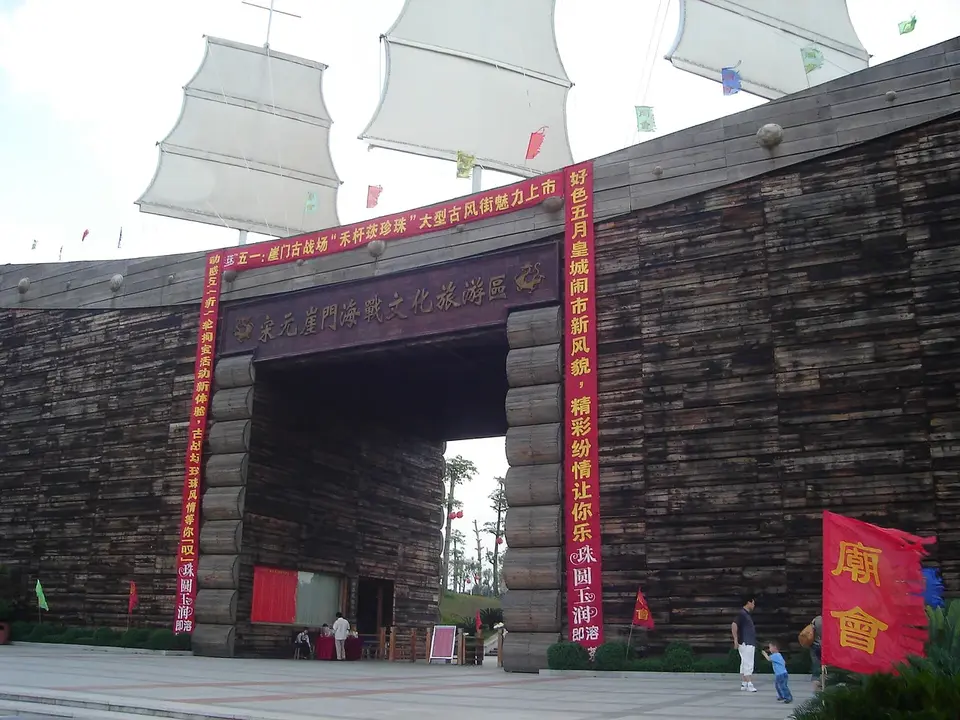
The Battle of Yamen, fought in the second lunar month of 1279 off the coast of Mount Ya in modern Xinhui, Guangdong, was the cataclysmic naval climax of the Mongol conquest of the Song dynasty. In 1276, Yuan armies captured the Southern Song capital of Lin'an, accepting the submission of five-year-old Emperor Gong. Loyalist statesmen Lu Xiufu, Zhang Shijie, and Wen Tianxiang fled southward with the emperor's young brothers, enthroning seven-year-old Zhao Shi as Emperor Duanzong. Following Duanzong's death during an oceanic storm, the court crowned seven-year-old Zhao Bing and established a fortified maritime bastion at Mount Ya, assembling twenty thousand loyalists and one thousand war junks. Yuan commander Zhang Hongfan blockaded the bay with naval and land columns, cutting off freshwater and firewood. On the sixth day of the second month, Yuan forces launched a coordinated four-pronged assault amidst driving rains and sudden tidal reversals, penetrating the chained Song fleet. Seeing that escape was impossible, Grand Chancellor Lu Xiufu donned full court regalia, bound eight-year-old Emperor Bing to his back with white silk, and leaped into the waves to drown. Empress Dowager Yang and over one hundred thousand loyalist soldiers, court ladies, and civilians followed, choosing death over foreign servitude, marking the final extinction of the Song dynasty.
Emperor Gong surrenders Lin'an; loyalist ministers spirit away princes Zhao Shi and Zhao Bing to lead resistance.
Seven-year-old Zhao Shi is crowned Emperor Duanzong; Chen Yizhong, Zhang Shijie, and Lu Xiufu reorganize the administration.
Fuzhou falls; the court moves to Guangdong waters after Pu Shougeng defects; Duanzong falls ill after nearly drowning.
Duanzong dies; Lu Xiufu crowns seven-year-old Zhao Bing and relocates the maritime court to Mount Ya in Xinhui.
Wen Tianxiang is captured at Wupoling, transported to Mount Ya, and refuses to write surrender letters, penning his famous poem.
Zhang Hongfan and Li Heng blockade the bay; Zhang Shijie chains 1,000 ships together in a defensive circle.
Yuan forces cut off access to inland springs and firewood; Song soldiers drink seawater, suffering sickness and exhaustion.
Li Heng attacks with the tide from the north; Zhang Hongfan uses music to deceive Song defenders before boarding.
Seeing defeat, Lu Xiufu binds eight-year-old Zhao Bing to his chest and leaps into the waves; over 100,000 follow.
Over 100,000 corpses float upon the bay; Empress Dowager Yang and Zhang Shijie drown, ending the Song dynasty.
In 1273, after a grueling five-year siege, Mongol forces captured the strategic gateway of Xiangyang and Fancheng along the Han River, clearing the path into the Southern Song heartland. In the first lunar month of 1276, Grand General Bayan led the main Yuan army to the gates of Lin'an (modern Hangzhou). Grand Empress Dowager Xie and five-year-old Emperor Gong, Zhao Xian, formally submitted, surrendering the imperial seal. Amidst the chaos, Lady Yang, consort of the late Emperor Duzong, was escorted by her brother Yang Liangjie and imperial guards out of the city, spiriting away Duzong's sons, Zhao Shi and Zhao Bing.
Fleeing to Jinhua in eastern Zhejiang, the imperial family joined retreating loyalist leaders Lu Xiufu, Zhang Shijie, Chen Yizhong, and Wen Tianxiang. In the fifth month of 1276, the exile court reached Fuzhou, proclaiming seven-year-old Zhao Shi as Emperor Duanzong. The court appointed Chen Yizhong as Chancellor, Zhang Shijie as Supreme Military Commander, Lu Xiufu as Signatory Official of the Bureau of Military Affairs, and Wen Tianxiang as Duke of Xin. However, Bayan's columns pursued the refugees relentlessly. When Fuzhou fell in 1277, the court fled toward Quanzhou, but Pu Shougeng, the wealthy superintendent of maritime trade, defected to the Mongols and refused them ships. Seizing vessels by force, Zhang Shijie sailed southward toward Guangdong.
Disaster plagued the exile fleet throughout its coastal flight. In early 1278, a ferocious typhoon struck the fleet off the Leizhou Peninsula. The imperial flagship capsized, and though young Emperor Duanzong was fished from the waves, he contracted an illness and died on Gangzhou Island. Grief and defeatism swept through the surviving ministers, but Lu Xiufu rallied the assembly, declaring: "Emperor Duzong still has an imperial son alive; how can we abandon the dynasty for the loss of one sovereign?"
In the fourth month of 1278, the court enthroned seven-year-old Zhao Bing as Emperor Bing, adopting the reign title Xiangxing and raising Consort Yang to Empress Dowager. In the sixth month, recognizing that coastal islands were vulnerable, Zhang Shijie and Lu Xiufu relocated the entire fleet to Mount Ya, located eighty li south of Xinhui. Mount Ya faced Tangping Mountain across an inlet known as Yamen, creating a natural deepwater anchorage. The court constructed temporary timber palaces and fortifications, gathering twenty thousand court officials, scholar-gentry, imperial clansmen, soldiers, and refugee families aboard one thousand large ocean-going vessels. Meanwhile, Wen Tianxiang's inland resistance collapsed when he was captured at Wupoling, leaving Mount Ya as the sole surviving bastion of Song authority.
In the first lunar month of 1279, Grand General Zhang Hongfan of the Yuan dynasty arrived off Mount Ya at the head of hundreds of warships and over twenty thousand veteran marines, while General Li Heng advanced south from Guangzhou. Yuan naval and land columns placed Mount Ya under a three-sided blockade. Although the Song possessed numerical superiority with over one thousand vessels, the vast majority were laden with civilian refugees, court ladies, civil bureaucrats, and imperial examination students, with only several tens of thousands of combat-ready troops.
As the Yuan fleet closed in, tactical debates divided the Song command. Staff officers urged Zhang Shijie to deploy forward squadrons to hold the mouth of the bay, preserving an open westward retreat route toward Southeast Asia or Hainan. Fearing that an escape route would tempt troops to scatter, Zhang Shijie rejected the proposal. Instead, Zhang made a desperate stand: he burned all shore palaces and timber settlements, moored one thousand heavy transport junks together in a circular formation miles long, and bound them stem to stern with thick hemp ropes and heavy iron chains. Placing the imperial flagship at the center, Zhang coated ship hulls with fire-retardant mud and erected high wooden bulwarks, resolving to fight to the death.
Seizing the mouth of the bay, Zhang Hongfan attempted to destroy the chained formation using fire ships loaded with tallow, sulfur, and dried brushwood. However, Zhang Shijie had anticipated the tactic; Song crews wielded long timber spars to fend off the burning vessels, while the wet mud along the ship hulls neutralized fire arrows. Thwarted, Zhang Hongfan brought the captive Wen Tianxiang to the fleet, urging him to write a letter soliciting Zhang Shijie's surrender. Wen Tianxiang refused, composing the poem Passing Through the Lingding Sea, declaring: "Since antiquity, who can escape death? Let my loyal heart illuminate the pages of history."
Recognizing that frontal fire assaults were ineffective, Zhang Hongfan adopted an attrition strategy. Li Heng's squadron severed the freshwater channels leading into the bay, cutting off Song access to firewood and mountain springs, while Zhang Hongfan blockaded the open ocean. Trapped aboard the chained ships for ten days without fresh water, Song soldiers and refugees were reduced to drinking brine and chewing dry uncooked rice. Drinking seawater caused widespread vomiting, dysentery, and severe dehydration, crippling the fighting strength of the defenders.
At dawn on the sixth day of the second lunar month in 1279, dense fog and a cold drizzle shrouded the waters of Mount Ya. Zhang Hongfan and Li Heng coordinated a combined assault, dividing their fleet into four squadrons. Li Heng led the northern division to attack from the river mouth with the outgoing ebb tide; Zhang Hongfan attacked from the southwest; and two secondary columns maneuvered to pin the Song flanks.
At noon, the wind and currents shifted suddenly, blowing from the north as the tide reversed. Li Heng's warships surged forward with the tide, unleashing storms of crossbow bolts upon the Song junks. Concurrently, Zhang Hongfan approached the southern flank, cloaking his upper decks with reed screens and ordering his shock marines to crouch beneath bucklers. Zhang ordered military pipes and drums to sound joyful melodies, tricking the exhausted Song defenders into believing the Yuan commanders were feasting. When the vessels collided, Yuan marines threw off the screens, sounding battle horns and swarming over the gunwales with broadswords. Dehydrated and disoriented, Song crews could not resist the onslaught; masts toppled, cables snapped, and the chained array disintegrated into chaos.
By late afternoon, heavy rain and thick fog engulfed the bay. Recognizing that all was lost, Zhang Shijie dispatched light pinnaces into the center of the broken array to rescue young Emperor Bing. However, Grand Chancellor Lu Xiufu, stationed aboard the imperial flagship, feared that the small boats were Yuan decoys and refused to yield the boy sovereign, determined that the monarch should not suffer captivity.
As Yuan boarders closed in, forty-three-year-old Lu Xiufu dressed himself in formal embroidered court vestments and made three prostrations toward the northern capital. Turning to eight-year-old Zhao Bing, Lu wept: "The affairs of state have come to this; Your Majesty must die for the realm! The shame suffered by Emperor Deyou in Lin'an was intolerable; Your Majesty must never suffer such humiliation!" Lu affixed the imperial jade seal to the child's sash, bound the boy to his chest with lengths of white silk, and leaped into the depths of the sea.
Witnessing their sovereign's martyrdom, a profound wave of mass suicide swept through the remaining vessels. Imperial consorts, princesses, high ministers, and tens of thousands of soldiers and civilians wept aloud and leaped into the crashing waves. Zhang Shijie hacked through the anchor cables with sixteen war junks, breaking through the outer cordon to escort Empress Dowager Yang out to sea. When the Empress Dowager learned that young Zhao Bing had drowned, she threw herself into the ocean. Zhang Shijie interred her remains along the coast. Days later, struck by a violent typhoon off Hailing Island in Yangjiang, Zhang Shijie refused to abandon ship, crying to the heavens that if heaven willed the end of the Song, he would drown in the deep. Over one hundred thousand corpses floated upon the waters of Mount Ya the following morning, bringing the 319-year-old Song dynasty to a tragic end.
The Battle of Yamen marked the absolute conclusion of the Song dynasty, which had governed China since its founding by Zhao Kuangyin in 960. The loss of its imperial family, ministerial corps, and armed fleet extinguished all organized resistance against Mongol rule, ending three centuries of Song cultural and administrative achievements.
The victory at Yamen completed Kublai Khan's unification of China under the Yuan dynasty. The conquest brought an end to over three hundred years of political division that had persisted since the late Tang and Five Dynasties periods, uniting territories previously divided among Song, Liao, Jin, Western Xia, and Dali. The creation of this expansive empire laid the territorial framework for the Ming and Qing dynasties. Concurrently, the unyielding loyalty displayed by the 100,000 martyrs of Mount Ya came to be celebrated as an enduring symbol of Chinese national integrity and sacrifice.