Uprising of Liu Yuan and Li Xiong
Xiongnu commander Liu Yuan declared himself King of Han at Lishi, and Di leader Li Xiong founded the Cheng Han realm in Sichuan, beginning the Sixteen Kingdoms era.
Northern Wei Dynasty (北魏) · HISTORICAL EVENT
五胡乱华
The Uprising of the Five Barbarians (五胡乱华) refers to the epochal historical period from 304 (first year of Yongxing) to 439 (fifth year of Taiyan), marked by massive inward migrations of northern ethnic nomadic tribes, the collapse of the Western Jin dynasty, and more than a century of severe sociopolitical division across China. Since the Eastern Han and Cao Wei dynasties, millions of nomadic peoples, primarily the Xiongnu, Jie, Xianbei, Di, and Qiang,…
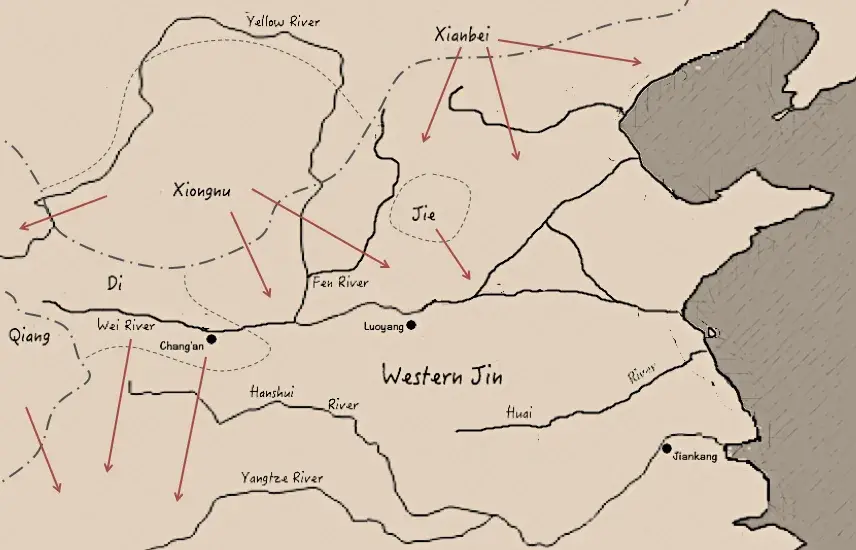
The Uprising of the Five Barbarians (五胡乱华) refers to the epochal historical period from 304 (first year of Yongxing) to 439 (fifth year of Taiyan), marked by massive inward migrations of northern ethnic nomadic tribes, the collapse of the Western Jin dynasty, and more than a century of severe sociopolitical division across China. Since the Eastern Han and Cao Wei dynasties, millions of nomadic peoples, primarily the Xiongnu, Jie, Xianbei, Di, and Qiang, migrated south of the Great Wall, creating an intricate pattern of cohabitation in Guanzhong and the Central Plains. The Western Jin court was plagued by systemic corruption, and the sixteen-year War of the Eight Princes utterly depleted the empire's treasury and imperial guards. In 304, Xiongnu chieftain Liu Yuan and Di leader Li Xiong established independent realms, inaugurating the turbulent Sixteen Kingdoms era. The fall of Luoyang in the Disaster of Yongjia in 311 and the capture of Chang'an in 316 extinguished the Western Jin. The Jin court and aristocratic families fled across the Yangtze River to found the Eastern Jin, spearheading comprehensive economic growth in the south. The north witnessed fierce warfare among nomadic regimes until Emperor Taiwu of Northern Wei unified northern China in 439. This prolonged upheaval reshaped East Asian geopolitics and stimulated an unprecedented synthesis of nomadic and agrarian civilizations.
Xiongnu commander Liu Yuan declared himself King of Han at Lishi, and Di leader Li Xiong founded the Cheng Han realm in Sichuan, beginning the Sixteen Kingdoms era.
Han-Zhao forces under Liu Yao and Shi Le sacked Luoyang, captured Emperor Huai alive, and slaughtered thousands of officials.
Liu Yao besieged Chang'an, forcing Emperor Min to surrender bare-chested and terminating the Western Jin dynasty.
Sima Rui ascended the throne at Jiankang with the backing of southern and northern gentry clans, establishing the Eastern Jin dynasty.
Jie general Shi Le declared himself King of Zhao at Xiangguo, eventually crushing Han-Zhao and unifying northern China.
Eastern Jin general Zu Ti recovered territories south of the Yellow River but died in grief at Yongqiu due to court obstruction.
Han general Ran Min exterminated the Shi clan, established Ran Wei, and issued orders to slaughter nomadic populations across northern China.
Former Qin prime minister Wang Meng commanded imperial forces to capture Ye, annexing Former Yan territory.
Former Qin absorbed Former Liang and the Tuoba realm of Dai, achieving total political unification across the north.
Fu Jian's massive southern expedition was decisively routed by Xie An's Beifu army at the Fei River, triggering immediate regional fracturing.
Tuoba Gui restored the state of Dai at Niuchuan and renamed it Wei, laying the foundations for the Northern Wei dynasty.
Northern Wei cavalry under Tuoba Gui routed the Later Yan army at Canhe Slope, decisively shifting military hegemony to the Tuoba clan.
Tiefu Xiongnu chieftain Helian Bobo rebelled against Later Qin, founded Great Xia, and erected the formidable Tongwan City.
Emperor Taiwu conquered Northern Liang, completing the political unification of northern China and terminating the Sixteen Kingdoms period.
Since Emperor Guangwu of the Eastern Han welcomed the Southern Xiongnu to settle along the northern border, northern non-Han tribes continuously entered the Central Plains. During the Three Kingdoms and Western Jin periods, continuous military conflict severely reduced the Han agricultural population. To recruit soldiers, reclaim wasteland, and secure labor, imperial authorities aggressively encouraged frontier nomadic tribes to resettle inside the Great Wall. Over a century, millions of Xiongnu, Jie, Di, Qiang, and Xianbei peoples settled across Guanzhong, Youzhou, and Bingzhou, leading to a profound demographic transformation where non-Han populations accounted for half the inhabitants of the Guanzhong basin.
Following the founding of the Western Jin, Emperor Wu (Sima Yan) enfeoffed numerous imperial princes with territorial commands and autonomous armies to protect the ruling house. However, after his death, Emperor Hui proved incompetent, and factional struggles between Empress Jia and imperial regents ignited the devastating sixteen-year War of the Eight Princes (291-306). Vying for supreme power, rival princes enlisted Xianbei and Xiongnu cavalry forces to crush their kin. The brutal conflict wiped out over three hundred thousand elite imperial troops, devastated cities throughout the Central Plains, and left the empire completely defenseless.
Despite residing alongside Han peasants, the newly resettled ethnic tribes endured severe exploitation and humilation by Western Jin officials and aristocratic clans. The Jin administration registered non-Han tribesmen as serfs and tenants, while wealthy nobles treated them as expendable chattel, frequently capturing and selling them into slavery. In 299 (ninth year of Yuankang), the visionary scholar Jiang Tong submitted the famous memorial Tui Rong Lun (Treatise on Resettling Frontier Tribes), warning that non-Han peoples held distinct customs and grievances, urging the court to relocate them back beyond the Great Wall while stability remained. Preoccupied with luxury and political feuds, the Jin ruling elite dismissed his counsel.
In 296 (sixth year of Yuankang), Qiang and Di tribesmen in Guanzhong revolted under the leadership of Di chieftain Qi Wannian, responding to crushing exploitation by Western Jin regional military commanders. The rebel forces besieged counties and defeated several Jin armies dispatched from Chang'an, killing imperial commander Sima Lun's subordinates. The Western Jin court took three years of grueling campaigning to suppress the uprising, exhausting provincial resources across Guanzhong and Longyou and exposing the vulnerability of imperial defenses.
In 304 (first year of Yongxing), amidst the chaotic final stages of the War of the Eight Princes, Southern Xiongnu commander Liu Yuan seized the strategic opportunity to assemble the Five Banners of the Xiongnu at Lishi in Shanxi. Claiming descent from the Han imperial line through historic marriage treaties, Liu Yuan took the title of King of Han (later Han-Zhao), established an administration blending nomadic tribal titles with Han bureaucratic posts, and launched an open rebellion against the Western Jin.
Following Liu Yuan's death, his successor Liu Cong accelerated offensives against the crumbling Western Jin heartland. In 311 (fifth year of Yongjia), Han-Zhao commanders Liu Yao, Shi Le, and Wang Mi converged on the imperial capital of Luoyang. The city suffered severe famine and fell after a fierce siege. Victorious nomadic forces set fire to the imperial palaces, slaughtered over thirty thousand officials and civilians, looted the imperial tombs, and captured Emperor Huai of Jin alive, a catastrophic event recorded in history as the Disaster of Yongjia.
After the catastrophe at Luoyang, surviving Jin loyalists fled west to Chang'an, crowning the young Sima Ye as Emperor Min in 313. However, the Western Jin court in Chang'an possessed neither treasury reserves nor operational armies. In 316 (fourth year of Jianxing), Liu Yao led elite Han-Zhao cavalry to besiege Chang'an. Starvation forced Emperor Min to surrender bare-chested before the palace gates. He was escorted to Pingyang and subsequently murdered, formally extinguishing the fifty-two-year rule of the Western Jin dynasty.
As northern provinces collapsed under nomadic horsemen, imperial prince Sima Rui, the Prince of Langya, served as military commander at Jiankang south of the Yangtze River. Advised by master statesman Wang Dao of the Langya Wang clan, Sima Rui consolidated support among southern aristocrats and northern refugee elites. In 317 (first year of Jianwu), Sima Rui ascended the imperial throne at Jiankang, founding the Eastern Jin dynasty and establishing a shared governance system between the throne and prominent aristocratic families.
Eager to recover the Central Plains, patriotic commander Zu Ti petitioned Emperor Yuan of Jin to authorize a northern expedition in 317. Granted nominal command and meager supplies, Zu Ti struck an oar against the waters of the Yangtze, vowing never to return south without expelling the invaders. Advancing north of the Huai River, Zu Ti forged disciplined militias, rallied local fortress leaders, and defeated several forces of Shi Le, reclaiming territories south of the Yellow River. However, internal factional jealousy within the Eastern Jin court sabotaged his supplies, and Zu Ti died in grief at Yongqiu in 321.
In the central and eastern plains, Jie military commander Shi Le gradually expanded his power base independent of Han-Zhao. In 319 (second year of Daxing), Shi Le broke away to establish the Later Zhao dynasty at Xiangguo. After destroying Liu Yao and annexing Han-Zhao in 329, Shi Le consolidated control over the vast territories of northern China. Facing endemic violence, local Han clans fortified hilltop compounds known as wubao, maintaining defensive militias and negotiating uneasy truces with nomadic overlords.
Following the death of tyrannical Later Zhao ruler Shi Hu in 349, succession warfare erupted among his sons. Han general Ran Min, an adopted grandson of Shi Hu, staged a bloody palace coup in 350, exterminating the Shi imperial clan and establishing the Ran Wei dynasty. Ran Min issued sweeping edicts ordering the extermination of non-Han nomadic warriors across northern China, triggering widespread bloodshed in which hundreds of thousands perished. Ran Min's regime was short-lived, as he was defeated and captured by the Xianbei army of Murong Jun in 352.
Originating in Liaodong, the Murong branch of the Xianbei tribe steadily built a formidable state under Murong Huang and Murong Jun. Incorporating Han administrative advisors and nomadic cavalry tactics, the Murong state established the Former Yan dynasty and moved its capital to Ye in 357. Led by brilliant general Murong Chui, Former Yan expanded southwestward, crushing Ran Wei and conquering Henan and Shandong to become the supreme military power in eastern northern China.
In the western half of northern China, the Di-led Former Qin dynasty rose to prominence under Emperor Xuanzhao (Fu Jian). Fu Jian appointed gifted Han scholar-statesman Wang Meng as prime minister, granting him absolute authority to enforce laws, suppress recalcitrant nobles, build irrigation infrastructure, and promote Confucian schooling. In 370 (sixth year of Jianyuan), Wang Meng personally commanded the Former Qin army to capture Ye and conquer Former Yan. By 376, Former Qin had absorbed Former Liang and the Tuoba realm of Dai, achieving the first complete unification of northern China.
Following Wang Meng's death, Fu Jian sought to unify the entire Chinese realm by launching a colossal military expedition against the Eastern Jin in 383 (eighth year of Taiyuan). Marshaling an army estimated at hundreds of thousands of infantry and cavalry, Fu Jian advanced to the Fei River in modern Anhui. However, the diverse ethnic ranks lacked ideological cohesion. Eastern Jin prime minister Xie An and general Xie Xuan deployed eighty thousand elite Beifu troops to mount a counterattack. A tactical panic turned into a catastrophic rout for Former Qin, shattering Fu Jian's empire overnight.
The Fei River catastrophe completely destabilized Former Qin authority. Nomadic generals serving under Fu Jian immediately rebelled to restore their regional domains. Murong Chui marched to eastern China to establish the Later Yan dynasty, while Qiang general Yao Chang captured and murdered Fu Jian in 385 to found the Later Qin in Chang'an. Northern China fractured once more into competing warlord realms, plunging the populace into another prolonged phase of destructive conflict.
Across the northern steppes, the Tuoba branch of the Xianbei people, whose ancestral realm of Dai had been subdued by Former Qin, reorganized under sixteen-year-old chieftain Tuoba Gui. In 386 (first year of Dengguo), Tuoba Gui convened a grand tribal assembly at Niuchuan, declaring the restoration of Dai and shortly renaming the state Wei (Northern Wei). Adopting administrative reforms that merged nomadic cavalry organization with centralized bureaucratic taxation, Tuoba Gui established his capital at Pingcheng and launched aggressive campaigns against adjacent tribal rivals.
Tensions between Northern Wei and Later Yan erupted into full-scale war in 395 (twentieth year of Taiyuan), when Later Yan emperor Murong Chui sent his crown prince Murong Bao with eighty thousand troops to crush Northern Wei. Tuoba Gui executed a strategic retreat across the Yellow River and severed Yan communications. When Murong Bao began a chaotic withdrawal, Tuoba Gui led twenty thousand elite cavalry in a relentless pursuit, ambushing and annihilating the Later Yan army at Canhe Slope. The battle broke the backbone of Later Yan, establishing Northern Wei as the uncontested master of the northern plains.
Capitalizing on their Canhebei victory, Emperor Daowu (Tuoba Gui) and his successor Emperor Mingyuan (Tuoba Si) swept south of the Great Wall, capturing key strongholds across modern Shanxi, Hebei, and Henan. Northern Wei armies defeated regional resistance, settled hundreds of thousands of artisans and agriculturalists around Pingcheng, and repelled Southern Dynasties counteroffensives along the Yellow River, institutionalizing imperial authority across the Central Plains.
In 407 (first year of Baique), Tiefu Xiongnu chieftain Helian Bobo rebelled against Later Qin and founded the Great Xia dynasty across northern Shaanxi. Utilizing lightning cavalry ambushes, Helian Bobo eroded Later Qin control and captured Chang'an in 418 following Liu Yu's withdrawal. In 413, Helian Bobo mobilized over one hundred thousand laborers to construct Tongwan City, using steamed clay to build impregnable, gleaming white walls that withstood sieges for centuries, exemplifying the ferocity and architectural ambition of the northern nomadic regimes.
Emperor Taiwu of Northern Wei (Tuoba Tao), a military prodigy, initiated systematic campaigns to terminate the remaining northern kingdoms. Between 426 and 439, Taiwu crushed the Great Xia, eradicated Northern Yan in Liaodong, and captured Gu Zang from Northern Liang in 439 (fifth year of Taiyan). The fall of Northern Liang formally ended the Sixteen Kingdoms era, unifying northern China under Northern Wei and concluding more than a century of fragmented regional warfare.
Over a century and a half of cohabitation profoundly altered the demographic and cultural landscape of northern China. While early stages brought intense racial conflicts and warfare, prolonged interaction forced nomadic rulers to rely on Han bureaucratic systems, agrarian taxation, and Confucian jurisprudence. Intermarriage between aristocratic Han families and nomadic elites gradually blurred cultural barriers, generating a resilient hybrid civilization that revitalized Chinese society and laid institutional groundwork for the subsequent Sui and Tang empires.
The catastrophic devastation of the north triggered the largest southward migration in Chinese history up to that point. Millions of northern Han peasants, craftsmen, and literati migrated to the Yangtze River delta, Poyang Lake basin, and Lingnan. Bringing advanced iron plows, sophisticated double-cropping techniques, and hydraulic engineering, the immigrants transformed the once marshy southern wilderness into productive granaries. This dramatic demographic shift established Jiangnan as an indispensable economic powerhouse, forever altering China's geographic distribution of wealth.
In the southern capital of Jiankang, the Eastern Jin established a distinctive system of aristocratic clan politics, characterized by shared power between the imperial court and prominent families such as the Langya Wang and Chenjun Xie clans. Despite military vulnerabilities, southern society produced brilliant philosophical debates, calligraphy masterpieces by Wang Xizhi, and lyrical poetry by Tao Yuanming, preserving and refining traditional Han classical culture while developing an aesthetic sophistication that came to define Southern Dynasties heritage.
The Uprising of the Five Barbarians completely dismantled the fragile national unification achieved by the Western Jin after the Three Kingdoms Period. Between 304 and 439, more than twenty independent regimes emerged in rapid succession across northern China, eventually crystallizing into a two-century polarization between the Northern and Southern Dynasties across the Huai River and Qinling Mountains.
The loss of the northern heartland compelled millions of Han peasants, artisans, and aristocratic families to flee south of the Yangtze River. These immigrant populations introduced sophisticated metallurgical implements, intensive agricultural techniques, and extensive labor into the fertile basins of southern China. This demographic influx catalyzed the rapid economic transformation of Jiangnan, permanently shifting the economic center of gravity from the Yellow River to the Yangtze River.
Although the nomadic conquests inflicted immense destruction and widespread suffering, the prolonged interaction compelled Xiongnu, Jie, Xianbei, Di, and Qiang rulers to discard rudimentary tribal customs in favor of Confucian administrative institutions, agrarian tax models, and bureaucratic governance. Concurrently, millions of Han inhabitants residing in fortified villages integrated with neighboring nomadic peoples through intermarriage and cultural adaptation, forging an energetic, resilient hybrid culture that laid the foundation for the cosmopolitan prosperity of the Sui and Tang empires.
In the official Book of Jin (Jin Shu), Tang dynasty chancellor Fang Xuanling reflected on the tragedy of the Western Jin: "Emperor Hui was incompetent, while Empress Jia monopolized power. Factional hatred erupted among the imperial princes, and internal calamities consumed the ruling clan. Wolves devoured one another, and standard social order collapsed. The frontier tribes seized their opportunity, throwing the divine realm into turmoil. Never in history had there been such a calamity."
In the Comprehensive Mirror in Aid of Governance (Zizhi Tongjian), Song dynasty historian Sima Guang analyzed the structural failure of the Jin court: "Ever since Emperor Hui failed to govern, eight princes waged internecine war, leaving skeletons piled in the fields and blood flowing like rivers. Nomadic forces pressed inward from the frontiers, and the imperial capitals collapsed. Scholars and commoners drifted into exile, and all under Heaven fell into chaos. It was not Heaven that destroyed the Jin; the Jin destroyed itself."
In Notes on the Comprehensive Mirror (Du Tongjian Lun), late Ming philosopher Wang Fuzhi highlighted the enduring civilizational synthesis: "The upheaval of the Five Barbarians devastated the people; yet through this crisis the vital energy of the northern realm was transformed, and the lineages of Han and nomadic peoples became thoroughly intertwined. The Tuoba clan arose from the northern steppes, unified the Central Plains, honored Confucian learning, and paved the way for the Northern Qi, Northern Zhou, Sui, and Tang. When chaos reaches its apex, order inevitably returns, following historical forces that govern dynastic transformation."