Zhu Wen Founding Later Liang
Zhu Wen forced Emperor Ai of Tang to abdicate, establishing the Later Liang at Kaifeng and terminating the Tang dynasty.
Tang Dynasty (唐朝) · HISTORICAL EVENT
五代十国时期
The Five Dynasties and Ten Kingdoms Period (五代十国时期) was an era of intense political fragmentation and dynastic transformation spanning from 907 (first year of Kaiping) to 979 (fourth year of Taiping Xingguo), between the collapse of the Tang dynasty and the re-establishment of nationwide unification by the Northern Song. During the late Tang, regional military governors (fanzhen) acquired unchecked territorial autonomy, and the devastating Huang Chao…
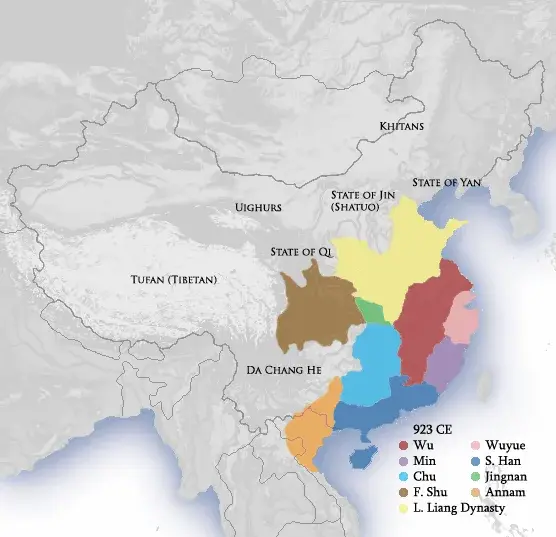
The Five Dynasties and Ten Kingdoms Period (五代十国时期) was an era of intense political fragmentation and dynastic transformation spanning from 907 (first year of Kaiping) to 979 (fourth year of Taiping Xingguo), between the collapse of the Tang dynasty and the re-establishment of nationwide unification by the Northern Song. During the late Tang, regional military governors (fanzhen) acquired unchecked territorial autonomy, and the devastating Huang Chao Rebellion effectively dismantled imperial central authority. In 907, warlord Zhu Wen deposed the last Tang emperor to establish the Later Liang, inaugurating seventy-two years of divided rule across China. In the northern Central Plains, five ephemeral dynasties—Later Liang, Later Tang, Later Jin, Later Han, and Later Zhou—succeeded one another in rapid succession through military coups and usurpations. Concurrently, ten regional autonomous kingdoms flourished primarily across southern China and Shanxi: Former Shu, Later Shu, Southern Wu, Southern Tang, Wuyue, Min, Southern Han, Jingnan, Chu, and Northern Han. The cession of the Sixteen Prefectures of Yanyun to the Khitan Liao Empire by Shi Jingtang compromised northern border defenses for centuries. However, the period also witnessed the transformative reforms and conquests of Emperor Shizong of Later Zhou (Chai Rong), while southern regimes fostered economic vitality and cultural achievements by maintaining regional peace. In 960, Zhao Kuangyin founded the Northern Song, which systematically absorbed the southern kingdoms and conquered Northern Han in 979, establishing an enduring centralized bureaucratic state.
Zhu Wen forced Emperor Ai of Tang to abdicate, establishing the Later Liang at Kaifeng and terminating the Tang dynasty.
Li Keyong died at Taiyuan; his son Li Cunxu succeeded as Prince of Jin, reorganizing his military forces and relieving Luzhou.
Khitan chieftain Yelü Abaoji proclaimed himself Heavenly Emperor, adopting Khitan scripts and establishing the dual administration system.
Li Cunxu proclaimed the Later Tang at Weizhou, executing a surprise advance on Kaifeng to destroy Later Liang.
Weibo troops mutinied at Yedu, and Emperor Zhuangzong died during a palace revolt in Luoyang; Li Siyuan ascended the throne to restore governance.
Shi Jingtang allied with the Khitans to overthrow Later Tang, ceding the Sixteen Prefectures of Yanyun to found Later Jin.
Liao armies captured Kaifeng, deporting Emperor Chudi; Liu Zhiyuan proclaimed Later Han at Taiyuan, recovering Kaifeng as Khitan forces withdrew.
Facing execution by Emperor Yindi, Guo Wei revolted and was acclaimed emperor in the Chanzhou mutiny, founding Later Zhou.
Emperor Shizong of Later Zhou (Chai Rong) led frontlines at Gaoping, crushing a joint Northern Han and Liao invasion.
Chai Rong concluded three successful southern campaigns, forcing Southern Tang to cede fourteen prefectures north of the Yangtze.
Chai Rong recovered three strategic passes from the Liao in forty-two days, but fell ill and died in Kaifeng at age thirty-nine.
Zhao Kuangyin was acclaimed emperor in the Chenqiao mutiny, founding the Northern Song dynasty and adopting the southern unification strategy.
King Qian Chu of Wuyue surrendered thirteen prefectures and his armed forces peacefully to the Song court.
Emperor Taizong personally directed the siege of Taiyuan, compelling Northern Han to surrender and concluding the Five Dynasties and Ten Kingdoms era.
The catastrophic outbreak of the An Lushan Rebellion in 755 (fourteenth year of Tianbao) permanently terminated the zenith of the Tang dynasty. To quell the rebellion, the imperial court indiscriminately appointed surrendered rebel generals and loyalist military leaders as regional military governors (jiedushi), entrenching hereditary, autonomous commanderies throughout northern China and the Central Plains. Over the subsequent century, these warlords commanded independent armies, withheld provincial tax revenues, and appointed sub-officials without central oversight. Imperial efforts to curb military governors consistently concluded in compromise, reducing the authority of the throne to nominal prestige.
During the late Tang, the court fell victim to severe institutional decay, characterized by continuous power struggles between imperial eunuchs and rival bureaucratic factions in the Niu-Li Party Strife. In 875 (second year of Qianfu), a colossal agrarian rebellion led by salt merchant Huang Chao engulfed northern, southern, and central China. Rebel forces captured the imperial capital of Chang'an in 880, proclaiming the Qi dynasty and forcing Emperor Xizong to flee to Sichuan. The central government survived only by granting unlimited military autonomy to regional commanders. The rebellion annihilated the imperial Shence Army and erased imperial fiscal resources, reducing the Tang monarch to a defenseless captive among competing warlords.
During the suppression of the Huang Chao Rebellion, Shatuo Turkic nomadic cavalry forces under Li Guochang and his son Li Keyong migrated south of the Great Wall to assist the imperial house. Recognized for their battlefield valor, the Shatuo chiefs were granted the imperial surname Li and enfeoffed with the military governorship of Hedong at Taiyuan. The elite Shatuo "Black Crow Army" evolved into the preeminent military counterweight to Han warlords in the Central Plains. This integration of Shatuo military elites shaped northern Chinese geopolitics, as three of the subsequent Five Dynasties—Later Tang, Later Jin, and Later Han—were founded by Shatuo commanders.
In 875 (second year of Qianfu), salt merchant Huang Chao raised an insurrection in Caozhou, responding to Wang Xianzhi's uprising against predatory taxation and official corruption. The insurgent forces swept across the Central Plains, raided Lingnan and Jiangnan, and captured the imperial capital Chang'an in 880 (first year of Guangming), where Huang Chao proclaimed himself emperor of the Qi dynasty. Emperor Xizong fled to Sichuan, marking the total breakdown of centralized Tang authority.
To suppress the rebellion, the Tang court conferred sweeping administrative and military powers upon provincial military governors and enlisted nomadic cavalry forces. Regional commanders withheld taxes, expanded personal armies, and operated independently of imperial oversight. Although the rebellion was ultimately crushed, the Tang imperial guards were annihilated, leaving the emperor a powerless figurehead among competing warlords.
During the suppression of the Huang Chao Rebellion, insurgent general Zhu Wen (later granted the imperial name Zhu Quanzhong) demonstrated sharp political opportunism. In 882 (second year of Zhonghe), facing encirclement by Tang forces and Shatuo cavalry, Zhu murdered his supervisory eunuch and surrendered with his garrison at Tongzhou. Delighted, Emperor Xizong appointed Zhu as military governor of Xuanwu, based at Bianzhou (modern Kaifeng, Henan).
At Kaifeng, Zhu consolidated military and economic resources, utilizing Bianzhou's strategic location along the Grand Canal. He annexed adjacent military circuits, including Tianping and Ganhua, building the Xuanwu Army into the dominant military machine in the Central Plains. Under Zhu's rule, Kaifeng supplanted war-ravaged Chang'an and Luoyang as the northern political and commercial epicenter.
Zhu Wen's fiercest rival was the Shatuo chieftain Li Keyong, a military commander known as the "One-Eyed Dragon" for his archery prowess. After recapturing Chang'an from Huang Chao, Li passed through Bianzhou in 884. Zhu hosted a lavish banquet at the Shangyuan Posthouse. During the feast, Li ridiculed Zhu's past as a rebel under Huang Chao, provoking Zhu's murderous wrath.
That night, Zhu surrounded the posthouse with troops, setting it ablaze and loosing barrages of arrows. A sudden rainstorm extinguished the flames, enabling Li Keyong to scale the city walls and escape, though hundreds of his retainers were slaughtered. The Shangyuan Incident initiated a forty-year feud between the Liang and Jin factions, defining decades of destructive warfare across northern China.
In northwestern China, Fengxiang Military Governor Li Maozhen emerged as a dominant warlord. Originally named Song Wentong, he distinguished himself fighting Huang Chao's forces and was rewarded with the imperial surname and the governorship of Fengxiang. Li dominated the imperial court, executing chancellors and forcing Emperor Zhaozong to flee Chang'an. In 901, eunuchs allied with Li abducted the emperor to Fengxiang, triggering a protracted siege by Zhu Wen's armies.
Encircled for over a year, Fengxiang suffered severe famine, forcing Li Maozhen to execute the eunuchs and surrender the emperor. When Zhu usurped the throne to found the Later Liang, Li refused to acknowledge his legitimacy, declaring himself Prince of Qi and maintaining the Tianyou reign era for two decades. In 924, facing the ascendant power of Later Tang, an aging Li submitted to Emperor Zhuangzong, ending the independent Qi realm.
Across northern Hebei, Liu Rengong and his son Liu Shouguang established a despotic regime in Youzhou. Formerly a commander under Li Keyong, Liu Rengong broke away to rule Youzhou autonomously, extorting heavy taxes, conscripting all males between fifteen and seventy, and constructing luxurious palaces on Mount Da'an.
His son, Liu Shouguang, staged a palace coup, imprisoning his father and murdering his elder brother to seize control. In 911, Liu Shouguang proclaimed himself emperor of Greater Yan (Jie Yan), employing brutal tortures to terrorize subjects. In 913, Li Cunxu's Later Tang forces besieged Youzhou, capturing father and son, who were escorted to Taiyuan and executed, extinguishing the regime.
By 903, Zhu Wen compelled Li Maozhen to surrender Emperor Zhaozong and escorted the monarch back to Chang'an, where he slaughtered hundreds of palace eunuchs. In 904, Zhu forced the court to relocate to Luoyang, dismantling Chang'an's palaces and timber to float them downriver, reducing the ancient imperial metropolis to ruins.
To clear obstacles to usurpation, Zhu dispatched Privy Councilor Jiang Xuanhui in August 904 to assassinate Emperor Zhaozong, enthroning thirteen-year-old Li Zhu as Emperor Ai. In 905, advised by confidant Li Zhen, Zhu assembled over thirty prominent aristocrats at Baima Station on the Yellow River, slaughtering them and casting their bodies into the river, ending centuries of aristocratic gentry dominance in court politics.
In April 907 (fourth year of Tianyou), having eliminated loyalist opposition, Zhu Wen forced Emperor Ai to abdicate, ascending the throne in Luoyang. Proclaiming the Great Liang (Later Liang) and establishing the Kaiping reign era, Zhu designated Bianzhou as Kaifeng Prefecture, formally terminating the 289-year Tang dynasty and inaugurating the Five Dynasties and Ten Kingdoms era.
Zhu enacted administrative measures to centralize authority and stimulate agriculture, reducing land taxes and promoting reclamation. However, his personal tyranny and harsh military laws, such as decapitating entire units if their commander fell, created resentment. Warlords like Li Keyong in Hedong and Yang Wo in Huainan refused to recognize Liang authority, perpetuating regional warfare.
While northern China fragmented into warring states, the Khitan nomadic chieftain Yelü Abaoji united the eight Khitan tribes of the northern steppes. Overcoming traditional tribal rotations of power, Abaoji proclaimed himself Heavenly Emperor in 907, founding the Khitan state (later the Liao Empire).
Abaoji established an imperial administration, enlisting Han advisors like Han Yanhui to design state ceremonies, develop Khitan scripts, and build imperial capitals at Shangjing. He instituted the dual Northern and Southern administrations to govern pastoral Khitans and sedentary Han agriculturalists respectively, transforming the Khitans into a formidable empire that shaped northern border relations throughout the Five Dynasties.
In 910, Zhu Wen attempted to annex the tributary circuits of Chengde and Yiwu, provoking both to ally with Jin Prince Li Cunxu. In the spring of 911, Li dispatched general Zhou Dewei with Shatuo cavalry to confront over one hundred thousand Liang troops under Wang Jingren at Baixiang (modern Hebei). Zhou lured the Liang infantry into open ground before launching decisive cavalry flank charges, routing the Liang army.
The defeat cost Later Liang its strategic dominance in Hebei. In 912, an ailing Zhu Wen planned to designate his adopted son Zhu Youwen as heir, infuriating his biological son Zhu Yougui. Yougui staged a coup, assassinating his father. The following year, Zhu Youzhen overthrew Yougui to assume the throne, leaving the dynasty internally fractured.
Following Li Keyong's death in 908, his twenty-four-year-old heir Li Cunxu assumed the title of Prince of Jin. Gifted in military tactics and classical arts, Li had been praised in his youth by Emperor Zhaozong as a future pillar of state. Upon succeeding his father, Li faced domestic conspiracy and a protracted Liang siege at Luzhou.
Li eliminated conspirators within the clan and led cavalry forces through dense fog to crush the Liang perimeter at Luzhou, relieving the city. At Taiyuan, Li instituted strict military discipline, executing soldiers who panicked or plundered civilians. He reformed land and salt taxes, transforming the Shatuo tribal forces into an elite, highly disciplined standing army.
The turbulent pretorianism of the Five Dynasties was exemplified by the Silver Spear Guards of Weibo. Stationed in southern Hebei, successive Weibo military governors had cultivated this elite bodyguard corps, lavishing them with privileges. Over a century, these soldiers developed strong corporate entitlement, deposing and murdering governors who attempted to restrict their prerogatives.
From Zhu Wen's rise to Li Cunxu's reign, the Silver Spear Guards repeatedly revolted, dictating regional appointments. Even Zhu Wen admitted his fear of their commander Yang Shihou. Although Li Cunxu absorbed Weibo into Later Tang, their volatile loyalties sparked the 926 Yedu mutiny that overthrew his regime, until later emperors systematically disbanded the corps.
Having subdued Youzhou and incorporated Weibo's armies, Li Cunxu proclaimed himself emperor of Later Tang at Weizhou in April 923, adopting the reign era Tongguang and presenting himself as the legitimate restorer of the Tang dynasty. Later Tang and Later Liang engaged in continuous warfare along the Yellow River, contesting critical bridgeheads at Yangliu and Desheng.
Liang commander Wang Yanzhang fought stubbornly with heavy spears, but the Liang court remained paralyzed by corruption. In October 923, guided by intelligence from Liang defector Kang Yanxiao, Li Cunxu bypassed river fortifications and led five thousand elite cavalry on a forced march of five hundred li, striking directly at unprotected Kaifeng.
During the final campaign, Later Liang general Wang Yanzhang stood as a model of unwavering loyalty. Renowned for wielding paired iron spears weighing over a hundred pounds, he was appointed supreme commander during Liang's existential crisis, capturing Desheng Fortress in three days and severing Tang river bridges.
However, corrupt court favorites undermined his authority, replacing him with incompetent favorites. Recalled to command during Tang's surprise advance, Wang fought tenaciously at Zhongdu before falling wounded and captured. When Li Cunxu personally urged him to defect, Wang declared that no honorable general serves two masters, calmly accepting execution and earning lasting historical respect.
Li Cunxu's cavalry arrived before Kaifeng's walls, catching Liang Emperor Zhu Youzhen unprepared. Despairing of rescue and unwilling to face capture, Zhu ordered retainer Huangfu Lin to execute him, terminating the seventeen-year Later Liang dynasty. Li Cunxu entered Kaifeng, later transferring his capital to Luoyang and uniting the Central Plains.
In 925, Li launched sixty thousand troops under Prince Li Jiji and Chancellor Guo Chongtao to conquer Former Shu in Sichuan. Tang armies breached the Jianmen Pass; weakened by internal decay under the hedonistic Wang Yan, Former Shu surrendered within seventy days, expanding Later Tang's territory to its imperial zenith.
Following his victories, Li Cunxu abandoned governance, indulging in theatrical performances and granting state titles to comic actors. Adopting the stage name "Li Tianxia," he appointed performers to govern prefectures, while Empress Liu hoarded wealth in private treasuries. Falsely suspecting treason, Li executed illustrious general Guo Chongtao, alienating the military.
In 926, frustrated garrison troops at Yedu mutinied under Huangfu Hui. Sent to suppress the revolt, adoptive brother Li Siyuan was forced by his own soldiers to join the rebels and march on Luoyang. In the capital, palace actors led by Guo Congqian mutinied at Xingjiao Gate. Struck by a stray arrow while fighting the rebels, Li Cunxu died amidst the flames of his palace.
Following Zhuangzong's death, Li Siyuan assumed the throne as Emperor Mingzong, adopting the Tiancheng reign era. A seasoned Shatuo commander of humble disposition, Mingzong executed corrupt palace actors, abolished predatory taxes, and discharged a thousand palace attendants to trim imperial expenditure. Appointing statesmen like Feng Dao, he restored bureaucratic order and enforced administrative accountability.
During his eight-year reign (926-933), the Central Plains enjoyed rare stability and agricultural recovery. Mingzong prayed nightly that heaven grant peace to the common people, earning his reign the historical reputation of modest prosperity. However, he failed to permanently curb regional military governors or pretorian guards, leaving underlying tensions unresolved.
In late 933, Emperor Mingzong died in the wake of an abortive coup by Prince Li Congrong. His successor, Emperor Min (Li Conghou), was manipulated by chancellors who distrusted powerful regional commanders, particularly the emperor's adoptive brother Li Congke at Fengxiang and brother-in-law Shi Jingtang at Taiyuan. The court attempted to reassign Li Congke, prompting him to revolt.
Government forces sent to quell the rebellion defected to Li Congke, who advanced on Luoyang, deposed Emperor Min, and ascended the throne as Emperor Modi. However, Li Congke remained suspicious of Shi Jingtang's veteran cavalry at Taiyuan, deploying containment forces that pushed Shi into an open insurrection that brought down the dynasty.
Facing imperial encirclement at Taiyuan in 936, Shi Jingtang convened confidants, including Liu Zhiyuan and Sang Weihan. They resolved to appeal to the Khitan Liao Empire for military intervention. In exchange, Shi agreed to address the younger Liao Emperor Yelü Deguang as "Imperial Father," proclaiming himself "Son Emperor."
More consequentially, Shi ceded the Sixteen Prefectures of Yanyun, including Youzhou and Yunzhou, and pledged annual tributes of three hundred thousand bolts of silk. The loss of these mountain bastions stripped northern China of natural defensive barriers, exposing the Central Plains to northern nomadic incursions for the next four centuries.
In September 936, Liao Emperor Yelü Deguang led fifty thousand cavalry through Yanmen Pass, encircling Later Tang forces under Zhang Jingda at Jin'an Post. Tang armies held out for months before subordinate Yang Guangyuan assassinated Zhang and surrendered. Yelü Deguang invested Shi Jingtang as Emperor of Later Jin, establishing the Tianfu reign era.
Combined Khitan and Later Jin armies marched south. Surrounded in Luoyang, Later Tang Emperor Li Congke ascended the Xuanwu Tower with the imperial seal and immolated himself. Shi Jingtang established his capital at Kaifeng, ruling as a Khitan tributary throughout his reign.
Following Shi Jingtang's death in 942, his nephew Shi Chonggui assumed the throne as Emperor Chudi. Defiant against Khitan dominance, Shi Chonggui addressed Yelü Deguang as "Grandson" rather than "Subject," refusing further territorial concessions. Enraged, the Liao emperor launched three massive invasions of the Central Plains between 944 and 946.
Later Jin forces fought tenaciously, routing Khitan cavalry at Chanzhou and Yangcheng. However, court factionalism crippled the defense. In late 946, supreme commander Du Zhongwei surrendered thirty thousand imperial troops at Zhongdu Bridge. Unopposed, Liao armies seized Kaifeng in early 947, deporting Shi Chonggui to Manchuria and subjecting northern China to brutal pillaging.
During the second Khitan invasion in 945, Later Jin armies achieved an extraordinary cavalry victory at Yangcheng (modern Hebei). Outnumbered by Khitan forces who severed their water supplies and set grassland fires, Jin troops faced imminent destruction.
General Fu Yanqing rallied his soldiers, declaring that death in battle was preferable to dying of thirst. Leading ten thousand heavy cavalry into headwind smoke, Fu charged directly through the Khitan center, routing the steppe armies. Yelü Deguang fled on a white camel, marking one of the few instances where Central Plains cavalry routed Khitan forces in open battle.
The collapse of Later Jin resulted directly from treason by its high command. In 946, Shi Chonggui entrusted his main army to Du Zhongwei and Li Shouzhen to repel the third Khitan offensive. Yelü Deguang exploited Du's ambitions by secretly promising to install him as emperor of China if he surrendered.
Blinded by ambition, Du surrendered his entire army at Zhongdu Bridge, forcing his soldiers to disarm. The betrayal dismantled northern defenses, allowing Khitan forces to enter Kaifeng uncontested. Du's treachery extinguished Later Jin, plunging northern China into chaos.
Following the fall of Kaifeng, Yelü Deguang assumed the imperial throne in the capital, proclaiming the Liao dynasty and permitting his troops to plunder the populace. In response, armed resistance arose across the Central Plains, leaving the Khitans isolated in urban citadels. Acknowledging that the Han Chinese could not be easily ruled, Yelü Deguang ordered an evacuation northward, dying en route at Shahu Forest.
At Taiyuan, Shatuo governor Liu Zhiyuan had observed developments while husbanding his troops. In February 947, Liu proclaimed himself emperor of Later Han, marching south as Khitan forces withdrew. Regional governors rallied to his banner, and within months Liu secured Kaifeng and Luoyang, restoring domestic governance across the Central Plains.
Following Liu Zhiyuan's death in 948, his eighteen-year-old son Liu Chengyou assumed the throne as Emperor Yindi, assisted by regents Yang Bin, Shi Hongzhao, and Guo Wei. Resenting the influence of these veteran statesmen, Yindi orchestrated their assassination at court in late 950.
Yindi then dispatched assassins to eliminate General Guo Wei in Yedu and ordered the execution of Guo's family in Kaifeng, including his sons and infant relatives. This wanton purge alienated the military and triggered immediate rebellion.
In Yedu, Guo Wei revealed the imperial edict to his troops, who vowed to march on Kaifeng. Defeating government forces outside the capital, Guo captured Kaifeng, while Yindi was killed by retainers during his flight. Guo initially installed Liu Yun as a nominal successor to preserve order.
In early 951, false alarms of a Khitan invasion prompted Guo to march north. At Chanzhou, soldiers surrounded his quarters, draped an imperial yellow banner across his shoulders, and hailed him as emperor. Returning to Kaifeng, Guo deposed Liu Yun and founded the Later Zhou dynasty, adopting the Guangshun reign era.
Having risen from humble origins, Emperor Taizu of Later Zhou (Guo Wei) was attuned to the hardships of commoners. He abolished draconian penalties, executed corrupt officials, and eliminated tributary exactions. To demonstrate frugality, he ordered palace treasures and silk fabrics publicly destroyed, while remitting unpaid taxes in war-ravaged regions.
Guo reorganized military administration, transferring command of the elite Palace Corps directly to the throne, reducing the power of regional governors. He instituted equitable land taxation, encouraging agricultural reclamation. His reforms stabilized northern society, establishing the foundation for later imperial unification under Chai Rong and the Song dynasty.
The tumultuous politics of the Five Dynasties were personified by chancellor Feng Dao, who served ten monarchs across five rival dynasties—Later Tang, Later Jin, Liao, Later Han, and Later Zhou—earning him the moniker "Old Man of Perpetual Joy."
While later Song scholars criticized him for lacking dynastic loyalty, contemporaries lauded his efforts to protect civilians amidst endless warfare. During the Khitan occupation of Kaifeng, Feng persuaded Yelü Deguang to halt wholesale massacres. Moreover, Feng oversaw the monumental project of carving woodblock printing editions of the Confucian Nine Classics, democratizing access to scholarship across China.
In 954, Guo Wei died and was succeeded by his adoptive son Chai Rong (Emperor Shizong), who pledged to spend ten years expanding territory, ten years nourishing the people, and ten years securing peace. Learning of Guo's death, Northern Han ruler Liu Chong allied with Liao cavalry to invade Later Zhou, advancing toward Luzhou.
Chai Rong led imperial forces north, meeting the enemy at Gaoping. When his right wing fled under commanders Fan Aineng and He Hui, Chai personally charged the frontlines. Commanders Zhao Kuangyin and Zhang Yongde followed with elite Palace Guards, routing the Northern Han and Khitan coalition and securing Chai Rong's imperial authority.
Following Gaoping, Chai Rong executed over seventy officers who fled the battlefield, enforcing strict military accountability. He appointed Zhao Kuangyin to lead the Palace Corps, recruiting physically formidable soldiers nationwide to form an elite imperial guard that permanently eclipsed regional warlord armies.
Chai launched extensive administrative and social reforms, dredging the Yellow and Huai rivers, expanding Kaifeng's fortifications, and compiling a revised legal code. These measures centralized state revenue and bolstered military efficiency, preparing Later Zhou for national reunification campaigns.
By the late Five Dynasties, thousands of unauthorized Buddhist monasteries harbored draft evaders and hoarded copper, causing severe coin shortages that crippled domestic commerce. In 955, Chai Rong enacted strict decrees dismantling over thirty thousand unregistered monasteries, returning sixty thousand clergy to lay status.
Chai confiscated bronze temple statuary to cast the new Zhouyuan Tongbao currency. When courtiers protested the melting of sacred statues, Chai remarked that the Buddha sacrificed his life for the world, and melting statues to aid suffering people honored the Buddha's compassion. This reform enriched state reserves and normalized national currency circulation.
Between 955 and 958, Chai Rong conducted three campaigns against Southern Tang, targeting the fertile Huainan region. Zhou forces under Li Gu, Wang Shenqi, and Zhao Kuangyin captured key fortresses across Zhengyang, Shouzhou, and Chuzhou, defeating Southern Tang general Huangfu Hui.
At Shouzhou, Southern Tang commander Liu Renzhan defended the fortress for over a year until starving defenders surrendered. In 958, Southern Tang ruler Li Jing ceded fourteen prefectures north of the Yangtze, renounced his imperial title, and accepted Later Zhou suzerainty, granting Later Zhou control over vital southern waterways.
In 959, Chai Rong launched a massive campaign to recover the Sixteen Prefectures from the Liao Empire. Advancing along land and water routes, Zhou forces secured broad public support, capturing Mo and Ying prefectures alongside three strategic northern passes—Yikou, Waqiao, and Yijin—in forty-two days.
As forward units approached Youzhou, Liao leaders prepared to evacuate. However, Chai fell critically ill in camp, forcing an immediate withdrawal to Kaifeng. Chai died in July 959 at age thirty-nine, leaving the complete recovery of the northern border an enduring historical regret.
Chai Rong was succeeded by his seven-year-old son, Chai Zongxun, under the regency of Empress Dowager Fu and Chancellor Fan Zhi. In early 960, false rumors of a joint Northern Han and Liao invasion prompted the court to dispatch Palace Guard Commander Zhao Kuangyin with the imperial army.
At Chenqiao Station, officers organized a bloodless mutiny, draping an imperial yellow robe over Zhao Kuangyin and acclaiming him emperor. Zhao marched back to Kaifeng, received the formal abdication of the young ruler, and founded the Northern Song dynasty, ending seventy-two years of unstable dynastic turnover in the Central Plains.
In southeastern China, Qian Liu established the Wuyue kingdom, securing thirteen prefectures across Zhejiang. Adopting a policy of domestic peace and nominal submission to Central Plains dynasties, Qian protected the region from the ravages of northern warfare for nearly a century.
Qian directed major public works, constructing the famous stone sea dike to hold back the tidal bore of the Qiantang River, converting coastal marshes into fertile agricultural land. He dredged West Lake to support irrigation, laying the economic foundation that transformed Hangzhou into a prosperous regional center.
Along the lower Yangtze, Yang Xingmi founded Southern Wu, consolidating control over thirty prefectures. His restrained governance allowed the devastated Huainan region to recover. Following his death, political power shifted to chancellor Xu Wen and his adopted son Xu Zhigao (Li Bian).
In 937, Li Bian deposed the Wu monarch to found the Southern Tang at Jinling (Nanjing), claiming descent from the Tang imperial house. Enacting tax reductions and avoiding conflicts with neighbors, Li Bian established Southern Tang as a stable cultural and economic center in southern China.
Southern Tang enjoyed significant prestige under Li Bian and his successor Li Jing. In the 940s and 950s, Southern Tang absorbed Min and Chu, expanding across Jiangxi, Hunan, and Fujian. However, military overextension drained resources, leading to rebellion in conquered territories and defeat against Later Zhou in 958.
Both Li Jing and his son, the Last Ruler Li Yu, were celebrated poets who fostered lyrical poetry and painting at court. Following the Song conquest of Jinling in 975, Li Yu was taken captive to Kaifeng, where he composed poignant ci poetry that enriched Chinese classical literature.
In the Sichuan Basin, former Tang general Wang Jian founded Former Shu in 907, appointing refugee scholars to organize court rituals and promote agriculture. Former Shu was extinguished by Later Tang in 925 due to the dissipation of its second ruler, Wang Yan.
In 934, Later Tang governor Meng Zhixiang established Later Shu in Chengdu. His successor, Meng Chang, ruled for thirty years, issuing the famous admonition to officials: "Your pay and emoluments are the people's marrow; the commoners are easily oppressed, but Heaven is hard to deceive." Protected from northern conflicts, Sichuan became a major center for commerce, culture, and woodblock printing until submitting to Song in 965.
In the Lingnan region, Liu Yin and his brother Liu Yan established Southern Han at Panyu (Guangzhou) in 917. Capitalizing on maritime trade with Southeast Asia and the Indian Ocean, Southern Han accumulated immense wealth in pearls, silks, and spices.
However, its rulers governed with extreme cruelty, executing imperial relatives and employing mutilation tortures. Under Liu Chang, state offices were restricted to eunuchs, leaving thousands of eunuchs in administrative control. This corrupt regime fell rapidly to Song forces under Pan Mei in 971.
In Fujian, Wang Shenzhi established the Min kingdom, developing agriculture and overseas commerce at Fuzhou. After his death, fratricidal succession struggles broke out among his sons, resulting in repeated coups that enabled Southern Tang to conquer the realm in 945.
Similarly, Ma Yin built the Chu kingdom in Hunan, promoting tea cultivation and trade with northern dynasties. Following his death, his sons violated his succession compact, engaging in open warfare that ravaged Changsha until Southern Tang forces captured the capital in 951, ending the Chu kingdom.
Following the collapse of Min, local commander Liu Congxiao established autonomous control over Quanzhou and Zhangzhou. Governing for sixteen years, Liu reduced levies, encouraged land reclamation, and expanded Quanzhou into an international trading port known as Zaiton, welcoming foreign merchant ships.
In 978, his successor Chen Hongjin recognized the inevitability of Song unification, peacefully surrendering his prefectures and troops to Emperor Taizong, integrating coastal Fujian into the Song realm.
The collapse of Chu illustrated the destructive nature of familial conflict in the Ten Kingdoms. After Ma Xifan's death, younger brother Ma Xiguang assumed the throne in Changsha, prompting elder brother Ma Xi'e to lead tribal auxiliaries in a violent assault on the capital. Ma Xi'e captured Changsha and executed his brother, only to be overthrown by another sibling.
These endless conflicts decimated Hunan's resources. In 951, Southern Tang dispatched General Bian Hao to seize Changsha without significant resistance, extinguishing the realm Ma Yin had spent decades constructing.
Jingnan (Nanping), the smallest of the Ten Kingdoms, controlled only three prefectures around Jiangling under Gao Jixing and Gao Conghui. Situated at the crossroads of major regional routes, its rulers maintained survival by paying nominal homage to northern dynasties and southern kingdoms while seizing passing tribute envoys.
In contrast, Northern Han was established at Taiyuan in 951 by Liu Chong, brother of Later Han founder Liu Zhiyuan, to preserve his clan's royal claims. Impoverished and isolated, Northern Han submitted as a tributary to the Liao Empire, relying on Khitan cavalry to wage bitter resistance against Later Zhou and Song for nearly three decades.
Gao Conghui perfected Jingnan's survival strategy, building extensive observation towers to monitor passing diplomatic missions and merchant caravans. Whenever tributary embassies passed through his territory, his forces seized their silver and silks, returning only a fraction upon formal protest.
Despite being derided as "Gao the Scoundrel," his pragmatic diplomacy preserved his tiny principality amid powerful neighbors, maintaining regional peace until Song forces annexed the territory in 963.
Following the founding of the Song, Zhao Kuangyin and Chancellor Zhao Pu formulated the strategy of "subduing the south before the north, taking easy targets before hard ones." Between 963 and 975, Song armies systematically annexed Jingnan, Later Shu, Southern Han, and Southern Tang, while Wuyue surrendered peacefully in 978.
In 979, Emperor Taizong personally led three imperial armies to encircle Taiyuan. After a protracted siege that repelled Liao relief forces, Northern Han ruler Liu Jiyuan surrendered. The fall of Northern Han terminated seventy-two years of fragmentation, formally concluding the Five Dynasties and Ten Kingdoms era.
The prolonged warfare of the Five Dynasties delivered the final blow to the hereditary aristocratic clans that had dominated Chinese politics since the Eastern Han and Northern and Southern Dynasties. The Baima Station Massacre and repeated sackings of Luoyang and Chang'an dismantled the economic estates and administrative privileges of prestigious families such as the Cui, Lu, Zheng, and Li clans. With the biological and economic destruction of the old aristocracy, civilian landlords and non-noble scholars rose to prominence, enabling the Northern Song to establish a civil service examination system open to commoners.
Seventy-two years of frequent imperial usurpations, mutinous palace bodyguards, and rogue military governors provided profound lessons to the founders of the Song dynasty. Emperor Taizong and Zhao Kuangyin instituted structural reforms, peacefully retiring senior generals through imperial compensation and separating administrative, judicial, and fiscal powers. By assigning civil officials to govern prefectures, rotating garrison units, and concentrating supreme military authority in the central Privy Council, the Song eliminated the warlordism that had plagued China since the An Lushan Rebellion.
Continuous devastation across the Yellow River basin triggered persistent migrations of peasants, artisans, and literati southward into the Yangtze River plain, Sichuan basin, and coastal southeast. Southern regimes in Wuyue, Southern Tang, and Shu pursued domestic stability, investing heavily in hydraulic irrigation, tea cultivation, ceramic industries, and maritime commerce. Consequently, southern population densities, agricultural yields, and commercial revenues decisively surpassed those of northern China, permanently establishing the Yangtze River basin as the economic and cultural heart of imperial China.
In Historical Records of the Five Dynasties (Xin Wudai Shi), Northern Song scholar Ouyang Xiu reflected grimly on the moral collapse of the era: "Alas! The chaos of the Five Dynasties reached the extreme! Was this not a time when heaven and earth closed and worthy men hid in obscurity? During this era, ministers slew their monarchs, sons murdered their fathers, and natural human relationships were overturned. Propriety, righteousness, integrity, and honor are the four pillars of state; when these four pillars collapse, the state perishes."
In the Comprehensive Mirror in Aid of Governance (Zizhi Tongjian), historian Sima Guang recognized the pivotal transition under Emperor Shizong: "During the Five Dynasties, the realm was fractured and continuous warfare devastated the people. Only when Emperor Shizong of Later Zhou took power did an enlightened monarch gather heroes, pacify bandits, discipline armies, and clarify laws. Commoners in the Central Plains finally enjoyed protection, and the promise of national unity reemerged. The Song dynasty inherited this foundation, which was not achieved in a single day."
Late Ming philosopher Wang Fuzhi highlighted the historical inevitability of unification in Notes on the Comprehensive Mirror (Du Tongjian Lun): "During the Five Dynasties, there was no central monarch, human desires ran unchecked, and armed conflict never ceased. Yet the founder of Song subdued rival kingdoms without overwhelming forces; why? Because the people had long grown weary of division and yearned for order. Although Shi Jingtang ceded Yanyun to cause enduring border peril, the prosperity of the south provided resources to support the state. The transition from division to unity reflected the unmistakable will of the populace."