Ningxia Mutiny
Surrendered officer Pubei revolts; Ming armies flood the citadel with Yellow River water to eradicate the rebellion.
Ming Dynasty (明朝) · HISTORICAL EVENT
万历三大征
The Three Great Campaigns of the Wanli Era (万历三大征) refers to three major concurrent military mobilizations executed by the Ming imperial government between 1592 and 1600: the Ningxia Campaign, the Korean Campaign, and the Bozhou Campaign. In February 1592, surrendered Mongol commander Pubei mutinied in Ningxia, assassinating the provincial governor and threatening Shaanxi. Concurrently in April, Japanese warlord Toyotomi Hideyoshi launched over one…
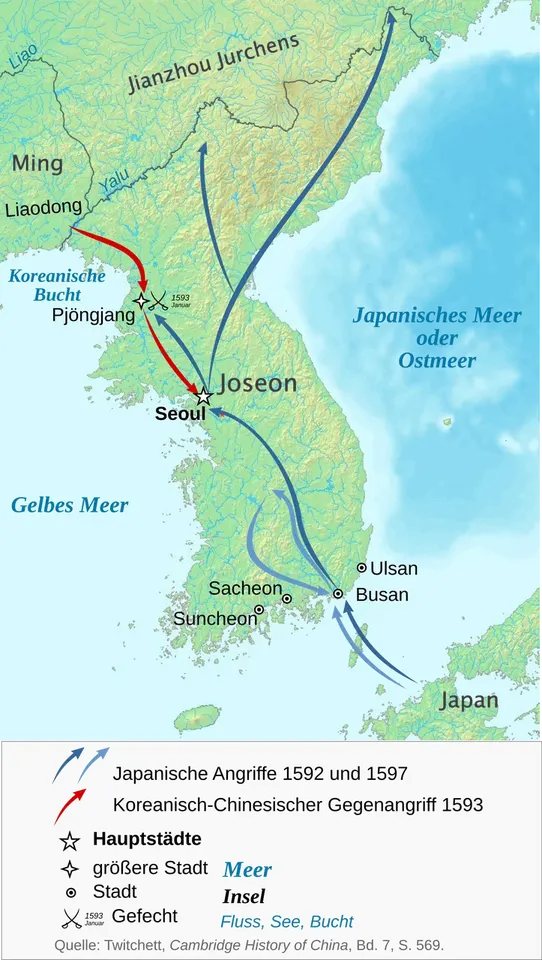
The Three Great Campaigns of the Wanli Era (万历三大征) refers to three major concurrent military mobilizations executed by the Ming imperial government between 1592 and 1600: the Ningxia Campaign, the Korean Campaign, and the Bozhou Campaign. In February 1592, surrendered Mongol commander Pubei mutinied in Ningxia, assassinating the provincial governor and threatening Shaanxi. Concurrently in April, Japanese warlord Toyotomi Hideyoshi launched over one hundred and forty thousand troops across the sea to conquer Korea as a springboard into China, sweeping north toward the Yalu River. Simultaneously, hereditary Miao-Han chieftain Yang Yinglong rebelled in Bozhou, raiding strategic borders across Sichuan, Guizhou, and Huguang. In response, the Wanli Emperor and the Grand Secretariat mobilized veteran Liaodong iron cavalry, frontier firearm divisions, and multi-provincial armies under renowned commanders Li Rusong, Ma Gui, Xing Jie, and Li Hualong. Over eight years of brutal campaigning, the Ming dynasty crushed all three adversaries, defending dynastic sovereignty and cementing geopolitical order across East Asia.
Surrendered officer Pubei revolts; Ming armies flood the citadel with Yellow River water to eradicate the rebellion.
Li Rusong crosses the Yalu River, recapturing Pyongyang, Kaesong, and Hanseong; the Battle of Noryang concludes total victory.
Li Hualong directs an eight-pronged envelopment to breach Hailongtun fortress, prompting Yang Yinglong's suicide and establishing direct civil rule.
Since the mid-Ming era, the dynasty had suffered chronic defense decay and fiscal exhaustion from piracy along the southeastern coast and nomad incursions across the northern steppe. During the early Wanli reign, Grand Senior Secretary Zhang Juzheng implemented the Single Whip Law, cadastral resurveys, and administrative audits, revitalizing bureaucratic efficiency. The imperial Taicang treasury amassed over four million taels of silver alongside vast grain stores, providing an unprecedented financial cushion for major military conflicts.
In defense modernization, Zhang Juzheng partnered with celebrated generals Qi Jiguang and Li Chengliang to reconstruct northern frontier ramparts, equipping border corps with matchlocks, swivel cannons, and armored artillery wagons. This transformed the Liaodong cavalry and metropolitan brigades into formidable tactical shock divisions.
Around 1592, imperial border security disintegrated simultaneously along three distant frontiers. In the northwest, Ningxia served as an essential pillar of the Nine Garrisons. Pubei, a surrendered Mongol commander holding high military office, clashed violently with provincial civil governor Dang Xin over rations, inciting garrison mutiny and opening frontier gates to nomadic Ordos cavalry.
In East Asia, Toyotomi Hideyoshi unified Japanese feudal factions and launched his grand design to conquer Ming China. Japanese armies crossed the Korea Strait, overrunning eight Korean provinces within two months. King Seonjo fled north to the border outpost of Uiju, appealing desperately to the Ming court for military salvation. Meanwhile, in the southwestern mountains, hereditary aboriginal chieftain Yang Yinglong exploited imperial distractions, raiding Jiangjin and Nanchuan, forcing the Ming Empire to wage simultaneous wars on three distant fronts.
On February 18, 1592, retired Vice General Pubei, his son Pucheng'en, and adoptive son Pucun incited garrison shock troops to mutiny. The rebels assassinated Governor Dang Xin and Vice Commissioner Shi Jifang, burning government yamens, seizing official seals, and driving Commander-in-Chief Zhang Weizhong to suicide. Seducing Ordos Mongol chieftains with grazing lands, the rebel confederacy captured Zhongwei, Guangwu, Yuquanying, and Lingzhou, throwing all Shaanxi into panic.
The Wanli Emperor appointed Ye Mengxiong as Supreme Commander and summoned Liaodong Regional Commander Li Rusong as Field General, paired with veteran Ma Gui. Mobilizing over forty thousand elite cavalry from Xuanfu, Datong, Shanxi, and Liaodong, Ming armies severed Mongol supply links and crushed Ordos cavalry in desert engagements.
By June, Ming legions encircled Ningxia citadel, where rebels repelled assaults behind thick masonry. Supreme Commander Ye Mengxiong conceived an engineering stratagem, constructing extensive dikes around the perimeter to divert the Yellow River directly against the ramparts. By September, flooded walls collapsed, and famine and pestilence ravaged the garrison. Li Rusong led amphibious storming parties onto the breached battlements, slaying Pucun. Facing hopeless defeat, Pubei immolated himself in flames, while Pucheng'en and Liu Dongyang were captured and executed, concluding the eight-month siege in absolute victory.
With Ningxia stabilized, the court redirected elite forces toward northeast Asia. In December 1592, the Wanli Emperor appointed Li Rusong as Supreme Expeditionary Commander, marching over forty thousand veteran Liaodong horsemen and firearm brigades across the frozen Yalu River into Korea.
On January 8, 1593, Li Rusong assaulted the strategic citadel of Pyongyang. Ming artillery battalions unleashed devastating barrages with Great General Cannons and European swivel guns against the Xuanwu Gate, while Liaodong assault corps engaged Konishi Yukinaga's First Division in savage hand-to-hand combat, recapturing Pyongyang in a single day and slaying over ten thousand invaders. Retiring southward in disorder, Japanese forces yielded Kaesong and Hanseong (modern Seoul). A prolonged four-year diplomatic and military stalemate ensued.
In 1597, Hideyoshi repudiated negotiations and unleashed one hundred and forty thousand troops in a second invasion. The Ming court dispatched Supreme Commander Xing Jie, General Ma Gui, and Yang Gao to Korea. Ming troops shattered Japanese advances at the Battle of Jiksan, bottling the invaders inside coastal fortress perimeters along the southern coast.
In August 1598, Hideyoshi died in despair at Fushimi Castle, ordering total evacuation. On November 19, Ming naval veteran Deng Zilong and Korean Admiral Yi Sun-sin directed a combined fleet in the historic Battle of Noryang Strait. Employing fire-ships and concentrated naval cannons, the allied fleet decimated hundreds of fleeing Japanese vessels. Although both Deng Zilong and Yi Sun-sin fell heroically in battle, the decisive naval victory annihilated Japanese expansionist ambitions, concluding seven years of war in complete allied triumph.
Following the conclusion of the Korean conflict, the court mobilized against the entrenched aboriginal threat in the southwest. In 1599, hereditary chieftain Yang Yinglong erupted in open rebellion, leading tens of thousands of fierce hill warriors to sack Qijiang, directly menacing Chongqing and Guiyang.
In early 1600, the Wanli Emperor appointed capable administrator Li Hualong as Vice Minister of War and Supreme Commander of Sichuan, Guizhou, and Huguang. Li assembled two hundred thousand multi-provincial troops, partitioning them into an eight-pronged concentric offensive led by celebrated generals Liu Ting, Ma Liying, and Wu Guang, advancing simultaneously across rugged borders toward Yang's citadel at Hailongtun.
Yang Yinglong entrenched his defenders behind three tiers of precipitous mountain gates. Li Hualong hacked military roads through primeval forests, blasting through defiles with heavy ordnance. In May, all eight columns converged beneath Hailongtun, encircling the cliff fortress. In June, General Liu Ting scaled the rear precipice in a midnight storm, breaching the inner sanctum. Facing capture, Yang donned chainmail and hanged himself alongside his consorts. Ming forces eradicated remaining resistance, dividing Bozhou into Zunyi and Pingyue prefectures under standard civil administration. The intense 114-day campaign ended in complete imperial victory.
The triumph of the Three Great Campaigns demonstrated the Ming Empire's extraordinary mobilization capabilities and firepower superiority during the late sixteenth century. The Ningxia campaign eliminated mutinous internal unrest along the northwestern corridor; the Korean war decisively repelled Japanese imperialist aggression, preserving the East Asian tributary system and securing two and a half centuries of regional peace; while the Bozhou campaign permanently eradicated vast hereditary feudal fiefs in the southwest, accelerating the integration of ethnic minorities under standardized civil rule.
However, waging multi-theater warfare across thousands of miles over eight continuous years imposed crippling costs upon imperial reserves. The campaigns consumed more than ten million silver taels, exhausting the treasury reserves accumulated during Zhang Juzheng's reforms.
Critically, shifting elite Liaodong cavalry and veteran frontier commanders to Korea and the southwest created a catastrophic defense vacuum in the northeast. While Ming forces were committed elsewhere, Jurchen chieftain Nurhaci expanded unchecked across the Changbai Mountains, subjugating neighboring clans and building the Manchu military apparatus that would ultimately topple the Ming Dynasty.
The Annals of Emperor Shenzong in the History of Ming records: "At that time, annual levies increased by five million taels and three hundred thousand troops were mobilized, shaking inside and out. Yet Ningxia was pacified, Korea restored, and Bozhou subdued; Emperor Shenzong proclaimed them the Three Great Campaigns, regarding them as glorious triumphs, though the state's vitality was consumed thereby."
Wang Shizhen remarked in Works of Yanzhou Shanren: "The realm had long rested in peace, leaving frontier defenses decayed when formidable adversaries arose together. Emperor Shenzong boldly dispatched legions over vast distances, prevailing on water and land. The Three Great Campaigns achieved absolute victories, projecting Ming majesty across the seas in a magnificent display of martial valor."