Dual Commandery-Principality System Established
Liu Bang invests nine agnatic princes and seals the White Horse Alliance, creating expansive feudatories that sow seeds of regional fragmentation.
Western Han (西汉) · HISTORICAL EVENT
推恩令
The Decree of Extending Grace (推恩令) was a landmark political reform promulgated in the spring of 127 BCE (the second year of the Yuanshuo era) by Emperor Wu of Han upon the counsel of Palace Grandee Zhufu Yan, designed to peacefully neutralize the deep-seated regional separatist threat posed by autonomous agnatic princes. In the early Western Han dynasty, the dual system of commanderies and principalities allowed imperial clansmen to amass vast…
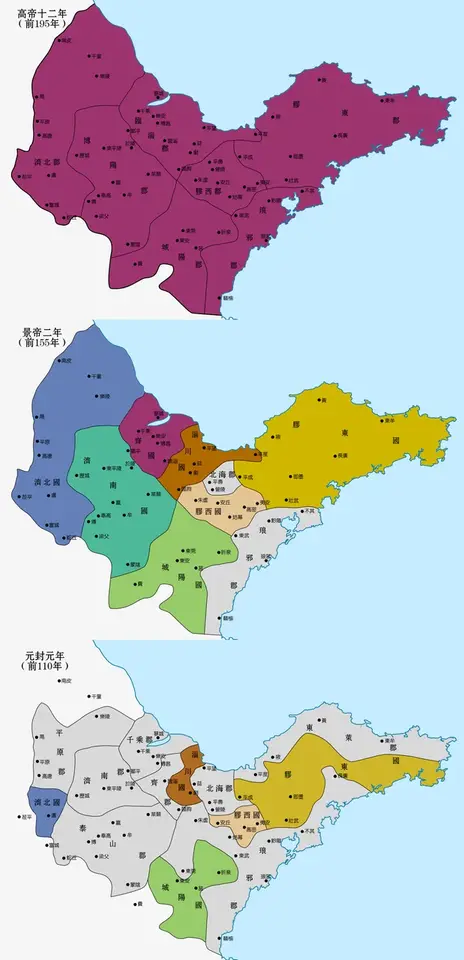
The Decree of Extending Grace (推恩令) was a landmark political reform promulgated in the spring of 127 BCE (the second year of the Yuanshuo era) by Emperor Wu of Han upon the counsel of Palace Grandee Zhufu Yan, designed to peacefully neutralize the deep-seated regional separatist threat posed by autonomous agnatic princes. In the early Western Han dynasty, the dual system of commanderies and principalities allowed imperial clansmen to amass vast territories and private armies. An aggressive territorial retrenchment under Emperor Jing had triggered the Rebellion of the Seven States, and although that uprising was suppressed, the underlying structural danger of massive feudal enclaves remained unresolved. Emperor Wu embraced the maxim of multiplying principalities to dilute their strength, commanding that vassal kings retain the royal lineage through the primary heir while granting secondary and cadet sons land parcels elevated to imperial marquisates administered directly by central commandery governors. By cloaking dynastic dissolution under imperial benevolence and filial piety, the decree spurred secondary sons to divide kingdoms from within, precipitating natural territorial fragmentation. Complemented by the Left Office Law, the Law Against Collusion, and the Liquor Gold purges, the reform stripped princely realms of all military and administrative menace, firmly establishing undivided centralized bureaucratic rule nationwide.
Liu Bang invests nine agnatic princes and seals the White Horse Alliance, creating expansive feudatories that sow seeds of regional fragmentation.
Jia Yi analyzes the danger of overmighty vassals, proposing the strategy of multiplying principalities to diminish their power.
Chao Cuo's aggressive land seizures trigger a major coalition revolt; Zhou Yafu crushes the rebellion and the court revokes princely appointment rights.
Emperor Wu ascends the throne seeking total centralization, while princes in Huainan and Yan accumulate weaponry and pose hidden threats.
Palace Grandee Zhufu Yan advises allowing princes to endow cadet sons with land, which Emperor Wu embraces as grand national strategy.
Emperor Wu issues the decree permitting princes to ennoble secondary sons, placing new marquisates under commandery rule and triggering partition.
Imperial statutes degrade princely officials and impose death penalties for collusion, thoroughly isolating feudal courts from elite talent.
Liu An's conspiracy collapses and the conspirators commit suicide; Huainan, Hengshan, and Qi are annexed directly as imperial commanderies.
Emperor Wu inspects ceremonial gold offerings, revoking titles and domains from 106 marquises over alleged bullion purity deficiencies.
Princes are restricted strictly to tax revenues with zero governing power; commanderies rule the entire realm as Emperor Wu performs the Mount Tai sacrifices.
Following the founding of the Western Han dynasty after the fall of the Qin, Emperor Gaozu (Liu Bang) reflected on the swift collapse of the Qin regime, which he attributed to its total reliance on centralized commanderies without a hereditary nobility to serve as imperial buffers. Consequently, Liu Bang implemented a dual system of commanderies and principalities. After eradicating the non-clansmen rebel kings such as Han Xin, Peng Yue, and Ying Bu, he sealed the White Horse Alliance, decreeing that only members of the imperial Liu clan could be invested as princes, hoping kinship ties would safeguard the dynasty.
However, as generations passed and blood ties attenuated, the agnatic princes exercised vast territorial sovereignty. The larger feudal kingdoms encompassed entire commanderies and dozens of cities, replicating the palaces and ministerial apparatus of the imperial capital. Vassal kings collected independent taxes, controlled iron and salt monopolies, minted private currency, appointed internal officials, and drilled autonomous armed forces. Under Emperors Wen and Jing, states such as Wu, Chu, and Qi occupied over half the realm's territory, routinely defying central edicts and posing a lethal menace to imperial sovereignty.
Foreseeing the catastrophe of bloated feudal fiefs, Western Han statesmen sought structural remedies. During Emperor Wen's reign, the brilliant political essayist Jia Yi warned in his celebrated Memorial on Peace and Order that the feudatories resembled swollen limbs crippling the body politic. He formulated the seminal concept of establishing numerous principalities to disperse their strength, advocating the division of large realms into diminutive enclaves so that diminished territories would naturally curb subversive arrogance. Emperor Wen, mild by temperament, initiated tentative partitions but refrained from systematic enforcement.
Upon Emperor Jing's accession, Imperial Censor Chao Cuo pursued an aggressive policy of direct territorial confiscation, arguing that vassals would rebel whether their land was stripped or not, but an early revolt would be smaller and easier to quell. Chao Cuo revoked commanderies from Zhao, Jiaoxi, Chu, and Wu. This abrupt, top-down stripping of land provoked violent resistance. In 154 BCE, Prince Liu Pi of Wu rallied seven feudatories under the slogan of executing Chao Cuo and purging the court, igniting the massive Rebellion of the Seven States.
Although Imperial Commander Zhou Yafu crushed the insurrection within three months, and Emperor Jing revoked the princes' power to appoint internal officials, the sprawling territorial landmass of the kingdoms remained virtually intact. The principalities retained dense populations and rich agricultural revenues. Vassal princes continued to patronize private swordsmen, harbor fugitives, and maintain clandestine contacts with court grandees, leaving the empire perpetually exposed to internal rebellion.
Emperor Wu ascended the throne in 141 BCE as an ambitious, visionary ruler determined to end decades of humiliating appeasement and tributary marriage treaties with the nomadic Xiongnu confederation. Launching expansive military expeditions across the northern steppes demanded the total mobilization of imperial grain reserves, taxation, and cavalry drafts. The presence of wealthy, semi-autonomous feudal states inside the empire created an intolerable vulnerability: if the imperial standing army marched deep into the Gobi Desert, opportunistic vassal princes could revolt and cut off the capital from behind.
At this juncture, Liu An, Prince of Huainan, was actively recruiting thousands of guest scholars, manufacturing siege weaponry, and forging imperial seals, while other princes harbored similar defiance. Emperor Wu recognized that moral suasion could not restrain ambitious rulers, whereas repeating Chao Cuo's blunt military confiscations risked triggering another devastating civil war.
Into this strategic impasse stepped Zhufu Yan, a destitute scholar from Linzi versed in political stratagems and philosophical arts. Traveling to Chang'an, Zhufu Yan submitted a memorial at the palace gates and was granted an immediate audience on the same evening. He presented Emperor Wu with an ingenious stratagem that resolved the vassal crisis through irresistible institutional psychology: the Policy of Extending Grace.
Around 128 BCE, Palace Grandee Zhufu Yan secretly memorialized Emperor Wu, observing that ancient feudal lords held territories no larger than a hundred li, which maintained natural power parity. In contrast, contemporary Han princes controlled vast expanses spanning a thousand li. If treated leniently, they indulged in dissipation and overweening ambition; if pressured abruptly, they formed coalitions to resist the throne, as demonstrated by the tragedy of Chao Cuo.
Zhufu Yan pinpointed the core internal contradiction within feudal families: under strict primogeniture, the royal title, palace treasury, and the entirety of the princely domain passed exclusively to the eldest legitimate son. Yet vassal kings fathered dozens of offspring through multiple consorts. Younger sons and cadet siblings, despite royal birth, received not an inch of land and were reduced to commoner status, breeding profound filial bitterness and family resentment.
Zhufu Yan proposed a masterstroke: let the emperor decree that vassal kings be permitted to extend ancestral kindness by distributing portions of their kingdoms to their secondary sons, elevating each into an imperial marquis. The secondary sons would rejoice at receiving landed status, the emperor would be lauded for benevolent filial virtue, and the princely domains would be peacefully fractured and neutralized without the court seizing a single parcel by force. Emperor Wu praised the stratagem and ordered its immediate execution.
In the first month of spring in 127 BCE (the second year of the Yuanshuo era), Emperor Wu officially issued the historic imperial edict. The decree magnanimously praised former royal loyalties and proclaimed that princes were hereby granted imperial permission to distribute portions of their estates among their younger sons as marquisates, with the court conferring official noble titles and names upon each.
The institutional mechanics of the decree formed an airtight political trap: First, voluntary appearance coupled with inescapable domestic compulsion. The central court did not issue an authoritarian land seizure edict. Instead, it merely granted permission for princes to endow their younger sons. Once publicized, the younger sons passionately pleaded for their shares. Any vassal prince who refused faced immediate domestic mutiny, public denunciation for unfilial cruelty, and direct accusations of defying an imperial decree of grace.
Second, radical restructuring of administrative jurisdiction. This represented the lethal stroke of the reform. Under imperial regulations, newly created marquisates did not remain subordinate to the original kingdom; rather, they were severed entirely from the principality and incorporated directly under the jurisdiction of imperial commandery governors appointed by Chang'an. Princely territorial integrity was instantly breached, transforming chunks of royal domain into standard imperial counties.
Third, progressive generational demotion. Cadet sons received the rank of marquis rather than prince. Marquisates could not inherit royal status and steadily degraded over subsequent generations into commoner holdings unless sustained by extraordinary military merit, or were promptly annexed by the court whenever a marquis committed an infraction. The colossal principalities melted away through normal biological succession.
Following the promulgation, an irreversible chain reaction swept across every imperial kingdom. Secondary sons of the princes of Qi, Zhao, Chu, Lu, and Liang submitted registries to Chang'an, petitioning the emperor for landed enfeoffment.
Emperor Wu broadly opened the imperial gates of ennoblement. Over the course of several years, hundreds of new marquisates were carved out. Records in the Book of Han indicate that over four hundred prince-son marquisates were established during Emperor Wu's reign. In Qi, Prince Liu Jianglü had over ten sons; the decree carved out more than a dozen marquisates including Linqu, Pingdu, and Yidu, transferring most of the kingdom's territory to imperial commanderies. Hejian was partitioned into dozens of petty holdings. The realms of Zhao, Chu, and Lu were similarly subdivided into fragile parcels. The kingdom of Liang, previously partitioned after Prince Xiao, was atomized further into inconsequential remnants.
Vast territories that once spanned whole commanderies and generated enormous commercial wealth were sliced into fragmented plots. The remaining royal domains dwindled to barely ten cities, and individual marquisates measured only dozens of li. Deprived of tax bases, princes could no longer sustain private armed forces or scholar retainers. Princes were consumed by domestic squabbles over property distribution, neutralizing any capacity for revolt. Paradoxically, princely clans expressed sincere gratitude to Emperor Wu for his benevolent generosity.
To consolidate the fragmentation achieved by the decree, Emperor Wu and his legalist ministers enacted a cordon of draconian administrative statutes, permanently severing the princes' political ties:
First, the Left Office Law. In Han political etiquette, the right signified honor while the left represented inferiority. Officials serving in the domestic administrations of princely states were designated as holding left offices, suffering degraded status, lower salaries, and absolute legal prohibitions against transferring into the central imperial bureaucracy. This law cut off the flow of ambitious Confucian scholars and capable administrators to feudal courts, forcing the empire's elite talent to seek advancement through imperial examinations and civil recommendations in Chang'an, reducing princely courts to administrative backwaters.
Second, the Law Against Collusion with Vassals. Emperor Wu imposed capital punishment by waist-bisection on any imperial or commandery official who fraternized with, accepted gifts from, or advocated for vassal princes. This terrifying penalty caused court grandees and military commanders to shun vassal kings entirely, utterly isolating them from the center of power.
Third, travel restrictions and partisan faction statutes strictly confined vassal kings within their designated borders, forbidding private excursions beyond their boundaries and penalizing imperial overseers who shielded princely misdeeds.
When isolated veteran princes attempted resistance, Emperor Wu crushed them with unsparing judicial force.
Between 124 and 123 BCE (the fifth and sixth years of the Yuanshuo era), the long-incubating treason plots of Prince Liu An of Huainan and Prince Liu Ci of Hengshan were unmasked. Imperial inquisitors discovered forged seals, stockpiled siege engines, and clandestine communications with the northern nomads. Confronted with overwhelming evidence, both Liu An and Liu Ci committed suicide. Emperor Wu formally abolished the kingdoms of Huainan and Hengshan, converting their territories into Jiujiang and Hengshan commanderies and executing thousands of conspirators. Shortly thereafter, Prince Liu Cichang of Qi committed suicide over legal charges, and Qi was converted into an imperial commandery; Prince Liu Dingguo of Yan also took his own life after an incest scandal, resulting in the dissolution of Yan into a commandery.
In 112 BCE (the fifth year of the Yuanshuo era), Emperor Wu utilized ancestral sacrifice rituals to deliver a decisive administrative blow known as the Liquor Gold Purge. Every autumn, noble marquises were obligated to submit pure gold offerings during the imperial temple libation ceremonies. Emperor Wu inspected the bullion in person, declaring that the offerings were of inferior purity and deficient weight. In a single sweep, he stripped one hundred and six marquises of their titles and confiscated their lands, including Chancellor Zhao Zhou. By 112 BCE, the century-old feudal enclaves east of the passes had been virtually eliminated.
Through decades of institutional fragmentation and rigorous legal enforcement, the political structure of the Western Han underwent an irreversible transformation. Agnatic kingdoms were geographically dismantled and administratively hollowed out into empty ceremonial titles.
Emperor Wu enacted legislation decreeing that vassal princes were completely excluded from local governance, entitled only to collect stipulated tax revenues from remaining personal estates. All administrative, financial, judicial, and military governance within princely lands was transferred to chancellors appointed directly by the imperial court, whose authority and compensation matched those of commandery governors and who answered directly to the central ministries in Chang'an. Princes were reduced to gilded aristocrats confined to inner palaces, lacking even the legal power to mobilize a single laborer or judge a minor offense.
The historic structural struggle between hereditary feudal enfeoffment and centralized bureaucratic commandery administration, which had persisted since the Warring States and Qin periods, was permanently decided. Every region and household across the realm was integrated into the uniform administrative grid of the centralized empire.
The implementation of the Decree of Extending Grace concluded in total triumph for the Western Han imperial court. Relying on exquisite institutional design without mobilizing troops or igniting civil war, Emperor Wu guided the sprawling agnatic principalities into voluntary self-fragmentation, splintering them into hundreds of minor marquisates. Reinforced by the Left Office Law, anti-collusion statutes, and the Liquor Gold purges, vassal princes were reduced to secluded figureheads collecting tax revenues while actual governance passed entirely to court-appointed chancellors and commandery governors, completely extinguishing internal separatist threats.
The Decree of Extending Grace exerted profound, epochal influence on Chinese political development. First, it permanently resolved the structural dichotomy between feudal enfeoffment and bureaucratic commandery governance that had troubled the empire since the Qin-Han transition, cementing the undisputed orthodoxy of the centralized bureaucratic state and establishing the foundational framework of a unified China for two millennia. Second, it secured Emperor Wu's rear flanks, enabling the court to mobilize grain, tax revenues, and cavalry from across the realm for four decades of northern expeditions against the Xiongnu, establishing the four commanderies of Hexi and opening the Eurasian Silk Road. Third, in the annals of statecraft, the decree established a timeless political paradigm of transforming overt conflict into subtle internal interest alignment, offering later dynasties a textbook model for peacefully dismantling regional warlords and centrifugal forces.