Oirat Offensive Begins
Esen launches a four-route invasion; Ming commander Wu Hao is killed at Maoerzhuang, prompting urgent frontier alerts.
Ming Dynasty (明朝) · HISTORICAL EVENT
土木堡之变
The Tumu Crisis (土木堡之变) was a catastrophic military campaign fought in August 1449 at Tumu Fortress in Northern Zhili. Following the unification of the Mongol tribes, the Oirat leader Esen Taishi launched a massive four-pronged invasion toward Datong. Persuaded by the influential court eunuch Wang Zhen, the twenty-two-year-old Emperor Yingzong of Ming embarked on a hasty imperial expedition with over 200,000 troops, disregarding widespread ministerial…
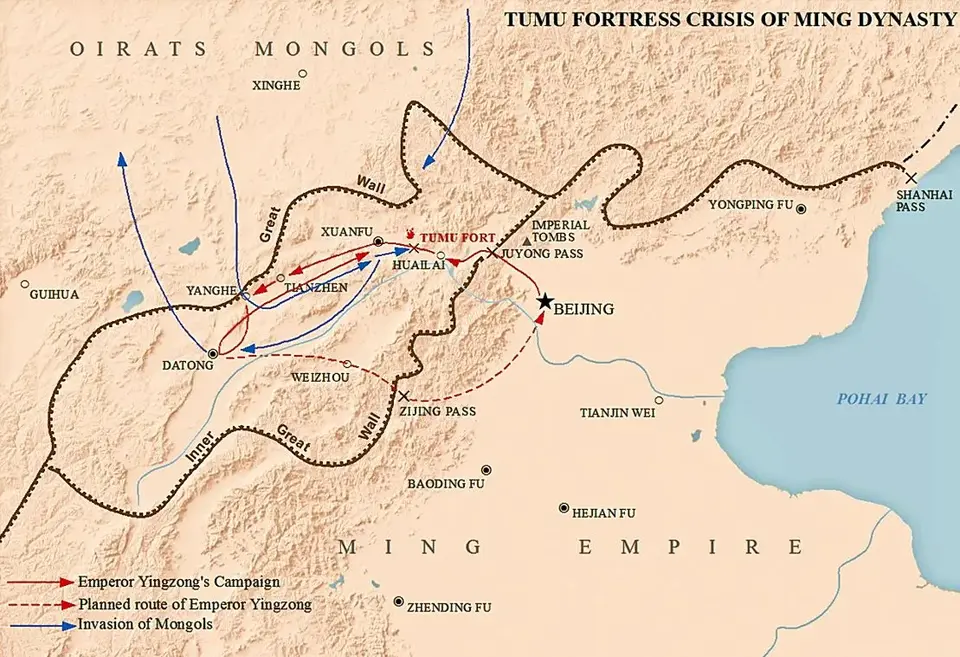
The Tumu Crisis (土木堡之变) was a catastrophic military campaign fought in August 1449 at Tumu Fortress in Northern Zhili. Following the unification of the Mongol tribes, the Oirat leader Esen Taishi launched a massive four-pronged invasion toward Datong. Persuaded by the influential court eunuch Wang Zhen, the twenty-two-year-old Emperor Yingzong of Ming embarked on a hasty imperial expedition with over 200,000 troops, disregarding widespread ministerial opposition. Hampered by severe summer downpours, inadequate supplies, and operational confusion, the expedition collapsed into disarray following early defeats on the frontier. Wang Zhen ordered an erratic retreat, detouring toward his home district of Yuxian to flaunt his influence before abruptly reversing course to avoid trampling his private estates. On August 13, the Ming rearguard was crushed at Yaoerling, and the main force was surrounded at waterless Tumu Fortress. On August 15, Esen feigned retreat and offered peace; when the parched Ming soldiers broke formation to rush for water, Oirat cavalry attacked from all sides, annihilating the entire army. Dozens of high-ranking statesmen perished, Wang Zhen was slain by imperial guard Fan Zhong, and Emperor Yingzong was captured. The disaster marked the turning point of the Ming dynasty from expansion to strategic defense, though Yu Qian subsequently preserved the capital in the Defense of Beijing.
Esen launches a four-route invasion; Ming commander Wu Hao is killed at Maoerzhuang, prompting urgent frontier alerts.
Persuaded by Wang Zhen, Emperor Yingzong leads an expedition of over 200,000 men from Beijing, leaving Zhu Qiyu to guard the capital.
A frontier army of 40,000 under Song Ying is destroyed by Oirat forces; the imperial column suffers severe torrential storms.
Terrified by battlefield slaughter, Wang Zhen orders an immediate retreat, arbitrarily redirecting the route toward Yuxian.
Fearing damage to his private estates, Wang Zhen orders the army to reverse course toward Xuanfu, squandering four critical days.
Oirat cavalry wipe out 40,000 cavalry under Zhu Yong at Yaoerling.
Only twenty li from Huailai, Wang Zhen forbids entering the city while waiting for his private baggage wagons, forcing the army to camp in the arid open field.
Oirat forces sever access to the southern river; parched Ming soldiers fail to reach water as the camp descends into panic.
Esen's false truce prompts a stampede toward the river; Oirat cavalry massacre the disordered ranks, slay Wang Zhen, and capture Emperor Yingzong.
During the Zhengtong era of the Ming dynasty, the steppe landscape underwent profound geopolitical transformation. The Oirat chieftains Toghon and his son Esen subdued rival eastern Mongol tribes, reducing the titular Khagan Toghtoa Bukha to a figurehead and establishing undisputed Oirat hegemony across the northern plains. While maintaining nominal tributary relations with the Ming court, Esen sought to extract substantial material wealth—including silk, grain, and iron implements—through extensive trading missions.
In 1448, Esen dispatched an enormous embassy to Beijing, falsely declaring over three thousand envoys to claim excessive imperial rewards while offering inferior horses. The dominant eunuch Wang Zhen, who controlled court decisions, strictly audited the mission, slashed the imperial bounty to one-fifth of requested sums, and drastically curtailed horse valuations. Offended by this economic blow, Esen mobilized the Oirat confederacy for a full-scale offensive into northern China.
Following the strategic retrenchment from forward outposts like Kaiping during the Xuande reign, the northern defense perimeter receded toward the Great Wall line. By the 1440s, military officers routinely embezzled garrison lands and withheld rations, driving nearly half the registered hereditary soldiers to desert. Frontier troops lacked basic equipment, weapons manufacture suffered widespread corruption, and the prolonged Luchuan campaigns in the southwest had drained treasury funds and elite veteran divisions.
After the deaths of the respected Three Yang grand secretaries, the youthful Emperor Yingzong relied heavily on Wang Zhen, the Director of Ceremonial who had attended him since childhood. Wang Zhen monopolized administrative power, purging outspoken ministers and silencing dissent. Seeking military glory to silence outer-court criticisms, Wang Zhen trivialized warfare and urged the impressionable young sovereign to emulate the victorious northern expeditions of the dynastic founders.
In July 1449, Esen initiated a coordinated invasion across four fronts: Toghtoa Bukha and the Uriankhai targeted Liaodong, Alag Chingsang attacked Xuanfu, and Esen led the primary strike force toward Datong. On July 11, Ming commander Wu Hao fell in battle at Maoerzhuang. As urgent dispatches reached the capital, Wang Zhen relentlessly pressured Emperor Yingzong to command the campaign in person, aiming to consolidate autocratic authority through martial prestige.
Minister of Personnel Wang Zhi and Minister of War Kuang Ye led senior bureaucrats in kneeling outside the palace gates, warning that frontier defenses were unready and the throne should not risk hazardous terrain. The emperor ignored their counsel, appointing his younger brother Zhu Qiyu to oversee the capital and mobilizing the Three Great Training Divisions on July 16. Nominally declared at 500,000 men, the force numbered around 200,000, accompanied by over a hundred noblemen and grand secretaries, leaving the capital stripped of strategic reserves.
The expedition departed in haste with severely inadequate logistical arrangements. On July 17, the vanguard reached Longhutai, where poor perimeter security caused nocturnal panic among the untrained troops. After crossing Juyong Pass on July 19, the army encountered relentless torrential downpours. Roads dissolved into deep mud, supply carts bogged down, rations failed to arrive, and soldiers suffered exposure and hunger. On July 22, the emperor reached Leijiazhan, receiving news that a relief force of 40,000 under Song Ying and Zhu Mian had been completely wiped out by Oirat cavalry at Yanghe.
On August 1, the imperial retinue entered Datong. Surrounded by howling steppe gales and bloated corpses lining the roads, the troops were exhausted and terrified. Regional eunuch Guo Jing privately warned Wang Zhen that the Oirat forces were invincible and Datong was indefensible. Realizing that actual warfare differed drastically from imperial court pageantry, Wang Zhen panicked and persuaded the emperor to order an immediate withdrawal. On August 3, the expedition hastily retreated from Datong, with Wang Zhen directing the route toward his native Yuxian to showcase imperial favor to his kin.
Halfway toward Yuxian, Wang Zhen realized that the massive marching army would trample and ruin his extensive private grain fields. Disregarding operational logic, he ordered the columns to reverse direction and retreat along the exposed Xuanfu route. This senseless detour exhausted the starving troops and squandered four vital days, granting Esen ample time to encircle the retreating columns. By August 10, when the Ming force reached Xuanfu, Oirat advance cavalry were already snapping at their heels.
On August 13, Oirat cavalry struck the Ming rearguard at Yaoerling. The brothers Wu Kezhong and Wu Keqin mounted a desperate rearguard stand, fighting to the death after expending all ammunition. Grand Duke Zhu Yong and Marquis Xue Shou led 40,000 cavalry to reinforce the rear but advanced blindly into a narrow mountain ravine without scouting. Ambushed from the cliffs, the entire relief division was slaughtered, leaving the imperial core exposed and demoralized.
On the afternoon of August 13, the imperial procession reached Tumu Fortress, situated only twenty li from the fortified walls of Huailai County. Minister of War Kuang Ye repeatedly implored the throne to enter the safety of Huailai immediately. However, because Wang Zhen had over a thousand private wagons laden with personal treasures trailing behind, he adamantly forbade entry to prevent theft, commanding the army to pitch camp on the barren, elevated ground of Tumu.
Tumu Fortress sat on elevated arid terrain completely devoid of springs. The nearest water source lay fifteen li to the south, and Esen quickly seized the riverbank and dug trenches, cutting off access. For two full days, the troops and horses were deprived of water. Desperate digging reached depths of twenty feet without yielding a drop. Parched soldiers collapsed in agony, while transport animals died in rows under the scorching late summer heat.
,Target: On the morning of August 15, Esen executed a cunning ruse, feigning withdrawal and sending envoys to offer a ceasefire. Overjoyed and desperate, Emperor Yingzong and Wang Zhen accepted the overture without reconnaissance, issuing an immediate order to dismantle the camp and march toward the river. Thousands of frenzied, dehydrated soldiers broke ranks in an uncontrollable stampede, trampling comrades in a frantic rush for water.
Within minutes, hidden Oirat cavalry surged from surrounding hills, proclaiming that those who dropped their weapons would be spared. The demoralized Ming forces disintegrated without resistance, casting aside armor and weapons. Oirat horsemen fell upon the helpless masses, slaughtering fleeing soldiers across tens of li. Over 200,000 soldiers perished in the rout, and the imperial military apparatus collapsed completely.
Amidst the carnage, imperial bodyguard Fan Zhong seized an iron mace and confronted the paralyzed Wang Zhen, shouting that he was executing the villain for the realm before crushing Wang Zhen's skull with a single blow. Fan Zhong fell in battle shortly afterward. Over fifty prominent dignitaries—including Grand Duke Zhang Fu, Ministers Kuang Ye and Wang Zuo, and Grand Secretaries Cao Nai and Zhang Yi—were cut down on the field. Emperor Yingzong, his personal guard scattered, dismounted and sat cross-legged facing south until captured by Oirat warriors, bringing the catastrophe to its bloody end.
The defeat at Tumu Fortress stands as one of the most devastating tactical catastrophes in Chinese military history. The core field army of the empire, numbering over 200,000 elite soldiers and the premier firearms regiments, was wiped out in a single morning, leaving the capital virtually defenseless.
The loss of over fifty senior ministers, grand secretaries, and hereditary generals decapitated the civil and military leadership of the realm. For the first time since the founding of the Ming dynasty, a reigning emperor was captured alive on the battlefield. Esen seized hundreds of thousands of horses, suits of armor, and advanced firearms, subsequently advancing directly to the gates of Beijing.
Strategically, the disaster irrevocably shifted Ming frontier policy from proactive expeditionary warfare to defensive entrenchment behind stone fortifications. The court abandoned ambitious steppe campaigns and dedicated immense fiscal revenues to constructing the continuous masonry Great Wall across the Nine Garrisons, imposing enduring fiscal strain on the imperial treasury.
Politically, the crisis elevated Confucian civil officials, led by Yu Qian, to dominance over hereditary military nobles and palace eunuchs. The enthronement of Emperor Daizong saved the empire from collapse but planted bitter seeds of discord. Upon his release and eventual return, Emperor Yingzong orchestrated the Restoration of 1457, executing Yu Qian and creating deep administrative divisions that troubled subsequent reigns.
The disaster at Tumu was analyzed by subsequent generations as the inevitable consequence of administrative decay and eunuch interference. Gu Yingtai recorded in the Ming History Essentials that while Prime Minister Kou Zhun had secured peace at Shanyuan through resolute fortitude, Wang Zhen possessed neither learning nor strategy, plunging the state into ruin through reckless bravado. He observed that Wang Zhen's guilt exceeded measure, and even execution could not compensate for the loss of the army.
In the History of Ming, Qing historians emphasized the scale of ministerial devotion alongside systemic failure. The imperial annals recorded that over fifty high dignitaries and hundreds of thousands of soldiers perished, leading to the unprecedented humiliation of imperial captivity. Historical consensus maintained that long years of peace had eroded military discipline, allowing court sycophancy to overrule professional military judgment with catastrophic results for the empire.