Breaking of the Jiangnan Camp
Taiping field armies crush Qing forces under Xiang Rong, lifting the siege of Tianjing and reaching peak power.
· HISTORICAL EVENT
天京事变
The Tianjing Incident (天京事变), also known as the Yang-Wei Incident, was a catastrophic internal purge and leadership civil war that erupted within the capital of the Taiping Heavenly Kingdom (modern Nanjing) between September and November 1856. Following the capture of Nanjing, Eastern King Yang Xiuqing monopolized civil administration and military commands. Exploiting his unique status as the living mouthpiece of the Heavenly Father through trances, Yang…
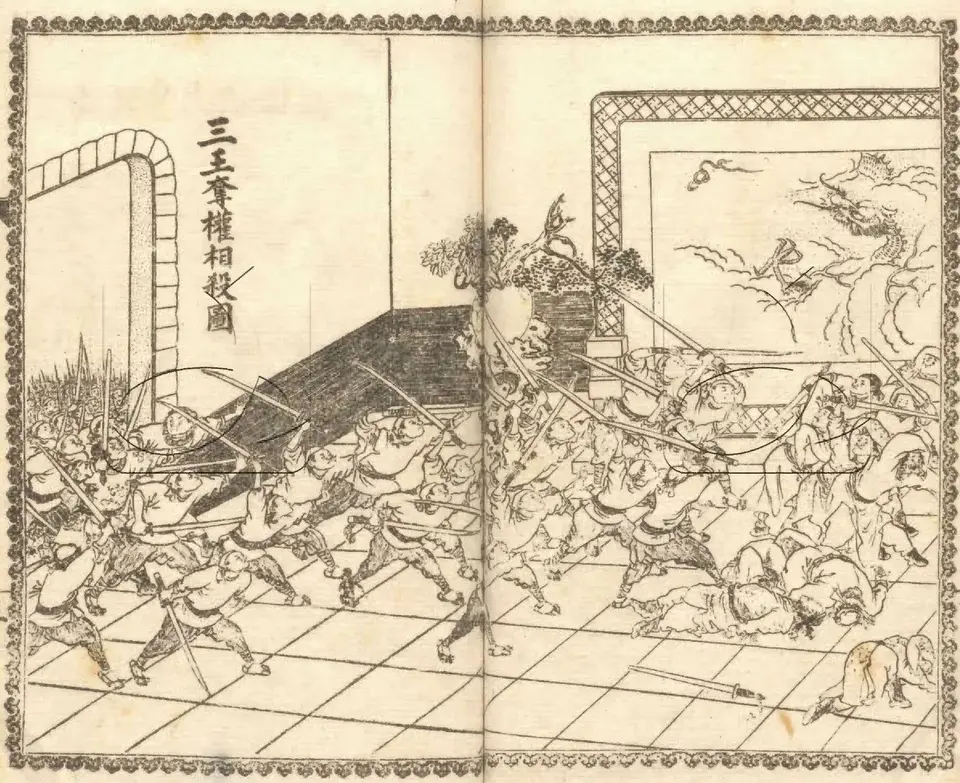
The Tianjing Incident (天京事变), also known as the Yang-Wei Incident, was a catastrophic internal purge and leadership civil war that erupted within the capital of the Taiping Heavenly Kingdom (modern Nanjing) between September and November 1856. Following the capture of Nanjing, Eastern King Yang Xiuqing monopolized civil administration and military commands. Exploiting his unique status as the living mouthpiece of the Heavenly Father through trances, Yang routinely undermined the authority of Heavenly King Hong Xiuquan and subjected rival kings to public floggings. In August 1856, after Taiping forces shattered the Qing Jiangnan Camp, Yang Xiuqing used a divine trance to demand that Hong Xiuquan bestow upon him the imperial honor of Ten Thousand Years. Confronting an existential threat, Hong Xiuquan secretly summoned Northern King Wei Changhui, Wing King Shi Dakai, and Swallow King Qin Rigang from the frontlines to eliminate Yang. Wei Changhui stormed the Eastern King Palace, assassinating Yang and initiating a two-month reign of terror that slaughtered over twenty thousand followers. When Shi Dakai protested the massacre, Wei murdered his family, prompting Shi to mobilize an army in Anqing. Desperate to restore order, Hong Xiuquan executed Wei Changhui. The fratricidal bloodbath destroyed the core leadership of the rebellion, prompting Shi Dakai's defection and sealing the ultimate defeat of the Taiping movement.
Taiping field armies crush Qing forces under Xiang Rong, lifting the siege of Tianjing and reaching peak power.
Yang Xiuqing uses a divine trance to demand the imperial title of Ten Thousand Years; Hong Xiuquan issues secret decrees.
Wei Changhui and Qin Rigang storm the Eastern King Palace, slaying Yang Xiuqing and his household retinue.
Wei Changhui lures five thousand unarmed followers of the Eastern King into an ambush, slaughtering them en masse.
Execution squads scour Tianjing, massacring over twenty thousand veteran soldiers, clerks, and family members.
Shi Dakai confronts Wei Changhui over the massacres; after escaping over the city walls, his entire family is murdered.
Shi Dakai mobilizes his army at Anqing and demands the execution of Wei Changhui, threatening to storm the capital.
Hong Xiuquan orders palace troops to arrest and dismember Wei Changhui, later executing Qin Rigang and Chen Chengrong.
Shi Dakai returns to administer the government, but is systematically undermined by Hong Xiuquan's brothers.
Distrusted by the Heavenly King, Shi Dakai leads over 100,000 veteran troops out of Tianjing, sealing the doom of the rebellion.
In the spring of 1853, the Taiping armies captured Jiangning, renaming it Tianjing and establishing it as their heavenly capital. From the origins of the Jintian Uprising, the Taiping state maintained a dual structure of authority: while Heavenly King Hong Xiuquan was the religious prophet and sovereign monarch, executive military and civil governance was vested in the Chief of Staff. Following the early battlefield deaths of South King Feng Yunshan and West King Xiao Chaogui, Eastern King Yang Xiuqing consolidated absolute control over the military, the civil administration, and the religious hierarchy.
Yang Xiuqing claimed the exclusive prerogative of divine possession, speaking with the absolute authority of the Heavenly Father (God). In this theocratic framework, Yang Xiuqing was not merely the prime minister, but a direct spiritual manifestation whose words bound even Heavenly King Hong Xiuquan. Over time, Yang secluded himself within the Eastern King Palace, conducting daily governance while Hong Xiuquan was relegated to an isolated ceremonial figurehead in the inner palace.
As absolute power hardened into tyranny, Yang Xiuqing alienated his fellow commanders through public humiliations. Citing divine commands during spiritual trances, Yang forced Hong Xiuquan to kneel before him and threatened the monarch with corporal flogging. He repeatedly flogged Northern King Wei Changhui and Swallow King Qin Rigang over minor infractions, and publicly humiliated Assistant King Shi Dakai's father-in-law, Huang Yukun, by administering three hundred cane strokes. A reservoir of hatred festered among the high command.
In June 1856, Taiping field armies under Yang Xiuqing's strategic direction destroyed the Qing army's elite Jiangnan Camp, relieving the three-year siege of Tianjing and lifting the rebellion to its military zenith. Drunk with success, Yang staged another divine trance in August, summoning Hong Xiuquan to the Eastern King Palace. Speaking as the Heavenly Father, Yang demanded that Hong grant him the title of Ten Thousand Years—a prerogative reserved exclusively for the reigning emperor—and bestow the same title upon his heirs. This transparent maneuver to usurp the throne forced Hong Xiuquan into active resistance.
Recognizing that compliance meant his eventual deposition and death, Hong Xiuquan outwardly consented to the demand while secretly dispatching trusted messengers to the war fronts. He issued confidential edicts commanding Northern King Wei Changhui in Jiangxi, Wing King Shi Dakai in Hubei, and Swallow King Qin Rigang to return immediately to the capital with elite troops to execute Yang Xiuqing.
On the night of September 1, 1856, Wei Changhui arrived outside Tianjing with three thousand elite shock troops, having conducted a rapid march from Jiujiang. He rendezvoused with Qin Rigang, while Chancellor Chen Chengrong, harboring bitter resentment against Yang Xiuqing, opened the city gates to let the conspirators enter. Before dawn on September 2, Wei Changhui's forces surrounded the Eastern King Palace, battered through the gates, and slaughtered the guards. Yang Xiuqing was cut down in his bedchamber, and his immediate family and personal retinue were massacred.
Having eliminated his primary rival, Wei Changhui surrendered to unrestrained bloodlust. Exploiting the absence of rival kings and wielding martial authority, Wei expanded the operation into an indiscriminate purge of all personnel associated with the Eastern King. On September 5, Wei Changhui and Chen Chengrong devised a trap: proclaiming that the Heavenly King had ordered Wei to undergo public cane floggings to appease the Eastern King's followers, they invited over five thousand unarmed veterans to the palace grounds to witness the punishment.
Once the unarmed soldiers assembled inside the courtyards, Wei Changhui ordered the gates barred and commanded hidden riflemen and swordsmen to attack. Trapped within the walls, thousands of veteran soldiers were slaughtered. Over the following weeks, Wei Changhui's execution squads conducted door-to-door sweeps across Tianjing, executing clerks, palace maids, administrators, and soldiers. Over twenty thousand veterans and non-combatants perished in the slaughter, with corpses choking the city streets and turning the waters of the Qinhuai River red.
In late September, Wing King Shi Dakai rushed back to Tianjing from the Hubei front after capturing Wuchang. Entering the capital, he was horrified by the devastation and the stench of decay. In a tense confrontation at the Northern King Palace, Shi Dakai severely reprimanded Wei Changhui, arguing that even if Yang Xiuqing was guilty of treason, slaughtering tens of thousands of veteran comrades was an act of madness that would destroy the kingdom.
Guilty and paranoid, Wei Changhui took offense and plotted to murder Shi Dakai that very night. Forewarned by loyalist guards, Shi Dakai scaled the city ramparts with ropes under cover of darkness and escaped the capital. Enraged by his flight, Wei Changhui surrounded Shi Dakai's residence in Tianjing, butchering his aged mother, his pregnant wife, his infant children, and all his household retainers.
Reaching the stronghold of Anqing, Shi Dakai was overcome with grief and fury. He mobilized tens of thousands of elite western expeditionary troops, issued a manifesto denouncing Wei Changhui as a traitor, and dispatched messengers to Hong Xiuquan declaring that unless Wei was executed, he would march his armies back to lay siege to Tianjing. Shi Dakai's declaration won universal support across the Taiping army and among the terrified citizens of the capital.
Recognizing that Wei Changhui had lost all legitimacy and that his own position was untenable, Hong Xiuquan coordinated with palace guards and local garrison commanders. On November 2, 1856, loyalist troops assaulted the Northern King Palace, capturing Wei Changhui. The Northern King was executed, his body dismembered, and his head paraded through the streets. Swallow King Qin Rigang and Chancellor Chen Chengrong were subsequently condemned to death, concluding two months of uninterrupted bloodletting.
In November 1856, Shi Dakai returned to Tianjing to assume control of civil and military affairs. Welcomed by the population as a savior, he restored administrative order and stabilized the frontlines. However, deeply traumatized by the mutiny, Hong Xiuquan grew chronically suspicious of non-kin commanders. To neutralize Shi Dakai's authority, Hong elevated his two incompetent elder brothers, Hong Renfa and Hong Renda, to royal status, appointing them to oversee state business and obstruct the Wing King.
Realizing that remaining in the capital invited another purge, Shi Dakai made the fateful decision to depart. In May 1857, he led over one hundred thousand elite veteran soldiers out of Tianjing, embarking on an independent military campaign through southwestern China. Stripped of its best general and its most capable fighting divisions, Shi Dakai's army wandered aimlessly through Jiangxi, Hunan, and Sichuan before meeting complete destruction along the Dadu River in 1863.
The immediate aftermath of the Tianjing Incident was catastrophic. Over twenty thousand elite soldiers, administrators, and experienced officers—men who had marched from Guangxi through central China—were annihilated not by Qing armies, but by the swords of their own comrades.
The purge decapitated the central government. The deaths of Yang Xiuqing, Wei Changhui, and Qin Rigang shattered the unified command structure that had directed the expansion of the rebellion. The moral authority of the Taiping theocracy evaporated as common soldiers witnessed their sacred kings butcher one another for temporal supremacy.
In the strategic dimension of the Chinese civil war, the Tianjing Incident was the definitive turning point that ensured the survival of the Qing dynasty. Prior to the purge, the Taiping state stood poised to conquer the Yangtze valley and advance across northern China. The internal bloodbath and Shi Dakai's subsequent defection with one hundred thousand veteran troops created a fatal military vacuum.
The Qing court exploited this paralysis with remarkable speed. Imperial commanders rebuilt the Jiangnan and Jiangbei camps, encircling Tianjing once again. Zeng Guofan's Xiang Army seized the strategic initiative along the middle Yangtze, recapturing Wuhan and Anqing. Deprived of seasoned leadership and unified command, the Taiping Heavenly Kingdom drifted into defensive fragmentation, culminating in the fall of Tianjing and the annihilation of the movement in 1864.
In his History of the Taiping Heavenly Kingdom, historian Luo Ergang observed that the Tianjing Incident was the supreme tragedy of the Taiping revolution. He noted that Yang Xiuqing's royal ambitions provoked Wei Changhui's uncontrolled slaughter of twenty thousand veterans, leaving the realm without generals and the court without statesmen, extinguishing the revolutionary momentum of the movement.
In his autobiographical deposition, Loyal King Li Xiucheng recalled the trauma with profound grief, reflecting that the internal strife between the Eastern and Northern kings broke the morale of the entire army. He recorded that from the moment of the Tianjing massacres, mutual trust between the Heavenly King and his ministers ceased to exist, initiating the rapid decline of the kingdom.
Qing statesman Zeng Guofan analyzed the strategic shift with sharp clarity, writing in his memorials that the rebels had turned their weapons upon one another, slaying their most capable leaders and destroying their own unity. He concluded that Heaven had delivered the enemy into imperial hands, marking the Tianjing mutiny as the moment when the suppression of the rebellion was irrevocably secured.