Initial proclamation and suspension
Dorgon introduces head shaving upon entering Beijing but rescinds it due to intense northern resistance.
Qing Dynasty (清朝) · HISTORICAL EVENT
剃发令
The Queue Order (剃发令, Tifaling) was a defining cultural and political decree enforced by the Qing dynasty during its conquest of China. First introduced tentatively in 1644 following the fall of Beijing and temporarily suspended due to fierce resistance in the north, the edict was reissued with absolute brutality in the summer of 1645 after Prince Yu Dodo captured Nanjing and extinguished the Southern Ming Hongguang regime. Conceived by Prince Regent…
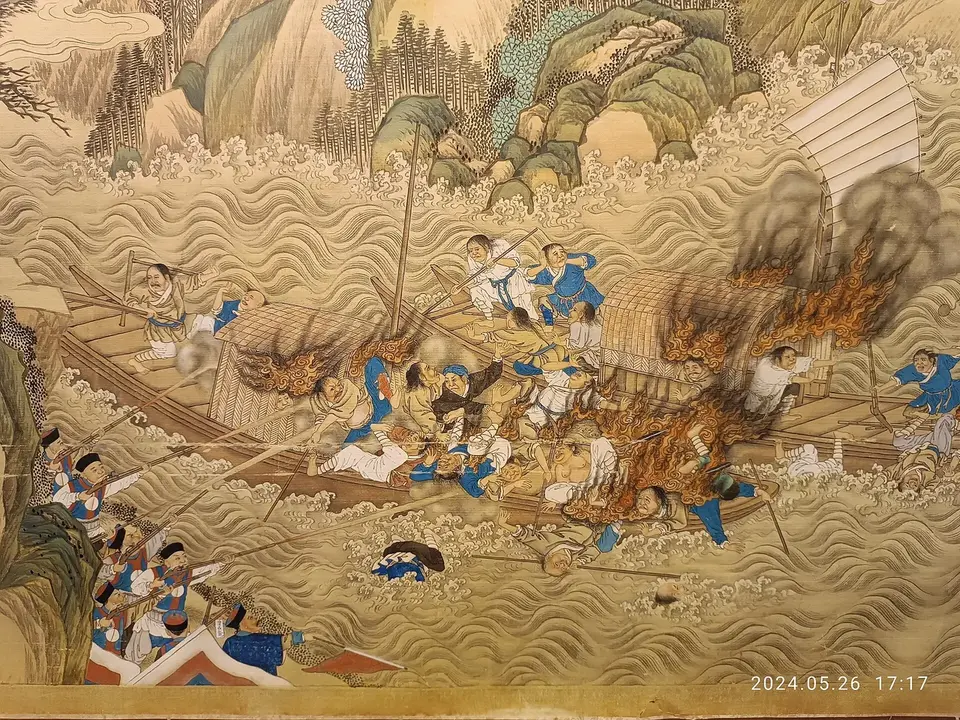
The Queue Order (剃发令, Tifaling) was a defining cultural and political decree enforced by the Qing dynasty during its conquest of China. First introduced tentatively in 1644 following the fall of Beijing and temporarily suspended due to fierce resistance in the north, the edict was reissued with absolute brutality in the summer of 1645 after Prince Yu Dodo captured Nanjing and extinguished the Southern Ming Hongguang regime. Conceived by Prince Regent Dorgon upon the urging of Chinese collaborator Sun Zhixie, the decree commanded all adult Han Chinese males across the empire to shave the front and sides of their heads within ten days and braid the remaining hair into a queue, accompanied by the mandatory adoption of Manchu horse-hoof attire. Traditional Chinese culture regarded hair and headwear as the physical vessel of filial piety and civilizational dignity. The forced imposition ignited ferocious armed resistance throughout the prosperous Jiangnan cities, precipitating catastrophic tragedies including the Eighty-One Days of Jiangyin and the Three Massacres of Jiading. Through overwhelming military devastation, the Qing dynasty firmly established the queue system for two hundred and sixty-seven years, fundamentally altering Chinese social life until the Republican Provisional Government enacted the queue-cutting decree in 1912.
Dorgon introduces head shaving upon entering Beijing but rescinds it due to intense northern resistance.
Following the fall of Nanjing, Dorgon adopts Sun Zhixie's memorial and issues a nationwide ten-day ultimatum.
The Qing court prohibits traditional Han clothing and mandates horse-hoof robes and official peacock hats.
Yan Yingyuan and Chen Mingyu lead one hundred thousand citizens to shut city gates and defy the shave edict.
Qing artillery breaches the walls; Yan and Chen die as martyrs while one hundred and seventy thousand civilians perish.
Li Chengdong sacks Jiading three times following recurrent insurrections, slaughtering thirty thousand residents.
Zheng Chenggong mounts coastal campaigns while Li Dingguo leads inland armies under Ming banners.
Popular resistance solidifies unwritten compromises permitting Ming attire for women, corpses, and actors.
Revolutionary soldiers and citizens cut hair braids across liberated cities to symbolize the overthrow of imperial rule.
The Republican government mandates complete removal of braids within twenty days, abolishing the Qing hair system.
Within classical Chinese civilization, hairstyles, caps, and robes were never regarded merely as utilitarian coverings or decorative vanity. Rather, they served as the sacred embodiment of Confucian rites, moral propriety, and cultural identity. The Classic of Filial Piety established as a core axiom that one's body, hair, and skin derive from one's parents and must not be harmed, constituting the very foundation of filial conduct.
From the Zhou and Han dynasties onward, coming-of-age rituals for adult men and women centered upon binding all hair into topknots fastened with hairpins, crowned with caps, and draped in wide-sleeved robes with right-overlapping collars. This ritual attire distinguished civilized order from peripheral cultures and constituted the pillar of cultural self-esteem.
Originating within the dense boreal forests and river valleys of the northeast, the Jurchen and Manchu peoples lived as hunters, gatherers, and mounted warriors. In thick timberlands and fast cavalry engagements, long unbound hair or tall topknots frequently caught upon branches and vines, obstructed peripheral vision, and accumulated sweat that froze in bitter winters.
To facilitate archery on horseback and instantly identify allies during warfare, early Jurchens developed the practical custom of shaving the front crown and temples entirely, gathering the rear hair into a single slender braid. The Manchu leadership elevated this functional habit into a sacred symbol of martial virtue, clan solidarity, and dynastic identity, even viewing the braid as the spiritual anchor of a fallen warrior.
Well before breaching the Shanhai Pass, the Later Jin and early Qing regimes had institutionalized head shaving as an unalterable litmus test of absolute surrender. In 1631, when Khan Hong Taiji besieged and captured Dalinghe, surrendering Ming general Zu Dashou and his garrison were immediately ordered to shave their heads as an irreversible breach with the Ming court.
Subsequent victories over Songshan and Jinzhou, along with the capture of Hong Chengchou, similarly mandated the razor. When Hong Taiji subdued the Joseon kingdom of Korea, hairstyle compliance was actively debated as a parameter of vassal submission. By 1644, extramural administrative experience had transformed head shaving into an uncompromising metric of dynastic fealty.
In May 1644, following Li Zicheng's capture of Beijing and Chongzhen's suicide, general Wu Sangui surrendered the Shanhai Pass to Prince Regent Dorgon. The joint Qing-Wu forces crushed the Shun armies at the Battle of Shanhai Pass, and Eight Banners forces occupied the imperial capital. Eager to assert supreme dominance, Dorgon issued a directive in early June ordering all surrendering officials and citizens in the metropolitan province to shave their foreheads and adopt Manchu hairstyles.
The reaction among northern literati and commoners was one of profound terror and vehement outrage. Markets closed in protest, scholars wept behind shuttered gates, and violent clashes erupted in surrounding counties such as Tongzhou and Baoding, where imperial couriers were ambushed.
At that critical juncture, Shun rebel remnants maintained massive armies in the northwest, while the Southern Ming Hongguang court commanded vast wealth and substantial garrisons along the Yangtze. Recognizing that premature enforcement risked driving millions of northern subjects into active rebellion, Dorgon heeded advice from Chinese advisers such as Fan Wencheng. On June 28, 1644, he formally revoked the directive, granting subjects temporary freedom in personal dress and hair while consolidating political control.
A decisive turning point occurred in June 1645. Southern expeditionary armies under Prince Yu Dodo bypassed stubborn resistance, captured Yangzhou with the martyrdom of Shi Kefa, crossed the Yangtze without serious opposition, and occupied Nanjing. The capture of Emperor Hongguang effectively dismantled the southern center of political gravity.
Dorgon concluded that the pacification of the south was fundamentally achieved and that political compromise was no longer required. At this juncture, Sun Zhixie, a disgraced former Ming official from Shandong who had eagerly submitted to the Qing, provoked imperial intervention.
Hoping to curry imperial favor, Sun Zhixie shaved his head and donned Manchu attire ahead of other ministers. However, during imperial court audiences, Manchu nobles expelled him from their ranks as an alien flatterer, while unshaven Chinese officials refused to stand beside him in contempt.
Humiliated and enraged, Sun Zhixie submitted a poisonous memorial to Dorgon, asserting that while His Majesty had pacified the realm, the populace still wore Ming caps and robes; without an absolute queue decree, His Majesty would rule as a Qing sovereign over subjects who remained spiritually Ming. This argument directly appealed to Dorgon's desire for absolute assimilation, prompting an immediate decree.
On July 21, 1645, Dorgon promulgated the infamous Queue Edict under the name of the child emperor Shunzhi. The text, preserved in the Veritable Records of the Qing Court, aggressively retracted previous accommodations, proclaiming that the earlier delay was merely a tactical pause awaiting territorial pacification.
The decree established an inflexible ultimatum: imperial capital residents were granted ten days from promulgation, while provincial subjects were given ten days from the arrival of the board courier to shave their hair completely. Any hesitation, concealment of hair, or philosophical debate was equated with high treason and punished with summary decapitation. Local magistrates whose districts harbored even one unshaven subject were subject to immediate dismissal and execution.
On August 29, 1645, the Qing government promulgated the complementary Dress Reform Order, mandating that all who shaved their heads must also dress in accordance with dynastic statutes. Millennia-old Han Chinese sartorial traditions—including loose overlapping-collar robes, wide sleeves, and scholar square headwear—were formally outlawed.
Subjects were compelled to wear Manchu garments characterized by standup collars, narrow sleeves, center-button closures, side vents, and riding gowns. Officials were required to adopt Qing court necklaces, rank badges, peacock feathers, and conical summer or winter hats with descending horse-hoof cuffs designed to cover the hands during submissive prostrations. Wearing ancestral robes during civil examinations or temple sacrifices was treated as capital sedition.
To enforce compliance across urban neighborhoods and country paths, the Qing military established brutal mobile patrols. Barbers bearing distinctive crimson wooden carrying poles were escorted through city streets by armed Eight Banners cavalry and Green Standard infantry.
At the front of each barber station fluttered an ominous white banner inscribed with the terrifying slogan: Keep your head and lose your hair, or keep your hair and lose your head. One side of the carrying apparatus housed a charcoal brazier to boil water, while the other held a toolbox of razors, whetstones, and iron hooks explicitly designed for human heads.
Patrolling soldiers seized any adult male retaining a traditional topknot, forced him to his knees before the barber station, and shaved him on the spot. If an individual displayed grief, pleaded for his ancestral traditions, or resisted in any manner, soldiers drew broadswords and executed him on the pavement. The severed head was promptly suspended by its remaining locks from the wooden pole, carried through busy markets as a grotesque visual warning to all onlookers.
The hairstyle initially imposed during the early Qing differed vastly from the broad queues portrayed in modern cinema. Known as the coin-sized rat tail, the seventeenth-century standard required shaving virtually the entire skull, leaving only a circular patch no larger than a copper coin at the crown.
This remaining tuft was braided into a thin cord so slender that it could be threaded completely through the square center hole of an ordinary copper coin. Any subject retaining a wider patch was prosecuted for illegal hair preservation. Only across the eighteenth century, through continuous passive expansion, did the patch broaden into the palm-sized snake tail or pig tail, finally settling in the mid-nineteenth century into the thick queue covering the rear half of the skull.
News of the decree transformed passive acceptance of dynastic transition across the Yangtze delta into desperate armed rebellion. The most epic resistance occurred at Jiangyin in Changzhou prefecture. In early August 1645, newly appointed Qing magistrate Fang Heng arrived carrying the shave-hair edict, proclaiming the ultimatum. Thousands of citizens gathered at the Confucian temple, openly weeping and declaring that heads could roll but hair could never fall.
The enraged townsfolk executed Fang Heng and imperial messengers, electing former minor officials Yan Yingyuan and Chen Mingyu to command city defense. Yan Yingyuan fortified the battlements, stockpiled munitions, and organized more than one hundred thousand townsfolk into disciplined fighting units.
Enraged by the rebellion, Dorgon and Dodo dispatched over two hundred thousand Eight Banners and auxiliary troops under Prince Bolo and Prince Nikan, surrounding the isolated walled city with dozens of European cannons. The defenders withstood relentless bombardments and infantry assaults for eighty-one days, repelling dozens of assaults and killing three Qing princes and eighteen generals, inflicting over seventy-five thousand casualties.
On October 9, torrential rains weakened the northeastern ramparts, allowing imperial forces to breach the perimeter. Yan Yingyuan fought through city streets with several hundred survivors before attempting to drown himself; dragged from shallow water, he refused to kneel before Dodo and was run through with pikes. Chen Mingyu led forty-three family members into immolation. Qing troops engaged in a three-day massacre, slaughtering over one hundred and seventy thousand inhabitants until fewer than sixty elderly individuals hidden in abandoned wells survived. Not a single defender surrendered.
Simultaneously, in Suzhou prefecture, former Ming general Li Chengdong arrived at Jiading to enforce the edict. Former minister Hou Dongzeng and prominent scholar Huang Chunyao led local gentry and commoners to seal the city gates, dismantle surrounding bridges, and organize militia defense.
Li Chengdong deployed flotillas and artillery to assault the town. On August 24, the walls crumbled, and imperial forces sacked the city. Hou Dongzeng drowned himself, while Huang Chunyao and his younger brother hanged themselves at a Buddhist cloister, leaving a moving poem on the wall mourning three decades of scholar life.
Qing forces murdered thousands of inhabitants until river currents were choked with corpses, marking the first massacre. Days later, rural partisan leader Zhu Ying rallied survivors, ambushed the garrison, and reclaimed the town. Li Chengdong returned in fury, perpetrating a second, even more devastating massacre that burned the city to ashes. When guerrilla fighter Ge Rong subsequently struck imperial outposts at neighboring Gelong town, Li Chengdong mounted a third punitive sweep through rural districts, butchering tens of thousands more. In total, over thirty thousand civilians perished during the Three Massacres of Jiading.
The fury provoked by the queue decree energized resistance across maritime and southwestern frontiers. Off the southeastern coast, Prince of Yanping Zheng Chenggong launched campaigns from bases on Xiamen and Kinmen, upholding Southern Ming sovereignty, retaining traditional topknots and Ming robes, and commanding a formidable naval force that threatened Nanjing and eventually liberated Taiwan from Dutch colonial rule.
In the southwestern provinces of Guizhou, Yunnan, and Guangxi, Southern Ming remnants allied with peasant armies under Li Dingguo. Championing the preservation of ancestral attire and civilization, Li Dingguo scored massive battlefield victories, destroying the forces of Prince Kong Youde at Guilin and slaying Prince Nikan at Hengzhou, sustaining resistance for more than a decade.
The brutal implementation of the queue resonated across East Asia and the wider world. Envoys from the Joseon dynasty of Korea traveled regularly to Beijing on tribute missions, leaving extensive diaries. Crossing into northern China, Korean diplomats expressed profound shock and grief at seeing Chinese scholars and commoners shaved and braided in Jurchen dress, lamenting that ancestral civilizational dress had vanished from the Central Plains.
Korean literati privately retained the Chongzhen reign title in private writings for two centuries, viewing the Qing as illegitimate barbarians. Similarly, Japanese sailors shipwrecked near Beijing recorded the grim social landscape in accounts such as records of the Tartar drifting, while late eighteenth-century British sketches by William Alexander preserved vivid images of braided Chinese subjects for European audiences.
Recognizing that unrelenting coercion threatened permanent destabilization, the Qing court gradually tolerated informal social compromises across the late seventeenth century. The populace formalized these tacit accommodations into the celebrated Ten Concessions:
Men comply, women do not: adult males were forced to shave and wear Manchu gowns, but women retained traditional Ming hairstyles, foot-binding, and embroidered garments. The living comply, the dead do not: men wore queues in life, but upon death families were permitted to dress corpses in Ming robes and cap them with topknots for burial. The yang complies, the yin does not: secular civic administration followed Qing law, while funeral rites and underworld sacrifices preserved Ming rituals. Officials comply, servants do not: imperial bureaucrats followed court attire, but theatrical actors and personal servants retained traditional Ming stage costumes. Confucian scholars comply, Buddhist monks and Taoist priests do not: monastic orders retained tonsured baldness or wrapped hair crowns. These concessions carved out a psychological sanctuary for ancestral culture beneath despotic rule.
By the nineteenth century, as Western gunboats breached imperial defenses, the braided queue became an internationally recognized emblem of backwardness, subservience, and despotism. In revolutionary tracts, reformers and republicans identified the queue as an unbearable badge of imperial subjugation. Radical youths such as Zou Rong, Qiu Jin, Lu Xun, and Huang Xing dramatically severed their queues while studying in Tokyo to proclaim their commitment to revolution.
On October 10, 1911, the Wuchang Uprising ignited the Xinhai Revolution, prompting provinces to renounce dynastic allegiance while citizens publicly sheared their braids. In January 1912, the Provisional Government of the Republic of China was inaugurated in Nanjing. On March 5, Provisional President Sun Yat-sen formally issued the national decree to sever all queues within twenty days. Millions celebrated the end of dynastic rule by casting off the hair braid. After two hundred and sixty-seven years of blood and coercion, the Queue Order was permanently consigned to history.
Through extreme state terror and regional extermination campaigns, the Qing dynasty ultimately crushed overt armed resistance across the Central Plains and Jiangnan heartland. Millions of Han males submitted to the razor and queue. However, the depth of cultural resistance forced the Qing autocracy to concede the Ten Concessions, preserving ancient dress traditions for women, funeral rites, and theatrical performances.
The Queue Order severed centuries of living sartorial traditions, inflicting enduring trauma on the collective psyche of the Chinese populace. For nearly three centuries, the forced queue operated as an unmistakable badge of subjugation. The ethnic resentment generated by the decree endured beneath imperial stability, reemerging in the late nineteenth century as a potent ideological weapon for revolutionary nationalism that ultimately brought down the Qing imperial system.