Initial Official Contact
Songtsen Gampo dispatches envoys to Chang'an, initiating formal relations with the Tang Empire.
Tang Dynasty (唐朝) · HISTORICAL EVENT
唐与吐蕃和战
The Wars and Peace Treaties between Tang and Tubo (唐与吐蕃和战), extending from 634 to 823 CE (from the Zhenguan era of Emperor Taizong to the Changqing era of Emperor Muzong), represents an epochal two-century struggle, diplomatic engagement, and cultural convergence between the Tang Empire and the Tibetan Empire (Tubo). Following the unification of the Tibetan Plateau by Songtsen Gampo, Tang China and Tubo engaged in protracted, back-and-forth warfare…
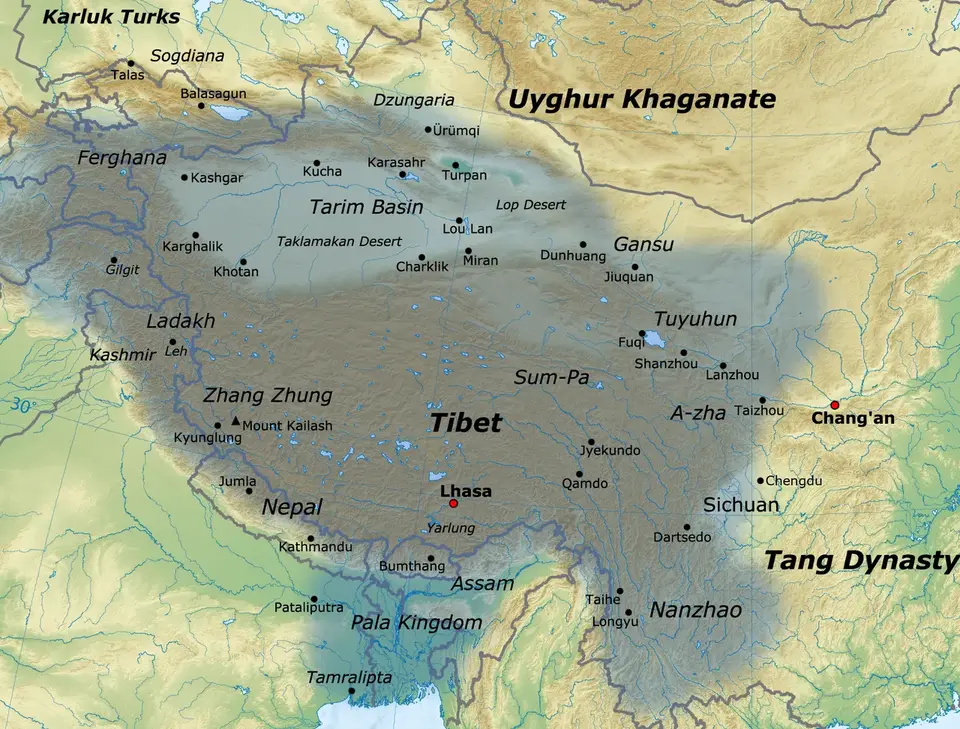
The Wars and Peace Treaties between Tang and Tubo (唐与吐蕃和战), extending from 634 to 823 CE (from the Zhenguan era of Emperor Taizong to the Changqing era of Emperor Muzong), represents an epochal two-century struggle, diplomatic engagement, and cultural convergence between the Tang Empire and the Tibetan Empire (Tubo). Following the unification of the Tibetan Plateau by Songtsen Gampo, Tang China and Tubo engaged in protracted, back-and-forth warfare across the strategic crossroads of the Qinghai Lake basin, the Four Garrisons of Anxi along the Tarim Basin, the Hexi Corridor, and the alpine frontiers of Sichuan. Their bilateral relations exhibited an enduring historical dynamic characterized by warfare interspersed with diplomacy, matrimonial alliances, and treaty oaths. Throughout two centuries of conflict, the struggle witnessed pivotal engagements such as the Battle of Songzhou, the catastrophic Tang defeat at Dafeichuan, Geshu Han's bloody storming of Shibao Fortress, the temporary Tibetan occupation of Chang'an in 763 CE, and the treacherous Pingliang ambush. Concurrently, it produced milestone diplomatic achievements, including the royal marriages of Princess Wencheng and Princess Jincheng, alongside eight formal peace conclaves, culminating in the Chiling Alliance of 734 CE. Following the An Lushan Rebellion, Tubo annexed Longyou and Hexi, cutting off Tang garrisons in Central Asia, while Tang countered by allying with the Uighurs and Nanzhao under Chancellor Li Mi's encirclement grand strategy. Between 821 and 823 CE, both empires formalized the celebrated Changqing Alliance, erecting bilingual stone stelae in Chang'an and Lhasa to proclaim permanent peace, which solidified the deep, unbreakable historical and cultural ties between the Han and Tibetan peoples.
Songtsen Gampo dispatches envoys to Chang'an, initiating formal relations with the Tang Empire.
Tibetan forces attack Songzhou; Hou Junji and Niu Jinda launch a night raid to rout the invaders, prompting Songtsen Gampo to sue for peace.
Princess Wencheng is escorted to Tibet by Prince Li Daozong, introducing Central Plains agriculture, medicine, and technologies.
Su Dingfang defeats Dayan Mangbuzhi at Wuhai, momentarily checking Tibetan advances across Qinghai.
Gar Tongtsen crushes Tuyuhun forces, annexing the Qinghai Lake basin and leaving Tang frontiers exposed.
Gar Trinring wipes out Guo Daifeng's supply train and destroys Xue Rengui's main army, securing absolute Tibetan control over Qinghai.
Hechi Changzhi launches a daring commando night attack to salvage Li Jingxuan's army, establishing agricultural colonies across Qinghai.
Wu Zetian dispatches Wang Xiaojie to crush Tibetan forces, permanently stationing 24,000 troops across the Four Garrisons.
Tridu Songtsen purges the Gar clan; Gar Trinring commits suicide and his brother Gar Tsenba defects to China, ending half a century of Gar dominance.
Princess Jincheng marries Me Agtsom; governor Yang Ju surrenders the fertile Nine Bends of the Yellow River to Tibet.
Both empires erect boundary stones at Mount Chiling to delineate frontiers and establish mutual trade.
Tang general Geshu Han captures Shibao Fortress, establishing forward garrisons and achieving dominance in the northwest.
Tang redeploys western armies to quell the An Lushan Rebellion; Tibetan forces seize Longyou and briefly occupy Chang'an for fifteen days.
Yan Chao surrenders Dunhuang after eleven years of isolation; Beiting falls as Guo Xin and isolated garrisons hold out in Anxi.
Zhang Gyalsig launches a treacherous ambush during peace talks at Pingliang; Li Mi establishes the grand encirclement strategy.
Wei Gao combines with Nanzhao to route 160,000 Tibetan troops in Sichuan, capturing Prime Minister Lun Mangre.
Emperor Muzong and Tsenpo Ralpacan ratify the permanent peace treaty, erecting the Alliance Stele before the Jokhang Temple.
In the early 7th century, Songtsen Gampo unified the fragmented tribes across the Tibetan Plateau, established his capital at Rasa (modern Lhasa), and laid the statutory and military foundations of the Tibetan Empire. Endowed with vast territory but constrained by a harsh alpine ecology, the emerging empire mobilized its martial population under the Gö (warrior) organizational system to seek external resources. Geopolitical expansion focused on the northern periphery: the fertile pasturelands around Qinghai Lake and the Qaidam Basin, then controlled by the Tuyuhun Kingdom. Dominating Qinghai offered crucial cavalry reserves and served as an indispensable springboard to seize the Silk Road oases of the Tarim Basin and directly threaten the Tang heartland in the Wei River valley.
Under Emperor Taizong, the Tang Dynasty subdued the Eastern Turks, incorporated oasis city-states across the Western Regions, and established the Heavenly Khaganate (Tian Kehan) order. To safeguard the Silk Road and protect the western flank of the metropolitan capital Chang'an, the Tang regarded the Tuyuhun and the Four Garrisons of Anxi as paramount protective barriers. In 634 CE, Tang general Li Jing crushed the Tuyuhun, enthroning Murong Shun and later Nuohebo as client monarchs. The Tuyuhun thereby served as a loyal buffer state shielding the Tang empire from southern threats. Any northward thrust by Tubo inevitably placed the two rising empires on a collision course.
Within the traditional East Asian diplomatic framework, the bestowal of an imperial princess in marriage (heqin) signaled formal imperial recognition and high international standing. Upon learning that the Sui Dynasty had previously wed princesses to the Eastern Turks and Tuyuhun khagans, Songtsen Gampo sought a matrimonial alliance with the Tang court to establish parity with Chang'an and acquire Chinese agronomic, textile, medicinal, and calendrical technologies. However, the initial Tibetan overtures were rebuffed by the Tang court, prompting Songtsen Gampo to resort to armed force to test Tang resolve.
In 634 CE, Songtsen Gampo dispatched an initial embassy to Chang'an to initiate formal relations, and Emperor Taizong sent envoy Feng Dexia to Lhasa in return. In 636 CE, Songtsen Gampo sent another mission requesting an imperial marriage alliance, which Taizong declined. Tibetan envoys blamed the refusal on the Tuyuhun, prompting Songtsen Gampo to launch punitive expeditions against the Tuyuhun, Tangut, and Bailan Qiang tribes.
In 638 CE, Songtsen Gampo led an army of two hundred thousand troops to assault the Tang border prefecture of Songzhou (modern Songpan, Sichuan), routing governor Han Wei. Emperor Taizong swiftly appointed Minister of Revenue Hou Junji as commander-in-chief, dispatching Zhishi Sili and Niu Jinda with fifty thousand elite troops to relieve the garrison. Niu Jinda launched a daring night raid against the Tibetan encampment, killing over a thousand soldiers. Realizing the discipline and power of Tang arms, Songtsen Gampo withdrew his forces and dispatched an apology to Chang'an.
In the autumn of 640 CE, Songtsen Gampo sent Prime Minister Gar Tongtsen Yulsung (Lu Dongzan) to Chang'an, bearing five thousand ounces of gold and rare gems to formally renew the marriage proposal. Impressed by his dedication and eloquence, Emperor Taizong agreed to bestow his kinswoman Princess Wencheng. In 641 CE, Prince of Jiangxia Li Daozong escorted Princess Wencheng to Tibet. Songtsen Gampo welcomed her in person at Lake Baihai (Gyaring Lake), constructed palaces in the Chinese style, and enthusiastically promoted Chinese agriculture, sericulture, paper-making, and metallurgy, inaugurating two decades of harmonious coexistence.
Following the deaths of Taizong and Songtsen Gampo, geopolitical rivalry reignited. In 659 CE, Tibetan forces under general Dayan Mangbuzhi clashed with Tang armies under general Su Dingfang near Lake Wuhai in Qinghai; Su Dingfang defeated the superior Tibetan force, momentarily stabilizing the border.
In 661 CE, Gar Tongtsen assumed supreme executive authority and embarked on aggressive northward expansion, subduing the Bailan Qiang and capturing Humi (the Wakhan Corridor), which unlocked access to the Western Regions. In 662 CE, Tubo allied with the Bowman Turks to attack Kucha. In 663 CE, Gar Tongtsen launched a full-scale invasion of Tuyuhun, shattering its armies; King Nuohebo fled to Liangzhou, and the entire Qinghai Plateau was absorbed into the Tibetan Empire.
The collapse of Tuyuhun stripped Tang China of its western buffer. In 669 CE, Tsenpo Mangsong Mangtsen dispatched Gar Tongtsen's son, Gar Trinring Tsendro (Lun Qinling), to command massive armies along the Qinghai border. In the fourth month of 670 CE, Gar Trinring led forty thousand troops to conquer eighteen prefectures across the Western Regions, compelling the Tang court to abandon the Four Garrisons of Anxi.
To reclaim lost ground and restore Nuohebo to his ancestral realm, Emperor Gaozong commissioned Grand General Xue Rengui as commander-in-chief, with Ashina Daozhen and Guo Daifeng as vice commanders, leading fifty thousand veteran troops westward. Reaching Dafeichuan (southwest of modern Gonghe, Qinghai), Xue Rengui advanced with a flying cavalry column to crush Tibetan units at Lake Wuhai, leaving Guo Daifeng with twenty thousand men to guard the heavy baggage train at Dafeichuan. However, Guo Daifeng defied strict orders and advanced sluggishly with the wagons, allowing Gar Trinring to ambush and wipe out the supply column. Gar Trinring then marshaled four hundred thousand Tibetan troops to encircle Xue Rengui at Dafeichuan. Trapped without supplies, the Tang army was crushed, and Xue Rengui was compelled to negotiate a humiliated truce to withdraw survivors. Dafeichuan permanently consolidated Tibetan control over Qinghai and initiated decades of all-out warfare.
Following Dafeichuan, the two empires fought a desperate tug-of-war for Central Asian supremacy. Tang forces temporarily recovered the Four Garrisons in 675 CE, but lost them again in 678 CE. In 679 CE, strategist Pei Xingjian recovered Kucha, Tokmak (Suiye), Khotan, and Kashgar through tactical guile. In 686 CE, Empress Wu Zetian temporarily ordered the withdrawal of garrison troops; however, in 692 CE, Wu Zetian dispatched Wang Xiaojie with a massive expeditionary force, shattering the Tibetan army and permanently reinstalling the Protectorate-General of Anxi at Kucha with a standing army of 24,000 elite troops.
Along the Qinghai border, Tibetan raiders struck Shanzhou, Kuozhou, Hezhou, and Diezhou in 676 CE. In 678 CE, a major Tang offensive under Li Jingxuan met disaster near Qinghai Lake, avoided only when general Hechi Changzhi led a suicidal night raid with five hundred commandos to rout the Tibetan headquarters. In 680 CE, Hechi Changzhi became military governor of Heyuan, establishing 5,000 qing of military agrarian colonies (tuntian) that solved food supply shortages and halted Tibetan raids. In 682 CE, veteran general Lou Shide achieved eight consecutive victories over Tibetan units at Baishuijian.
In 694 CE, Wang Xiaojie routed Tibetan general Bolun Zanren and Western Turk pretenders at Lengquan near Qinghai Lake. In 696 CE, Gar Trinring and his brother Gar Tsenba invaded Lintao; Wang Xiaojie and Lou Shide suffered a major tactical defeat at Mount Suoluohan. Riding high on this victory, Gar Trinring demanded the cession of the Four Garrisons and partition along the Yellow River, which Wu Zetian rejected. Wu Zetian sent Guo Yuanzhen on an embassy to Tibet, astutely sowing seeds of distrust between the young Tsenpo Tridu Songtsen and the over-mighty Gar clan.
In 699 CE, Tridu Songtsen executed a palace coup, slaughtering over two thousand Gar clan retainers. Gar Trinring committed suicide after his troops melted away, while his brother Gar Tsenba and his nephew Lun Gongren fled to China to submit to Wu Zetian, receiving noble titles. In 700 CE, Tibetan general Qumangbuzhi assaulted Liangzhou; governor Tang Xiujing met the enemy at Hongyuan Valley, executed a brilliant counter-attack, won six successive engagements, and erected a pyramid of enemy skulls (jingguan) on the battlefield. In 702 CE, Chen Daci won four consecutive victories in Maozhou, compelling Tibet to sue for peace.
Following the death of Tridu Songtsen, the regency in Lhasa requested a renewed marital alliance. In 710 CE, Emperor Zhongzong sent Princess Jincheng (daughter of Prince Li Shouli) to marry young Tsenpo Me Agtsom (Tride Tsuktsen). In the same year, Tibetan envoys bribed Tang governor Yang Ju into petitioning the court to grant the "Nine Bends of the Yellow River" (Jiuqu) in Qinghai as the princess's personal fiefdom. The fertile grasslands of Jiuqu provided Tibet with an ideal cavalry staging ground adjacent to the Tang interior, triggering renewed conflict.
In 714 CE, Tibetan generals Bendar-yen and Qilixu led one hundred thousand troops to ravage Lintao and Lanzhou. Emperor Xuanzong commissioned Xue Ne and Wang Jun, who crushed the invasion at Wujie, slaying tens of thousands of invaders. Subsequent Tang counter-offensives under Guo Zhiyun at Jiuqu in 717 CE, Wang Junzhuo at Qinghai Lake in 727 CE, and Zhang Shougui at Guazhou in 728 CE broke Tibetan border cohesion. In 729 CE, Prince Li Yi assaulted and captured the mountain citadel of Shibao Fortress (Shibaocheng), shattering Tibet's forward defense line.
Under sustained Tang military pressure, Tibet signed a formal treaty with the Tang in 734 CE at Mount Chiling (modern Mount Riyue, Qinghai), erecting demarcation boundary stones and opening mutual border markets. However, geopolitical rivalry resumed in 737 CE when Tang general Cui Xiyi defeated Tibetan forces west of Qinghai Lake. In 738 CE, Du Xiwang seized strategic fortifications to establish Weirong Army.
In Central Asia, Tang forces pushed back Tibetan influence. In 717 CE, Zhang Xiaosong led Tang cavalry to topple an Arab-Tibetan client king in Farghana. In 747 CE, Korean-born Tang general Gao Xianzhi led ten thousand troops across the dizzying Pamir passes, storming Little Balur (Gilgit), capturing its king and his Tibetan consort, and severing the link between Tibet and the Abbasid Caliphate. In 749 CE, Geshu Han mounted a bloody frontal assault to recapture Shibao Fortress, consolidating Tang dominance over the entire northwest.
In the winter of 755 CE, the catastrophic An Lushan Rebellion erupted across northern China. Emperor Suzong evacuated to Lingwu and recalled border divisions from Shuofang, Hexi, Longyou, and the Western Regions to fight the rebels. This massive redeployment stripped the entire western frontier of defensive garrisons, creating an open vacuum that Tubo exploited.
Beginning in 756 CE, Tibetan forces seized Weirong, Shenwei, and dozens of strategic fortresses in Qinghai, annexing Shanzhou, Wuzhou, and Diezhou. In the tenth month of 763 CE, Tibetan field marshals Ma Chongying and Shang Xijie led two hundred thousand cavalry to strike directly at Chang'an. Emperor Daizong fled to Shanzhou, and Tibetan troops entered the capital, pillaging the imperial palaces and setting up Prince Li Chenghong as a puppet sovereign. Renowned Tang general Guo Ziyi assembled dispersed garrison remnants and employed deceptive nighttime drums and blazes to convince the invaders that an enormous relieving host was approaching. Suffering from summer sickness and fearful of encirclement, the Tibetans abandoned Chang'an after fifteen days, carrying off immense treasure and thousands of civilian captives.
Following their retreat from Chang'an, Tibetan armies systematically severed the Hexi Corridor, isolating cities one by one. Hexi military governor Yang Zhilie resisted valiantly until his death in 766 CE. In 776 CE, Tibetan forces surrounded Shazhou (Dunhuang); governor Zhou Ding was murdered by army officer Yan Chao, who rallied the garrison and citizens to defend the walls for eleven harrowing years. Only in 781 CE, when weapons and provisions were utterly exhausted, did Yan Chao negotiate a surrender on the condition that citizens would not be enslaved.
In the far West, the garrisons of Anxi and Beiting were cut off from Chang'an for decades. In 781 CE, envoys sent by commanders Li Yuanzhong and Guo Xin successfully traveled across Uighur lands to reach Chang'an, bringing Emperor Dezong to tears with the news that the elderly, white-haired Tang garrisons were still holding the frontiers. Beiting finally fell in 790 CE when Tibetan armies combined with Qarluq and White-Clothed Turk allies, killing governor Yang Xigu. Guo Xin and his defenders held out in Kucha and neighboring posts into the 9th century before being completely engulfed.
Throughout the reign of Emperor Daizong, Tibetan cavalry conducted annual autumn raids (fangqiu) against the Guanzhong plain, forcing the capital into constant martial law. Renowned commanders such as Guo Ziyi, Li Sheng, and Ma Lin repeatedly clashed with Tibetan forces across Binzhou, Lingzhou, and Yanzhou.
In 783 CE, Emperor Dezong concluded the Qingshui Alliance with Tibetan Prime Minister Nganlam Zhang Gyalsig (Shang Jiezan), partitioning territories along Mount Long. However, when Tibet demanded the handover of Anxi and Beiting in exchange for military assistance during the Jingyuan Mutiny, Tang negotiations broke down. In 786 CE, Zhang Gyalsig attacked Longyou, but was defeated by Li Sheng at Qiancheng.
Realizing that Tang generals Li Sheng, Ma Sui, and Hun Jian were formidable obstacles, Zhang Gyalsig executed a cunning plot. He proposed peace to Ma Sui while exploiting court rivalries to convince Dezong to strip Li Sheng of his military command. In the intercalary fifth month of 787 CE, Zhang Gyalsig ambushed Tang negotiators at Pingliang. Chief negotiator Hun Jian leapt onto a swift charger and barely escaped a hail of arrows, but vice-envoy Cui Hanheng and over sixty civil-military officials were seized and slaughtered. The Pingliang Ambush disgraced the court and broke all prospects of bilateral trust.
Following Pingliang, Chancellor Li Mi devised his celebrated grand strategy: "Form an alliance with the Uighurs in the north, establish ties with Nanzhao in the south, and cooperate with the Abbasid Caliphate in the west" to strangle Tibet. In Sichuan, military governor Wei Gao oversaw southwestern strategy; in 794 CE, King Yimouxun of Nanzhao formally renounced Tibetan suzerainty and defected to the Tang, routing Tibetan frontier units at Shenchuan.
In 802 CE, Wei Gao launched an expansive counter-offensive into eastern Tibet alongside Nanzhao allies, routing sixteen Tibetan divisions across Yazhou and Weizhou. When Tibetan Prime Minister Lun Mangre arrived with one hundred thousand reinforcements, Wei Gao ambushed and destroyed the army, capturing Lun Mangre alive. The disaster broke the martial back of the Tibetan Empire, accelerating internal decay.
By the early 9th century, both empires faced domestic fatigue and recognized that endless attrition was unsustainable. Between 821 and 822 CE, Emperor Muzong and Tsenpo Ralpacan (Tritsu Detsen) conducted formal religious oaths in Chang'an and Lhasa. In 823 CE, the bilingual Tang-Tubo Alliance Inscription was erected before the Jokhang Temple in Lhasa, proclaiming: "The uncle and nephew have agreed that their states are as one, concluding a grand reconciliation... Neither shall act as bandit nor commit aggression, guarding their respective frontiers." This historic alliance ended two centuries of conflict and established an enduring symbol of fraternal peace.
The two-century confrontation between Tang China and Tibet transformed the balance of power across East and Central Asia. By expanding across Qinghai, the Tarim Basin, and the Hexi Corridor, Tibet challenged the traditional Chinese monopoly over the Silk Road, forcing the Tang court to construct regional military governorships (fanzhen) and rely on the elite Palace Command (Shencejun). This multifaceted struggle influenced the fate of surrounding kingdoms, including the Western Turks, Uighurs, Nanzhao, and the Arab Caliphate, constituting one of the grandest chapters of medieval multipolar geopolitics.
Prolonged contact through war and peace served as an immense catalyst for social and technological progress on the Tibetan Plateau. Princesses Wencheng and Jincheng introduced advanced Chinese methods of silkworm cultivation, grain irrigation, liquor distilling, paper making, block printing, and medicinal pharmacology. These innovations accelerated the transition of Tibetan society from a primitive tribal federation to a feudal agrarian economy. Meanwhile, Tibetan noble youths studied Confucian classics at the imperial academy in Chang'an, while Chinese Buddhist traditions deeply shaped the architectural and religious landscape of Tibetan Buddhism.
The unique "Maternal Uncle and Nephew" (jiu-sheng) diplomatic kinship established between Tang emperors and Tibetan kings transcended transient battlefield victories, weaving the Chinese central plains and the Tibetan plateau into an inseparable historical and civilizational union. Even during fierce military campaigns, commercial exchanges such as the tea-horse trade continued unabated. The eternal covenant of the Changqing Alliance provided the enduring legal and moral bedrock that enabled the Yuan Dynasty to formally incorporate Tibet under central administration, establishing the permanent territorial and political unity of the Chinese nation.
Dynastic annals and contemporary historians praise the monumental scope of the Tang-Tubo relationship. In the Old Book of Tang, official historians recorded: "Tubo was a formidable empire in the west, spanning the Qiang and Tuyuhun lands, contending as an equal with the Middle Kingdom... Yet from the day Princess Wencheng departed, embassies and tributary offerings never ceased across the roads; though warfare arose frequently, the oaths of fraternal friendship were never fully severed."
In the Zizhi Tongjian, Sima Guang analyzed the tactical lessons of the two-century conflict, praising Taizong's diplomatic foresight, Xuanzong's aggressive border defense, and Li Mi's grand encirclement strategy, while warning of the devastating consequences of border neglect. Modern Tibetologists agree that the Tang-Tubo wars were not merely a record of slaughter, but the epic historical process through which the Tibetan civilization integrated into the broader Chinese family, creating a shared heritage of enduring historical significance.