Ascension of Emperor Xuanzong
Xuanzong ascended the throne and reformed the civil examinations to emphasize poetry, initiating the golden age of High Tang verse.
Tang Dynasty (唐朝) · HISTORICAL EVENT
唐诗兴盛
The Flourishing of Tang Poetry (713–756, spanning the first year of Kaiyuan to the fifteenth year of Tianbao under Emperor Xuanzong, encompassing the broader zenith of Tang verse) represents the golden age of classical Chinese literature and aesthetic thought. Supported by imperial wealth, driven by imperial examinations testing poetic composition, and nurtured by an atmosphere of cultural tolerance, poetry transitioned from aristocratic court pastimes…
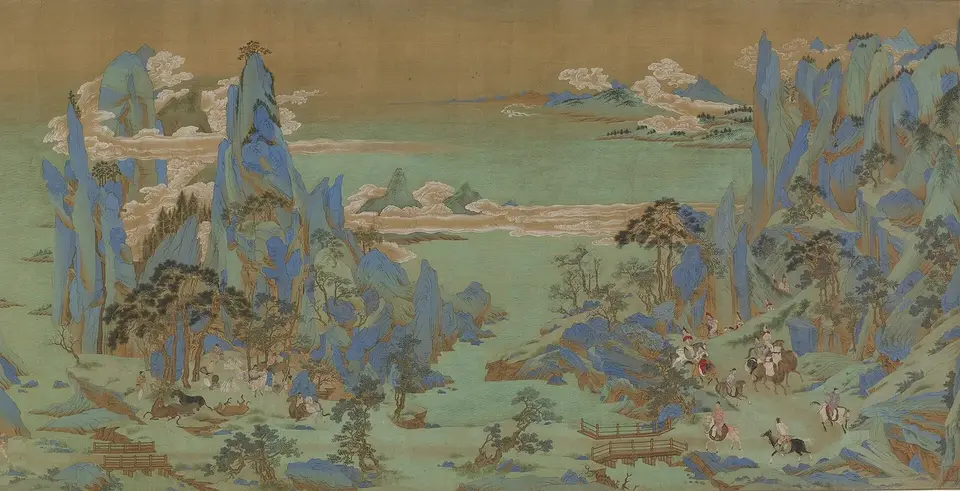
The Flourishing of Tang Poetry (713–756, spanning the first year of Kaiyuan to the fifteenth year of Tianbao under Emperor Xuanzong, encompassing the broader zenith of Tang verse) represents the golden age of classical Chinese literature and aesthetic thought. Supported by imperial wealth, driven by imperial examinations testing poetic composition, and nurtured by an atmosphere of cultural tolerance, poetry transitioned from aristocratic court pastimes into a vibrant nationwide artistic movement. The High Tang era produced an extraordinary constellation of poets: Wang Wei and Meng Haoran founded the Landscape and Pastoral School with tranquil Zen-infused depictions of nature, while Gao Shi, Cen Shen, and Wang Changling composed the heroic epics of the Frontier Fortress School. Poet Immortal Li Bai elevated romanticism to sublime heights through unrestricted quatrains and yuefu ballads, while Poet Sage Du Fu pioneered profound realism with his compassionate historical chronicles, together establishing twin summits in world literature. Tang poetry achieved perfection in tonal meter, aesthetic imagery, and phonetic balance, embodying the open, dynamic High Tang Spirit that continues to define Chinese artistic identity.
Xuanzong ascended the throne and reformed the civil examinations to emphasize poetry, initiating the golden age of High Tang verse.
Twenty-four-year-old Li Bai left his home in Sichuan with sword in hand, embarking on his wandering journey that transformed romantic poetry.
Wang Wei achieved first place in the imperial examinations, subsequently building his Wangchuan villa and establishing the Landscape-Pastoral School.
Released from the Hanlin Academy, Li Bai met Du Fu and Gao Shi in Luoyang, bringing together the two greatest masters of Chinese literature.
Gao Shi and Cen Shen served in military headquarters across the Western Regions, writing masterpieces that marked the apex of frontier poetry.
The rebellion brought devastation to the empire; Li Bai suffered exile while Du Fu fled through war-torn provinces, writing his immortal Poetic History.
Emperor Suzong ascended the throne at Lingwu, where Du Fu joined the court; poetry shifted from exuberant celebration toward solemn realism.
Following the consolidation of the Zhenguan reign and the Zhou interregnum, the Tang Dynasty achieved its peak under Emperor Xuanzong during the Kaiyuan and Tianbao eras. The realm enjoyed peace and agricultural abundance, with granaries overflowing across the empire. The Silk Road operated without disruption, drawing envoys and merchants from across Eurasia to Chang'an. This accumulation of wealth and cosmopolitan pride fostered unprecedented optimism among scholar-intellectuals.
Society was characterized by romantic ambition and vigorous civic engagement. Scholars refused to remain confined to bureaucratic desks, embarking on journeys across rivers and mountains or enlisting in frontier military garrisons, infusing poetry with firsthand experience and vitality.
The maturation of the civil service examination system served as the primary institutional catalyst for poetry. Under Emperor Gaozong and Empress Wu Zetian, the Jinshi examinations formally added tests of regulated verse and poetic composition. Unlike the Mingjing examinations, which relied on mechanical memorization of classical canons, the Jinshi degree prioritized literary talent, phonetic mastery, and original thought, earning supreme prestige.
To gain recognition, aspiring candidates circulated portfolios of their finest verses (xingjuan) among metropolitan grandees before examinations, making poetic brilliance the primary vehicle for social advancement. From prime ministers to humble scholars, society embraced poetic composition as a mark of virtue, status, and fellowship, dramatically broadening the creative community.
In literary form, early experiments with four tones and tonal defects pioneered by Shen Yue matured through the work of early Tang court masters, including Song Zhiwen and Shen Quanqi. Five-character and seven-character regulated verse (lüshi) and quatrains (jueju) achieved strict tonal leveling and rhyming principles, endowing Chinese verse with musicality without restricting emotional expression.
Philosophically, the Tang state pursued inclusive cultural policies. Confucian benevolence, Daoist natural spontaneity, and Chan Buddhist emptiness converged within the consciousness of Tang writers. Philosophical contemplation elevated aesthetic expression, setting the stage for the poetic explosion of the High Tang.
The flourishing of High Tang poetry was the culmination of decades of reform. Early Tang poetry had remained burdened by the decadent, ornate court style inherited from the southern dynasties. The Four Paragons of the Early Tang (Wang Bo, Yang Jiong, Lu Zhaolin, Luo Binwang) challenged this convention by shifting themes to city life and frontier landscapes, while Chen Zi'ang championed classical Han-Wei vigor.
With Emperor Xuanzong's ascension in 713, the literary world cast aside superficial mannerisms. Poets mastered regulated verse while retaining unvarnished vigor and moral vitality. A dynamic, majestic, and soaring aesthetic style emerged across the realm, celebrated by later literary critics as the immortal High Tang Spirit (Shengtang Qixiang).
During the Kaiyuan and Tianbao eras, Wang Wei and Meng Haoran elevated landscape and pastoral verse to supreme heights. Serving as Right Vice Minister of State Affairs, Wang Wei mastered music, painting, and Chan philosophy. In his later years, he retreated to his country villa at Wangchuan, capturing the subtle movements of nature through lines such as "bright moon shining through pine trees, clear spring water flowing over pebbles." Song master Su Shi remarked that in Wang Wei's poetry there is painting, and in his painting there is poetry.
Meng Haoran resided on Mount Luomen, choosing a life of rural retirement. His verse possessed effortless natural clarity, exemplified by timeless lines such as "in spring one sleeps unaware of dawn, hearing birds singing everywhere." Together with Pei Di and Chu Guangxi, Wang Wei and Meng Haoran created a serene landscape tradition that offered solace from bureaucratic entanglements.
Contrasting with the serenity of pastoral verse, the Frontier Fortress School captured the martial energy of the empire. With imperial armies securing the Western Regions, numerous scholars joined military secretariats in search of heroic honor.
Gao Shi campaigned across northern frontiers, producing resolute poetry that combined optimism with candid portrayals of soldiers' hardships. Cen Shen journeyed twice to the deserts of Central Asia, capturing the exotic beauty of the Tianshan Mountains with dramatic lines such as "as if a sudden night wind arrived, blooming thousands of pear blossoms." Master of Quatrains Wang Changling voiced patriotic duty and frontier homesickness in lines like "if only the Flying General of Dragon City were here, no nomadic steeds would cross the Yin Mountains." Wang Zhihuan contributed timeless masterpieces such as his Ascent of Stork Tower. These frontier verses embodied the martial confidence of the empire.
The most dazzling figure of the High Tang was Li Bai, honored as the Poet Immortal. Raised in Sichuan after leaving Central Asia, Li Bai mastered swordsmanship and wandered the empire. In the early Tianbao era, his brilliance earned an imperial summons to serve in the Hanlin Academy. Fiercely independent and contemptuous of sycophants, he was granted gold and released from court in 744 to resume his travels.
Li Bai brought classical Chinese romanticism to an unexcelled summit. Freeing himself from mechanical metrical restrictions, he favored spontaneous ancient yuefu ballads and seven-character quatrains. Employing cosmic imagination and sweeping cadence, he composed masterpieces including The Hard Road to Shu, Bring in the Wine, and Visiting Mount Tianmu in a Dream. His lines "do you not see the Yellow River water coming down from heaven" and "heaven bestowed my talents, they will surely be used" became the ultimate embodiment of High Tang confidence.
Standing alongside Li Bai was Du Fu, revered as the Poet Sage. In his youth, Du Fu traveled through Shandong and Henan, dreaming of ascending the summit to view all mountains below. However, ten years of hardship in Chang'an exposed him to court corruption and popular suffering, culminating in the catastrophe of the An Lushan Rebellion in 755.
Amidst national ruin, Du Fu employed unyielding craftsmanship and deep compassion to document his era. He infused Confucian humanism into verse, creating epic works including A Five-Hundred-Word Ballad from the Capital to Fengxian County and the legendary Three Officials and Three Partings. His poems recorded the anguish of commoners torn apart by war, earning his work the title of Poetic History. In regulated verse, Du Fu achieved consummate balance, establishing the supreme standard of classical realism.
The An Lushan Rebellion transformed Tang verse into deeper, more introspective forms. In the Mid-Tang, Bai Juyi and Yuan Zhen led the New Yuefu Movement, advocating that literature serve public welfare; Han Yu and Meng Jiao pursued innovative, jarring diction; and Liu Yuxi and Liu Zongyuan blended philosophical reflection with natural imagery. In the Late Tang, Li Shangyin and Du Mu (the Little Li-Du) composed poignant verses that reflected on the sunset of imperial glory.
The Complete Tang Poetry (Quan Tang Shi) compiled during the Qing Dynasty gathered nearly fifty thousand poems by more than 2,200 poets. Through its thematic range, refined craft, and spiritual depth, Tang poetry stands as a monumental achievement in world literature.
The flowering of Tang poetry established an unexcelled aesthetic standard for classical Chinese literature. Poets perfected seven-character and five-character regulated verse, quatrains, and ancient ballads. The precise balancing of tones, evocative use of nature imagery, and rhythmic cadence maximized the expressive power of the Chinese language, serving as the foundation for Song lyrics, Yuan drama, and Ming-Qing fiction.
Tang poetry transcended literature to shape the psychological character of the Chinese people. Li Bai's unyielding romanticism, Du Fu's patriotic compassion, Wang Wei's serene harmony with nature, and frontier poets' selfless loyalty were woven into the cultural identity of subsequent generations, providing spiritual strength during times of adversity.
Carried by tributary missions, monks, and students, Tang poetry spread across East Asia. Japanese poets emulated Chinese verse in compilations like the Kaifuso, establishing the foundation for Japanese kanbun literature. In Korea and Vietnam, Tang verse served as standard curriculum for civil examinations. Translated into dozens of modern languages, Tang poetry inspired Western modernist movements like Imagism, earning recognition as an irreplaceable treasure of world civilization.
Literary critics throughout Chinese history have praised the Flourishing of Tang Poetry. In his Canglang Poetics, Song critic Yan Yu celebrated the High Tang Spirit, writing: "The High Tang masters relied on pure inspiration, leaving no trace of artifice, like sounds in the air, color in a form, the moon in water, or an image in a mirror—words end, but meaning is infinite."
Ming scholar Li Panlong declared: "Prose reached its height in the Han, and poetry achieved its apex in the Tang." In his overview of the Siku Quanshu, Qing scholar Ji Yun wrote: "In the Tang Dynasty, poetry in all meters reached ultimate perfection, flowing like mighty rivers that no subsequent generation can discard." Modern literary historian Wen Yiduo characterized the era as the golden age of Chinese literature—a celestial carnival of stars that stands tall in world culture.